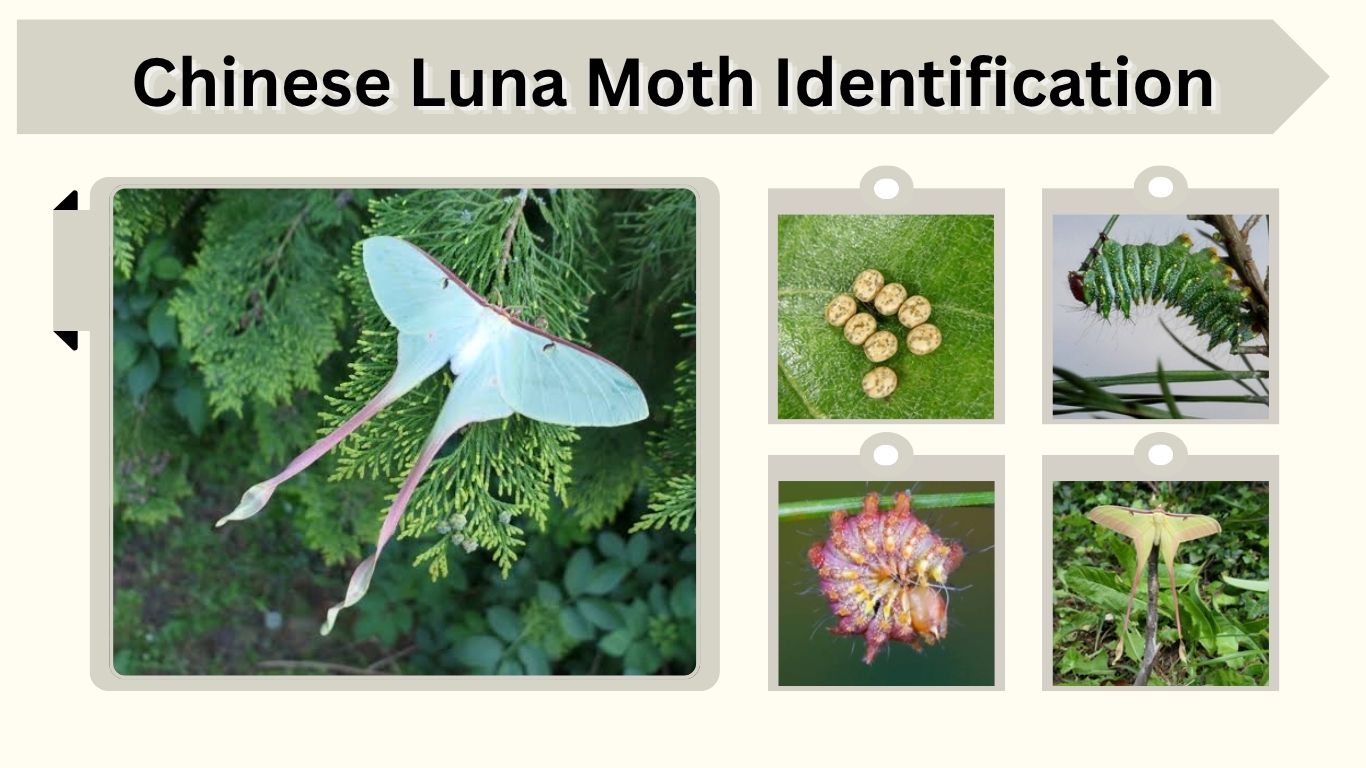
The Chinese luna moth is a spectacular giant silk moth recognized by its pastel-colored wings, extremely long tails, and unusual hairy caterpillar. Also called the Chinese moon moth or Chinese lunar moth, its scientific name is Actias dubernardi. It belongs to the same genus as the North American luna moth but is a separate species with different colors, host plants, and geographic range. Most of its life is spent developing as a caterpillar and pupa, while the beautiful adult survives only briefly to reproduce.
What Is a Chinese Luna Moth?
The accepted scientific name of the Chinese luna moth is Actias dubernardi. It belongs to the family Saturniidae, which contains the giant silk moths. The species was described by Charles Oberthür in 1897 and is also officially listed under the common names Chinese moon moth and Dubernard’s Chinese moon moth.
Chinese luna moths are primarily associated with mountainous regions of southern China. Scientific records include numerous Chinese provinces, while additional records have been reported near the China–Myanmar border. They are particularly associated with cool, humid forests containing suitable coniferous host plants.
| Feature | Chinese luna moth |
| Scientific name | Actias dubernardi |
| Family | Saturniidae |
| Main range | Southern and central China |
| Primary habitat | Mountainous coniferous forest |
| Caterpillar food | Pine and other conifers |
| Adult food | None |
| Adult lifespan | Approximately 10–12 days |
| Life cycle | Egg, caterpillar, pupa, adult |
Chinese Luna Moth Identification
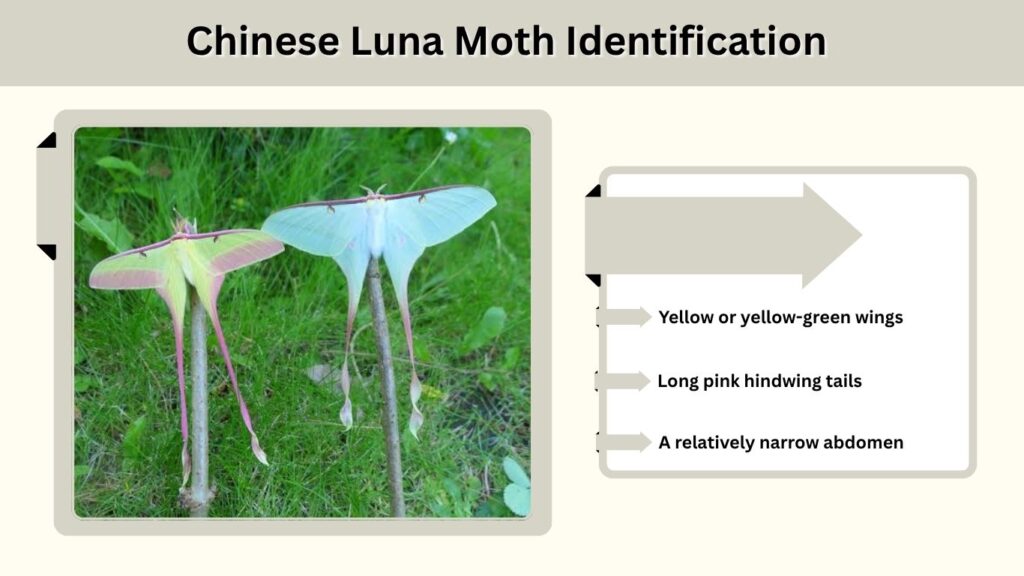
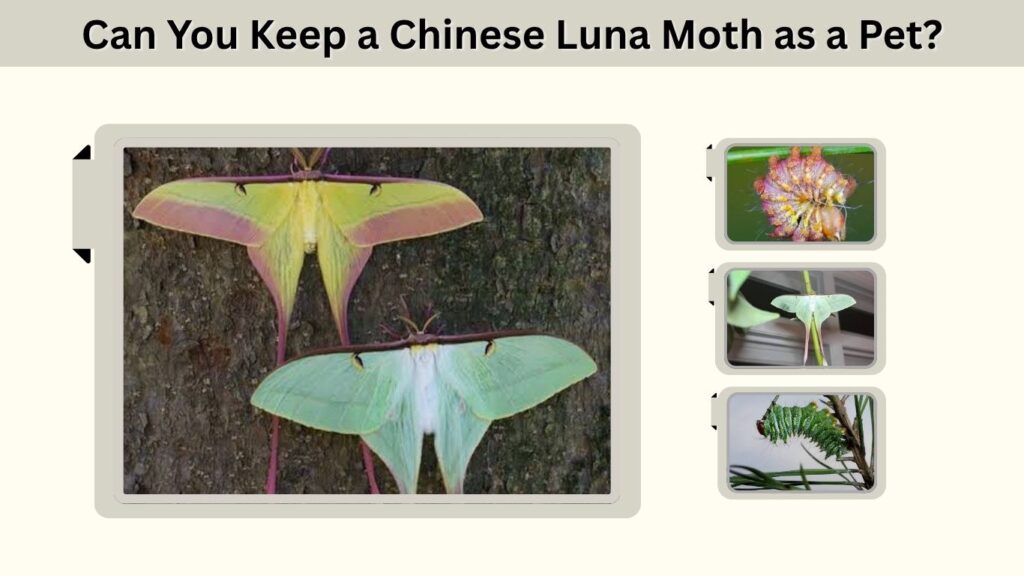
Adult Chinese luna moths have large wings, eyespots, furry bodies, and very long extensions from their hindwings. Their combination of yellow, pink, blue-green, and cream coloration makes them noticeably different from the mostly green North American luna moth.
Male Chinese Luna Moth
The male generally has:
- Yellow or yellow-green wings
- Bright pink or reddish wing borders
- Long pink hindwing tails
- Broad, strongly feathered antennae
- A relatively narrow abdomen
- More vivid coloration than the female
The male’s large antennae detect pheromones released by a receptive female. He may fly through the night while following the chemical signal to her location.
Female Chinese Luna Moth
Females are generally larger-bodied and may have broader wings. Their coloration is commonly pale blue-green, turquoise, or mint, accompanied by pink markings and long tails. Their antennae are narrower than those of males because they do not need the same extensive surface area for detecting female pheromones.
A female usually remains relatively still after emerging and releases pheromones that attract males. After mating, she deposits her eggs on or near suitable food plants.
Chinese Moon Moth vs Luna Moth
The Chinese moon moth and the North American luna moth belong to the genus Actias, but they are separate species.
| Characteristic | Chinese moon moth | North American luna moth |
| Scientific name | Actias dubernardi | Actias luna |
| Native range | China and nearby Asian regions | North America |
| Adult color | Pink, yellow, blue-green, or turquoise | Primarily pale green |
| Sexual differences | Males and females look noticeably different | Sexes have broadly similar coloration |
| Caterpillar hosts | Mainly conifers | Mainly broadleaf trees |
| Hindwing tails | Extremely long and narrow | Long but generally broader and shorter |
| Adult feeding | Does not feed | Does not feed |
Genetic research confirms that both species belong to the same moon-moth group, but A. dubernardi forms its own distinct species lineage. The North American luna moth is officially classified as Actias luna.
Chinese Luna Moth Caterpillar
The Chinese luna moth caterpillar changes dramatically as it grows. A newly hatched larva is mostly black. During the first stage, its color gradually becomes orange-red. Later instars become green and develop pale stripes, white spots, metallic silver or gold patches, and numerous long hairs.
Caterpillar Identification
A mature caterpillar may have:
- A bright-green body
- White vertical or diagonal markings
- Silvery or golden reflective spots
- Long white or transparent hairs
- Raised bumps along each body segment
- A contrasting warning pattern near the thorax
- A length of up to approximately 75 millimeters
The larvae pass through five growth stages, known as instars. Shortly before pupation, the mature green caterpillar may become reddish-brown and begin wandering away from its feeding position.
What Does the Caterpillar Eat?
Chinese luna moth caterpillars feed on conifer foliage. Pine is one of the best-known host groups, with Chinese red pine frequently mentioned as a natural food plant. Larvae have also been reared on several other pine species, larch, spruce, and Douglas fir.
The caterpillar stage is the only period during which the moth actively eats. Larvae must store enough energy to complete pupation, fly, mate, and produce eggs during adulthood.
Chinese Luna Moth Eggs
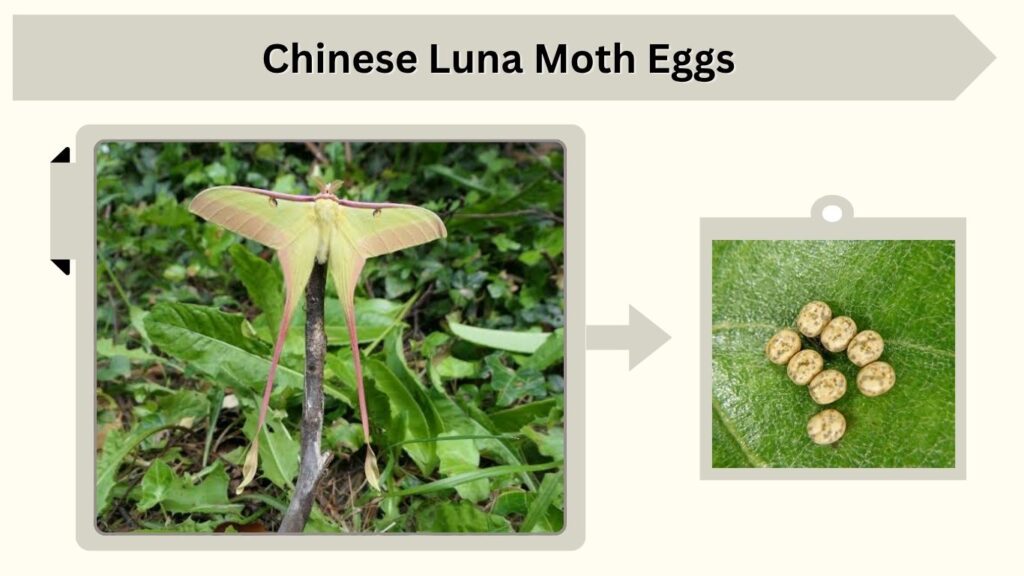
The female attaches individual eggs to the needles or other surfaces of the host plant. A scientific description recorded dark grayish-white, flattened oval eggs measuring approximately 2.6 millimeters long. One observed captive female laid 96 eggs, while other accounts report that a female may produce up to about 120.
The incubation period depends on temperature and other environmental conditions. After hatching, the tiny larvae begin feeding on fresh conifer needles and repeatedly shed their skin as they grow.
Cocoon and Pupal Stage
After completing its fifth larval stage, the caterpillar spins a brownish cocoon made from coarse silk. The cocoon may be formed among pine needles, moss, plant debris, or near the ground.
Inside the cocoon, the caterpillar becomes a pupa. Its body is reorganized during metamorphosis, producing the legs, antennae, wings, eyes, and reproductive structures of the adult moth.
The total development period from egg to adult may take approximately 70–85 days under favorable conditions. Temperature, seasonal timing, geographic population, and dormancy can all influence the duration.
How Long Do Chinese Luna Moths Live?
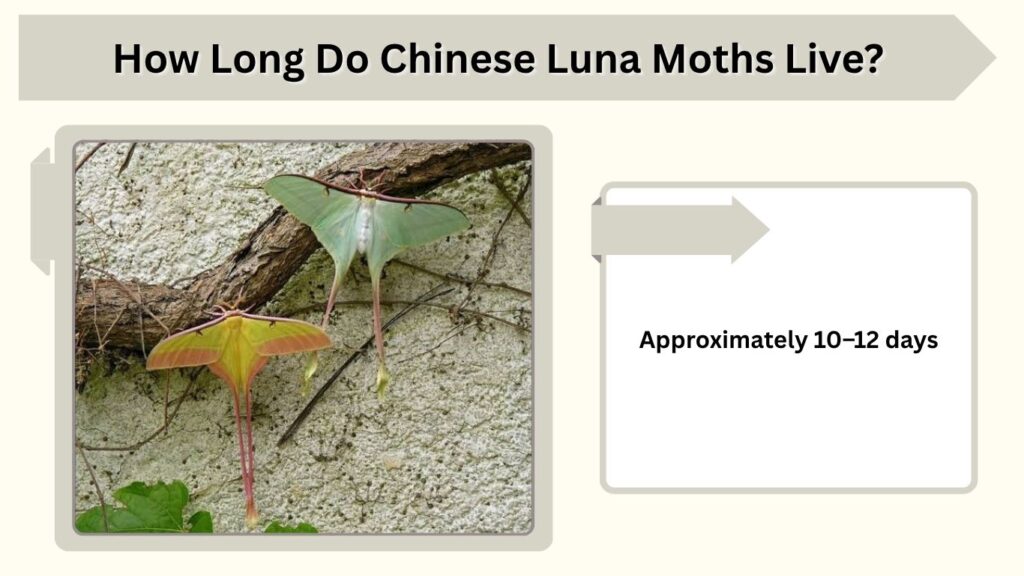
The adult Chinese luna moth normally lives for only approximately 10–12 days. It may spend considerably longer developing as an egg, caterpillar, and pupa than it does as a winged adult.
Adult giant silk moths have reduced or nonfunctional mouthparts. They cannot eat and depend on energy accumulated during the caterpillar stage. Their brief adult lives are devoted to finding a mate and producing the next generation.
Are Chinese Luna Moths Poisonous?
Adult Chinese luna moths do not have a stinger and are not known to be poisonous to people. They also cannot bite because they lack functional feeding mouthparts.
The caterpillars are covered with conspicuous hairs and raised structures, but they should not be confused automatically with venomous caterpillars. Scientific descriptions emphasize their metallic markings and thoracic warning pattern rather than venom-delivering spines. Handling should still be avoided because delicate larvae can be injured, and sensitive skin may react to insect hairs.
Can You Keep a Chinese Luna Moth as a Pet?
Chinese luna moth eggs, caterpillars, cocoons, and adults are sometimes offered by specialist breeders. However, the species is generally considered more challenging to rear than the North American luna moth.
Larvae require a continuous supply of appropriate conifer branches, careful ventilation, suitable humidity, cleanliness, and stable temperatures. Young caterpillars can be particularly sensitive to poor airflow, condensation, spoiled foliage, and handling. Experienced breeders commonly consider this species unsuitable as a first moth-rearing project.
Before purchasing live eggs or cocoons, check local import, transport, and ownership rules. Never release a captive or non-native moth outdoors.
Chinese Luna Moth Meaning and Symbolism
The Chinese luna moth has no scientifically established spiritual meaning. However, its dramatic metamorphosis and brief adult lifespan have made it popular in artwork, jewelry, framed displays, and tattoos.
Common symbolic interpretations include:
- Transformation and personal growth
- Beauty that does not last forever
- Renewal after a difficult period
- Mystery and nighttime energy
- Patience during major changes
- Following a new direction in life
These meanings are cultural and personal interpretations rather than biological characteristics.
FAQs
Is the Chinese luna moth rare?
It was once considered extremely rare in Western collections, but scientific observations indicate that it occurs regularly in suitable areas of southern China. It may still appear rare to most people because it is nocturnal, short-lived as an adult, and associated with mountainous forests.
Do Chinese luna moths have mouths?
Adults have reduced, nonfunctional mouthparts and cannot eat. They rely on fat and energy accumulated while they were caterpillars. Adult life is therefore brief and focused almost entirely on mating and laying eggs.
What does a Chinese luna moth caterpillar turn into?
It produces a brown silk cocoon and changes into a pupa. After metamorphosis, it emerges as a long-tailed adult Chinese luna moth with pastel pink, yellow, green, or turquoise coloration.
How many eggs does a female Chinese luna moth lay?
The number varies among individuals. Published observations include a female laying 96 eggs, while educational accounts state that females may produce up to approximately 120 eggs after mating.
Can you touch a Chinese luna moth?
It is safer not to handle one. Touching may damage the wing scales, legs, antennae, or long tails. A newly emerged adult should be left undisturbed while its wings expand and harden.