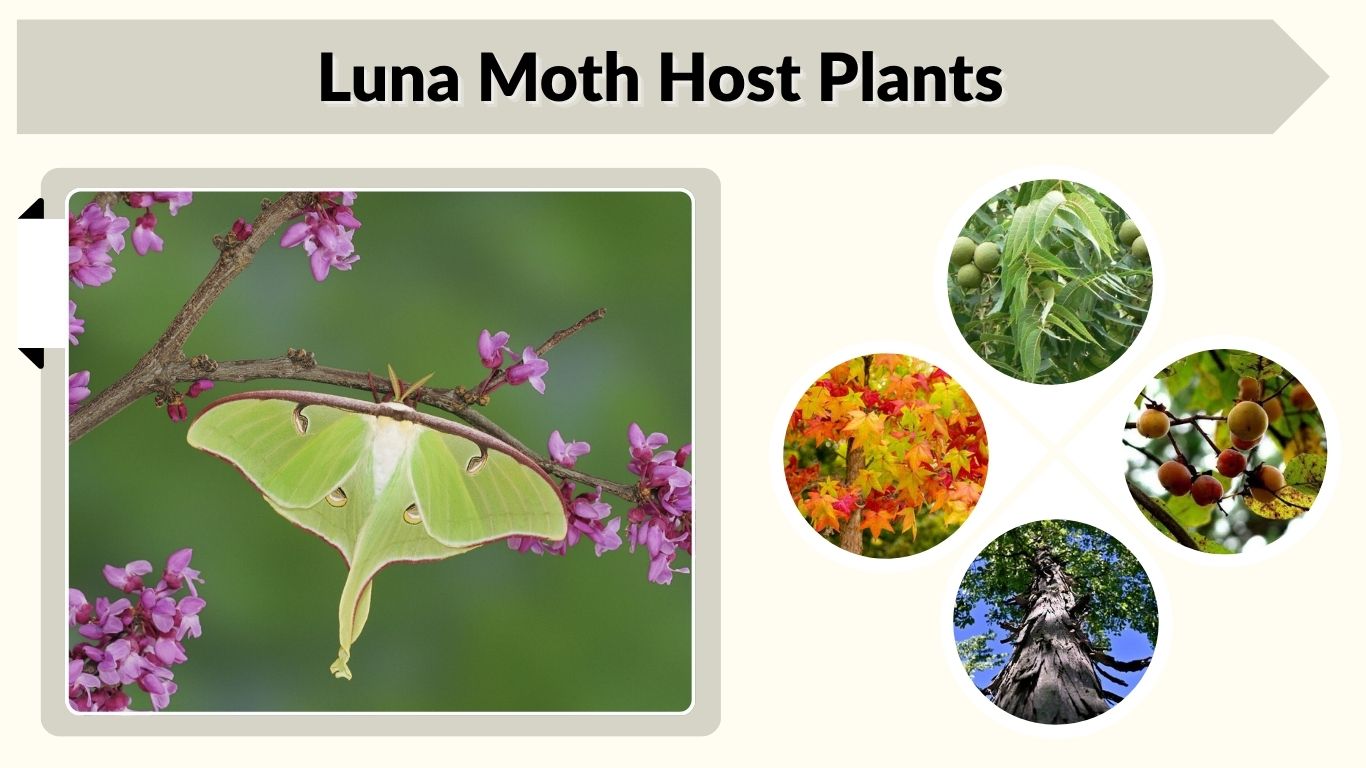
Luna moth host plants are trees whose leaves provide food for luna moth caterpillars. Common hosts include hickory, walnut, sweetgum, persimmon, white birch, pecan, and sumac. However, preferred plants vary by region, and a caterpillar adapted to one tree may not accept another. Adult luna moths do not eat, so planting suitable larval host trees is the most effective way to support their complete life cycle. This guide covers the best host plants, regional differences, tomato-plant confusion, and ways to attract luna moths naturally.
What Is a Luna Moth Host Plant?
A host plant is a tree or other plant on which a female luna moth lays her eggs and the newly hatched caterpillars feed. Luna moth caterpillars cannot survive on just any green leaf, even when the plant appears healthy and edible.
Adult luna moths have reduced, nonfunctional mouthparts and do not eat. Therefore, flowering plants do not feed the adults in the way nectar plants support many butterflies. Luna moth habitat depends primarily on suitable caterpillar food trees and safe places for cocoon development.
Females generally deposit eggs individually or in small groups on the upper or lower surfaces of host-tree leaves. After hatching, the larvae begin eating the foliage and pass through several growth stages before spinning cocoons.
Best Host Plants for Luna Moths
Luna moth caterpillars have been reported from numerous broadleaf trees. However, research shows that not every reported plant supports equally good survival and growth. Local populations often perform best on the tree species they naturally use in their region.
| Host plant | Scientific group | Where it is especially useful |
| Hickory | Carya species | Much of the eastern and southern United States |
| Walnut | Juglans species | Central, eastern, and southern areas |
| Sweetgum | Liquidambar styraciflua | Southeastern United States |
| Persimmon | Diospyros virginiana | Southern and eastern regions |
| White birch | Betula papyrifera | Northern United States and southern Canada |
| Pecan | Carya illinoinensis | Southern and central regions |
| Sumac | Rhus species | Eastern and southern areas |
| Willow | Salix species | Used by some local populations |
| Oak | Quercus species | Reported as a host in parts of the range |
Hickory
Hickories are among the most dependable luna moth host trees. Shagbark, mockernut, pignut, and other native hickories may support caterpillar development where luna moths occur naturally.
Hickories can become large trees, so they are best suited to properties with sufficient space. Pecan is also a member of the hickory genus and is recognized as a luna moth food plant.
Walnut
Black walnut and related walnut species are frequently listed as host plants. Their leaves provide food for luna moth larvae as well as several other native giant silk moth caterpillars.
Walnut trees produce compounds that can affect nearby plants, so their mature size and planting location should be considered before adding one to a small garden.
Sweetgum
Sweetgum is one of the most important southern host trees. It is especially useful in Florida and other parts of the southeastern United States, where several generations of luna moths may occur during a warm year.
Sweetgum can become a large shade tree and produces hard, spiky seed balls. Plant it where falling seed capsules will not interfere with walkways, driveways, or frequently used lawn areas.
Persimmon
American persimmon is another valuable southern and eastern host. In addition to supporting luna moth caterpillars, a mature female tree can produce fruit for birds, mammals, and people.
For wildlife value, choose native American persimmon rather than assuming every cultivated persimmon variety will provide identical benefits.
White Birch
White or paper birch is particularly important to luna moth populations in the northern part of their range. University of Florida researchers note that the northernmost populations most often use white birch.
Other birches may sometimes be used, but regional preference matters. A northern caterpillar accustomed to birch may perform poorly when transferred to a host commonly used by southern populations.
Sumac
Winged sumac and smooth sumac are reported hosts. Sumacs are smaller than hickory, walnut, or sweetgum, making them potentially useful on properties that cannot accommodate another large shade tree.
Because sumac can spread by underground shoots, it may form colonies unless managed. Plant it in a naturalized border where expansion is acceptable.
Regional Luna Moth Host Plants
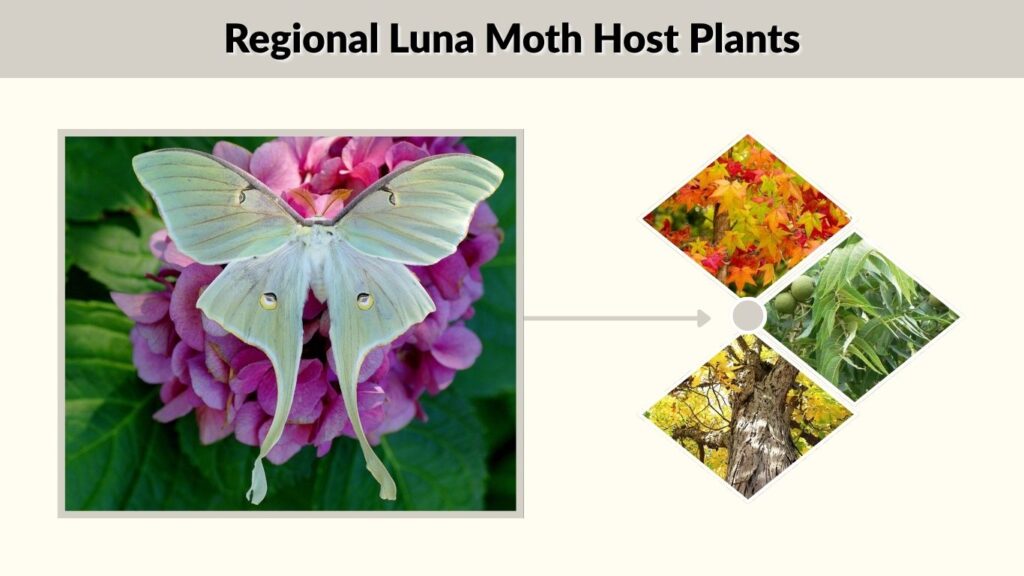
The best host plant depends partly on where you live. Luna moth populations are locally adapted, and their preferences are not identical throughout North America.
Host Plants in Florida and the South
The primary southern food plants commonly include:
- Sweetgum
- Hickory
- Walnut
- Persimmon
- Winged or smooth sumac
- Pecan
UF/IFAS identifies sweetgum, hickory, walnut, and persimmon as typical preferred hosts in the southern United States.
Host Plants in Missouri and the Central United States
Hickory, walnut, pecan, persimmon, sweetgum, sumac, oak, and willow may support luna moths in central portions of their range. The strongest choice is usually a native tree already known to grow naturally in nearby woodlands.
Local extension offices, native-plant groups, and moth observations can help identify which trees are used in a specific county.
Host Plants in New England and Northern Areas
White birch is especially important in northern regions. Other reported hosts include walnut, hickory, alder, willow, beech, and some native oaks.
In northern climates, luna moths commonly have fewer generations per year than they do in the South. Their cocoons may remain protected beneath fallen leaves through winter.
Do Luna Moth Caterpillars Eat Tomato Plants?
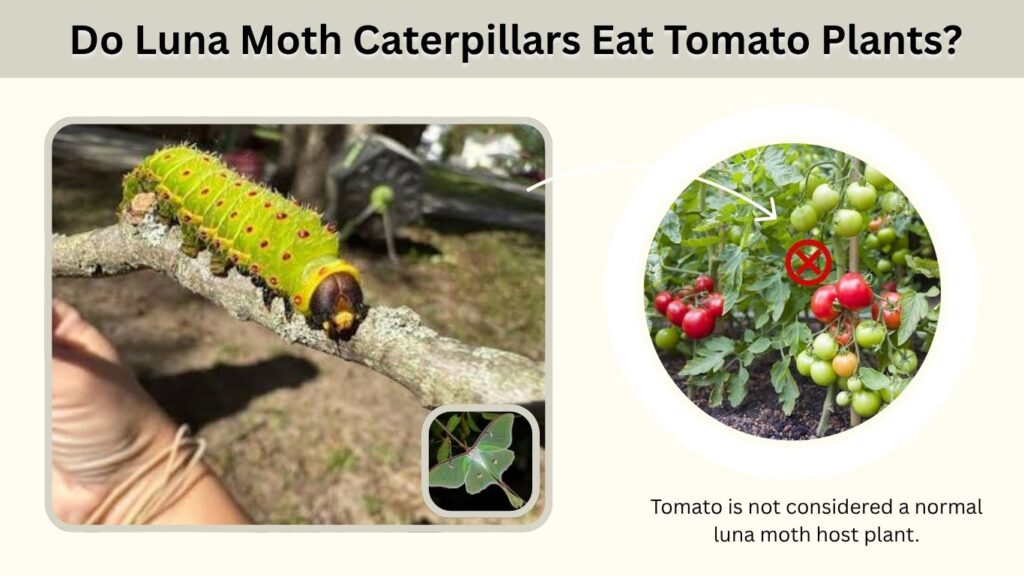
Tomato is not considered a normal luna moth host plant. A large green caterpillar feeding on tomatoes is much more likely to be a tomato hornworm or tobacco hornworm.
Tomato hornworms have a noticeable horn projecting from the rear of the body and pale V-shaped markings along their sides. Tobacco hornworms have diagonal stripes and generally have a red rear horn. Both feed on tomato and other plants in the nightshade family.
Luna moth caterpillars do not have the long, prominent rear horn associated with hornworms. They have bright-green bodies, a pale side stripe, small reddish or orange bumps, and sparse hairs.
Do not move an unidentified caterpillar to a different plant simply because both plants appear edible. Caterpillars may refuse unfamiliar foliage and starve.
What Plants Attract Luna Moths?
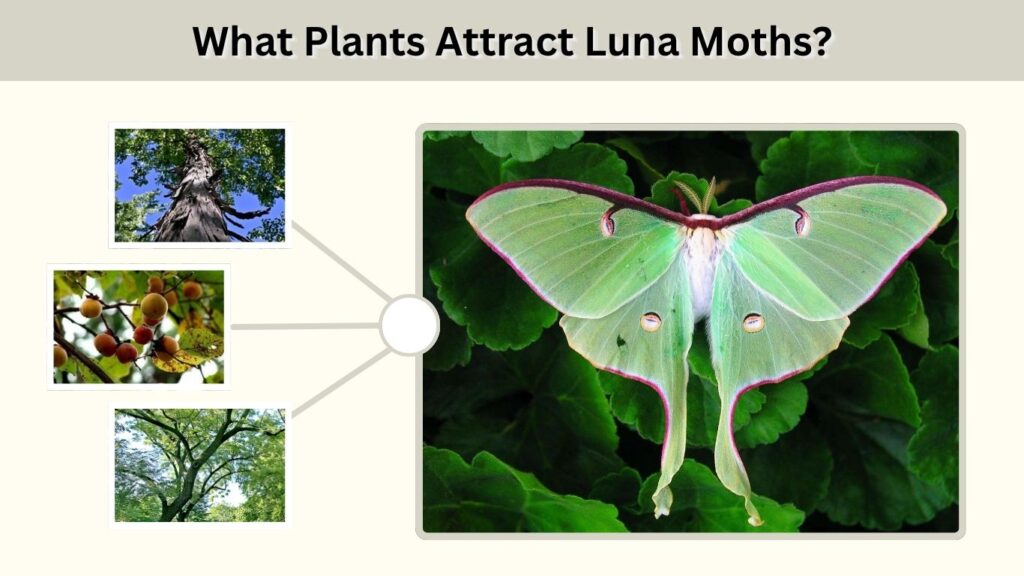
Planting native host trees is more effective than planting flowers specifically for adult luna moths. Adults cannot feed, so they do not visit flowers for nectar.
Suitable options include:
- Native hickories
- Black walnut
- American persimmon
- Sweetgum
- Paper or white birch
- Native sumacs
- Pecan
- Regionally appropriate willows
Plant selection should account for mature height, root spread, soil moisture, sunlight, climate, and available space. A locally native host is usually preferable to an ornamental tree imported from outside the region.
Preserve Fallen Leaves
Mature luna moth caterpillars wrap themselves in leaves when forming their cocoons. These cocoons commonly fall to the ground and remain hidden in leaf litter, sometimes throughout winter.
Removing, shredding, or burning every fallen leaf may destroy developing moths. Leave a natural layer beneath host trees or move whole leaves into a sheltered garden border rather than sending all of them through a mower.
Reduce Pesticide Use
Broad-spectrum insecticides can kill luna moth caterpillars as well as target pests. Avoid spraying host trees unnecessarily, particularly when caterpillars, eggs, or feeding damage are present.
Luna moth caterpillars are solitary and rarely become numerous enough to cause serious harm to a healthy mature tree. Some missing leaves generally do not require treatment.
Limit Outdoor Lighting
Luna moths are nocturnal and may be drawn toward bright porch, security, or landscape lights. Excessive lighting can interfere with normal movement and mating.
Turn off unnecessary lights at night, use motion sensors, direct fixtures downward, and close curtains where indoor lighting shines strongly into the yard.
Can You Rear a Caterpillar on a Host Plant?
A caterpillar found actively eating a particular tree should usually remain on that same species. If temporary care is necessary, provide fresh, pesticide-free leaves from the original tree.
Avoid changing food plants midway through development. Some luna moth populations will not readily switch, even to another plant that appears on a general host list.
Fresh branches can be placed in water, but the container opening must be securely covered so the caterpillar cannot fall into the water. Provide ventilation, remove droppings and wilted foliage, and include loose leaves when the caterpillar approaches pupation.
Wild caterpillars are generally safest when left outdoors on their natural tree.
FAQs
What is the best host plant for a luna moth?
There is no single best host across its entire range. Hickory, walnut, sweetgum, persimmon, white birch, pecan, and sumac are leading choices. White birch is especially important in northern areas, while sweetgum, hickory, walnut, and persimmon are common southern hosts.
What plant does a luna moth lay eggs on?
A female lays eggs on the leaves of a suitable caterpillar food tree. She may choose hickory, walnut, sweetgum, persimmon, birch, pecan, or sumac, depending on the host species available and the preferences of her local population.
Do adult luna moths eat plants?
No. Adult luna moths do not eat plants, nectar, fruit, or other foods because their mouthparts are nonfunctional. They live on energy stored during the caterpillar stage and spend their brief adult lives mating and laying eggs.
Is hosta a luna moth host plant?
No, hosta is not recognized as a normal luna moth caterpillar food plant. The similarity between “host plant” and “hosta plant” sometimes creates confusion. Luna moth larvae primarily feed on the leaves of broadleaf trees rather than garden hostas.
Can luna moth caterpillars eat any type of leaf?
No. They require appropriate host foliage, and preferences can vary by region. A caterpillar may reject an unfamiliar tree even when other luna moth populations use it. Keep a discovered caterpillar on the same tree species where it was feeding.