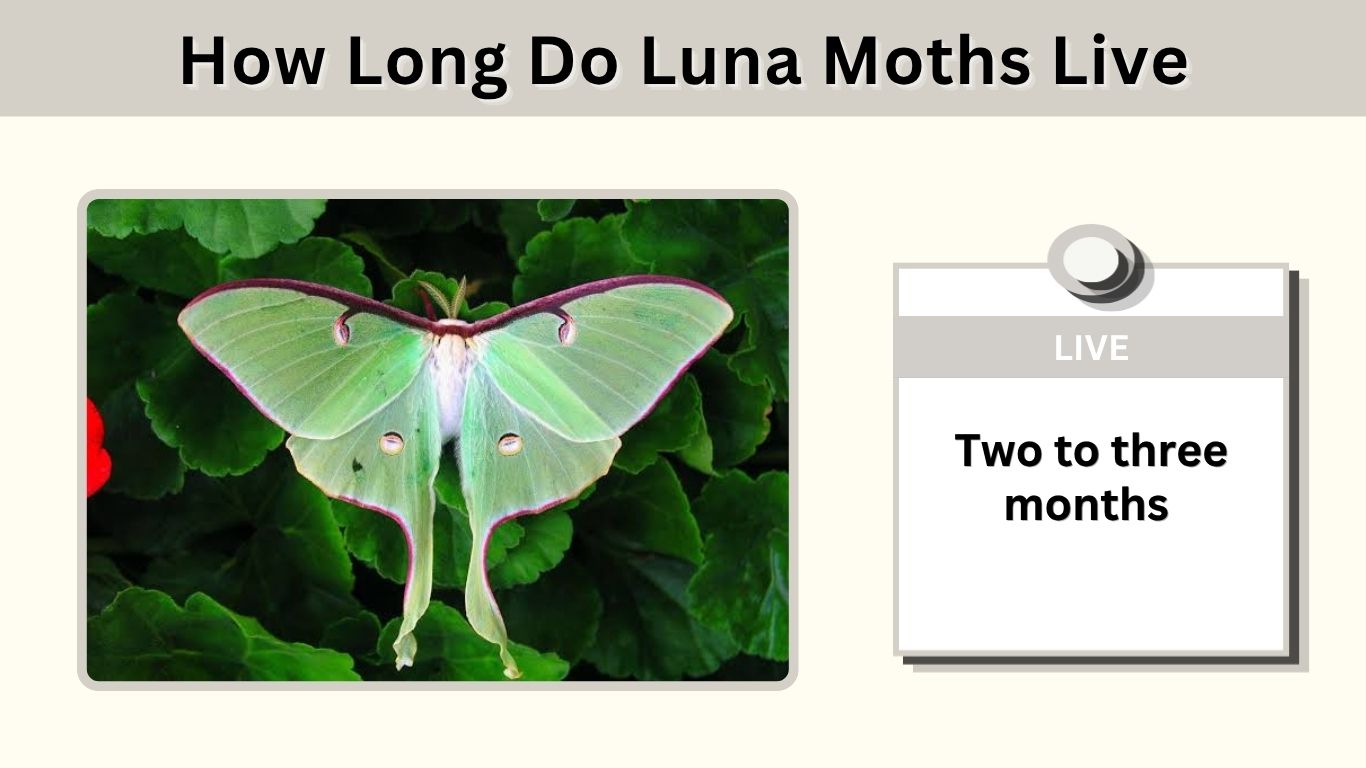
Luna moths are large, pale-green moths recognized by their long hindwing tails and striking eyespots. Although an adult luna moth usually lives for only about one week, its complete life cycle lasts much longer. It spends time as an egg, caterpillar, pupa inside a cocoon, and finally as an adult moth. Temperature, season, location, food quality, and winter dormancy can all affect how long each stage lasts.
How Long Does a Luna Moth Live?
An adult luna moth generally lives for about 7 to 10 days. Some individuals may survive slightly less or longer depending on weather, energy reserves, predators, and reproductive activity.
Adult luna moths have reduced, nonfunctional mouthparts. They cannot eat or drink and survive entirely on energy stored during the caterpillar stage. Their brief adult life is devoted to mating and laying eggs.
The entire life cycle, from egg to adult death, may last approximately two to three months during warm weather. However, luna moths that overwinter inside cocoons may remain in the pupal stage for several months, extending the total life cycle considerably.
Luna Moth Lifespan by Life Stage
Each stage of the luna moth’s development has a different duration. Environmental conditions may speed up or slow down the process.
| Life stage | Approximate duration |
| Egg | 8–14 days |
| Caterpillar | 4–6 weeks |
| Cocoon and pupa | 2–3 weeks or several winter months |
| Adult moth | 7–10 days |
| Complete life cycle | Around 2–3 months, excluding winter dormancy |
How Long Do Luna Moth Eggs Take to Hatch?
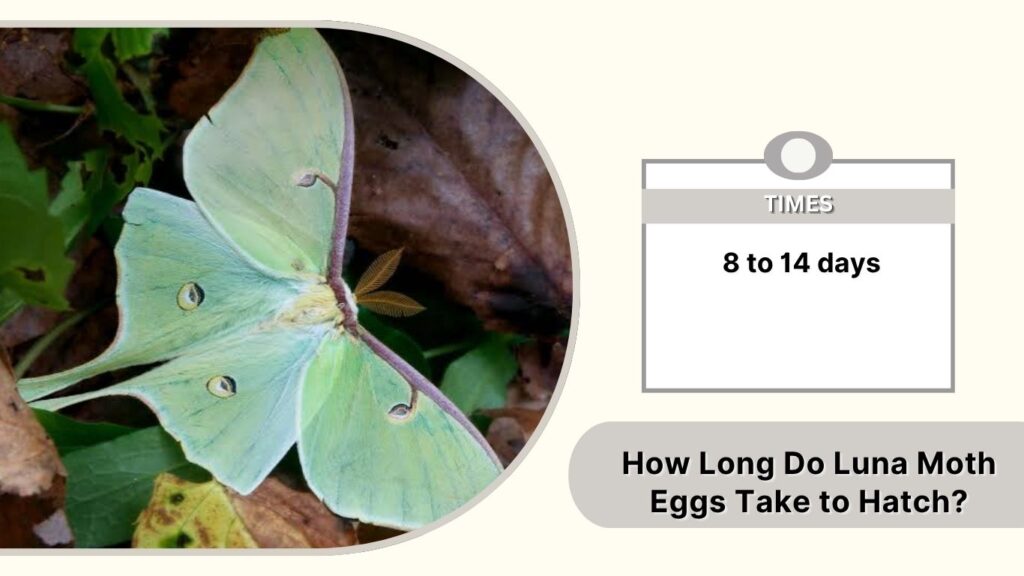
Luna moth eggs usually hatch within 8 to 14 days after they are laid. Warm conditions may encourage faster development, while cooler weather may delay hatching.
Female luna moths commonly lay eggs on the leaves or twigs of suitable host trees, including:
- Hickory
- Walnut
- Sweetgum
- Birch
- Persimmon
- Pecan
- Sumac
The eggs are small, round or oval, and may appear white, gray, tan, or brownish. Fertile eggs often become darker as the caterpillar develops inside.
After hatching, the tiny caterpillar begins feeding on fresh leaves from the host plant. It must eat enough during the larval stage to store all the energy it will need as an adult.
How Long Do Luna Moth Caterpillars Live?
Luna moth caterpillars usually spend approximately four to six weeks feeding and growing. Their development may take longer during cool weather or when food quality is poor.
The caterpillar passes through five growth stages called instars. It sheds its skin between each stage because its outer covering cannot expand continuously.
Early Caterpillar Stage
Newly hatched caterpillars are small and may initially appear dark, yellowish, or green. They remain close to the leaves where the female laid her eggs.
Young caterpillars eat relatively small amounts of foliage. Their feeding damage may be difficult to notice during the first few days.
Mature Caterpillar Stage
A mature luna moth caterpillar is bright green and may grow approximately 2½ to 3 inches long. It has a thick, segmented body with small spots and sparse hairs.
During this stage, the caterpillar consumes large quantities of leaves. Once it has stored enough energy, it stops eating and searches for a place to form its cocoon.
How Long Do Luna Moths Stay in Their Cocoons?
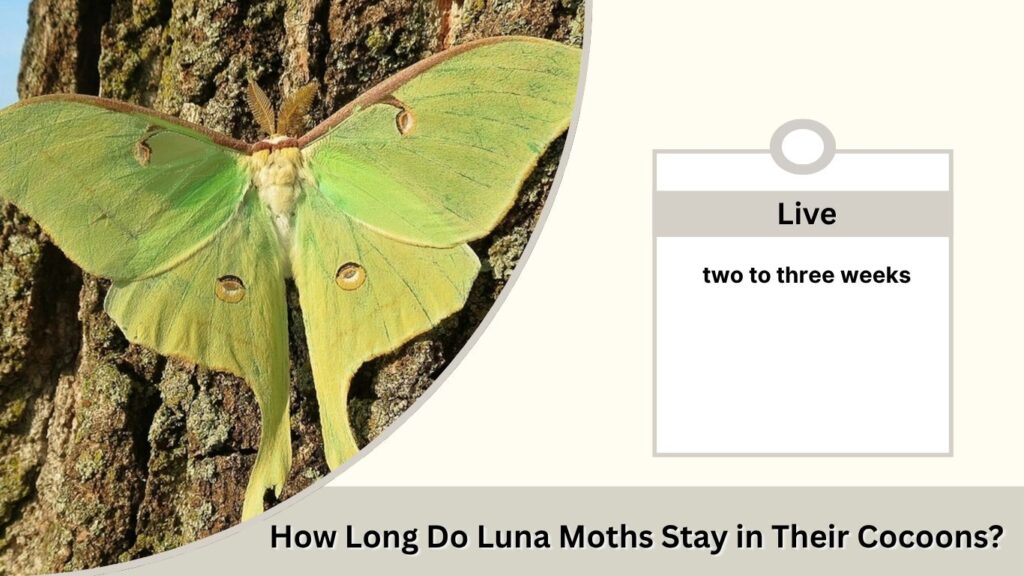
A luna moth may remain inside its cocoon for approximately two to three weeks during warm weather. However, the exact duration depends heavily on season and temperature.
The cocoon is usually made among leaves, often on or near the ground. Inside it, the caterpillar transforms into a pupa and later develops into an adult moth.
Summer Cocoons
In warm regions where luna moths produce multiple generations each year, adults may emerge from their cocoons after only a few weeks.
Warm temperatures encourage development, allowing the moth to complete another generation before the end of the season.
Overwintering Cocoons
In colder regions, luna moths usually survive winter as pupae inside their cocoons. They may remain there for several months before emerging in spring or early summer.
This dormant period is called diapause. Development slows significantly until temperature and daylight conditions become suitable.
Therefore, a luna moth may stay in its cocoon anywhere from a few weeks to more than half a year.
How Long Do Adult Luna Moths Live?
Adult luna moths usually live for approximately one week, with many surviving between seven and ten days.
Their lifespan is short because they cannot feed. Every adult activity uses energy accumulated while they were caterpillars.
Male Luna Moth Lifespan
Male luna moths spend much of their adult life flying in search of females. Their large, feathery antennae detect pheromones released by potential mates.
Long-distance flight uses considerable energy. Males may die soon after mating or after several nights of unsuccessful searching.
Female Luna Moth Lifespan
Female luna moths often remain relatively still after emerging. They release pheromones during the night to attract males.
After mating, a female flies between host plants and deposits her eggs. She may lay approximately 200 to 400 eggs over several nights. Her abdomen becomes noticeably slimmer as egg-laying continues.
Females generally die after completing reproduction, although they do not necessarily die immediately after laying their first eggs.
Why Do Luna Moths Have Such Short Adult Lives?
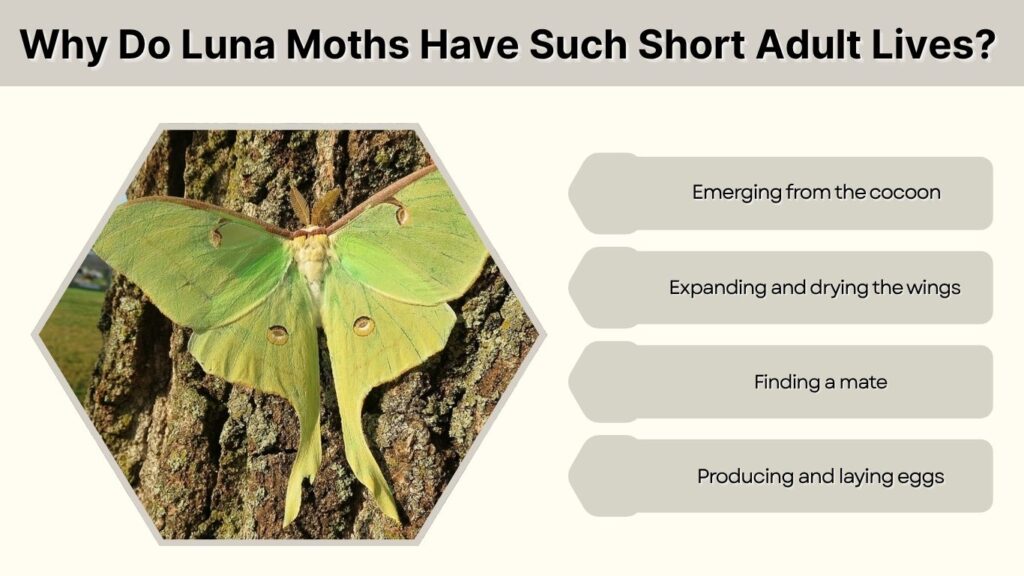
The adult luna moth is designed primarily for reproduction rather than feeding. It lacks a functional digestive system and does not drink nectar, water, fruit juice, or sugar water.
During the caterpillar stage, it stores fats and nutrients inside its body. These reserves provide energy for:
- Emerging from the cocoon
- Expanding and drying the wings
- Flying
- Finding a mate
- Producing and laying eggs
Once these reserves are depleted, the moth dies naturally. Its short lifespan is a normal part of its biology rather than a sign of illness.
How Long Do Luna Moths Live in Captivity?
A luna moth kept in captivity usually lives about as long as one in the wild—approximately 7 to 10 days as an adult. Captivity cannot greatly extend its lifespan because the moth cannot eat.
A protected enclosure may reduce the risk of predators, harsh weather, and physical injury. However, the moth will still use its limited stored energy and complete its natural life cycle.
An adult luna moth should be kept in a spacious, ventilated enclosure where it can hang vertically and move its wings. It should not be handled frequently because its body and wing scales are delicate.
Captive luna moths should not be given honey, fruit, nectar, or sugar water. They cannot consume these foods.
What Affects the Luna Moth’s Lifespan?
Several environmental and biological factors influence how long a luna moth survives.
Temperature
Warm temperatures generally speed up egg, caterpillar, and pupal development. Cool weather slows the process and may trigger winter dormancy.
Extreme heat or cold can reduce survival, particularly among eggs and young caterpillars.
Food Quality
Caterpillars that receive abundant, fresh host leaves can store more energy. Poor-quality, wilted, or chemically treated leaves may affect growth and adult health.
Predators and Parasites
Birds, bats, spiders, rodents, predatory insects, and parasitic wasps may attack luna moths during different life stages.
Their green coloration and long wing tails provide some protection, but many individuals do not survive to adulthood.
Reproductive Activity
Flying, mating, producing eggs, and laying eggs require energy. Highly active moths may use their reserves faster than individuals that remain still.
Geographic Location
Luna moth populations in northern areas often produce one generation per year. Southern populations may produce two or three generations because the warm season lasts longer.
How Long Do Chinese Luna Moths Live?
The Chinese luna moth, commonly known as the Chinese moon moth, is a related species rather than the North American luna moth. Its adult stage is also brief because it has reduced mouthparts and does not feed.
Adult Chinese moon moths commonly live for roughly one to two weeks, although individual lifespan varies. Their caterpillar and pupal development depends on temperature, host plants, and seasonal conditions.
Do Luna Moths Sleep?
Luna moths are primarily active at night and rest during daylight hours. They may remain motionless on tree trunks, walls, leaves, or other sheltered surfaces.
This daytime inactivity is often described as sleeping, although insect rest differs from human sleep. Resting helps the moth conserve its limited energy for nighttime flight and reproduction.
FAQs
How long does a luna moth live after emerging?
A luna moth usually lives for about 7 to 10 days after emerging from its cocoon. During this short adult stage, it cannot eat. Its main purpose is to find a mate, reproduce, and lay eggs before its stored energy is exhausted.
How long do luna moth caterpillars live?
The caterpillar stage generally lasts around four to six weeks. During this period, the caterpillar passes through five growth stages and feeds heavily on host-tree leaves before forming a cocoon.
How long does a luna moth stay in its cocoon?
A luna moth may remain inside its cocoon for two to three weeks during warm weather. An overwintering pupa may stay inside for several months before emerging when spring or summer conditions become favorable.
Can an adult luna moth live longer if it is fed?
No. Adult luna moths cannot eat because they lack functional mouthparts. Sugar water, nectar, fruit, and honey cannot extend their lifespan. They survive only on nutrients stored during the caterpillar stage.
What is the complete lifespan of a luna moth?
Without winter dormancy, the complete life cycle generally lasts around two to three months. If the moth overwinters as a pupa inside its cocoon, the life cycle may extend across several additional months.