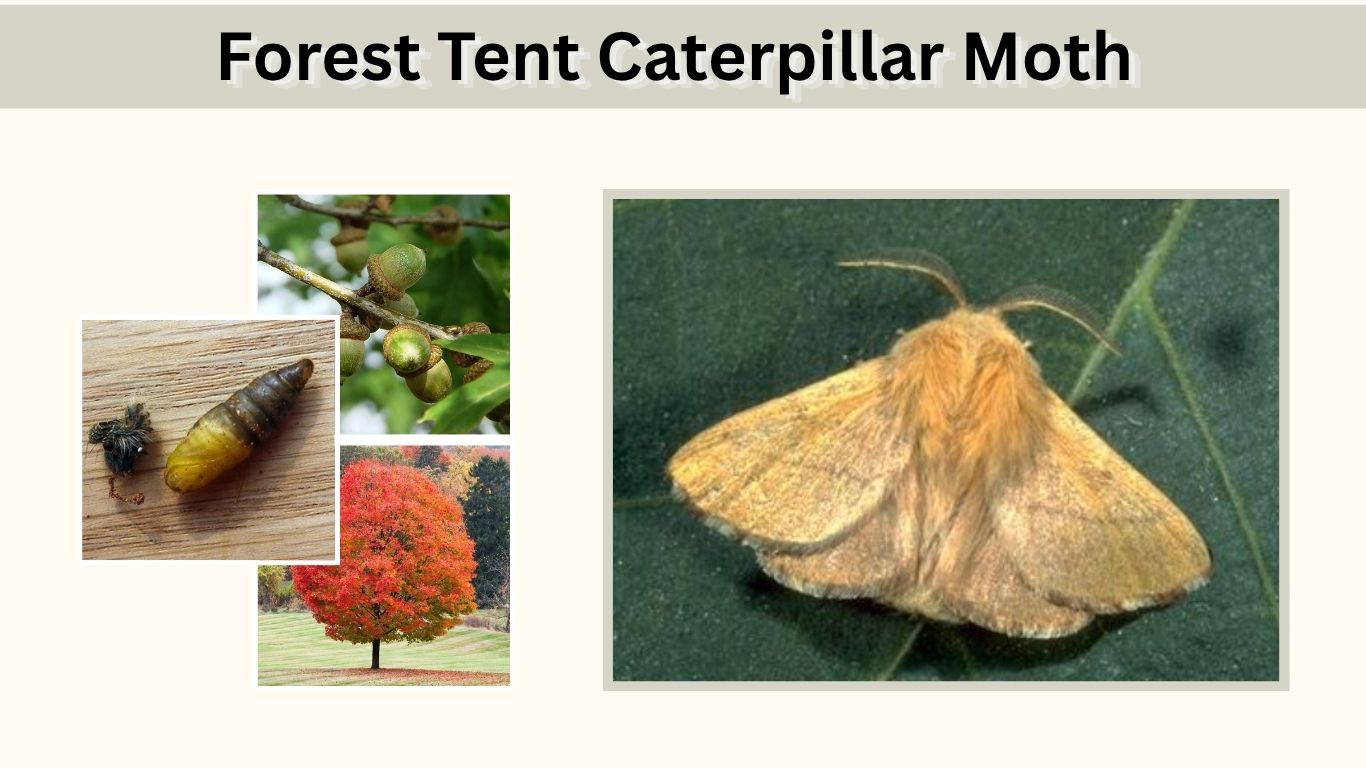
The forest tent caterpillar moth is a native North American moth best known for its leaf-eating larvae. Its scientific name is Malacosoma disstria, and it belongs to the lappet moth family, Lasiocampidae. Although its name suggests that the caterpillars build large silk tents, they actually create thin silken mats on tree trunks and branches. During major outbreaks, hundreds or thousands of larvae may strip leaves from hardwood trees and wander across yards, roads, and buildings.
What Is a Forest Tent Caterpillar Moth?
The forest tent caterpillar moth occurs across much of the United States and Canada wherever suitable deciduous forests are present. It is particularly associated with aspen, maple, oak, gum, birch, elm, and other broadleaf trees.
The species has one generation each year. Most of its visible damage occurs during the caterpillar stage in spring or early summer. Adult moths live only briefly, mate, lay eggs, and die without feeding.
Scientific Classification
| Category | Classification |
| Common name | Forest tent caterpillar moth |
| Scientific name | Malacosoma disstria |
| Order | Lepidoptera |
| Family | Lasiocampidae |
| Native range | North America |
| Generations | One per year |
| Main host plants | Deciduous trees |
Forest Tent Caterpillar Identification
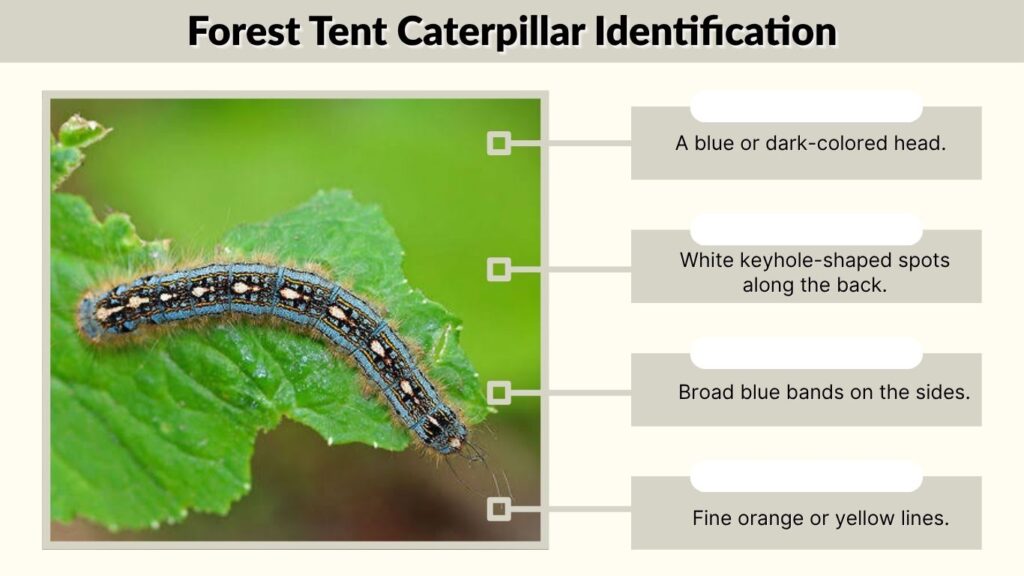
The moth, caterpillar, eggs, and cocoon look different from one another. The caterpillar is usually the easiest stage to recognize.
Caterpillar Appearance
A mature forest tent caterpillar grows to approximately two inches long. Its body is mostly dark blue, black, gray, or brown and is covered with fine hairs.
The most distinctive feature is a row of pale white or cream markings running down the center of the back. These markings are often described as footprints, keyholes, bowling pins, or tiny penguins. Blue bands and thin orange or yellow lines may also run along the sides.
Key identification features include:
- A blue or dark-colored head
- White keyhole-shaped spots along the back
- Broad blue bands on the sides
- Fine orange or yellow lines
- Numerous soft-looking body hairs
- A mature length of about two inches
The hairs can cause mild skin irritation in sensitive people, but forest tent caterpillars do not bite or sting.
Adult Moth Appearance
Adult forest tent caterpillar moths are light brown, tan, buff, or yellowish brown. Their thick bodies have a soft, furry appearance, and the forewings usually display two darker diagonal lines or a broad darker band.
The wingspan is generally around 1¼ to 1½ inches, although size can vary. The moths are active mainly at night and are strongly attracted to outdoor lights.
Egg Masses
Females lay approximately 100 to 350 eggs in cylindrical masses that completely encircle small twigs. The eggs are covered with a protective, foam-like material that hardens into a glossy brown or gray coating.
Forest tent caterpillar egg masses often have relatively square ends. They remain on the twigs throughout winter and hatch when leaves begin opening the following spring.
What Do Forest Tent Caterpillar Moths Eat?
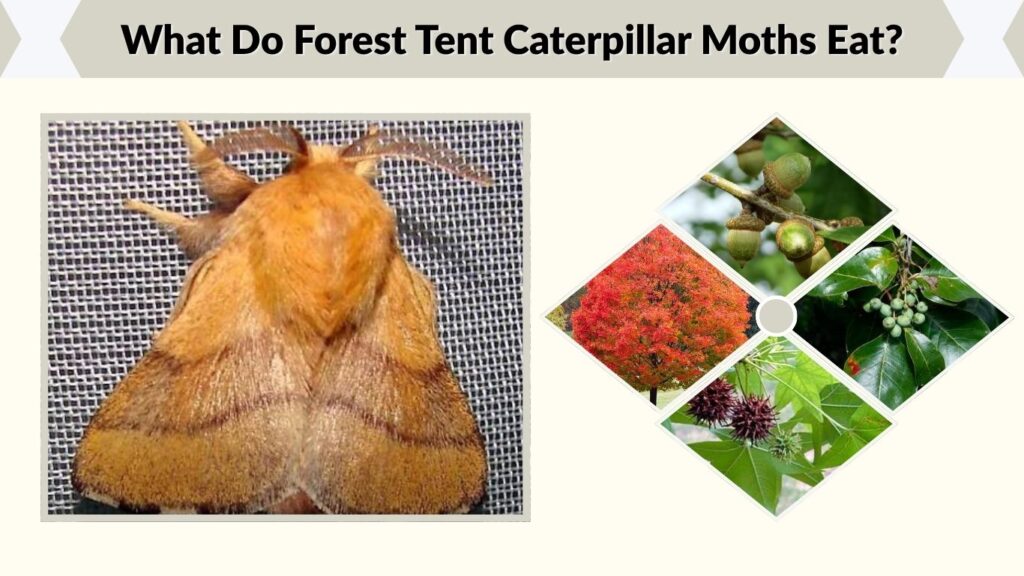
The answer depends on whether the insect is a caterpillar or an adult moth.
Caterpillar Diet
The caterpillars eat leaves from a wide range of deciduous trees. Their preferred food varies by region.
Common host trees include:
- Aspen
- Sugar maple
- Oak
- Sweetgum
- Black gum
- Tupelo
- Birch
- Elm
- Ash
- Basswood
- Willow
- Alder
- Cherry
- Apple
- Poplar
Aspen is an important host in northern and western regions, while maple, oak, sweetgum, and tupelo are frequently attacked elsewhere. The caterpillars usually avoid conifers and rarely feed on red maple, although very hungry larvae may consume unusual plants during severe outbreaks.
When their preferred trees have been stripped, mature larvae may move to nearby shrubs, fruit trees, garden vegetables, and nursery plants.
Adult Moth Diet
Adult forest tent caterpillar moths do not eat. Their mouthparts are not used for feeding, and the adults survive on energy stored during the larval stage.
They generally live for only a few days. During that short period, they find mates, reproduce, and lay the egg masses that produce the following year’s caterpillars.
Forest Tent Caterpillar Moth Life Cycle
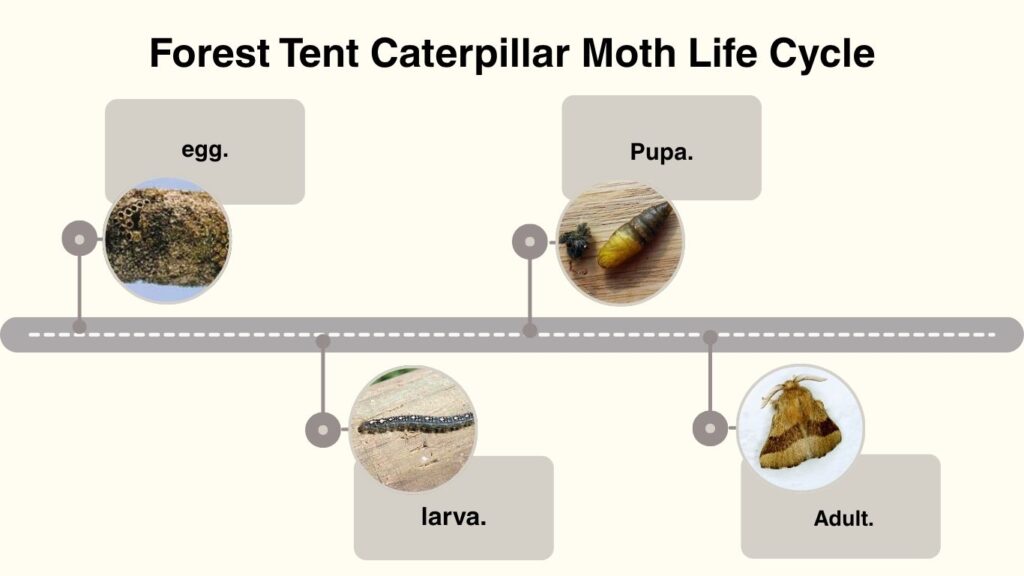
The forest tent caterpillar completes four stages: egg, larva, pupa, and adult moth. The timing differs with climate, but the entire cycle produces only one generation per year.
Egg Stage
Egg masses remain attached to twigs through autumn and winter. Tiny caterpillars develop inside the eggs but remain protected until spring.
Hatching usually occurs around the time host-tree buds open. This gives the young larvae access to tender, newly developing leaves.
Larval Stage
Newly hatched caterpillars are small, dark, and hairy. They initially remain together in colonies and travel along silk trails to feeding areas.
Unlike eastern tent caterpillars, they do not create a large enclosed tent. Instead, they make flat, relatively inconspicuous silk mats on trunks or branches where they gather to rest or molt.
The larvae feed for approximately five to six weeks. As they grow, they become less social and may wander individually in search of additional food or protected places for pupation.
Cocoon and Pupal Stage
Mature larvae spin pale yellow or whitish silk cocoons. Cocoons may be found:
- Inside folded leaves
- Beneath loose bark
- In tree crevices
- On fences
- Under roof edges
- On outdoor furniture
- Along building walls
- Beneath other protected structures
The silk may contain a yellow powdery material. Pupation normally lasts about 10 to 14 days before the adult moth emerges.
Adult Stage
Adult moths emerge from late spring through midsummer, depending on the region. They are nocturnal and frequently gather around lights during outbreak years.
After mating, females deposit egg masses around small branches. The adults die after several days, while the new eggs remain in place through winter.
Forest Tent Caterpillar vs Spongy Moth
The spongy moth was previously widely called the gypsy moth. Both species can defoliate hardwood trees, but their caterpillars have noticeably different markings.
| Feature | Forest tent caterpillar | Spongy moth caterpillar |
| Scientific name | Malacosoma disstria | Lymantria dispar |
| Back markings | White keyhole-shaped spots | Five pairs of blue dots followed by six pairs of red dots |
| Body color | Blue, black, gray, and brown | Dark and hairy with colored bumps |
| Silk structure | Flat silk mats | No communal tent |
| Origin in North America | Native | Introduced |
| Common hosts | Aspen, maple, oak, gum and other hardwoods | Especially oak and many other trees |
The row of white footprints is the quickest way to recognize a forest tent caterpillar. Spongy moth caterpillars instead have prominent pairs of blue and red raised spots.
Do Forest Tent Caterpillars Damage Maple Trees?
Forest tent caterpillars commonly feed on sugar maple and several other maple species. However, they generally avoid red maple because chemicals in its leaves discourage feeding.
A healthy mature tree can usually survive one season of defoliation and produce replacement leaves. Repeated heavy defoliation, drought, disease, root damage, or other stress can reduce growth and increase the risk of branch dieback or tree decline.
How to Control Forest Tent Caterpillars
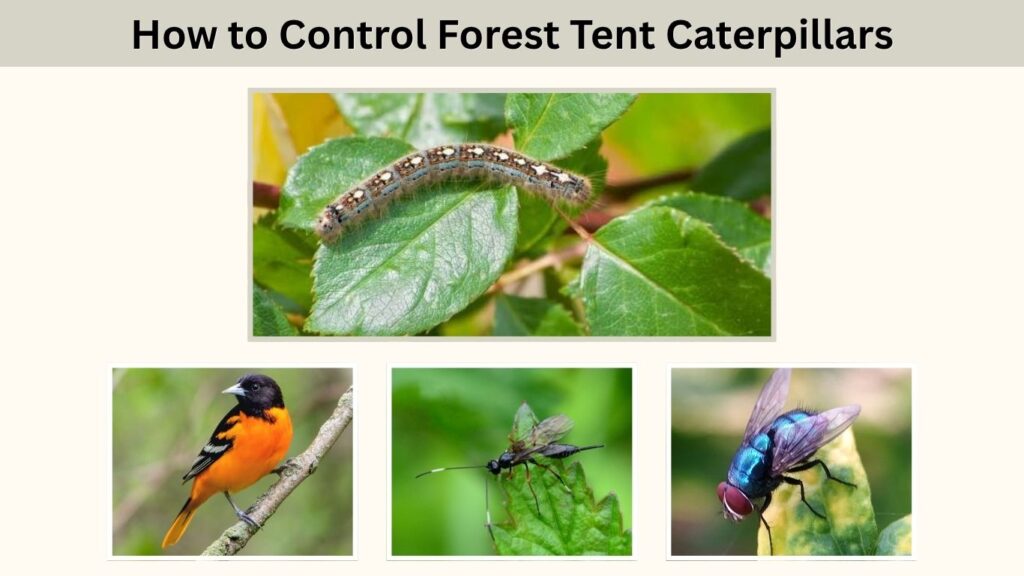
Small populations usually do not require treatment. Birds, parasitic wasps, flies, diseases, weather, and food shortages naturally reduce forest tent caterpillar populations. Outbreaks commonly collapse after several years.
Remove Egg Masses
Inspect reachable branches during autumn or winter. Egg masses can be scraped or pruned from small ornamental trees before they hatch.
Avoid damaging the bark while removing them.
Remove Small Groups of Caterpillars
Caterpillars can be brushed from small trees, walls, decks, and outdoor furniture. A strong stream of water may also dislodge them.
Do not burn caterpillars or apply fire to branches, because this can severely damage the tree.
Protect Valuable Trees
Young larvae are easier to control than fully grown caterpillars. Products containing Bacillus thuringiensis may work against small, actively feeding larvae but are much less useful once caterpillars mature.
Always select a product labeled for the pest and plant, and follow all application instructions. Large trees or severe infestations may require help from a licensed arborist or pest-management professional.
Are Moth Traps Effective?
Light or pheromone traps may capture adult moths and help indicate their presence, but trapping adults is unlikely to eliminate an established population. Most tree damage has already occurred by the time moths emerge.
Monitoring egg masses in winter and controlling small larvae shortly after hatching are generally more useful approaches.
FAQs
Do forest tent caterpillars build tents?
No. Despite their name, forest tent caterpillars do not create large enclosed tents. Young larvae produce flat silk mats on trunks and branches where they gather while resting or molting. They also lay silk trails while traveling between resting and feeding areas.
Are forest tent caterpillar moths harmful?
Adult moths are harmless and do not bite, sting, or eat plants. The caterpillars can damage trees by consuming leaves, especially during large outbreaks. Healthy deciduous trees usually survive a single defoliation event, but repeated damage can weaken stressed trees.
How long does the forest tent caterpillar stage last?
The caterpillar stage usually lasts around five to six weeks, although temperature, location, food quality, and weather can affect development. Mature larvae then leave feeding areas, find protected locations, and spin cocoons before transforming into adult moths.
Where do forest tent caterpillars make cocoons?
They may spin cocoons inside folded leaves, beneath bark, along tree trunks, in fence gaps, under building edges, or on outdoor furniture. During outbreaks, large numbers of pale silk cocoons may appear on houses and other structures.
How can I identify a forest tent caterpillar?
Look for a hairy, dark-colored caterpillar with blue bands and a row of white keyhole- or footprint-shaped markings down its back. It grows to approximately two inches long and rests on flat silk mats rather than inside a large silk tent.