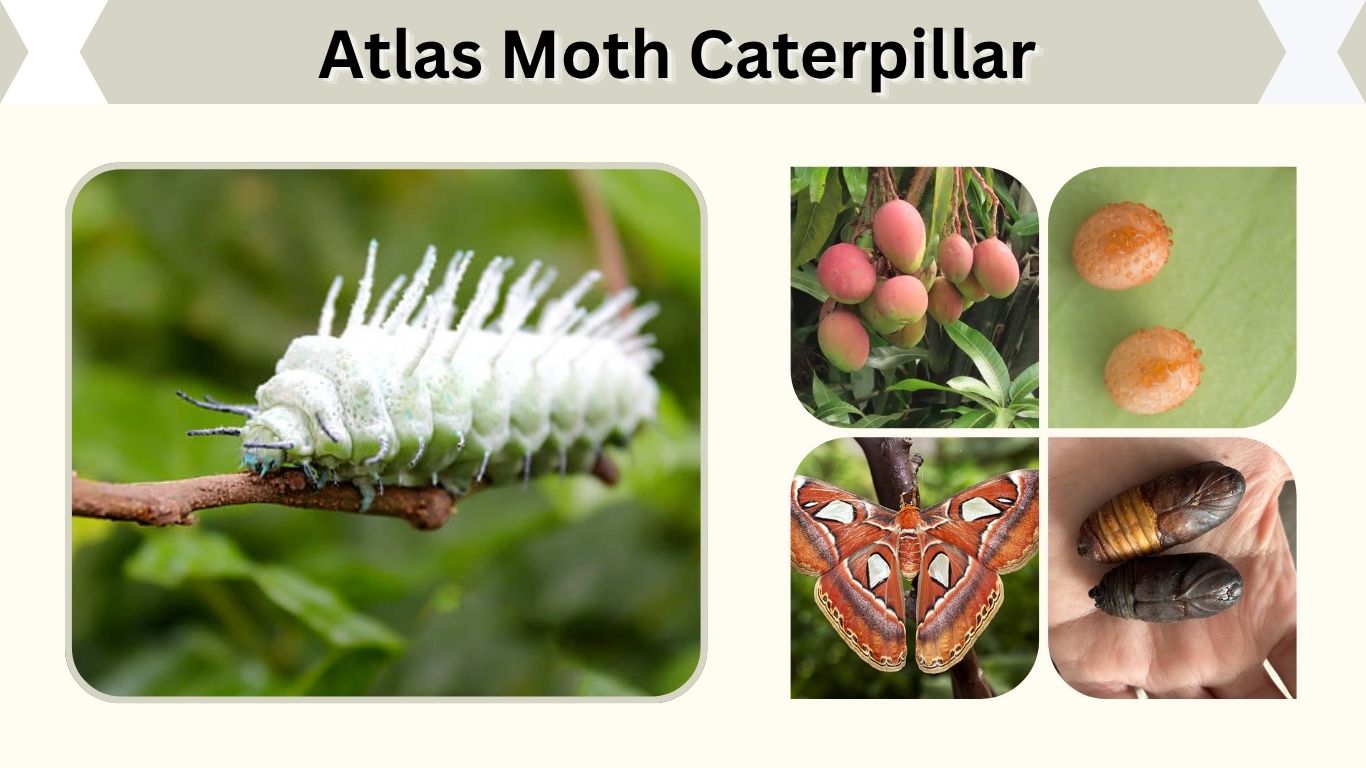
The Atlas moth caterpillar is the larval stage of Attacus atlas, one of the world’s largest moths. This enormous caterpillar has a pale green body covered with bluish-green projections and a powdery white, wax-like coating. It spends most of its time eating leaves and storing the energy it will need as an adult. After several weeks of rapid growth, the caterpillar spins a strong silk cocoon and transforms into a spectacular reddish-brown moth. Atlas moths naturally occur across tropical and subtropical areas of South and Southeast Asia.
Atlas Moth Caterpillar Quick Facts
Atlas moth caterpillars belong to the giant silk moth family, Saturniidae. Their large size, unusual waxy covering, and colorful body projections make them easier to recognize than many other caterpillars.
| Feature | Information |
| Scientific name | Attacus atlas |
| Family | Saturniidae |
| Caterpillar length | Up to approximately 12 cm |
| Color | Pale or bluish green |
| Main food | Leaves of suitable host plants |
| Larval period | Commonly several weeks |
| Life-cycle stages | Egg, caterpillar, pupa and adult |
| Cocoon | Strong, papery brown silk |
| Adult feeding | Adults do not eat |
| Natural range | South and Southeast Asia |
Atlas moth caterpillars may grow to approximately 12 centimeters, or about 4.7 inches, making them among the largest caterpillars commonly displayed in butterfly houses and insect collections.
What Does an Atlas Moth Caterpillar Look Like?
A mature Atlas moth caterpillar has a thick, heavy body that looks almost too large to remain attached to a leaf. Its coloration and waxy coating help it blend into vegetation and may discourage predators.
Identification Features
Look for the following characteristics:
- A large, thick body
- Pale green or bluish-green coloration
- White, powdery or wax-like coating
- Fleshy blue-green projections along the body
- Small orange or brown speckles
- A bright orange marking near the rear
- Short true legs near the head
- Fleshy abdominal prolegs for gripping branches
The white coating begins developing after the caterpillar’s earliest growth stage. Younger larvae are smaller and darker, while mature caterpillars become much thicker and more heavily coated. Scientific observations have measured later-stage larvae at approximately 88–92 millimeters, although other specimens may reach close to 12 centimeters.
Why Is It Covered in White Powder?
The powdery material is a waxy secretion rather than mold or disease. It may help the caterpillar resemble bird droppings, a dead larva, or a caterpillar affected by fungus, potentially making predators less likely to attack it.
The pale coating can be rubbed off through unnecessary handling. Its appearance may also vary according to the caterpillar’s age, recent molt, and general condition.
How Big Does an Atlas Moth Caterpillar Get?
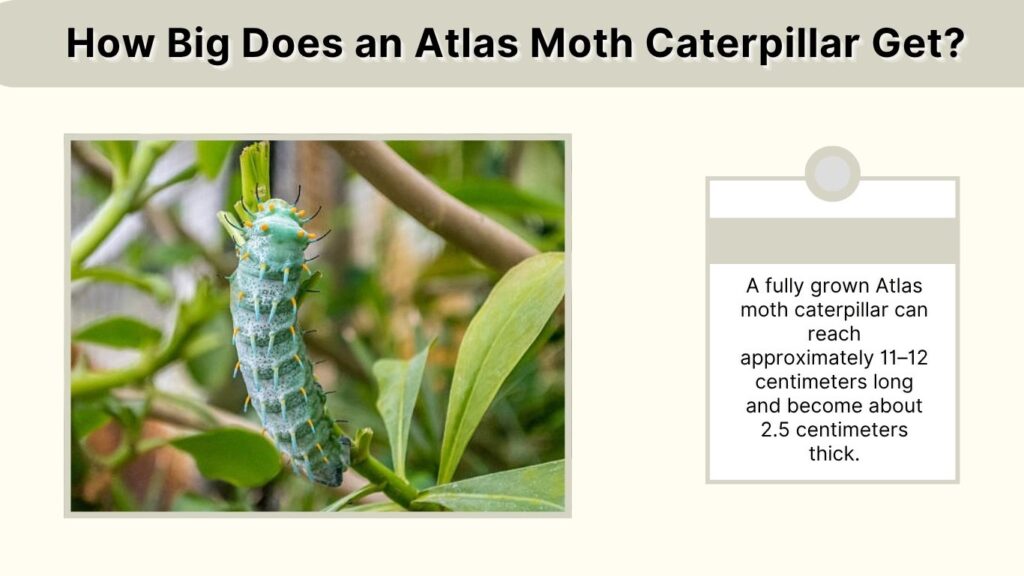
A fully grown Atlas moth caterpillar can reach approximately 11–12 centimeters long and become about 2.5 centimeters thick. Its final size depends on genetics, temperature, health, food quality, and the host plant on which it develops.
The caterpillar must consume an enormous amount of foliage because the adult moth has nonfunctional mouthparts. All the energy required for adult survival, mating, and egg production must therefore be stored during the caterpillar stage.
What Do Atlas Moth Caterpillars Eat?
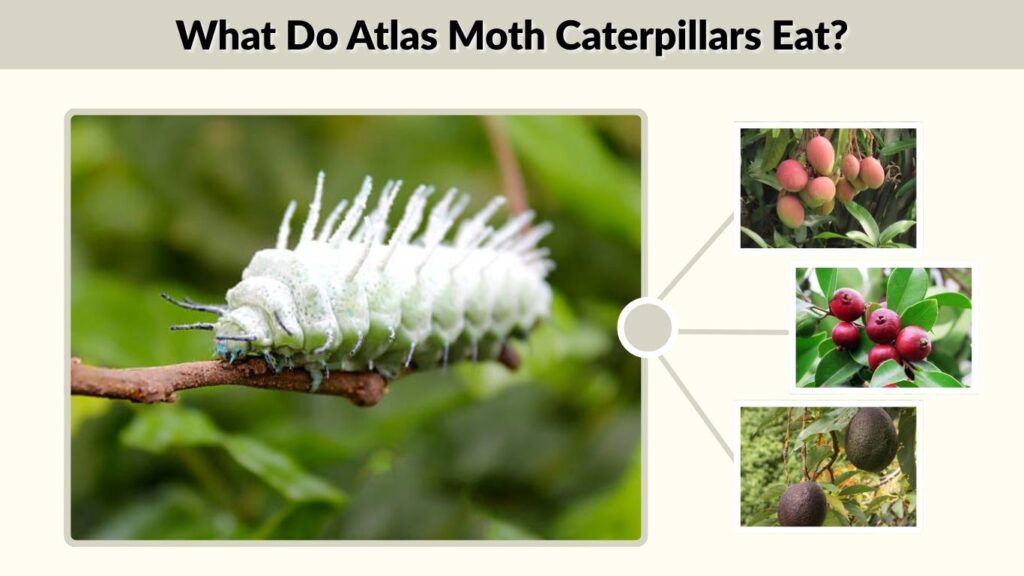
Atlas moth caterpillars are leaf-eating herbivores. They consume foliage from suitable host plants rather than eating fruit, flowers, wood, or artificial household food.
Natural Host Plants
Documented food plants include:
- Guava
- Mango
- Avocado
- Citrus trees
- Cinnamon and camphor trees
- Litchi
- Carambola or star fruit
- Cardamom
- Water apple
- Tea plants
- Mahogany
- Soursop
Atlas moth caterpillars can use a wider range of host plants than many related silk moths. Research and museum records document dozens of possible hosts, although caterpillars may accept some plants more readily than others.
Food Plants Used in Captivity
Captive caterpillars are frequently raised on privet. Depending on their origin and previous diet, they may also accept ash, lilac, cherry, ailanthus, willow, or other suitable broad-leaved plants.
It is generally best to continue using the same plant species the caterpillars started eating. Suddenly switching host plants can lead to feeding refusal, especially in older larvae. Leaves should be fresh, clean, free from pesticides, and collected away from heavily polluted roads.
Atlas Moth Caterpillar Life Cycle
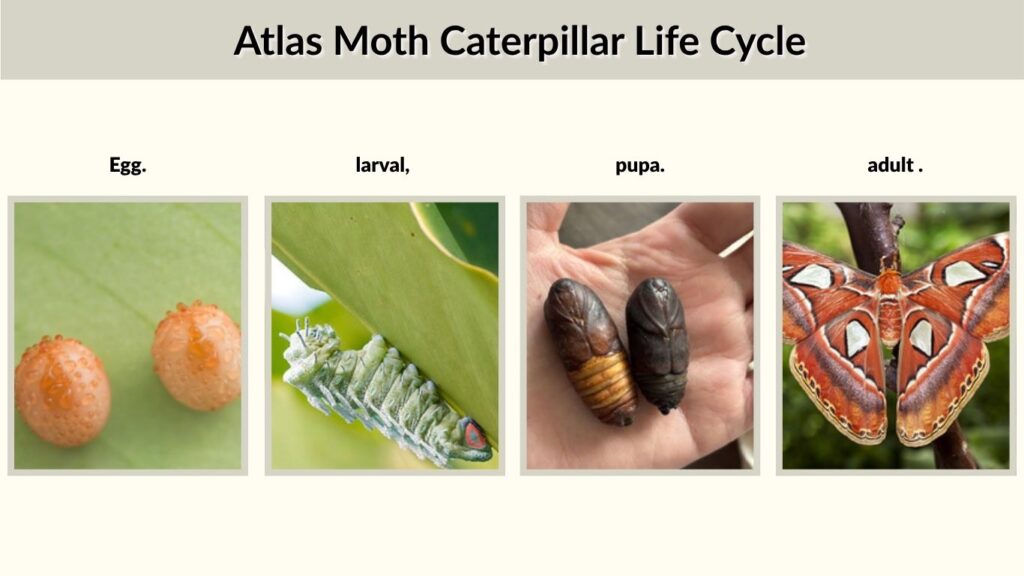
The Atlas moth undergoes complete metamorphosis, passing through four distinct stages: egg, larva, pupa, and adult.
Egg Stage
A female attaches pale, flattened eggs to leaves and other nearby surfaces. The eggs commonly hatch after approximately one to two weeks, although temperature and environmental conditions affect development.
The newly hatched caterpillars are only several millimeters long. They begin eating suitable host leaves and grow rapidly.
Caterpillar Growth and Molting
The caterpillar cannot expand its outer skin continuously. It must periodically stop eating, shed its old skin, and begin a new developmental stage called an instar.
Atlas moth caterpillars normally pass through five larval instars, although a sixth instar has been recorded under some rearing conditions. A caterpillar preparing to molt may become inactive and refuse food for a short period. It should not be disturbed or assumed to be sick during this normal process.
Cocoon and Pupal Stage
Once fully grown, the caterpillar stops feeding and begins searching for a protected place. It spins a strong, papery silk cocoon, often incorporating a leaf or attaching the structure to a branch.
The cocoon is usually light to dark brown, although its color can vary with the host plant. Inside, the caterpillar becomes a smooth, dark pupa and undergoes its dramatic transformation into an adult moth. Pupation commonly lasts around one to one and a half months but can take longer in cool conditions or during diapause.
Emergence as an Adult Moth
The adult normally emerges in the morning and remains near the empty cocoon while its wings expand and harden. It should not be handled during this vulnerable period.
Adult Atlas moths cannot feed because their mouthparts do not function. They survive on energy stored during the caterpillar stage and generally live for only about one or two weeks. Their main purpose is to mate and produce the next generation.
Are Atlas Moth Caterpillars Poisonous?
Atlas moth caterpillars are not generally considered poisonous or equipped with the type of venomous stinging hairs found on puss, saddleback, or flannel moth caterpillars. Their large projections may look dangerous, but they are not known as medically significant stinging spines.
However, the caterpillar can release an irritating defensive spray from small openings in its body projections when it is strongly touched or disturbed. This defense appears to be directed mainly against predators such as birds. Avoid touching the caterpillar unnecessarily, and wash exposed skin if irritation occurs.
Children and pets should not be allowed to handle unfamiliar caterpillars. Even a species that is not normally venomous may cause irritation in a sensitive person or carry plant residue on its body.
How to Care for an Atlas Moth Caterpillar
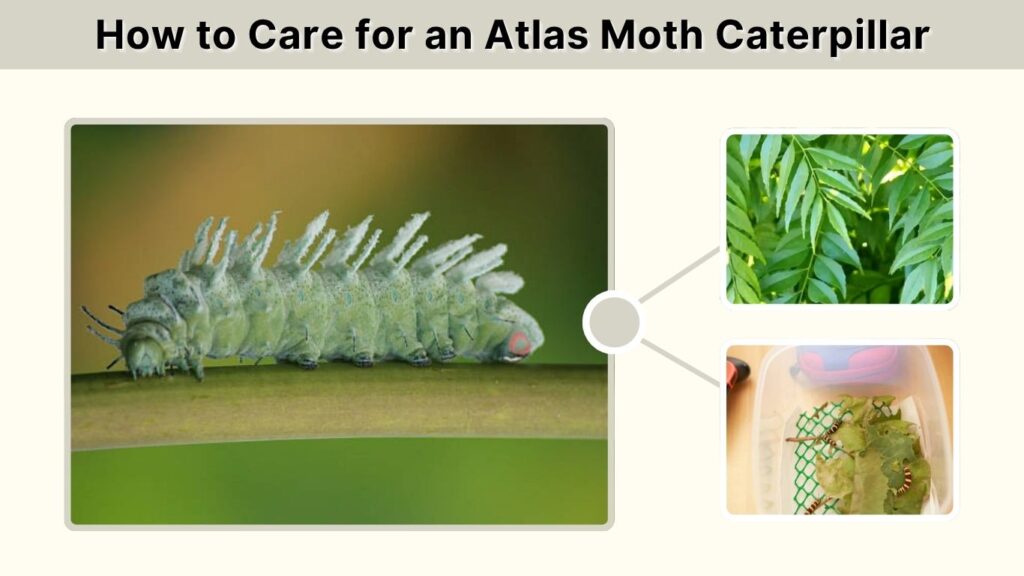
Atlas moth caterpillars should only be kept when they have been obtained legally and responsibly. Importation, possession, sale, and transport rules differ among countries because the species is not native to many places.
Enclosure and Ventilation
Young caterpillars can be housed in a clean plastic container with controlled ventilation. Older larvae require considerably more space and airflow because overcrowded, damp conditions encourage bacterial and fungal problems.
Use paper towels or another easily replaced lining. Remove droppings, dead leaves, and spoiled food regularly. Keep the enclosure protected from direct sunlight, overheating, pesticides, ants, and other predators.
Feeding
Supply fresh branches from an accepted host plant. Replace wilted leaves before they become dry or moldy.
When placing cut branches in water to keep them fresh, completely cover the water opening with cotton, foil, or another barrier. Caterpillars can fall into an uncovered container and drown.
Do not offer several random plant species at once. Use a plant known to be safe for Atlas moth larvae and continue with it throughout development whenever possible.
Temperature and Moisture
Warm room conditions are generally suitable, with many keepers maintaining the caterpillars at approximately 25°C. Excessively wet conditions can encourage fungal infections, while an extremely dry enclosure may interfere with molting.
The enclosure should be humid enough to prevent dehydration but ventilated enough to prevent condensation and mold. A standing water dish is unnecessary and creates a drowning risk.
Preparing for the Cocoon
A mature caterpillar may wander, stop eating, and produce loose strands of silk before pupating. Provide leaves, twigs, or mesh to which it can securely attach its cocoon.
Once the cocoon is complete, avoid opening, squeezing, or frequently moving it. The adult will need a tall, spacious enclosure with a rough vertical surface from which it can hang while expanding its wings.
Can You Keep an Atlas Moth Caterpillar as a Pet?
Atlas moth caterpillars are kept by experienced insect enthusiasts, museums, and educational facilities. Their calm behavior and dramatic transformation make them fascinating to observe.
However, they require a continuous supply of pesticide-free host leaves and produce a substantial amount of waste. Owners must also provide enough vertical space for the adult moth to emerge and fully expand its enormous wings. Never release an Atlas moth, caterpillar, egg, or pupa outside its native range.
FAQs
How long does an Atlas moth stay a caterpillar?
The caterpillar commonly feeds and grows for approximately five to seven weeks. Development may be faster or slower depending on temperature, host-plant quality, genetics, and whether it passes through five or six instars.
What does an Atlas moth caterpillar turn into?
It turns into the Atlas moth, Attacus atlas. The adult is a massive reddish-brown silk moth with transparent wing patches and curved forewing tips that resemble snake heads.
Does an Atlas moth caterpillar bite?
It is not known for biting people. Its mouthparts are designed for chewing leaves. However, unnecessary handling should be avoided because the caterpillar may release an irritating defensive substance when strongly disturbed.
How large is an Atlas moth caterpillar?
A mature caterpillar can reach approximately 11–12 centimeters long and about 2.5 centimeters thick. Younger larvae are much smaller and develop their characteristic waxy coating as they grow.
What is the best food for Atlas moth caterpillars?
The best food is the pesticide-free host plant on which they began feeding. Commonly accepted plants include guava, citrus, mango, cinnamon, camphor, avocado, and privet. Avoid changing plants suddenly once feeding is established.