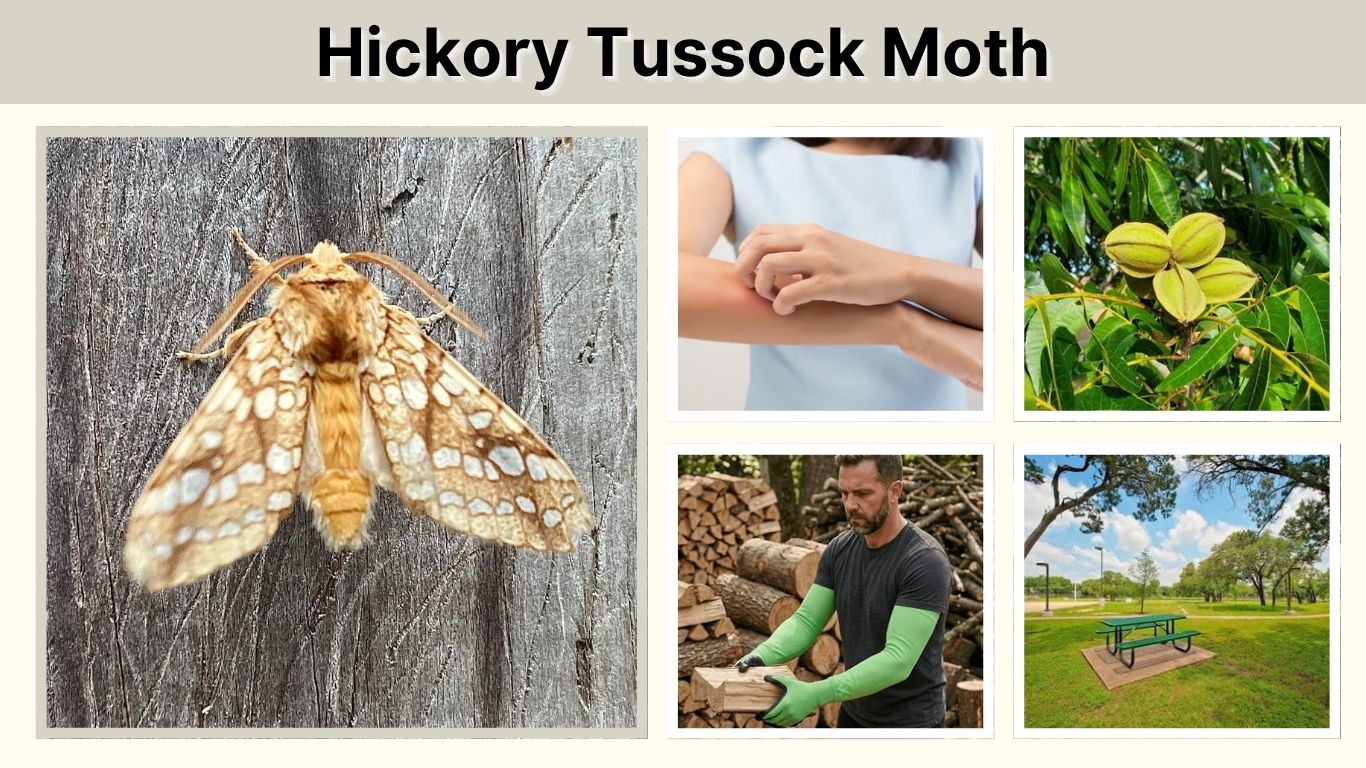
The hickory tussock moth (Lophocampa caryae), also called the hickory tiger moth, is a native North American moth best recognized during its caterpillar stage. The larva has a fuzzy white body marked with black tufts and long black hairs. Although it does not deliver a true venomous sting, touching its bristles can cause an itchy, red rash in sensitive people. The caterpillar feeds on numerous hardwood trees but rarely causes lasting forest damage.
What Is a Hickory Tussock Moth?
The hickory tussock moth belongs to the family Erebidae. Like other moths, it undergoes complete metamorphosis, passing through egg, caterpillar, pupa and adult stages. The conspicuous black-and-white caterpillar looks dramatically different from the pale adult moth.
| Feature | Description |
| Scientific name | Lophocampa caryae |
| Other name | Hickory tiger moth |
| Caterpillar appearance | White hairs with black tufts |
| Adult wingspan | Approximately 37–55 mm |
| Primary food | Leaves of hardwood trees |
| Human concern | Hairs may cause skin irritation |
| Native status | Native to North America |
The adult has cream or pale yellow forewings with brown markings and rows of translucent spots. Its hindwings are generally paler, although some individuals have darker shading. Adults are nocturnal and much less frequently noticed than the caterpillars.
How to Identify a Hickory Tussock Moth Caterpillar
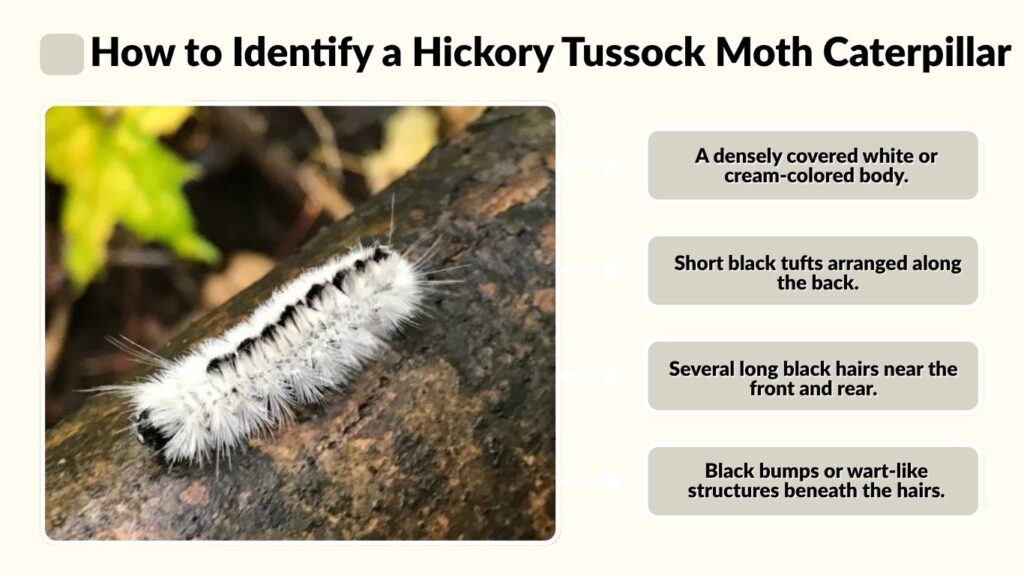
The mature caterpillar has a distinctive combination of white hairs, black markings and long hair pencils. Younger larvae may look less boldly patterned and are often found feeding together.
Key Identification Features
- A densely covered white or cream-colored body
- Short black tufts arranged along the back
- Several long black hairs near the front and rear
- Black bumps or wart-like structures beneath the hairs
- A shiny black or dark-brown head
- A mature length of approximately 35–45 mm
- A soft, woolly appearance
The caterpillar may resemble other fuzzy moth larvae, including the spotted tussock moth. Accurate identification should rely on the arrangement of its black tufts and long hair pencils rather than body color alone.
Is the Hickory Tussock Moth Caterpillar Poisonous?
Hickory tussock caterpillars are commonly called poisonous, but they are not venomous in the same way as saddleback or puss caterpillars. They have no stinger and do not intentionally inject venom.
Their defense consists of bristle-like hairs called setae. These hairs can become dislodged during contact and rest on or penetrate the skin, causing localized itching and inflammation. Reactions differ considerably: some people experience no obvious symptoms, while others develop a noticeable rash.
Does It Bite or Sting?
The caterpillar does not bite people and has no true stinging structure. What people describe as a “hickory tussock moth sting” is usually irritation caused by its hairs.
Because the hairs can detach easily, it is best not to touch the caterpillar, even with a quick or gentle stroke. Cocoons can also cause irritation because caterpillars incorporate their own hairs into the silk.
Hickory Tussock Moth Caterpillar Rash
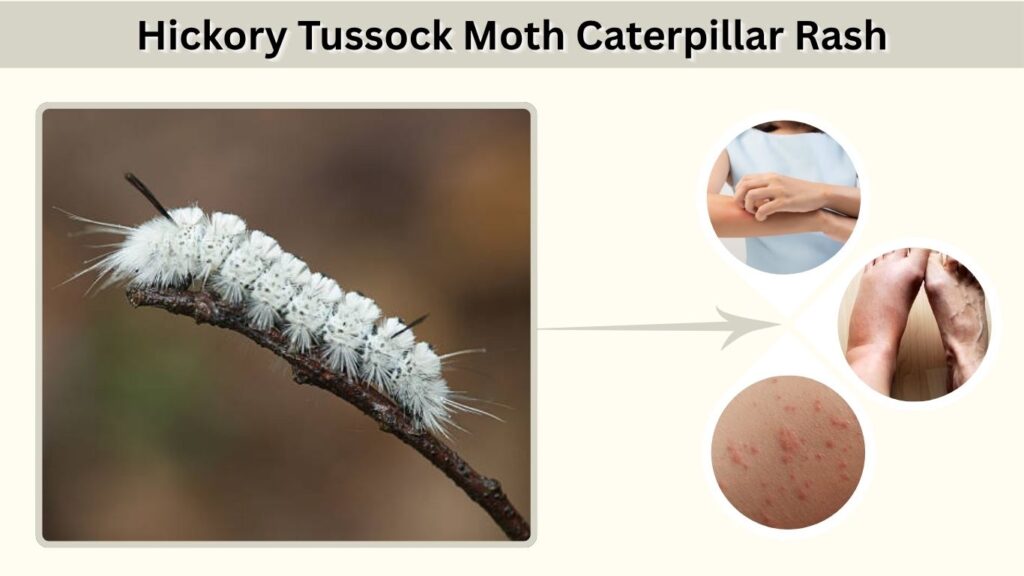
Contact usually causes a localized skin reaction rather than widespread illness. Symptoms may develop immediately or after a delay, depending on the number of hairs involved and the person’s sensitivity.
Possible Symptoms
- Itching
- Redness
- Small raised bumps
- Burning or prickling
- Localized swelling
- Welts or hives
- Tenderness
- Occasional blistering
The rash is not contagious because it is caused by physical exposure to the hairs. Dislodged hairs may remain on clothing, firewood, gardening tools, leaf litter and cocoons, allowing irritation to occur without direct contact with a living caterpillar.
How to Treat a Hickory Tussock Caterpillar Rash
Most reactions are mild and improve with basic first aid. Avoid scratching or rubbing the area because friction may push remaining hairs farther into the skin.
First-Aid Steps
- Move away from the caterpillar without touching it again.
- Apply adhesive tape to the affected skin.
- Pull the tape away to lift out loose hairs.
- Repeat with clean tape when necessary.
- Gently wash the area with soap and water.
- Apply a cold compress to reduce itching and swelling.
- Consider an antihistamine or topical steroid after consulting the product label or a healthcare professional.
- Wash exposed clothing before wearing it again.
Fine tweezers may be needed when visible hairs remain embedded after using tape. Most affected people recover with minimal supportive care, often within about 48 hours. Seek prompt medical care when hairs enter the eyes or mouth or when symptoms include facial swelling, difficulty breathing, trouble swallowing or a severe spreading reaction.
Are Hickory Tussock Caterpillars Dangerous to Dogs?
The irritating hairs may affect a dog that sniffs, licks or attempts to eat the caterpillar. Exposure around the mouth can potentially cause drooling, discomfort, irritability and a reduced willingness to eat.
Keep dogs and cats away from fuzzy caterpillars and their cocoons. Contact a veterinarian when a pet develops heavy drooling, persistent mouth-pawing, facial swelling, vomiting, eye irritation or breathing difficulty. Do not reach deeply into an animal’s mouth to remove hairs without professional guidance.
What Do Hickory Tussock Moth Caterpillars Eat?
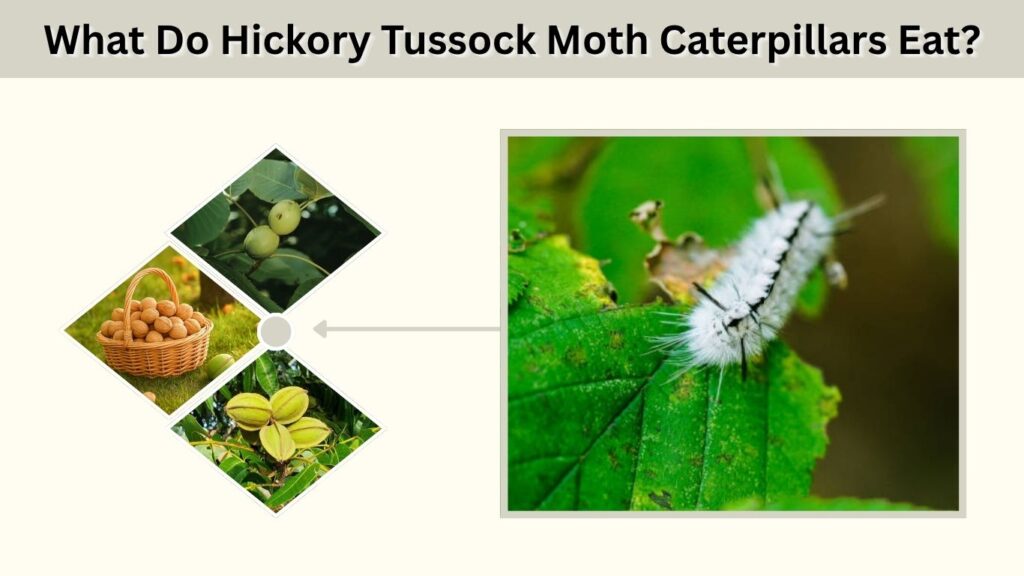
Despite their name, these caterpillars do not depend exclusively on hickory trees. They feed on a broad assortment of hardwood trees, shrubs, vines and cultivated plants.
Common Host Plants
- Hickory
- Pecan
- Walnut
- Birch
- Quaking aspen
- Basswood
- Black locust
- American hornbeam
- Ash
- Elm
- Oak
- Willow
- Sumac
- Raspberry
- Rose
- Blueberry
- Virginia creeper
Young caterpillars commonly feed in groups because females deposit eggs in large batches. Older larvae disperse and feed independently. Large groups can occasionally defoliate an individual tree, but the species generally causes limited forest damage.
Hickory Tussock Moth Life Cycle
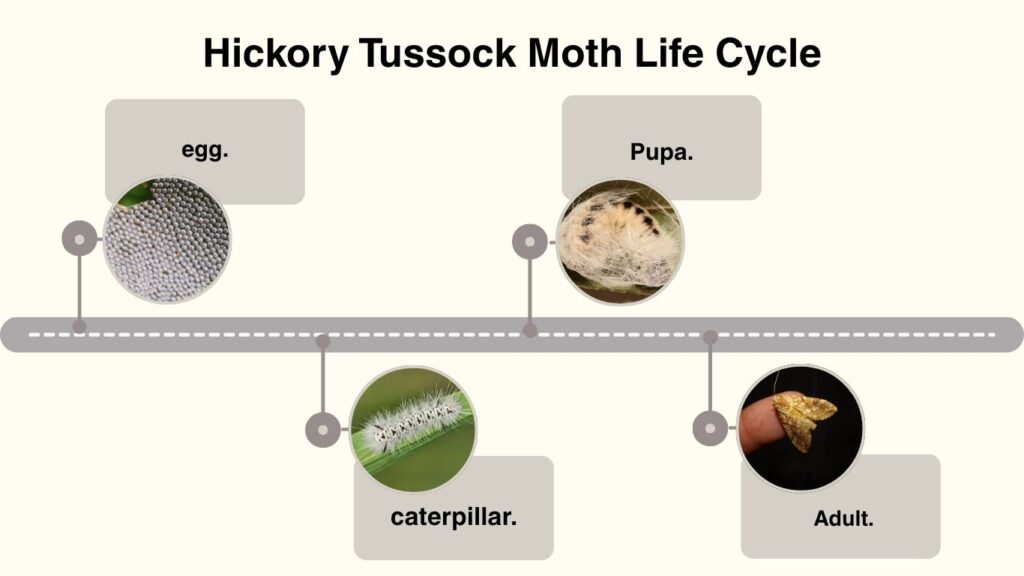
The hickory tussock moth completes four developmental stages. It normally produces one generation each year in much of its range.
Eggs
A female deposits a large batch of eggs on a suitable host plant. Because many eggs hatch close together, groups containing dozens or even more than 100 young larvae may appear on the same branch.
Caterpillars
Young larvae feed communally before gradually separating. As they mature, their white hairs, black tufts and long black pencils become more noticeable. Fully grown caterpillars eventually leave their host plants and wander in search of protected pupation sites.
Cocoons and Pupae
The mature larva creates a grayish cocoon using silk, surrounding debris and its defensive hairs. Cocoons may be concealed in leaf litter, beneath stones, around firewood or in other sheltered spaces. The insect typically survives winter as a pupa inside the cocoon.
Adult Moths
Adults emerge after completing pupal development. They mate, and females place new egg masses on appropriate host plants. The adult’s primary purpose is reproduction; it is not covered with the caterpillar’s irritating bristles and does not sting people.
Where Do Hickory Tussock Moths Live?
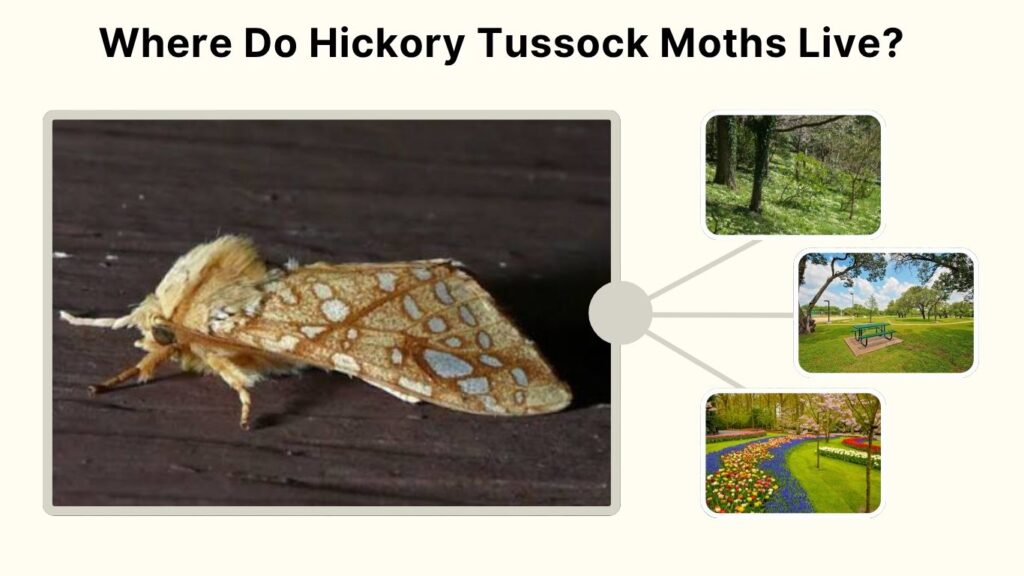
The species occurs across eastern and central North America. Its documented range includes parts of Canada and the United States, extending south and west into areas such as North Carolina, Wisconsin and Texas.
Typical habitats include deciduous forests, woodland edges, parks, gardens, orchards and residential areas with hardwood trees. Mature caterpillars are often noticed on decks, paths, exterior walls and tree trunks when they begin searching for cocoon sites.
Are Hickory Tussock Moths Invasive?
Hickory tussock moths are native to North America and are not considered invasive. Their populations may rise noticeably in certain places and years, but a temporary abundance does not mean the species has been introduced.
They form part of the natural forest community and serve as prey or hosts for predators, parasites and other organisms. Population outbreaks usually decline through natural environmental and biological controls.
Are Hickory Tussock Moths Good or Bad?
A few caterpillars are generally neither dangerous to trees nor a reason for pesticide use. They contribute to native biodiversity, although their irritating hairs make them unwelcome near playgrounds, patios, schools and areas used by pets.
Large groups can remove substantial foliage from young or stressed trees. Healthy established trees usually tolerate one feeding episode, while repeated or severe defoliation may require closer monitoring.
How to Get Rid of Hickory Tussock Caterpillars
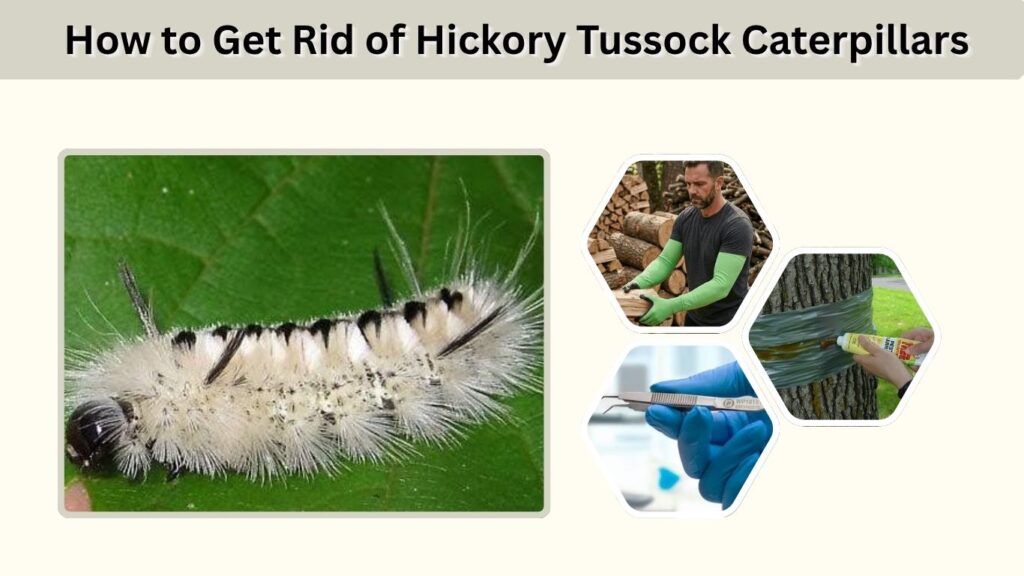
Control is usually unnecessary unless the caterpillars are numerous or gathering in frequently used spaces. Preventing skin contact should be the primary goal.
Safe Control Methods
- Wear gloves, long sleeves and eye protection.
- Use forceps or a long-handled tool rather than your hands.
- Remove leaves containing groups of young caterpillars.
- Place collected caterpillars in a container of soapy water.
- Avoid crushing them because this can scatter irritating hairs.
- Keep children and pets away from infested plants.
- Wear protective clothing while handling leaf litter or firewood.
- Ask a pest-management professional for help with a severe outbreak.
Avoid spraying a mature tree merely because one or two caterpillars are present. When treatment is justified, select a product labeled for caterpillar control on the affected plant and follow its instructions exactly.
FAQs
What does a hickory tussock moth caterpillar turn into?
It becomes the hickory tussock moth, or hickory tiger moth. The adult has pale cream or yellowish wings with brown markings and translucent spots. Its wingspan is approximately 37–55 mm.
Can you touch a hickory tussock caterpillar?
It should not be handled with bare hands. The detachable hairs may cause itching, redness, swelling or a bumpy rash, even though the caterpillar does not have a true stinger.
How long does a hickory tussock moth rash last?
Many mild reactions improve within several hours to about 48 hours. More persistent or severe symptoms should be evaluated by a healthcare professional, particularly when the eyes, mouth or breathing are affected.
Do hickory tussock moth caterpillars make nests?
They do not build large communal silk tents. Young larvae may feed together, while mature individuals create separate cocoons in leaf litter or other protected locations.
Are hickory tussock moth caterpillars bad for trees?
Large groups can defoliate branches and occasionally entire trees. However, serious forest damage is uncommon, and healthy mature trees generally recover from a single period of feeding.