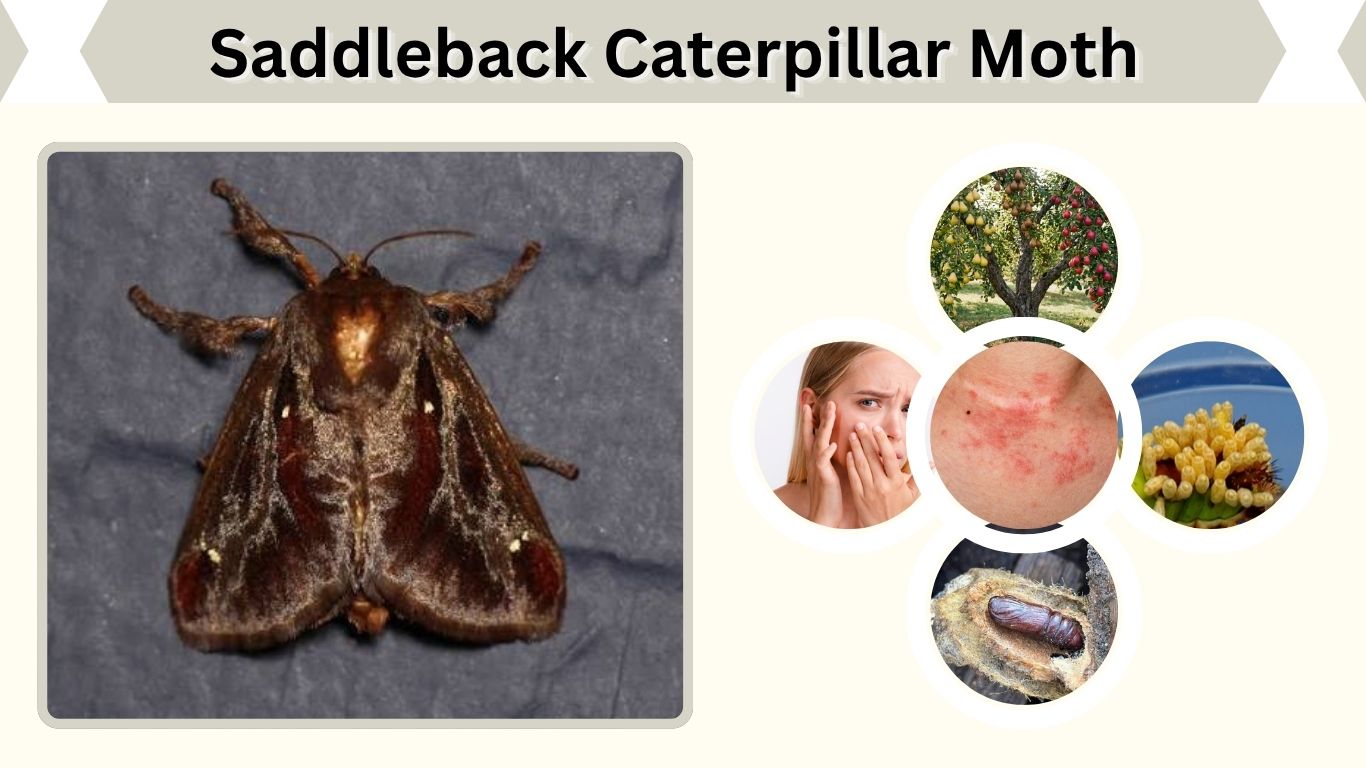
The saddleback caterpillar moth (Acharia stimulea) is best known for its brightly colored and venomous caterpillar stage. The larva has a vivid green “saddle” on its back, surrounded by sharp spines that can deliver an intensely painful sting. After pupation, it becomes a small, dark-brown moth that looks completely different and does not have the caterpillar’s stinging defenses. This species occurs widely across the eastern United States and feeds on many trees, shrubs, flowers, and food crops.
What Is a Saddleback Caterpillar Moth?
The saddleback caterpillar moth belongs to the slug moth family, Limacodidae. Its scientific name is Acharia stimulea, although older sources may call it Sibine stimulea. The name “saddleback” comes from the larva’s unusual green-and-brown marking, which resembles a saddle and saddle blanket.
Caterpillar and Adult Moth Differences
The caterpillar is the most recognizable—and dangerous—stage. It has a compact, slug-like body covered with venomous spines. The adult moth is dark brown, furry-looking, winged, and much less noticeable.
| Feature | Caterpillar | Adult Moth |
| Main color | Green and brown | Dark chocolate brown |
| Size | Up to about 20 mm long | Wingspan of 26–43 mm |
| Defensive structure | Venomous spines | No venomous larval spines |
| Main activity | Feeding on plants | Mating and laying eggs |
| Risk to people | Can cause a painful sting | Not considered a stinging moth |
The caterpillar’s unusual appearance serves as a warning to predators. Its adult form has glossy brown wings, black shading, small white spots and paler brown hindwings. Females are normally larger than males.
Saddleback Caterpillar Identification
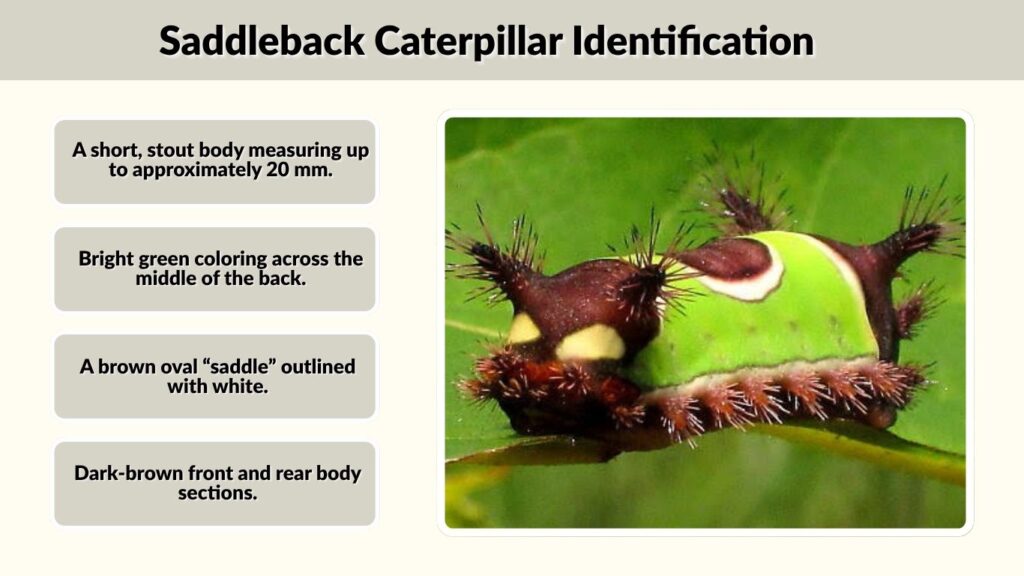
A mature saddleback caterpillar is difficult to confuse with most other species. However, young larvae may not yet display the complete saddle pattern, so people should avoid touching any unfamiliar spiny caterpillar.
Key Identification Features
- A short, stout body measuring up to approximately 20 mm
- Bright green coloring across the middle of the back
- A brown oval “saddle” outlined with white
- Dark-brown front and rear body sections
- Four prominent fleshy horns near the front and back
- Smaller clusters of spines along both sides
- A smooth, gliding movement similar to a slug
The large fleshy projections carry many hollow, easily detached spines. Young caterpillars are only around 1.2 mm when they hatch. As they grow, their green saddle marking, brown ends and defensive spines become increasingly noticeable.
Is the Saddleback Caterpillar Moth Poisonous?
The caterpillar is more accurately described as venomous rather than poisonous. It does not inject venom by biting. Instead, its sharp spines penetrate the skin when someone brushes against or handles it.
How the Sting Happens
The spines can break away from the caterpillar and remain embedded in the skin. Venom associated with these hollow spines causes irritation and tissue inflammation. More spines in the skin can result in a more painful reaction.
The bright colors act as a warning signal. Unfortunately, the caterpillar may be hidden beneath a leaf, causing gardeners to touch it accidentally while trimming or handling plants.
Can the Adult Saddleback Moth Sting?
The painful sting is associated with the caterpillar stage, not the adult moth. Once the insect completes metamorphosis, it emerges as a small brown moth without the caterpillar’s venomous horns and spines. The adult does not possess a wasp-like stinger and is not known for biting people.
However, an abandoned cocoon should still be handled carefully. Saddleback caterpillars may incorporate irritating spines into the cocoon’s silk, creating a contact risk even after the larva has pupated.
Saddleback Moth Caterpillar Sting Symptoms
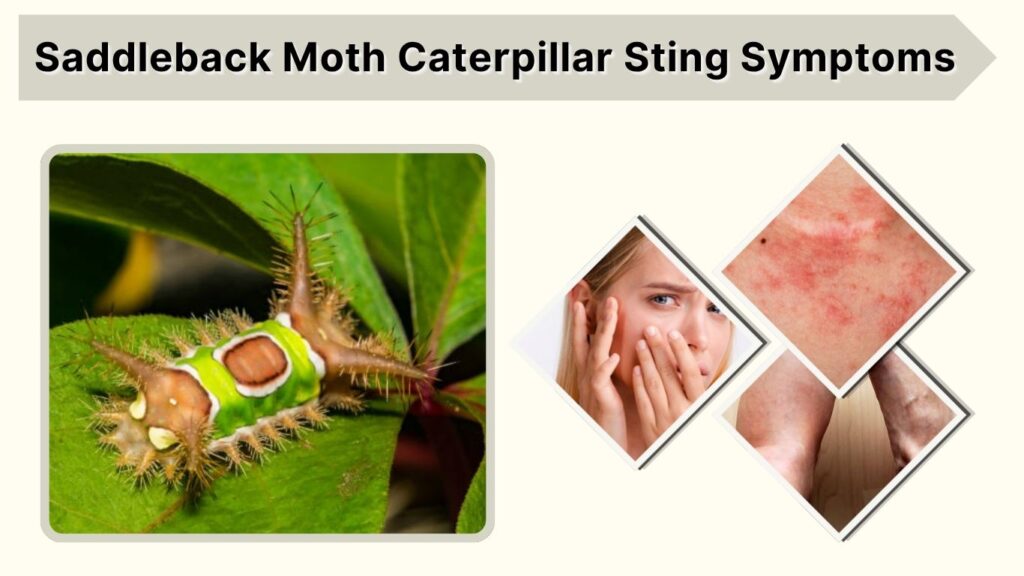
A saddleback sting usually causes an immediate burning or stinging sensation. The reaction may be limited to the contact area, although sensitivity varies among individuals.
Common Symptoms
- Sharp or intense burning pain
- Redness around the contact area
- Swelling and inflammation
- Itching or raised welts
- Red or pale patches on the skin
- Small blisters
- Tenderness lasting several hours
In less common cases, a person may experience headache, nausea, widespread hives or other systemic symptoms. Serious allergic reactions can involve difficulty breathing or swallowing and require emergency medical care.
Saddleback Caterpillar Sting Treatment
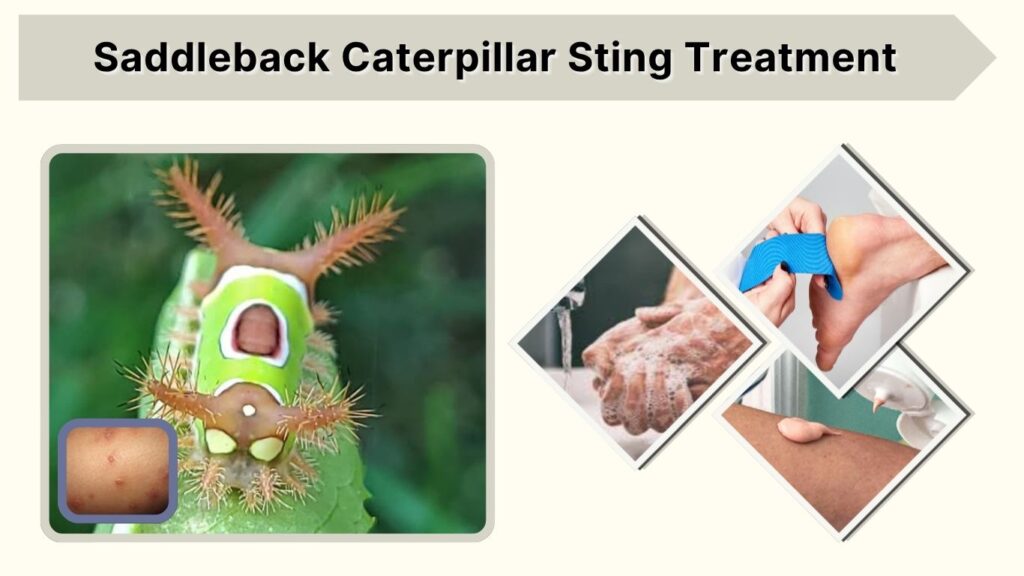
Treatment should begin by removing the embedded spines as soon as possible. Rubbing or scratching the area can push them farther into the skin and spread the irritation.
What to Do After Being Stung
- Move away from the caterpillar without touching it again.
- Place adhesive tape over the affected skin.
- Lift the tape away to remove loose spines.
- Repeat using fresh tape several times.
- Gently wash the skin with soap and water.
- Apply a cold compress to help reduce pain and swelling.
- Consider hydrocortisone cream for persistent itching, following the product directions.
Poison Control recommends removing the hairs or spines with tape before washing the affected area. Contact a healthcare professional if severe blistering develops, the pain continues to worsen or symptoms extend beyond the sting site.
Emergency assistance is necessary if the affected person develops breathing difficulty, facial or throat swelling, trouble swallowing, dizziness or signs of a severe allergic reaction.
Saddleback Caterpillar Moth Life Cycle
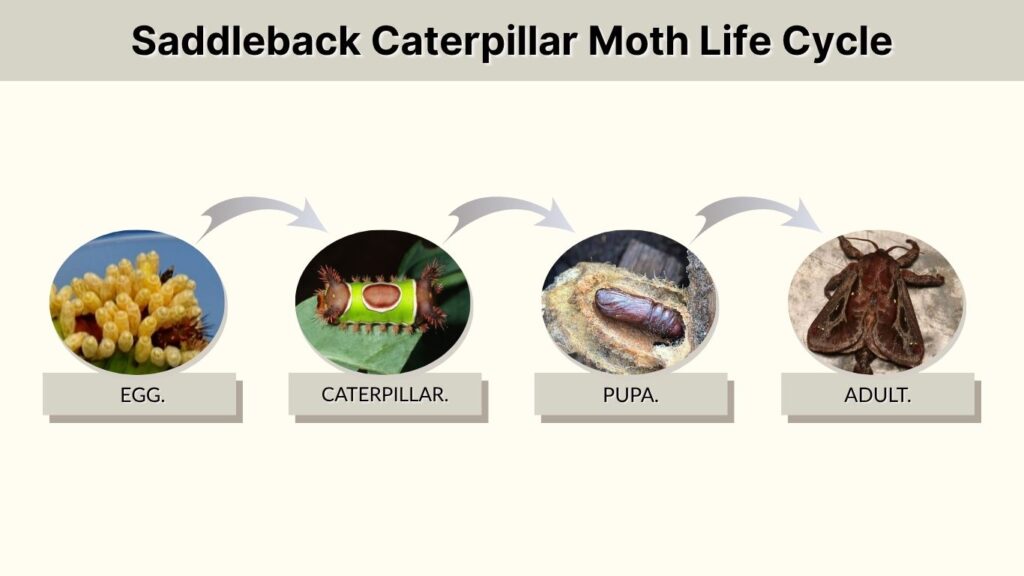
The saddleback moth undergoes complete metamorphosis through four stages: egg, larva, pupa and adult. Its appearance changes dramatically during this process.
1. Egg Stage
Female moths lay irregular clusters of approximately 30–50 eggs on the upper surface of host-plant leaves. The small, flattened eggs are yellowish and partly transparent. They normally hatch after about ten days.
2. Caterpillar Stage
Young caterpillars may initially feed together on the same leaf. As they grow, they develop the characteristic green saddle and stronger spines. Later-stage larvae can eat large sections of a leaf, including its veins.
Larval growth may continue for approximately four to five months. Mature caterpillars reach about 20 mm long before preparing to pupate.
3. Pupal Stage
The caterpillar spins a small, compact silk cocoon. The cocoon becomes hardened and protects the pupa inside. In temperate regions, the species can spend winter in this stage.
4. Adult Moth Stage
The adult exits through a circular opening in the cocoon. In northeastern areas, adults are often observed during June and July, although emergence can occur earlier in warmer climates. The moths mate, and females begin the next generation by laying eggs on suitable plants.
Habitat and Host Plants
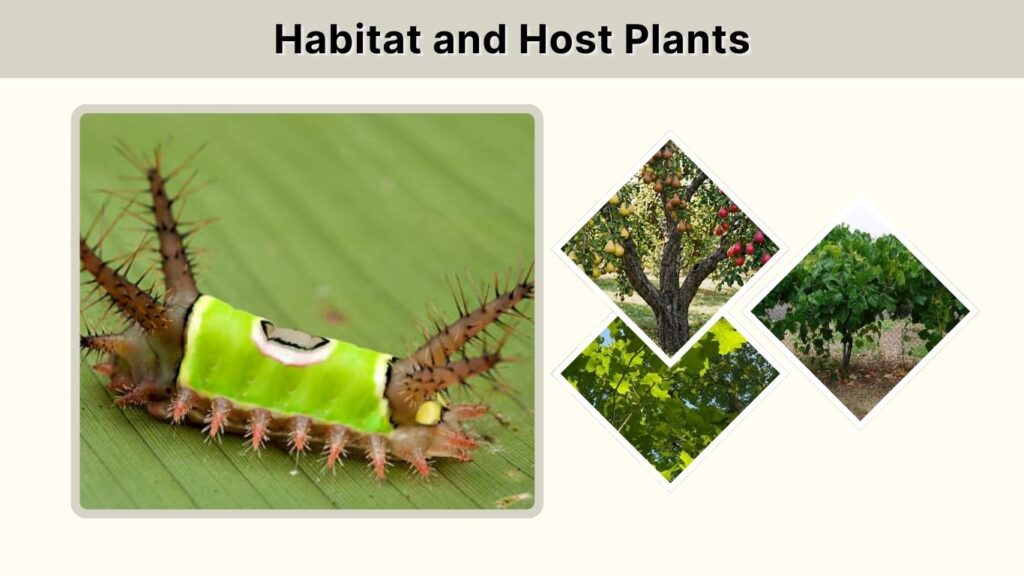
Saddleback caterpillars inhabit gardens, woodland edges, orchards, parks and landscaped areas. Their range extends through much of the eastern United States, from parts of New England south to Florida and west toward Texas and the central states.
Plants They May Feed On
These caterpillars are generalist feeders and may appear on:
- Maple and oak trees
- Apple, cherry and pear trees
- Blueberry and grape plants
- Corn and sunflower
- Hibiscus and hydrangea
- Dogwood and elm
- Crape myrtle
- Citrus trees
- Roses and gardenias
- Several species of palms
Because they feed on so many plants, finding one on a particular plant is not enough to identify it. Its saddle-shaped marking and clusters of spines are much more reliable identification features.
How to Remove Saddleback Caterpillars Safely
A small number of caterpillars rarely causes major plant damage, so removal is mainly important for preventing accidental contact.
Wear thick gloves, long sleeves, long pants and closed shoes when working around affected plants. Use long-handled forceps or pruning tools to remove caterpillars, leaves or cocoons without touching them. Place collected material inside a sealed container or bag.
Do not crush the caterpillars with bare hands. Detached spines may remain on tools, furniture, clothing or other surfaces and cause a later sting. Clean tools and wash protective clothing after working in an infested area.
FAQs
What does a saddleback caterpillar turn into?
It turns into the saddleback caterpillar moth, Acharia stimulea. The adult is a small, dark-brown slug moth with a wingspan of approximately 26–43 mm. It looks very different from the bright green, spiny caterpillar.
Does a saddleback caterpillar bite?
No. It does not bite people. Pain occurs when its venomous spines penetrate the skin after physical contact. Even light brushing against the caterpillar can break spines and leave them embedded.
Does the saddleback moth sting after transforming?
No. The adult moth does not retain the caterpillar’s venomous spines. However, its old cocoon may contain irritating larval spines, so avoid handling cocoons with unprotected hands.
How painful is a saddleback caterpillar sting?
The sting can produce immediate, intense burning along with redness, swelling and itching. Pain severity depends on individual sensitivity and how many spines entered the skin. Most reactions remain localized, but severe symptoms require medical attention.
Are saddleback caterpillars dangerous to pets?
The spines can irritate a pet’s nose, mouth, paws or skin if contact occurs. Contact a veterinarian promptly if a pet mouths the caterpillar, develops facial swelling, drools excessively, vomits or has difficulty breathing.