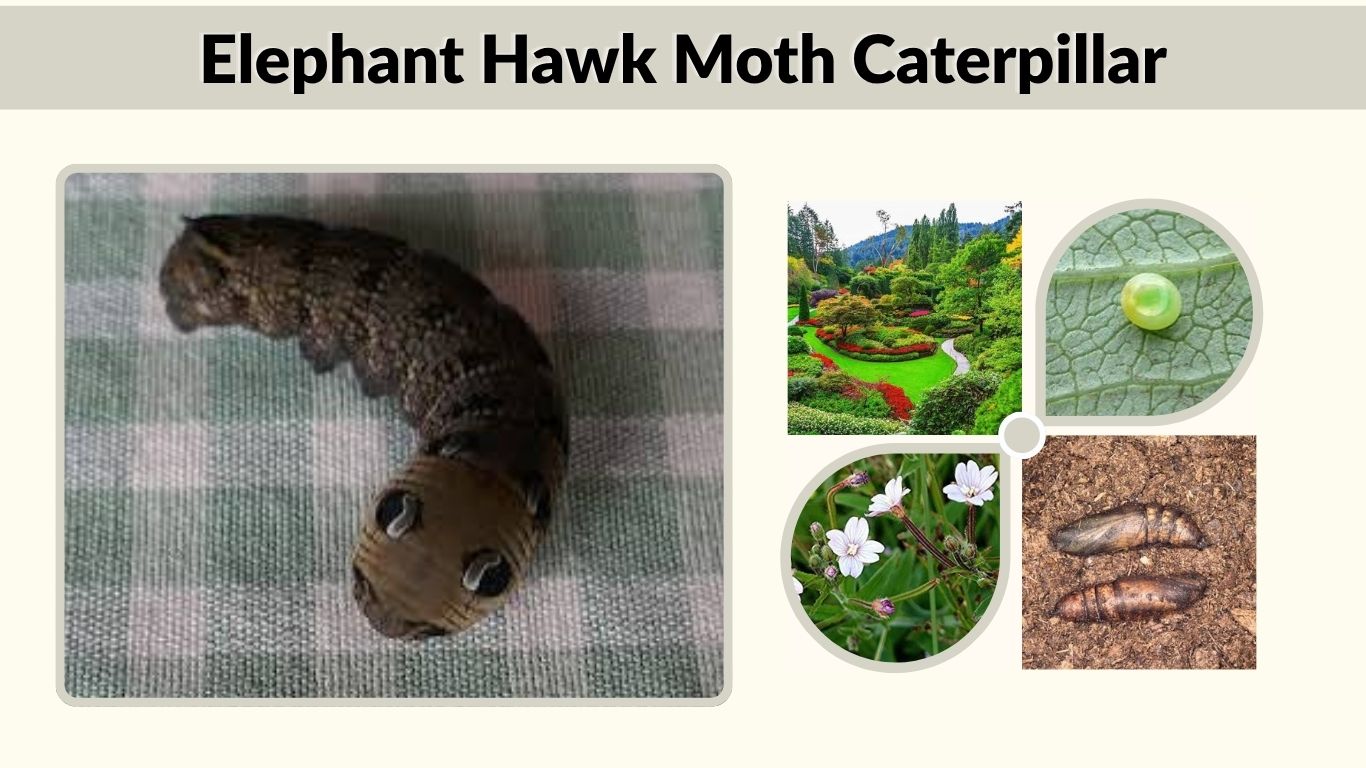
The elephant hawk moth caterpillar is one of the largest and most distinctive caterpillars found in British and European gardens. Its thick body, oversized false eyes, and snake-like defensive pose can look alarming, but this unusual caterpillar is generally harmless. Scientifically known as Deilephila elpenor, it eventually transforms into a beautiful olive-green and pink moth. Here is everything you need to know about its appearance, diet, habitat, safety, care, and life cycle.
Elephant Hawk Moth Caterpillar Identification
Young elephant hawk moth caterpillars may be difficult to recognize because they are smaller, greener, and less dramatic than mature larvae. As they grow, their bodies become thicker and their identifying markings become much clearer.
Key Identification Features
- Large, smooth body without dense hair
- Green, grayish-green, brown, or nearly black coloration
- Two pairs of prominent black-and-pink eyespots
- Narrow head and front section resembling an elephant’s trunk
- Small, curved horn at the rear
- Snake-like posture when disturbed
- Fine spots and lines covering the body
The caterpillar’s actual head is small and positioned in front of its false eyes. The large markings that look like eyes are located farther back on the body and are used to confuse predators.
Elephant Hawk Moth Caterpillar Size
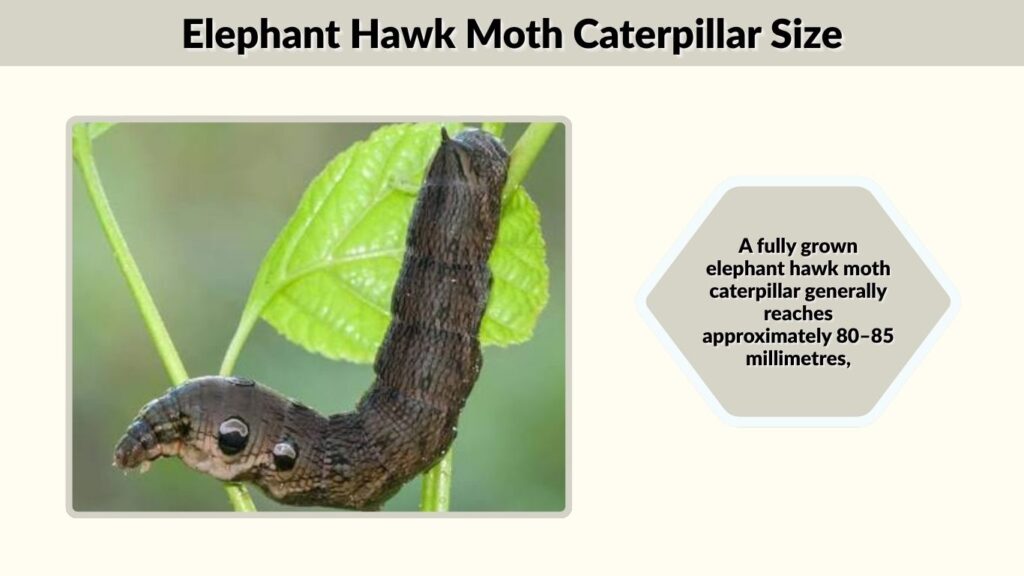
A fully grown elephant hawk moth caterpillar generally reaches approximately 80–85 millimetres, or slightly more than 3 inches, in length. Its thick body can make it appear even larger, especially when it pulls in its head and expands the front segments.
| Feature | Description |
| Mature length | Approximately 80–85 mm |
| Main colors | Green, gray-green, brown or dark brown |
| Body surface | Smooth and finely patterned |
| False eyes | Two large pairs near the front |
| Tail horn | Small and usually dark |
| Active period | Mainly late summer and early autumn |
Green caterpillars are often younger, although mature individuals can also remain green. Many become brown or dark gray before they leave their food plant to pupate.
Why Does It Look Like a Snake?
The elephant hawk moth caterpillar uses mimicry as protection. When threatened, it retracts its small head into the thicker front section of its body. This makes the area containing its false eyes swell and resemble the head of a small snake.
The sudden transformation can discourage birds and other predators that might otherwise attack it. The eyespots do not provide vision; they are simply markings designed to make the caterpillar look larger and more dangerous.
The narrow front of its body also resembles an elephant’s trunk when extended, which explains the insect’s common name.
What Do Elephant Hawk Moth Caterpillars Eat?
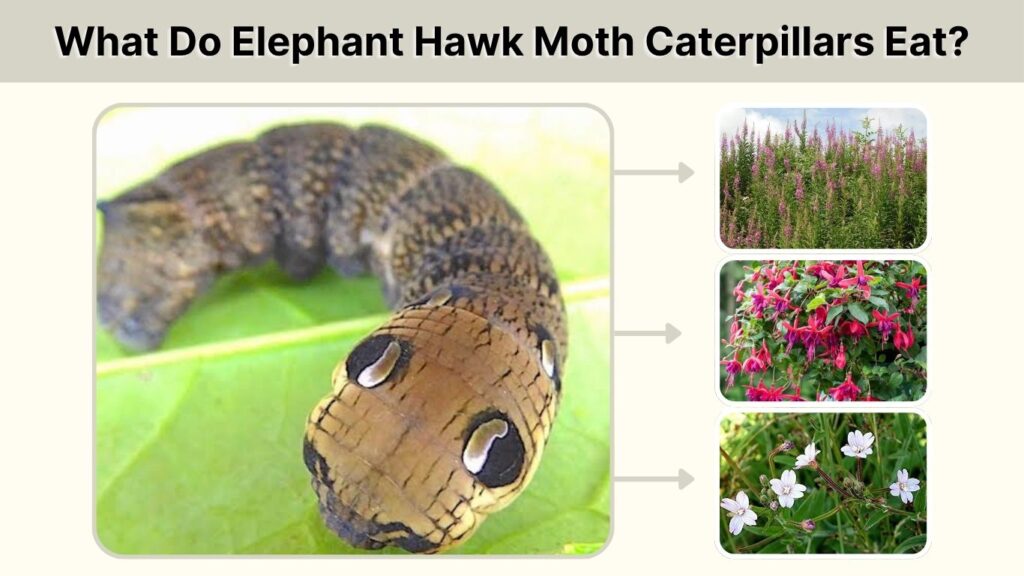
Elephant hawk moth caterpillars eat leaves rather than other insects. Rosebay willowherb is one of their most important wild food plants, but they can survive on several related garden and wild plants.
Common Food Plants
- Rosebay willowherb
- Other willowherb species
- Fuchsia
- Bedstraw
- Himalayan balsam
- Enchanter’s nightshade
Fuchsia is the plant on which these caterpillars are most commonly discovered in gardens. They usually feed during the night and rest among stems, fallen leaves, or vegetation during daylight hours.
Although a large caterpillar can eat several leaves, serious or widespread damage to healthy garden plants is uncommon. Chemical control is therefore unnecessary in most situations.
Habitat and Distribution
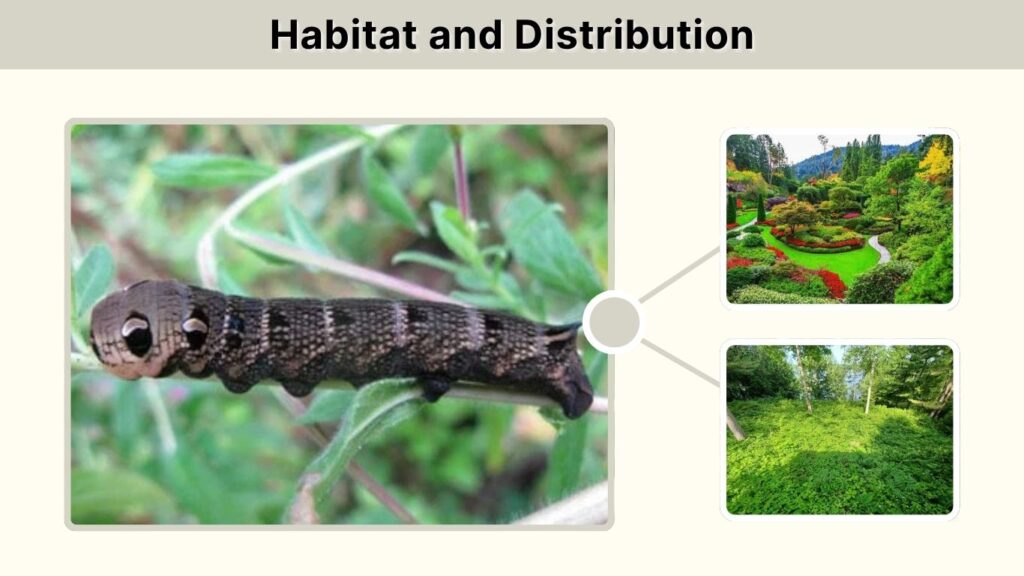
Elephant hawk moth caterpillars live wherever suitable food plants grow. They are particularly associated with damp or disturbed places containing willowherb, but they readily use gardens containing fuchsias.
Typical habitats include:
- Gardens and parks
- Woodland edges and clearings
- Hedgerows
- Rough grassland
- Waste ground
- Heathland
- Sand dunes
- Roadsides and railway banks
The species is widely distributed across England, Wales and Ireland, while its Scottish distribution is thinner. Its broader natural range extends across much of Europe and Asia.
Reports from places such as Texas or Australia should be checked carefully. Several unrelated hawk moth caterpillars have similar eyespots and tail horns and can easily be mistaken for Deilephila elpenor.
Is the Elephant Hawk Moth Caterpillar Poisonous?
The elephant hawk moth caterpillar is not a stinging caterpillar. Its tail horn may look sharp, but it is not a stinger, and the false eyes are only defensive markings.
It does not have the irritating hairs commonly associated with caterpillars such as oak processionary moth larvae. The Royal Horticultural Society advises that caterpillars may be moved by hand to an appropriate wild food plant when necessary, supporting the view that normal contact presents little risk.
Nevertheless, avoid unnecessary handling. Caterpillars are delicate, and oils or pressure from human hands can injure them.
Is It Poisonous to Dogs or Cats?
Elephant hawk moth caterpillars are not generally recognized as venomous to dogs or cats. However, pets should not be encouraged to bite or swallow any caterpillar. The insect, plant material, pesticides, or soil attached to it could cause drooling, vomiting, or digestive irritation.
Contact a veterinarian if a pet develops swelling, repeated vomiting, breathing difficulty, severe drooling, weakness, or unusual behaviour after putting a caterpillar in its mouth.
Elephant Hawk Moth Caterpillar Life Cycle
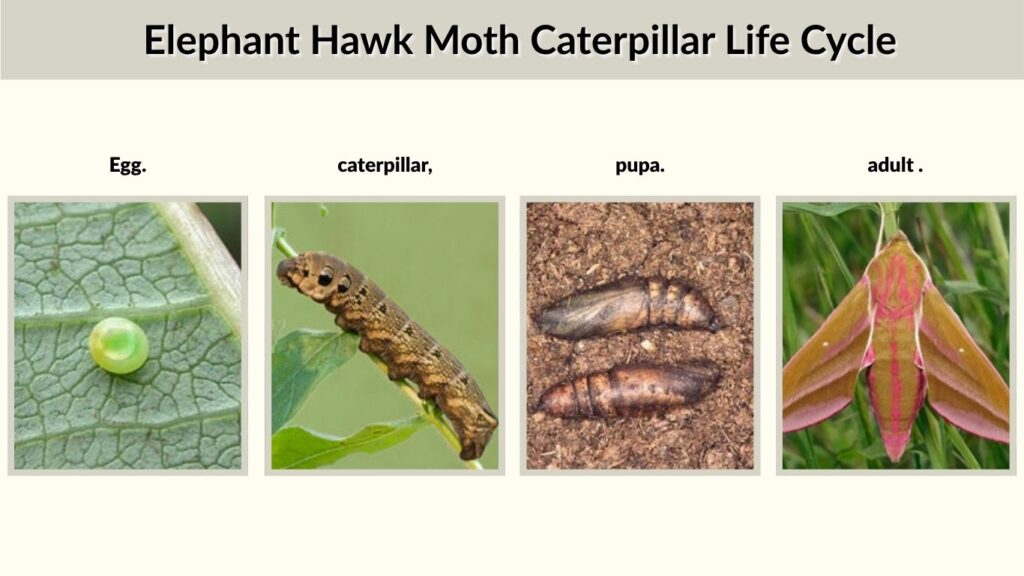
The elephant hawk moth undergoes complete metamorphosis through four main stages: egg, caterpillar, pupa and adult moth.
1. Egg
A female moth places her eggs on suitable food plants. The newly hatched larvae begin eating nearby leaves and grow through several developmental stages.
2. Caterpillar
The caterpillar feeds and sheds its skin repeatedly as it grows. Caterpillars are most frequently noticed from July to September, particularly when mature individuals begin travelling across paths and lawns.
3. Pupa and Cocoon
Once fully fed, the caterpillar leaves its plant and searches for a protected location. It forms a fragile cocoon among dry leaves, plant debris, or just beneath the soil surface. Inside this shelter, it changes into a pupa, sometimes casually called a chrysalis.
The species normally spends winter in the pupal stage.
4. Adult Moth
The adult usually emerges during late spring or early summer. It is an attractive moth with olive-green forewings, bright pink bars, and pink markings along its body. Adults are active around dusk and visit tubular flowers such as honeysuckle for nectar.
How to Care for a Found Caterpillar
The safest option is usually to leave the caterpillar where it was found. When it must be moved away from a road, doorway, pet, or other danger, place it beneath nearby vegetation or on a known food plant.
Simple Care Guidelines
- Handle it as little as possible.
- Move it using a leaf rather than squeezing its body.
- Place a feeding caterpillar on willowherb, fuchsia or bedstraw.
- Do not offer unfamiliar leaves or household food.
- Never place it in direct sunlight inside a container.
- Do not provide an open water dish, as caterpillars obtain moisture from leaves.
- Allow a wandering mature caterpillar access to dry leaf litter and loose soil.
A large caterpillar walking on the ground may no longer be hungry. It is often searching for a safe place to pupate, so repeatedly returning it to a food plant may interrupt its natural behaviour.
FAQs
Can an elephant hawk moth caterpillar sting?
No. The small horn at the end of its body is not a stinger. The caterpillar has no venomous spine and relies on snake mimicry, false eyes, and body swelling to frighten predators.
What does an elephant hawk moth caterpillar turn into?
It becomes an elephant hawk moth, a medium-sized nocturnal moth with striking olive-green and pink wings. The adult usually emerges after the pupa has spent winter hidden in soil or loose plant litter.
Why is the caterpillar walking across my garden?
A large caterpillar walking away from plants is probably fully grown and searching for a protected pupation site. It may cross paths, lawns and patios while looking for loose soil or dry leaf litter.
Are green and brown elephant hawk moth caterpillars the same species?
Yes. The caterpillars occur in green, gray-green, brown and very dark forms. Their large eyespots, tapered front section, smooth body and small rear horn are more reliable identification features than color alone.
Are elephant hawk moth caterpillars rare?
They are considered common and widespread in much of Britain, although their local abundance depends on habitat and food plants. They can be overlooked because they feed mainly at night and remain hidden during the day.