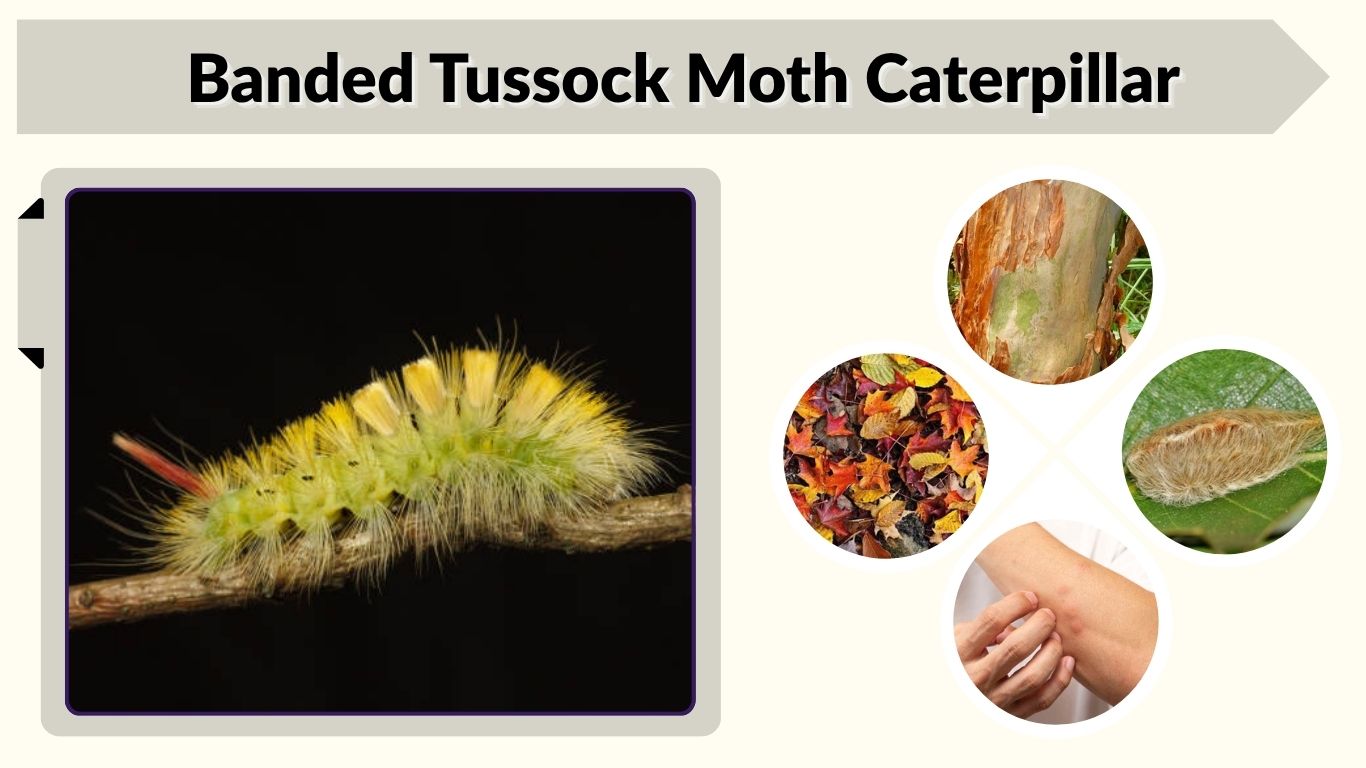
The banded tussock moth caterpillar is a fuzzy, pale-colored larva commonly seen on hardwood trees, fences, sidewalks, decks, and outdoor furniture. Its long hairs and contrasting black tufts give it a striking appearance, but they also make many people wonder whether it is poisonous or dangerous.
This caterpillar does not have a true stinger and is not considered dangerously venomous. However, its hairs may irritate sensitive skin and cause redness, itching, or a localized rash. Avoiding direct handling is therefore the safest approach. Here is how to identify a banded tussock moth caterpillar, understand its life cycle, and respond to accidental contact.
What Is a Banded Tussock Moth Caterpillar?
The banded tussock moth caterpillar is the larval stage of Halysidota tessellaris. The species is also commonly called the pale tiger moth or tessellated halisidota.
Despite its common name, it belongs to the tiger moth group within the family Erebidae. The term “tussock” refers to the distinctive tufts or clusters of hair found on the caterpillar’s body.
Banded tussock moth caterpillars are native to North America. They feed on a broad range of deciduous trees and are generally regarded as part of the natural woodland ecosystem rather than serious garden pests. Missouri conservation authorities describe them as caterpillars that consume the foliage of many hardwood tree species.
Banded Tussock Moth Caterpillar Identification
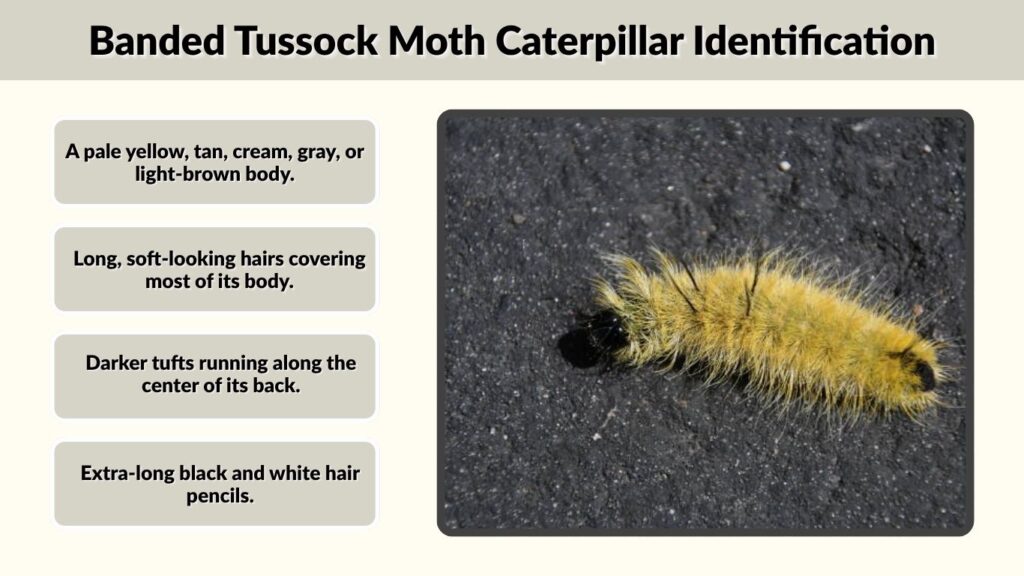
The caterpillar’s long hairs are its most noticeable feature. Its exact color varies, so identification should be based on several characteristics rather than color alone.
Main identification features
A mature banded tussock moth caterpillar usually has:
- A pale yellow, tan, cream, gray, or light-brown body
- Long, soft-looking hairs covering most of its body
- Darker tufts running along the center of its back
- Extra-long black and white hair pencils
- A dark brown or black head
- A body measuring approximately 1 to 1½ inches long
- A slender body hidden beneath dense hairs
The long hairs at the front and rear may project well beyond the body. These structures are sometimes described as lashes, pencils, tussocks, or tufts.
Young caterpillars are smaller and may not show the dramatic hair arrangement of mature larvae. As they grow and molt, their hairs become longer and their markings become more noticeable.
Yellow and white caterpillars
Some individuals appear distinctly yellow, while others are almost white or pale gray. A “white banded tussock moth caterpillar” is usually a light-colored variation rather than a different species.
Lighting, age, wear, and natural variation can all affect the caterpillar’s appearance. Identification is easier when its hair pencils, dark dorsal tufts, head color, location, and host plant are considered together.
Is the Banded Tussock Moth Caterpillar Dangerous?
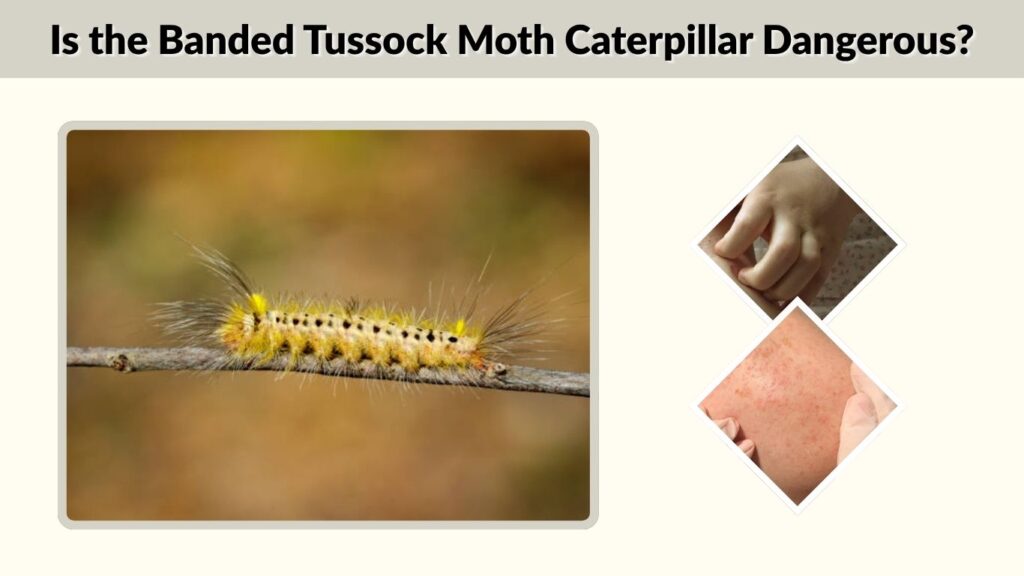
The banded tussock moth caterpillar is not considered highly dangerous to people. It does not aggressively attack, chase, or intentionally sting humans.
Its defensive hairs can nevertheless create a problem. When the caterpillar is touched, some hairs may break away and become lodged in the skin. Sensitive individuals may develop irritation ranging from mild itching to a more noticeable rash.
The University of Maine Extension notes that hairs from many tussock caterpillars, including the banded tussock moth caterpillar, may cause an itchy rash.
The risk is generally greater for:
- Children with sensitive skin
- People with existing skin allergies
- Anyone who handles the caterpillar repeatedly
- People who rub their eyes after contact
- Pets that mouth or chew fuzzy caterpillars
Observing one from a short distance is safe. Problems usually occur only after direct contact with its hairs.
Are Banded Tussock Moth Caterpillars Poisonous?
Banded tussock moth caterpillars are often described online as poisonous, but that term can be misleading.
A poisonous animal harms another animal when it is eaten or touched because toxic substances are present in its tissues. A venomous animal injects toxins through structures such as fangs, spines, or stingers.
The banded tussock moth caterpillar does not possess a venom-injecting stinger. Its hairs act mainly as a physical defense and may irritate the skin. For humans, it is more accurate to describe the caterpillar as potentially irritating rather than dangerously poisonous.
This does not mean it should be handled. Even nonvenomous hairs can create considerable discomfort in someone who is sensitive to them.
Do Banded Tussock Moth Caterpillars Sting?
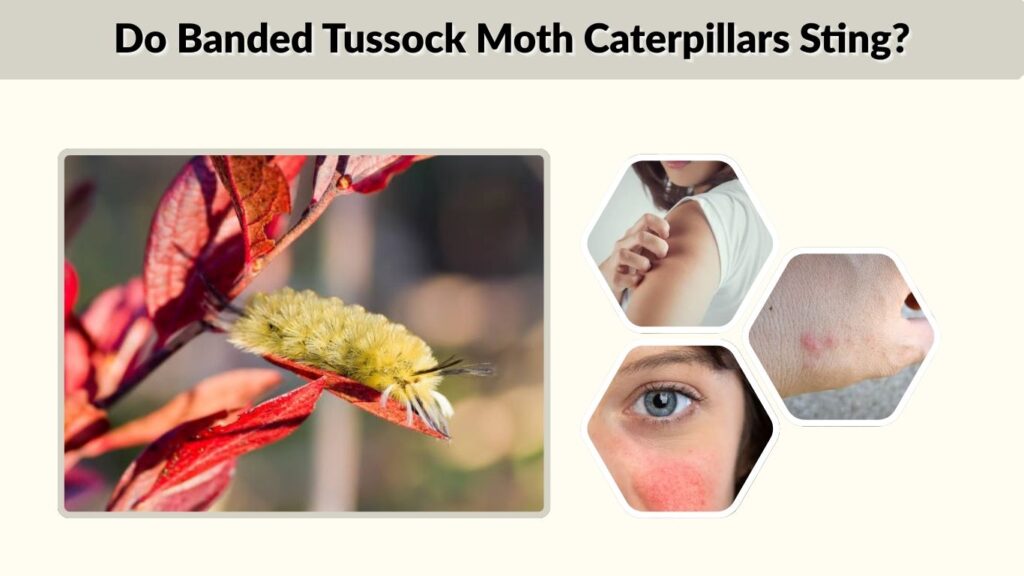
They do not sting in the same way as bees, wasps, or medically significant stinging caterpillars. They have no stinger and do not deliberately inject venom.
People sometimes describe contact as a sting because the hairs may create an immediate prickling, burning, or itching sensation.
Possible symptoms include:
- Redness
- Mild swelling
- Itchy bumps
- Burning or tingling
- A localized rash
- Skin tenderness
The severity of the reaction depends on the number of hairs involved, the contact area, and the individual’s sensitivity.
The caterpillar also does not normally bite people. Although it has mouthparts for chewing leaves, it is not adapted to bite humans defensively.
Can You Touch a Banded Tussock Moth Caterpillar?
You should avoid touching it with bare skin. A person may handle one without developing symptoms, but another person may experience itching or a rash from the same type of contact.
Teach children not to pick up fuzzy or brightly marked caterpillars. Their attractive appearance can make them tempting to touch.
To relocate one safely:
- Put on gardening gloves.
- Place a leaf, twig, or piece of cardboard in front of it.
- Allow the caterpillar to crawl onto the object.
- Move it to a nearby hardwood tree or sheltered area.
- Wash your hands afterward.
Avoid squeezing or brushing the caterpillar because this may release more hairs.
Banded Tussock Moth Caterpillar Rash
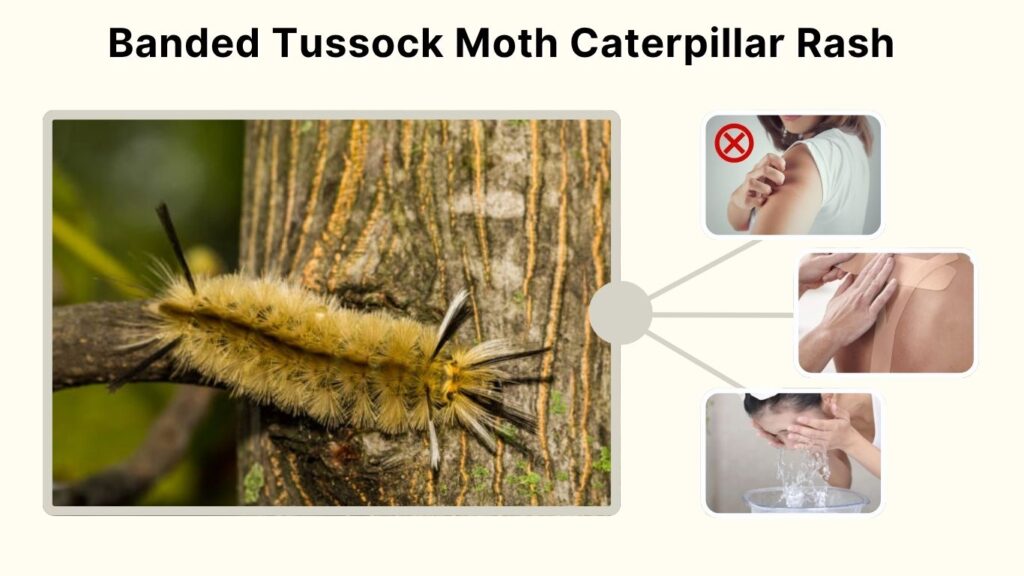
A rash generally develops where the hairs contact the skin. It may appear within minutes, although some reactions become noticeable later.
Common symptoms include small red bumps, itching, burning, warmth, or mild swelling. The affected area may resemble contact dermatitis or another minor insect-related rash.
Rash treatment
After accidental contact:
- Do not rub or scratch the area.
- Press adhesive tape gently onto the skin.
- Lift the tape away to remove loose hairs.
- Repeat with clean tape as necessary.
- Wash the area with soap and cool water.
- Apply a cold compress for 10 to 15 minutes.
An over-the-counter hydrocortisone cream or oral antihistamine may help relieve itching when used according to its directions and personal medical guidance.
Seek professional care if the rash is severe, continues spreading, affects the eyes or mouth, or does not improve. Breathing difficulty, facial swelling, dizziness, or widespread hives require urgent medical attention.
What Do Banded Tussock Moth Caterpillars Eat?
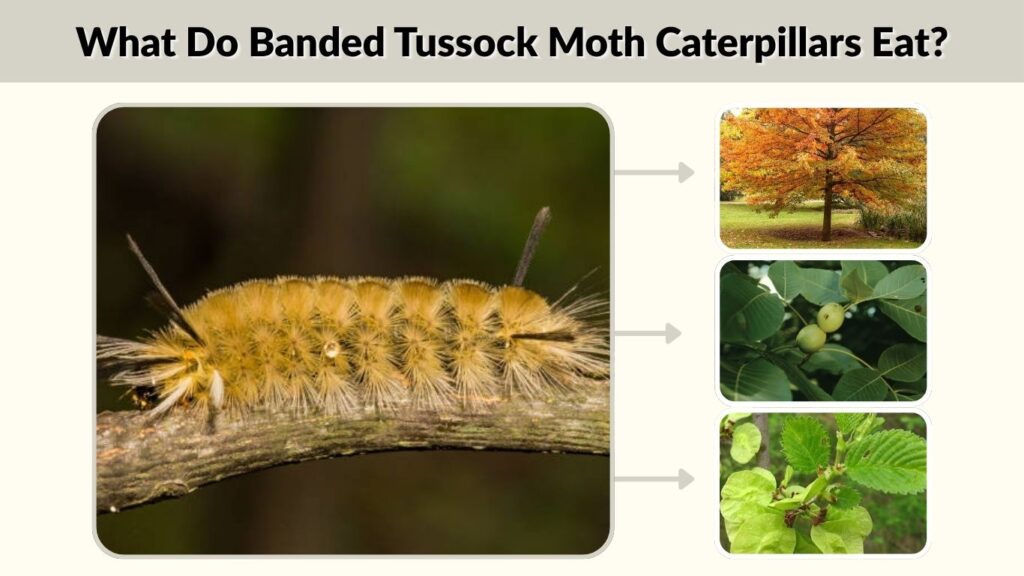
These caterpillars are generalist herbivores. That means they can feed on many host plants rather than depending on a single tree species.
Common host plants include:
- Oak
- Birch
- Ash
- Elm
- Hickory
- Walnut
- Willow
- Poplar
- Alder
- Hazel
- Hackberry
- Tulip tree
- Grape
They mainly consume leaves. Young larvae may feed near one another, while older caterpillars often wander and feed alone.
| Caterpillar stage | Main food | Typical behavior |
|---|---|---|
| Newly hatched larva | Soft leaf surfaces | May feed near siblings |
| Growing larva | Deciduous tree leaves | Eats increasing amounts of foliage |
| Mature larva | Leaves from multiple host plants | Often feeds alone and wanders |
| Adult moth | Nectar or little food | Focuses mainly on mating and reproduction |
Healthy, mature trees can usually tolerate their feeding. Banded tussock moth caterpillars rarely cause the widespread damage associated with major forest pests.
Banded Tussock Moth Caterpillar Life Cycle
The species undergoes complete metamorphosis, passing through egg, caterpillar, pupa, and adult stages.
Egg stage
An adult female lays eggs on or near an appropriate host plant. The eggs hatch into small larvae that begin feeding on foliage.
Caterpillar stage
The caterpillar grows through several instars. An instar is the period between molts. Its hairs become longer and more developed after each molt.
The caterpillars are often most visible during summer and early fall, although timing varies with climate and geographic location.
Cocoon and pupal stage
A mature caterpillar stops feeding and searches for a protected pupation site. It produces silk and forms a loose cocoon, often among bark, leaves, wood crevices, or sheltered structures.
Some of the caterpillar’s own hairs may be incorporated into the cocoon. For this reason, an abandoned-looking cocoon may still irritate the skin and should not be handled without gloves.
Inside the cocoon, the caterpillar transforms into a pupa. In colder regions, the species may spend winter in this stage.
Adult moth stage
The adult moth emerges from the cocoon when conditions are suitable. It has pale tan or cream-colored wings crossed by darker, wavy bands that create a checkered appearance.
Adults are primarily active at night and may visit lights or flowers. After mating, females lay eggs and begin the next generation.
Banded Tussock Moth Caterpillar Cocoon
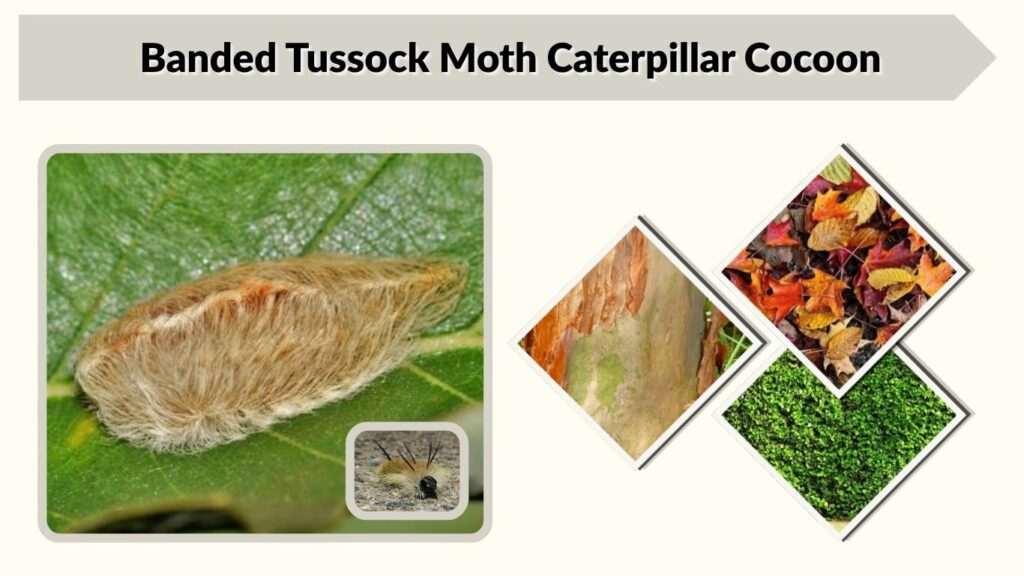
The cocoon is usually thin, loose, and somewhat untidy rather than smooth and tightly sealed. It consists of silk mixed with caterpillar hairs and nearby material.
Cocoons may be found:
- Under loose bark
- Inside leaf litter
- Between boards
- On fences
- In protected building crevices
- Among dried leaves
- Beneath outdoor furniture
Do not open a cocoon to see what is inside. Disturbing it can injure the developing moth and expose the skin to embedded hairs.
Can You Raise a Banded Tussock Moth Caterpillar?
It is possible to raise one temporarily for observation, but it requires proper ventilation, fresh host leaves, careful cleaning, and minimal handling.
A suitable enclosure should contain:
- A ventilated lid
- Fresh leaves from the plant on which it was found
- A twig for climbing
- Dry paper lining
- Space for cocoon construction
Replace wilted leaves regularly and remove droppings to reduce mold. Never place the enclosure in direct sunlight, where it may overheat rapidly.
Use gloves or tools when cleaning the container. Once the adult emerges and its wings have expanded, release it near the original collection location.
Wild caterpillars should generally be left outdoors unless they are being raised for a specific educational purpose.
Similar Tussock Moth Caterpillars
Several fuzzy caterpillars may be mistaken for Halysidota tessellaris.
| Species | Main appearance | Key distinction |
|---|---|---|
| Banded tussock moth | Pale tan or yellow with black and white hair pencils | Dark central tufts and long end hairs |
| Hickory tussock moth | Mostly white with bold black markings | Stronger black-and-white contrast |
| Sycamore tussock moth | Pale yellow or cream and very hairy | Often associated with sycamore trees |
| White-marked tussock moth | Four cream back tufts and a red head | Distinct rectangular dorsal brushes |
| Banded woolly bear | Black ends with a brown central band | Short, dense bristles rather than long pencils |
Some tussock moth species possess hairs that are more irritating than those of the banded tussock moth. Avoid handling any unidentified fuzzy caterpillar.
Are Banded Tussock Moth Caterpillars Good or Bad?
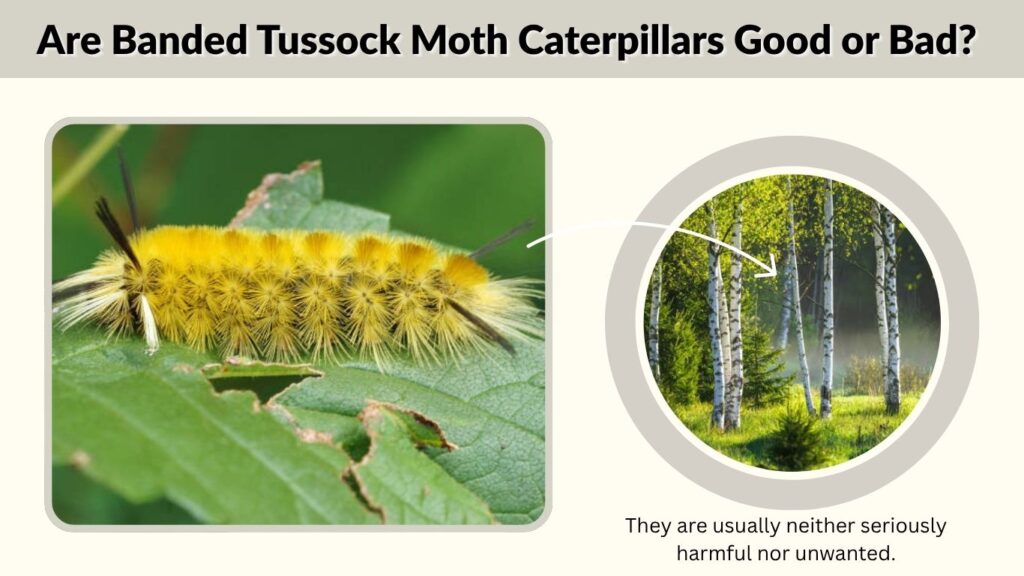
They are usually neither seriously harmful nor unwanted. They play a normal ecological role by feeding on plants and becoming prey for birds, insects, spiders, and other animals.
A few caterpillars on a mature tree typically require no treatment. Hand relocation is usually sufficient when one appears on a young ornamental plant.
Pesticide treatment is rarely justified for isolated individuals. Unnecessary insecticide use may kill beneficial insects and other harmless caterpillars.
FAQs
What does a banded tussock moth caterpillar turn into?
It becomes the banded tussock moth, a pale tan or cream-colored moth with darker checkered bands across its wings. It first forms a silk cocoon and develops through the pupal stage.
Does a banded tussock moth caterpillar bite?
It does not normally bite people. Its mouthparts are designed for chewing leaves. Skin discomfort is generally caused by contact with its hairs rather than by a bite.
Is a yellow banded tussock moth caterpillar dangerous?
Yellow coloration is a normal variation. It is not dangerously venomous, but its hairs may irritate sensitive skin. Avoid touching yellow, white, tan, or gray individuals with bare hands.
What should I do after touching one?
Remove loose hairs with adhesive tape, wash the skin with soap and cool water, and apply a cold compress. Seek medical advice if the reaction becomes severe or continues spreading.
Should I kill a banded tussock moth caterpillar?
Usually not. It rarely causes serious plant damage and serves as food for wildlife. Relocate it with a leaf, stick, or gloved hand when it is in an inconvenient location.