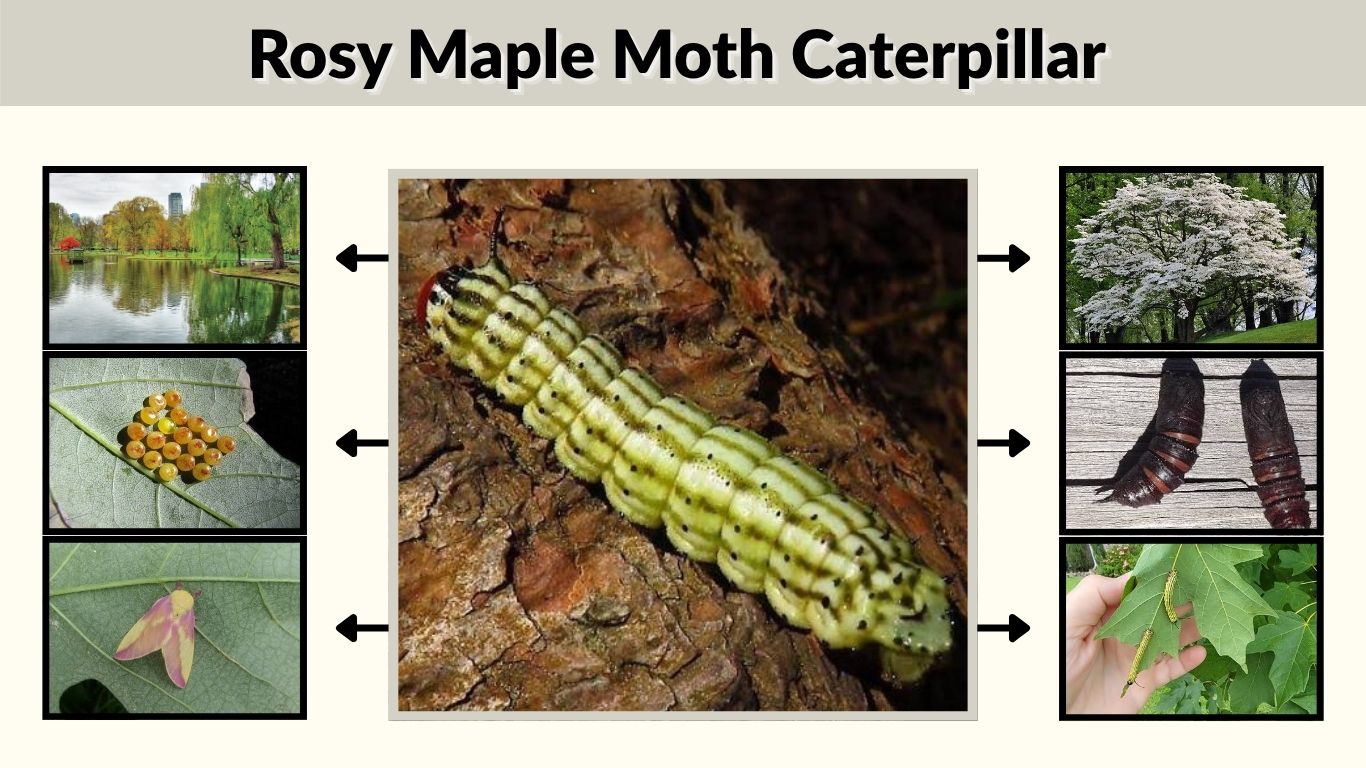
The rosy maple moth caterpillar is the larval stage of the colorful rosy maple moth, Dryocampa rubicunda. It is often called the greenstriped mapleworm because the caterpillar is pale green to yellow-green with lengthwise stripes. Unlike the pink-and-yellow adult moth, the caterpillar is built for feeding on leaves, especially maple leaves. This species is native to eastern North America and is usually more interesting than harmful.
What Is a Rosy Maple Moth Caterpillar?
A rosy maple moth caterpillar is a leaf-feeding caterpillar in the Saturniidae family, the same broad family that includes many large silk moths. The caterpillar stage eats, grows, molts, and eventually pupates underground before becoming an adult moth.
Rosy Maple Moth Caterpillar Identification
Mature rosy maple moth caterpillars have a very different look from the adult moth. They are usually greenish with stripes, small black spines, and a reddish or orange-brown head.
Key identification marks include:
- Pale green, yellow-green, or green-striped body
- Red, orange-brown, or beige head
- Two black horn-like projections near the front
- Small black spots or short spines along the body
- Sometimes rosy patches near the rear side
- Full-grown length around 1.5–2 inches
Missouri Extension describes full-grown greenstriped mapleworms as 1.5 to 2 inches long, with pale green bodies, red heads, alternating green lines, black horns on the second thoracic segment, and small black spines.
Rosy Maple Moth as a Caterpillar vs Adult
The caterpillar is mostly green and striped, while the adult moth is famous for soft pink and yellow coloring. Adults are attracted to lights and do not feed, while caterpillars feed on host tree leaves.
Where Do Rosy Maple Moth Caterpillars Live?
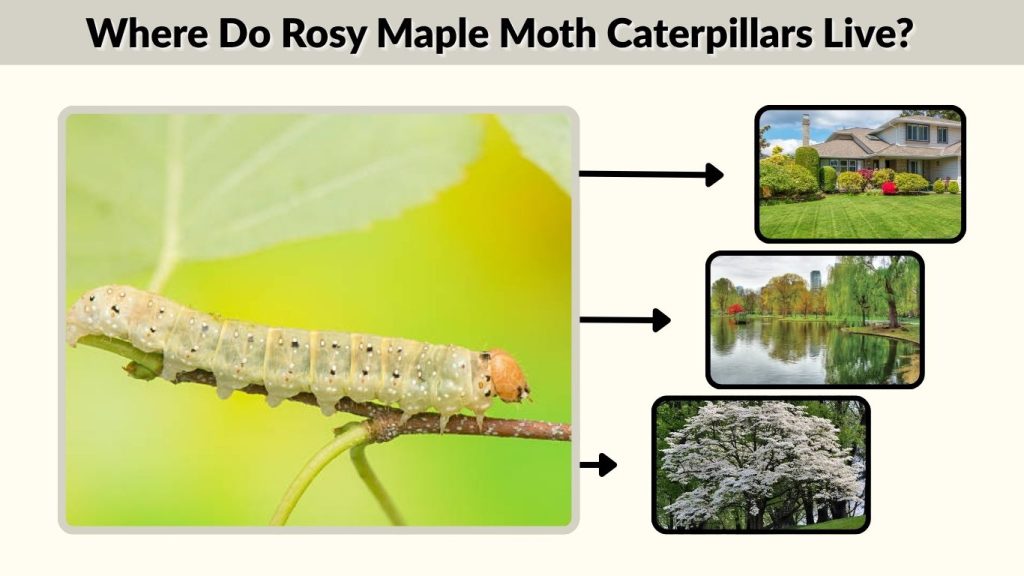
Rosy maple moth caterpillars live where their host trees grow, especially in deciduous forests, yards, parks, and wooded neighborhoods with maples. Butterflies and Moths of North America lists the habitat as deciduous forests and the range broadly across eastern North America.
Rosy Maple Moth Caterpillar in Pennsylvania
Yes, rosy maple moth caterpillars can occur in Pennsylvania. The species is found across the eastern United States, and BugGuide includes a Pennsylvania record of the adult rosy maple moth from Fayette County. Where maples are common, caterpillars may also be found on leaves during the growing season.
Common Host Plants
Rosy maple moth caterpillars mainly feed on maple trees, but they may also use some oaks and other hardwoods depending on location.
Common host plants include:
- Red maple
- Sugar maple
- Silver maple
- Boxelder maple
- Turkey oak
- Other oaks
- Sometimes beech or sycamore
Clemson states that the most common host species are sugar maple, silver maple, and red maple, with turkey oak sometimes used. BugGuide also lists maples, sycamore, beech, and oaks as caterpillar host plants.
Rosy Maple Moth Caterpillar Life Cycle
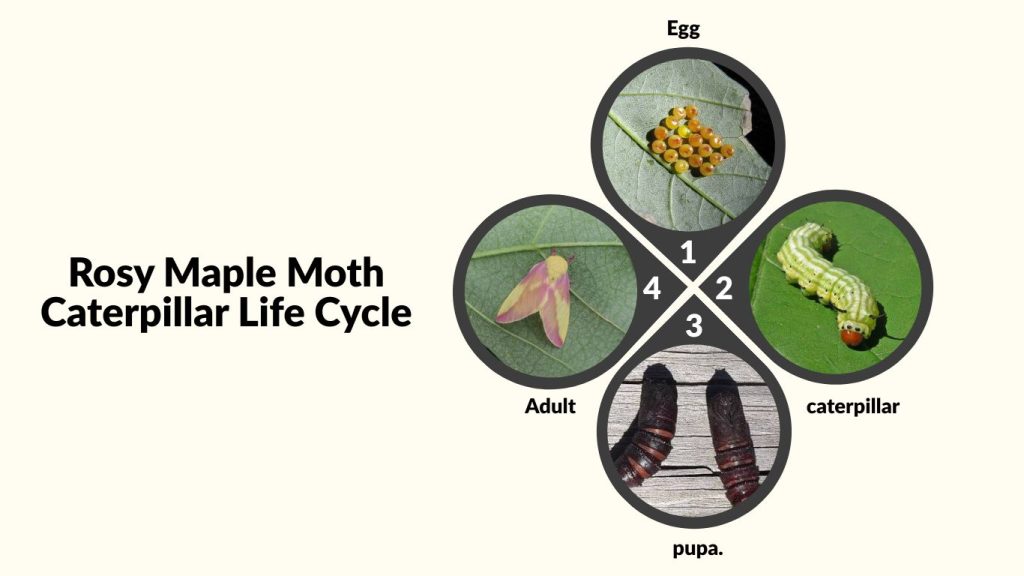
The rosy maple moth has a complete life cycle: egg, caterpillar, pupa, and adult. Females lay eggs on host plant leaves. Young caterpillars often feed together, then become more solitary as they mature.
| Stage | What Happens |
| Egg | Laid in clusters on host leaves |
| Young caterpillar | Feeds in groups on maple or oak leaves |
| Mature caterpillar | Feeds alone and grows to full size |
| Pupa | Drops to the ground and pupates in soil |
| Adult moth | Pink-and-yellow moth emerges to mate |
Clemson notes that young larvae feed together, mature caterpillars become solitary, and larvae crawl down the tree to pupate in a shallow hole or soil burrow.
When Do They Appear?
Timing depends on the region. Butterflies and Moths of North America reports one brood in the north from May to August, two broods in the south from April to September, and possibly three broods in the Deep South and Florida from March to October.
Rosy Maple Moth Caterpillar Sting: Does It Hurt?
The rosy maple moth caterpillar has small spines, so people often ask whether it can sting. It is not usually grouped with the most medically important stinging caterpillars, such as puss caterpillars or saddleback caterpillars. Still, because caterpillar sensitivity varies and spines can irritate skin, it is best not to handle it with bare hands.
Is the Rosy Maple Moth Caterpillar Poisonous?
There is no strong reason to treat rosy maple moth caterpillars as dangerously poisonous to people. However, do not eat them, crush them, or let children handle them. Poison Control gives a good general rule: brightly colored, spiny, bristly, or fuzzy caterpillars should not be touched because some can cause reactions.
What to Do If You Touch One
If your skin becomes irritated after contact:
- Wash the area with soap and water
- Avoid rubbing the skin
- Use tape gently to lift tiny hairs or spines if present
- Apply a cool compress
- Use anti-itch cream if needed
- Seek medical help for severe swelling, breathing trouble, or strong allergic symptoms
Luna Moth vs Rosy Maple Moth Caterpillar
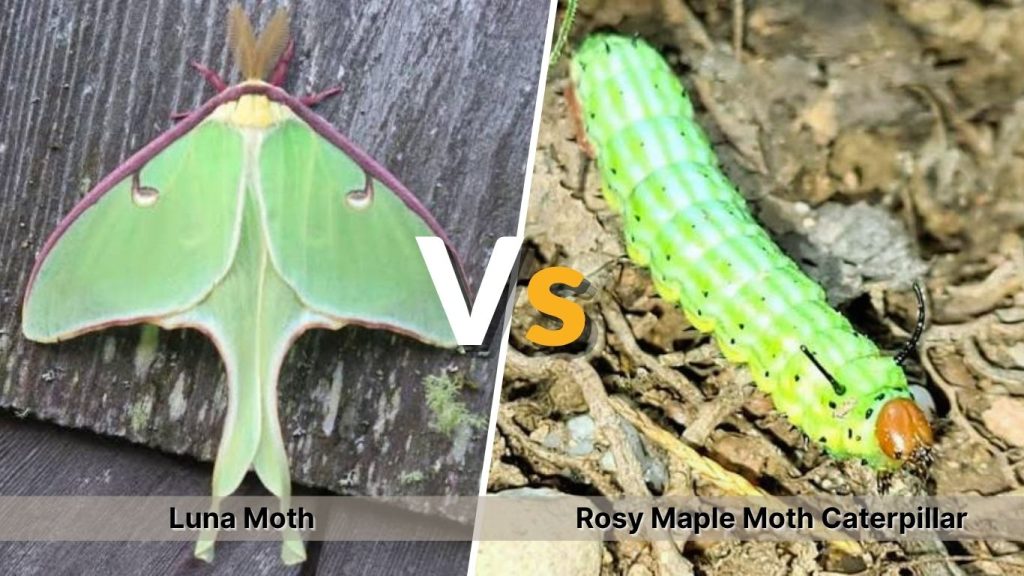
The luna moth and rosy maple moth are both silk moths, but their caterpillars are not the same. Luna moth caterpillars are usually bright green, smooth-looking, and feed on trees such as walnut, sweetgum, birch, and hickory. Rosy maple moth caterpillars are green-striped mapleworms that mainly feed on maples and sometimes oaks.
| Feature | Rosy Maple Moth Caterpillar | Luna Moth Caterpillar |
| Main color | Green with stripes | Bright green |
| Common host | Maple | Walnut, hickory, sweetgum, birch |
| Adult moth | Pink and yellow | Pale green with tails |
| Common name | Greenstriped mapleworm | Luna moth caterpillar |
Do Rosy Maple Moth Caterpillars Damage Trees?
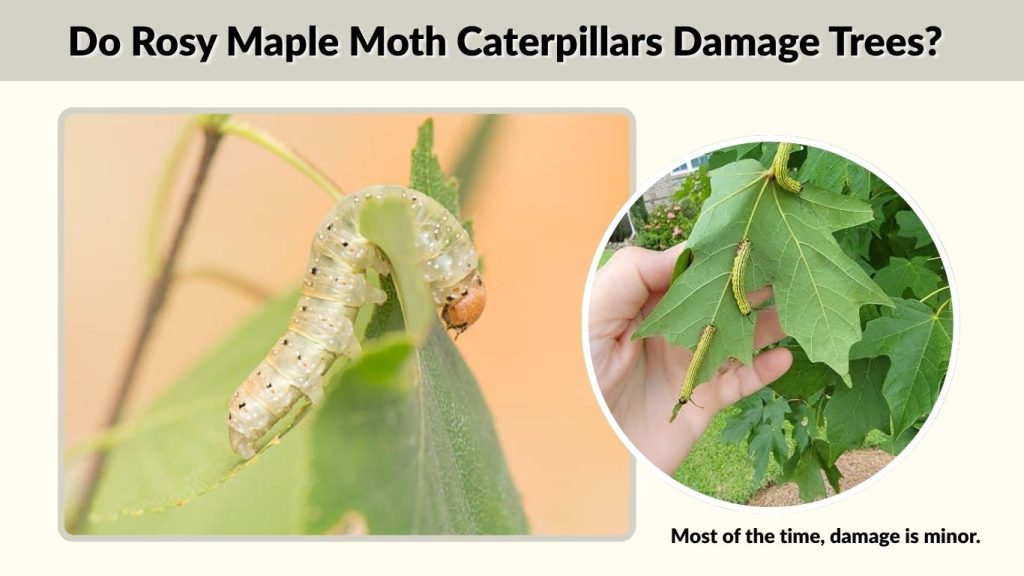
Most of the time, damage is minor. In large numbers, caterpillars can defoliate parts of maple trees, but healthy trees usually recover. Clemson says rosy maple moth larvae are not particularly destructive, though heavy numbers can make a tree partially or entirely bare and may harm saplings or stressed trees.
Signs on Maple Trees
- Chewed leaf edges
- Missing leaf tissue
- Groups of young caterpillars on leaves
- Green-striped caterpillars later feeding alone
- Droppings under branches during heavy feeding
Rosy Maple Moth Caterpillar for Sale
Some people search for rosy maple moth caterpillars for sale because the adult moth is colorful and popular online. Buying live caterpillars is not always a good idea. Rules can vary by state or country, and moving insects may spread pests, diseases, or nonlocal genetics. It is safer to observe native caterpillars outdoors or contact a local extension office before buying or rearing them.
Basic Care Note
If you find one naturally and observe it briefly, provide fresh leaves from the exact host plant where it was found. Caterpillars can be picky, and switching plants may cause stress. Release native caterpillars only where they were collected and do not release purchased insects into the wild.
FAQs
What does a rosy maple moth caterpillar look like?
A rosy maple moth caterpillar is usually pale green or yellow-green with lengthwise stripes, a reddish or orange-brown head, small black spines, and two black horn-like projections near the front. Mature caterpillars are often around 1.5–2 inches long.
Does a rosy maple moth caterpillar sting?
It has small spines, but it is not usually considered one of the major dangerous stinging caterpillars. Still, avoid touching it with bare hands. Some people may get mild irritation from contact with caterpillar spines or body hairs.
What do rosy maple moth caterpillars eat?
They mainly eat maple leaves, especially red maple, sugar maple, and silver maple. They may also feed on some oak species, including turkey oak. In some records, other hardwoods such as beech or sycamore may be used.
Are rosy maple moth caterpillars harmful to trees?
Usually, they are not seriously harmful. Heavy groups can chew many leaves and make a maple look bare, but healthy trees often recover. Damage is more concerning for young, stressed, or newly planted trees.
Can I buy a rosy maple moth caterpillar?
You may see rosy maple moth caterpillars for sale online, but buying live insects can involve local rules and ecological risks. It is better to observe wild native caterpillars naturally or ask your local extension office before purchasing or rearing them.