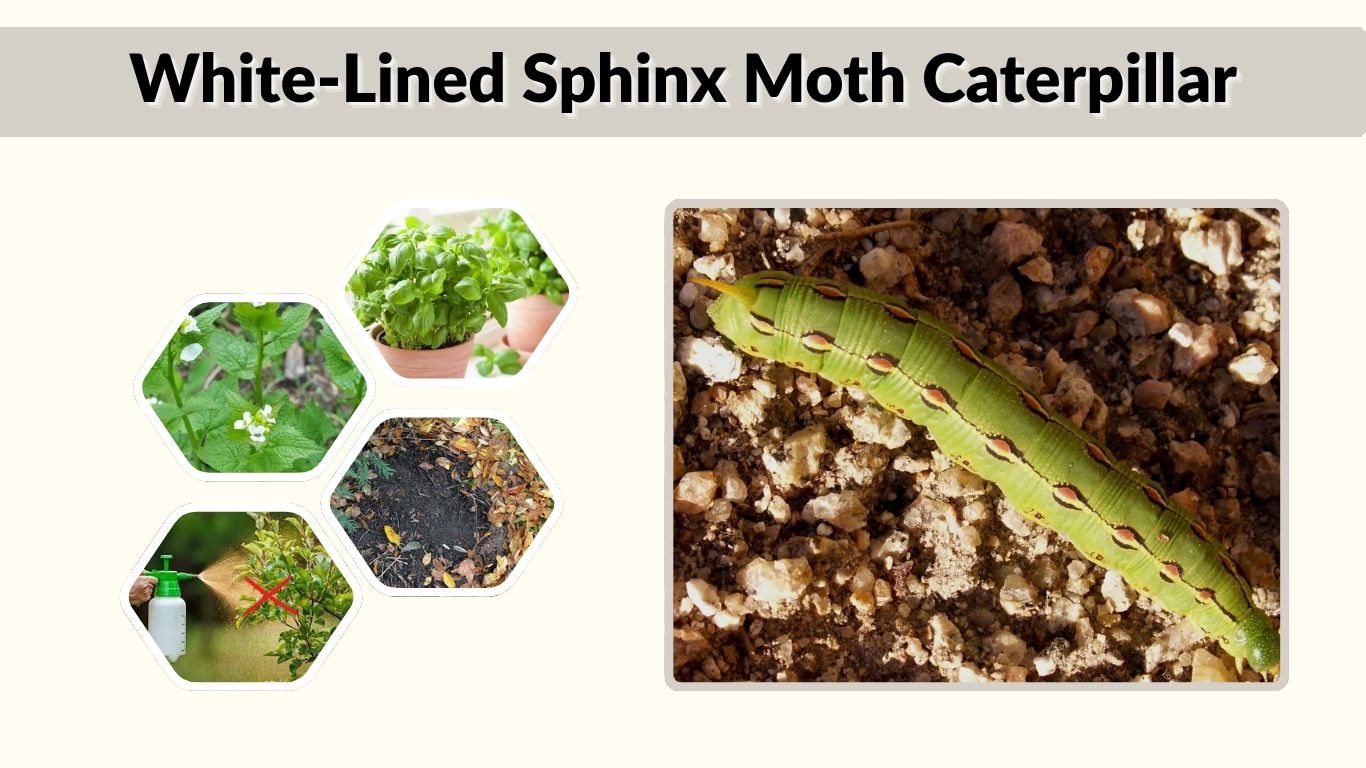
The white-lined sphinx moth caterpillar is the larval stage of Hyles lineata, a widespread sphinx moth also known as a hawk moth or hummingbird moth. The adult moth is famous for hovering at flowers like a tiny hummingbird, while the caterpillar is a large “hornworm” that can be green, black, brown, yellow, or patterned. Many people worry that the tail horn is poisonous, but it is not a stinger. This guide covers identification, diet, host plants, life cycle, care, and safety.
What Is a White-Lined Sphinx Moth Caterpillar?
A white-lined sphinx moth caterpillar is a smooth-bodied caterpillar that later becomes the white-lined sphinx moth. It belongs to the moth family Sphingidae, a group commonly called sphinx moths or hawk moths.
The adult moth is a strong flier and often visits flowers at dusk, dawn, or even during the day. White-lined sphinx moths are sometimes called hummingbird moths because they hover while feeding on nectar through a long proboscis. The Missouri Department of Conservation describes sphinx moths as large, heavy-bodied moths that often hover near flowers and feed with a long mouth tube.
White-Lined Sphinx Moth Caterpillar Identification
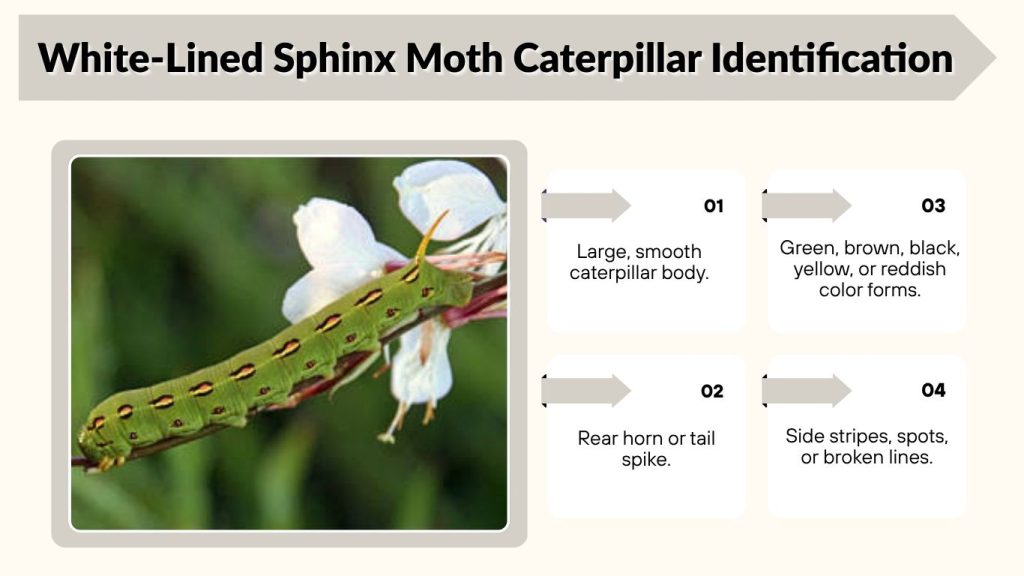
White-lined sphinx caterpillars are highly variable, which means they do not all look the same. Some are bright green, some are dark brown or black, and others have yellow, orange, or reddish markings. Many have a row of spots or stripes along the sides.
What Does It Look Like?
Look for these features:
- Large, smooth caterpillar body
- Rear horn or tail spike
- Green, brown, black, yellow, or reddish color forms
- Side stripes, spots, or broken lines
- Thick hornworm shape
- Usually found on host plants such as purslane, evening primrose, grape, apple, or tomato
- May crawl quickly when disturbed
The Natural History Museum of Los Angeles County notes that sphinx moth larvae are commonly called hornworms because of the spine-like structure at the end of the body, but this horn is soft and not harmful to touch.
White-Lined Sphinx Moth Caterpillar Size
White-lined sphinx caterpillars are usually large compared with many common garden caterpillars. Young larvae are small and easy to miss, but mature caterpillars can become thick and noticeable.
| Stage | Appearance | Approximate Size |
| Young larva | Small, darker or greenish | Under 1 inch |
| Growing larva | More visible stripes or spots | 1–2 inches |
| Mature larva | Large, thick hornworm | Up to about 3 inches |
| Pupa | Brown, hidden in soil | Around 1–2 inches |
| Adult moth | Brown wings with pale lines | 2–3 inch wingspan |
The adult white-lined sphinx moth is often noticed more than the caterpillar because it hovers around flowers like a hummingbird.
Is the White-Lined Sphinx Moth Caterpillar Poisonous?
No, the white-lined sphinx moth caterpillar is not poisonous or venomous to people. It does not sting, and the horn at the back is not dangerous.
Some people are nervous because the caterpillar looks large and has a tail spike. However, the horn is mostly a defensive structure that makes it look less edible to predators. It does not inject venom.
That said, you should still avoid handling caterpillars too much. Caterpillars may carry dirt, plant chemicals, or pesticide residue from the plants they eat. Sensitive people may also get mild skin irritation from handling insects or plants.
Is the White-Lined Sphinx Moth Caterpillar Poisonous to Dogs?
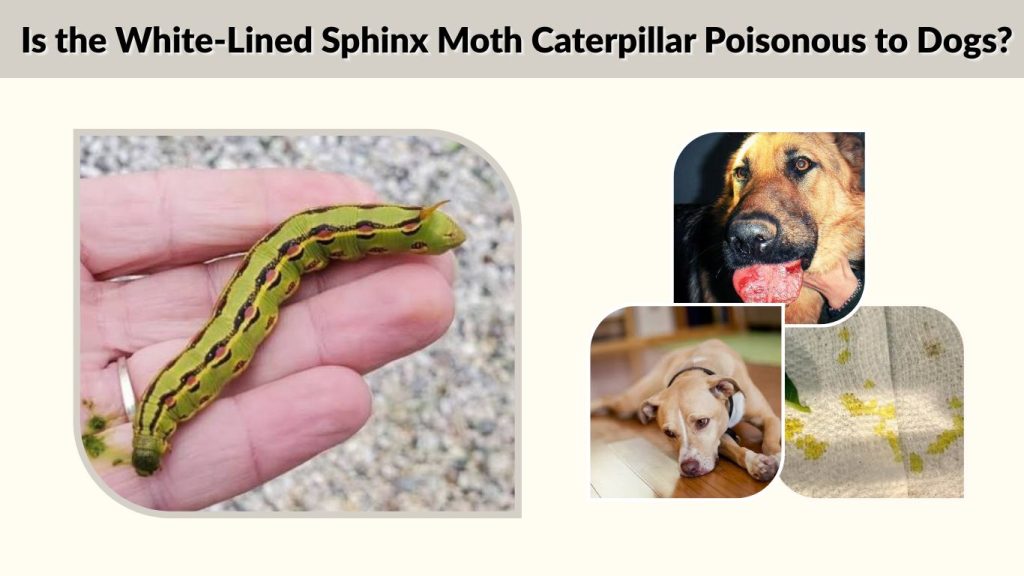
White-lined sphinx caterpillars are not usually considered seriously poisonous to dogs. However, dogs should not be allowed to eat them. A dog that chews caterpillars may drool, gag, vomit, or have stomach upset.
The biggest risks are:
- Irritation from chewing the caterpillar
- Pesticide residue on the caterpillar
- Upset stomach after eating insects
- Misidentifying a different caterpillar as white-lined sphinx
If your dog ate a caterpillar and shows severe vomiting, swelling, weakness, breathing trouble, or unusual behavior, contact a veterinarian.
White-Lined Sphinx Moth Caterpillar Diet
White-lined sphinx caterpillars eat many different plants. This wide diet is one reason they are common across much of North America.
University of Wisconsin Horticulture lists host plants such as apple, evening primrose, four-o’clocks, fuchsia, grape, pentas, purslane, tomato, and willow-weed. University of Nevada, Reno Extension also notes that caterpillars feed on many plant parts, including leaves, green fruits, and stems.
Common Food Plants
White-lined sphinx moth caterpillars may eat:
- Purslane
- Evening primrose
- Apple
- Grape
- Tomato
- Fuchsia
- Four-o’clocks
- Pentas
- Willowherb
- Rose-family plants
- Elm
- Lilac
- Elderberry
- Desert wildflowers
- Many herbs and weeds
If you find one on a plant, that plant is probably its host. It is usually best to feed it leaves from the same plant if you are trying to care for it.
White-Lined Sphinx Moth Caterpillar Host Plants
Host plants are the plants caterpillars can eat and grow on. White-lined sphinx caterpillars have a broad host range compared with many other moth species.
| Host Plant | Notes |
| Purslane | Very common host, especially in dry areas |
| Evening primrose | Important wild host plant |
| Grape | Common host in gardens and wild areas |
| Apple | Used by caterpillars in some regions |
| Tomato | Can be eaten, but not always the main host |
| Four-o’clocks | Common ornamental host |
| Fuchsia | Listed as a host plant |
| Willowherb | Used by larvae in many areas |
| Pentas | Common garden host in warm regions |
University of Minnesota Extension lists white-lined sphinx caterpillars on evening primrose and related plants, grapes, apples and other rose-family plants, and many herbs and woody plants.
White-Lined Sphinx Moth Caterpillar on Purslane
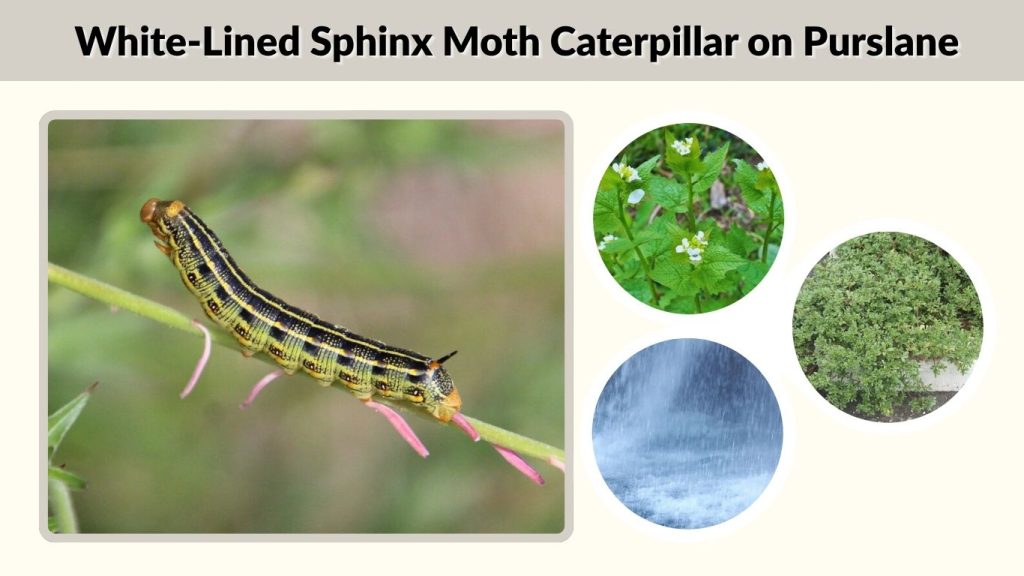
Purslane is one of the plants most commonly connected with white-lined sphinx caterpillars. In some areas, many caterpillars may appear after good rainfall because weeds and wildflowers grow quickly.
If the caterpillars are feeding on unwanted purslane or wild plants, they usually do not need control. They become pollinating moths as adults and also provide food for birds, reptiles, and other wildlife.
White-Lined Sphinx Moth Caterpillar on Mint
Some people report finding white-lined sphinx caterpillars on mint. Mint may not be one of the most commonly listed host plants, so check carefully before assuming the caterpillar is eating it. It may be resting on mint while feeding on nearby purslane, evening primrose, tomato, grape, or another host plant.
To confirm feeding, look for:
- Fresh chew marks on mint leaves
- Droppings below the plant
- Caterpillar returning to the same plant
- Nearby host plants with damage
If you are raising the caterpillar, offer leaves from the plant where it was actively feeding.
White-Lined Sphinx Moth Caterpillar Life Cycle
The white-lined sphinx moth has four stages: egg, caterpillar, pupa, and adult. Eggs are laid on suitable host plants. Caterpillars hatch and feed heavily as they grow. When mature, they leave the plant and pupate in the soil. Later, the adult moth emerges.
Life Cycle Stages
- Egg: Laid on host plant leaves or stems
- Larva: Caterpillar feeds and grows through molts
- Pupa: Mature caterpillar burrows into soil to transform
- Adult: Moth emerges and feeds on flower nectar
The Sphingidae of the United States account for Hyles lineata notes that eggs are laid on leaves and stems, and larvae may feed on suitable host plants or wander to nearby hosts.
White-Lined Sphinx Moth Caterpillar Pupa
When the caterpillar is fully grown, it usually leaves the host plant and burrows into loose soil or leaf litter. There it changes into a brown pupa. This stage may be hidden, so many people never see it.
If you are caring for a mature caterpillar, provide a few inches of clean, pesticide-free soil or dry leaf litter in the container. The caterpillar may stop eating, wander around, and look restless before pupating.
White-Lined Sphinx Moth Caterpillar Care
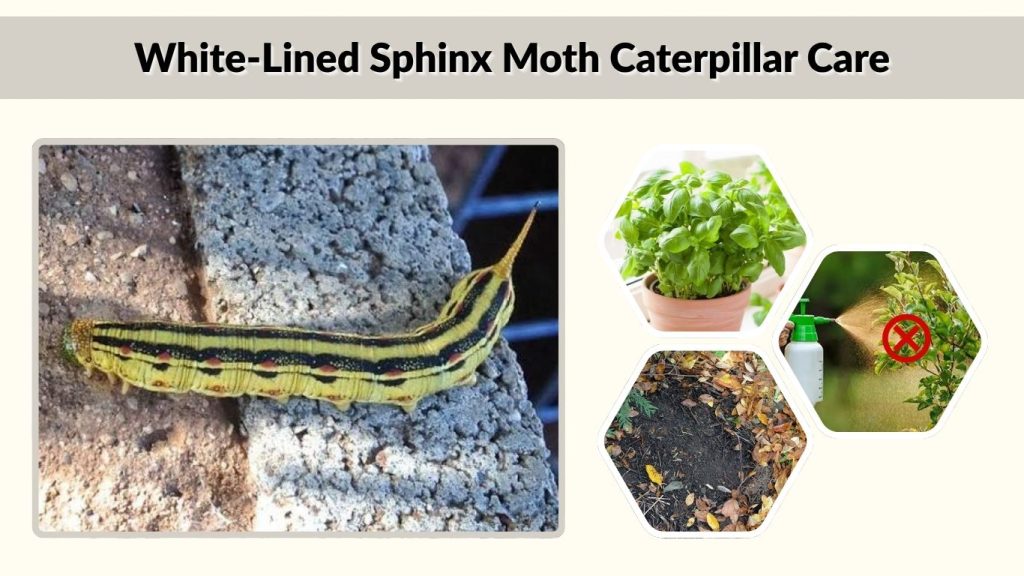
White-lined sphinx caterpillars can be raised at home for observation, but they need fresh host leaves and a clean container. The most important rule is to feed the same plant species the caterpillar was found eating.
Basic Care Tips
- Use a ventilated container.
- Add fresh host plant leaves daily.
- Avoid pesticide-treated leaves.
- Keep the container out of direct hot sun.
- Remove droppings every day.
- Add a paper towel for easier cleaning.
- Provide loose soil or leaf litter when the caterpillar is mature.
- Do not handle it often.
- Release the adult moth near where the caterpillar was found.
If the caterpillar refuses a plant, try the plant it was originally found on or another known host like purslane, evening primrose, grape, or apple.
White-Lined Sphinx Moth Caterpillar Horn
The horn is one of the most noticeable features of this caterpillar. It is located at the rear end of the body, not the head. Although it looks sharp, it is not a stinger.
What Is the Horn For?
The horn may help protect the caterpillar by making it look more dangerous to predators. Birds or small animals may avoid a caterpillar that looks spiky or unusual. The horn is harmless to people.
White-Lined Sphinx Moth Caterpillar Defense
White-lined sphinx caterpillars protect themselves in several ways. Their color patterns may help them blend with leaves, stems, soil, or shadows. Some individuals are green, while others are dark or spotted, making them harder for predators to recognize.
When disturbed, they may:
- Curl the body
- Thrash slightly
- Drop from the plant
- Hold still and rely on camouflage
- Use the horn-like tail as a warning shape
These defenses are meant to avoid being eaten, not to harm humans.
How to Control White-Lined Sphinx Moth Caterpillars
Control is usually not needed unless many caterpillars are damaging valuable plants. For small numbers, hand removal is enough.
Simple Control Options
- Handpick caterpillars and move them to another host plant.
- Leave them on weeds or wild plants when possible.
- Protect young garden plants with row covers.
- Avoid broad insecticides that harm pollinators.
- Use labeled caterpillar products only when damage is serious.
- Do not spray plants in bloom where bees and moths are visiting.
Because the adult moth is a useful pollinator, avoid killing caterpillars unless they are causing real damage.
FAQs
Is the white-lined sphinx moth caterpillar poisonous?
No, the white-lined sphinx moth caterpillar is not poisonous or venomous. Its rear horn is not a stinger. It may look intimidating, but it does not inject venom or sting people.
What does a white-lined sphinx moth caterpillar eat?
It eats many host plants, including purslane, evening primrose, grape, apple, tomato, fuchsia, four-o’clocks, pentas, willowherb, rose-family plants, lilac, and other herbs or weeds.
How big does a white-lined sphinx moth caterpillar get?
A mature white-lined sphinx moth caterpillar can reach about 3 inches long. Younger larvae are much smaller and may be green, brown, black, yellowish, or patterned.
Can I care for a white-lined sphinx moth caterpillar?
Yes, you can raise one in a ventilated container with fresh leaves from the plant it was found eating. Keep the container clean and provide loose soil or leaf litter when it is ready to pupate.
Is a white-lined sphinx moth caterpillar poisonous to dogs?
It is not usually considered seriously poisonous to dogs, but dogs should not eat it. Chewing caterpillars can cause drooling, vomiting, or stomach upset, especially if the caterpillar has pesticide residue.