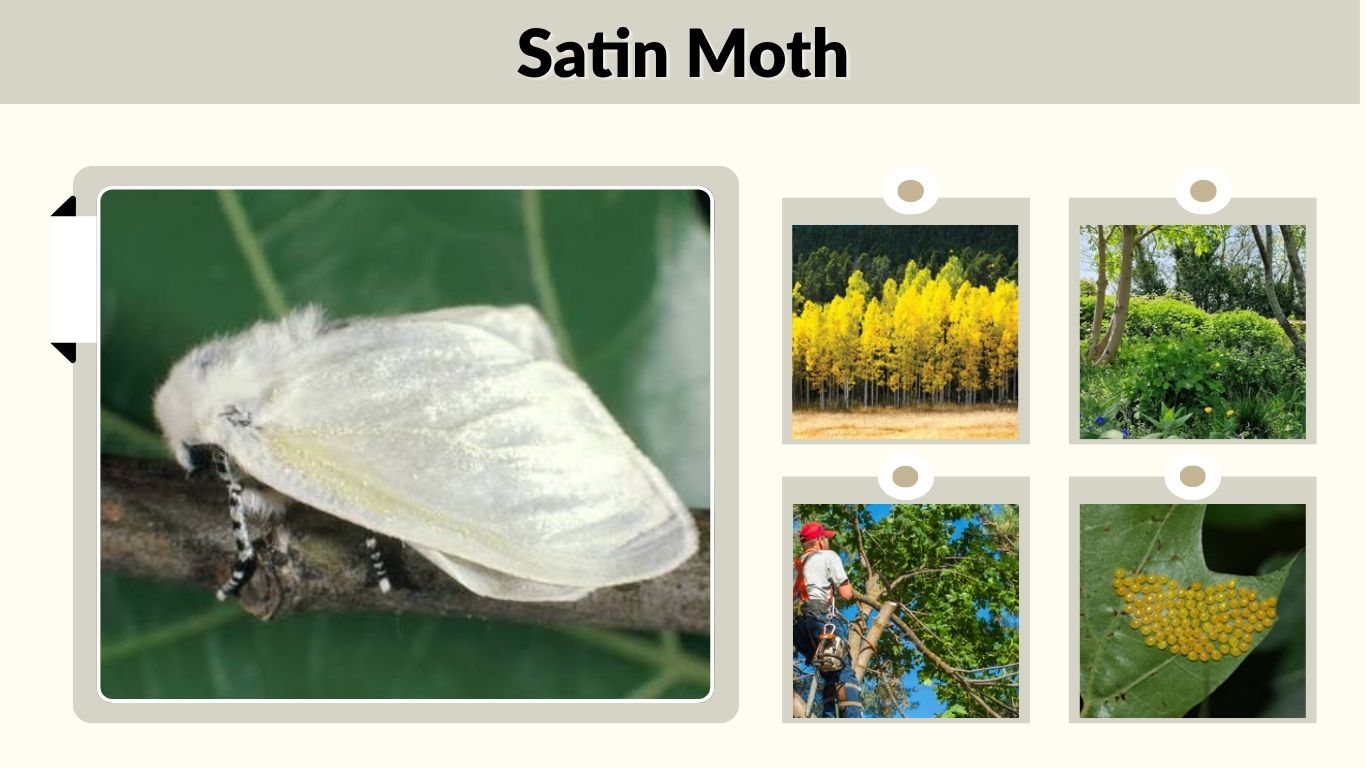
The satin moth, commonly called the white satin moth, is a striking white moth known scientifically as Leucoma salicis. Adults have silky white wings, a furry body, and contrasting black-and-white legs, while their caterpillars are darker and covered with hairs. Native to Europe and parts of Asia, the species has also become established in parts of North America, where larvae can heavily feed on poplar, willow, and related trees. Understanding its appearance, life cycle, diet, and potential impact makes identification much easier.
What Is a Satin Moth?
The name satin moth most commonly refers to Leucoma salicis, a member of the family Erebidae. Its common name comes from the smooth, glossy appearance of the adult’s white wings. Although adults look delicate, the caterpillar stage can consume significant amounts of foliage. The species is especially associated with willows, poplars, aspens, and cottonwoods in both natural and urban areas.
Satin Moth Identification
Common characteristics include:
- Scientific name: Leucoma salicis
- Common name: White satin moth
- Family: Erebidae
- Adult color: Almost completely white
- Wings: Smooth with a satin-like sheen
- Body: Thick and covered with white hairs
- Legs: Black-and-white patterned
- Wingspan: Approximately 35–50 mm
- Activity: Mostly nocturnal
- Main host plants: Willow and poplar species
Fresh adults can appear exceptionally bright white, although older individuals may become duller as their wing scales wear.
Male vs Female Satin Moth
Male and female white satin moths look similar, but females are usually larger and heavier-bodied because they carry eggs.
Males tend to have more strongly feathered antennae, which help them detect female pheromones.
Females spend much of their short adult life selecting suitable host trees and laying eggs, while males are generally more active in searching for mates.
White Satin Moth Caterpillar
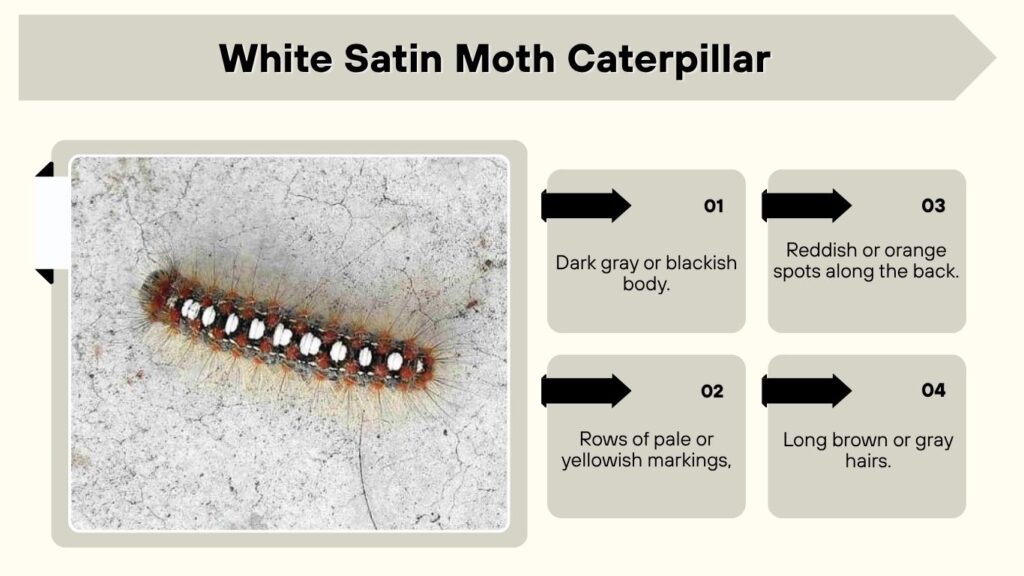
The satin moth caterpillar looks completely different from the white adult. Larvae are darker, patterned, and covered with tufts of hair. They feed openly on leaves during spring and early summer and may occasionally become numerous enough to noticeably defoliate host trees. Their distinctive coloration and feeding habits can help separate them from other hairy caterpillars.
Satin Moth Caterpillar Identification
Mature caterpillars typically have:
- Dark gray or blackish body
- Rows of pale or yellowish markings
- Reddish or orange spots along the back
- Long brown or gray hairs
- Several raised hair-covered bumps
- Dark head
- Length of approximately 35–45 mm
Young caterpillars are much smaller and may not show the adult larval markings as clearly.
Are White Satin Moth Caterpillars Poisonous?
White satin moth caterpillars are not generally considered dangerously poisonous.
However, they are hairy caterpillars, and direct contact may cause skin irritation in sensitive people. Reactions can include temporary itching, redness, or discomfort.
It is therefore sensible to avoid handling caterpillars with bare hands.
Children and pets should also be discouraged from playing with unfamiliar hairy caterpillars.
Satin Moth Habitat and Range
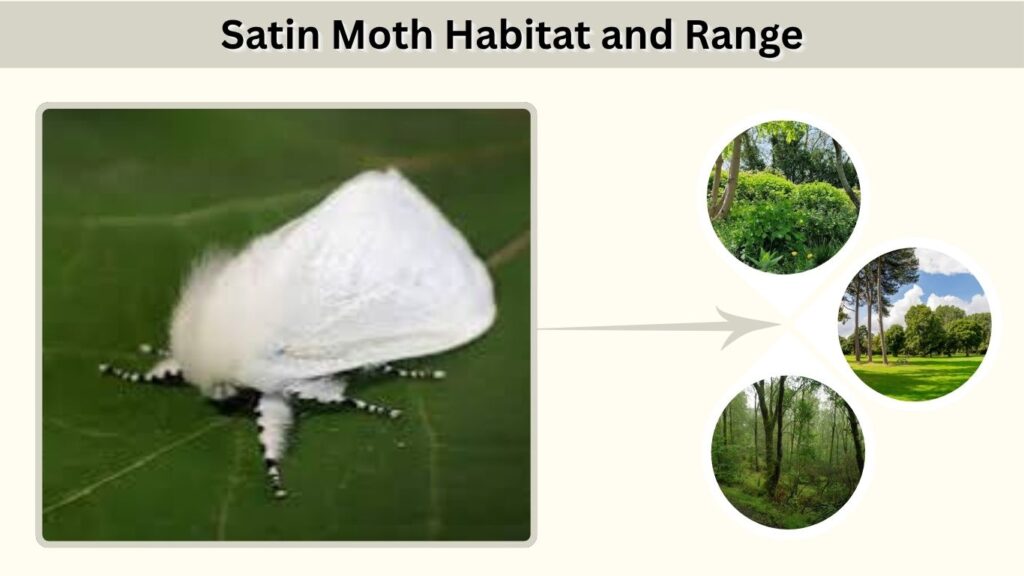
White satin moths are associated with habitats containing their preferred host trees. They occur naturally across parts of Europe and Asia and have been introduced into North America. Their ability to use common landscape trees such as poplars and willows allows them to survive in forests as well as cities, parks, shelterbelts, river valleys, and residential neighborhoods.
Where Satin Moths Live
Suitable habitats include:
- Willow stands
- Poplar forests
- Riverbanks
- Parks
- Urban streets with poplar trees
- Woodland edges
- Wetlands
- Shelterbelts
- Gardens
- Areas containing aspens or cottonwoods
Adult moths may also be attracted to outdoor lights at night.
White Satin Moth in North America
The white satin moth is not native to North America but has established populations in parts of the continent.
It may occur in portions of Canada and the northern or western United States where suitable host trees are abundant.
Poplars and willows planted along roads, parks, farms, and residential properties can provide extensive feeding habitat for larvae.
What Do Satin Moths Eat?
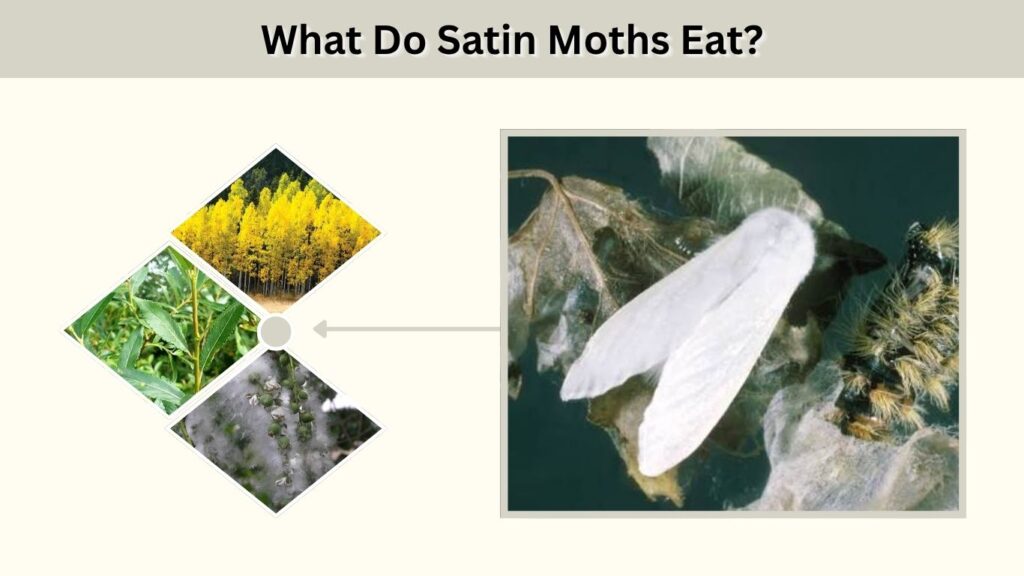
The feeding stage of the satin moth is primarily the caterpillar. Larvae consume foliage from several closely related deciduous trees and can sometimes strip significant portions of leaves when populations are high. Adult moths have a much smaller role in feeding because their main purpose is reproduction during their relatively short adult stage.
Satin Moth Caterpillar Food
Important host plants include:
- Poplar
- Willow
- Aspen
- Cottonwood
- Lombardy poplar
- Other trees in related plant groups
Poplars and willows are particularly important hosts.
Larvae may begin feeding soon after emerging from their overwintering shelters during spring.
Feeding Damage
A small number of caterpillars usually causes limited damage.
Large populations, however, can remove substantial amounts of foliage. Repeated severe defoliation can weaken trees, particularly when combined with drought, disease, or other stresses.
Healthy mature trees often recover after a single episode, but repeated infestations deserve closer monitoring.
Satin Moth Life Cycle
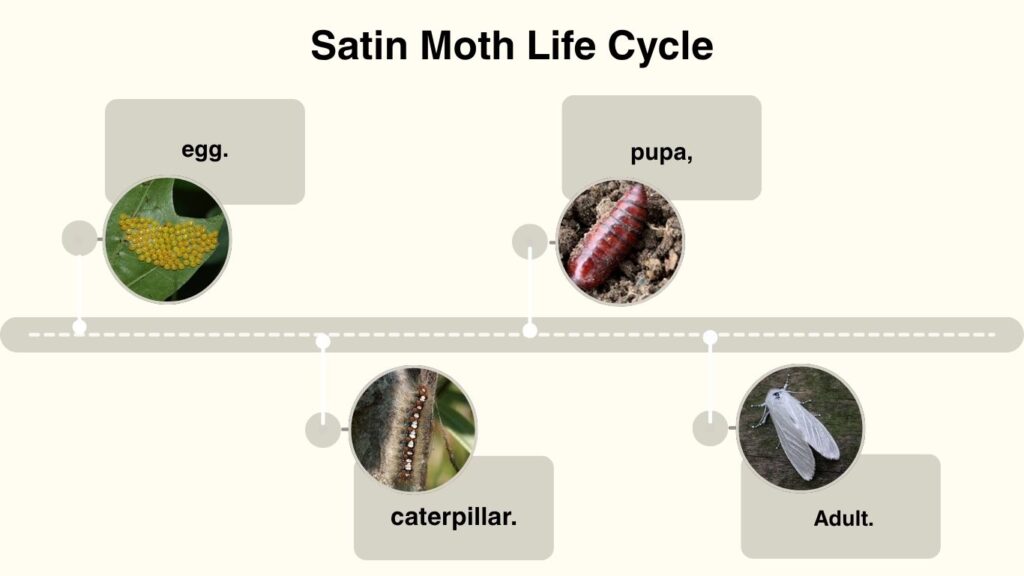
The satin moth undergoes complete metamorphosis, progressing through egg, caterpillar, pupa, and adult stages. In many regions it produces one generation each year. Eggs hatch into small larvae, which begin feeding before seeking protected locations for winter. Feeding resumes the following spring, followed by pupation and adult emergence during summer.
Satin Moth Life Cycle Stages
The main stages are:
- Egg: Females lay clusters of eggs on host trees.
- Young larva: Caterpillars hatch and begin feeding.
- Overwintering larva: Young larvae hide in protected bark crevices.
- Spring feeding: Caterpillars resume feeding as leaves develop.
- Mature larva: Feeding continues until full size is reached.
- Pupa: The caterpillar transforms inside a protected silk structure.
- Adult moth: White adults emerge during summer.
- Mating and egg laying: The next generation begins.
Timing varies with climate and local weather.
Satin Moth Eggs and Pupa
Females lay batches of eggs on bark, branches, or leaves of suitable host trees.
The egg mass may be covered with protective material produced by the female.
After completing larval development, the caterpillar forms a relatively loose cocoon or sheltered pupation site among foliage, bark, or other protected material.
Adult moths later emerge to mate.
Is the White Satin Moth Dangerous?
Adult satin moths are harmless to people. They do not bite, sting, or attack humans. Concern about this species is primarily related to tree damage caused by caterpillars rather than danger to people. The hairs of the caterpillars may occasionally irritate sensitive skin, but the species should not be confused with highly irritating caterpillars that can cause more serious reactions.
White Satin Moth in the House
An adult satin moth may occasionally enter a house because it is attracted to lights.
Finding one indoors does not normally mean that the home is infested.
The larvae depend on living host trees rather than carpets, clothing, stored food, or household materials.
An indoor moth can simply be placed outside without touching its wings directly.
Satin Moth Control
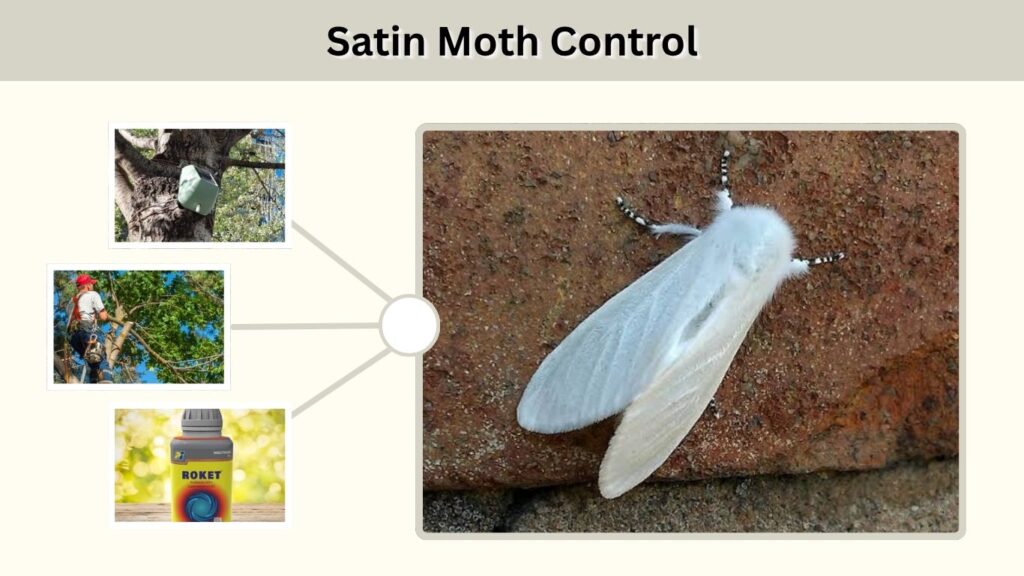
Control is usually unnecessary when only a few caterpillars are present. Natural predators and environmental conditions often keep populations limited. Management becomes more relevant when many larvae repeatedly defoliate valuable trees. Identifying the caterpillar correctly before applying any treatment is important because many harmless native caterpillars can appear superficially similar.
Ways to Reduce Satin Moth Damage
Possible approaches include:
- Monitor host trees during spring
- Remove small egg masses when practical
- Remove concentrated groups of young larvae
- Maintain healthy, well-watered trees
- Avoid unnecessary broad-spectrum pesticides
- Encourage birds and beneficial insects
- Consult a tree-care professional for severe infestations
Large mature trees or widespread infestations may require professional assessment.
Satin Moth Meaning and Symbolism
White moths are sometimes given symbolic meanings because of their pale coloration and nighttime behavior. In modern folklore, a white satin moth may be associated with transformation, renewal, peace, intuition, or personal change. These interpretations are cultural rather than biological and vary among individuals and traditions.
Does a White Satin Moth Have a Spiritual Meaning?
There is no scientifically recognized spiritual meaning for Leucoma salicis.
Its white appearance can lead people to associate it with purity, change, protection, or new beginnings.
Such interpretations are personal beliefs rather than characteristics of the moth itself.
FAQs
Satin moths are often noticed because the brilliant white adults look very different from their dark, hairy caterpillars. Questions commonly concern whether the caterpillar is dangerous, what trees it eats, whether the species is invasive, and what happens during its life cycle. The following answers cover five of the most common questions.
Is the White Satin Moth Poisonous?
No. Adult white satin moths are not poisonous or dangerous to people. Caterpillar hairs may cause mild irritation in sensitive individuals.
What Does a Satin Moth Caterpillar Eat?
The caterpillars mainly feed on leaves of poplar, willow, aspen, and cottonwood trees.
Is the White Satin Moth Invasive?
It is native to Europe and parts of Asia but has been introduced into North America, where it can be considered a non-native pest in affected areas.
How Long Does a Satin Moth Live?
The entire life cycle generally takes about one year in regions with one generation annually. The adult moth itself lives for only a relatively short period.
Why Is a Satin Moth in My House?
Adults may accidentally enter homes after being attracted to lights. They do not normally breed indoors because their caterpillars require living host trees for food.