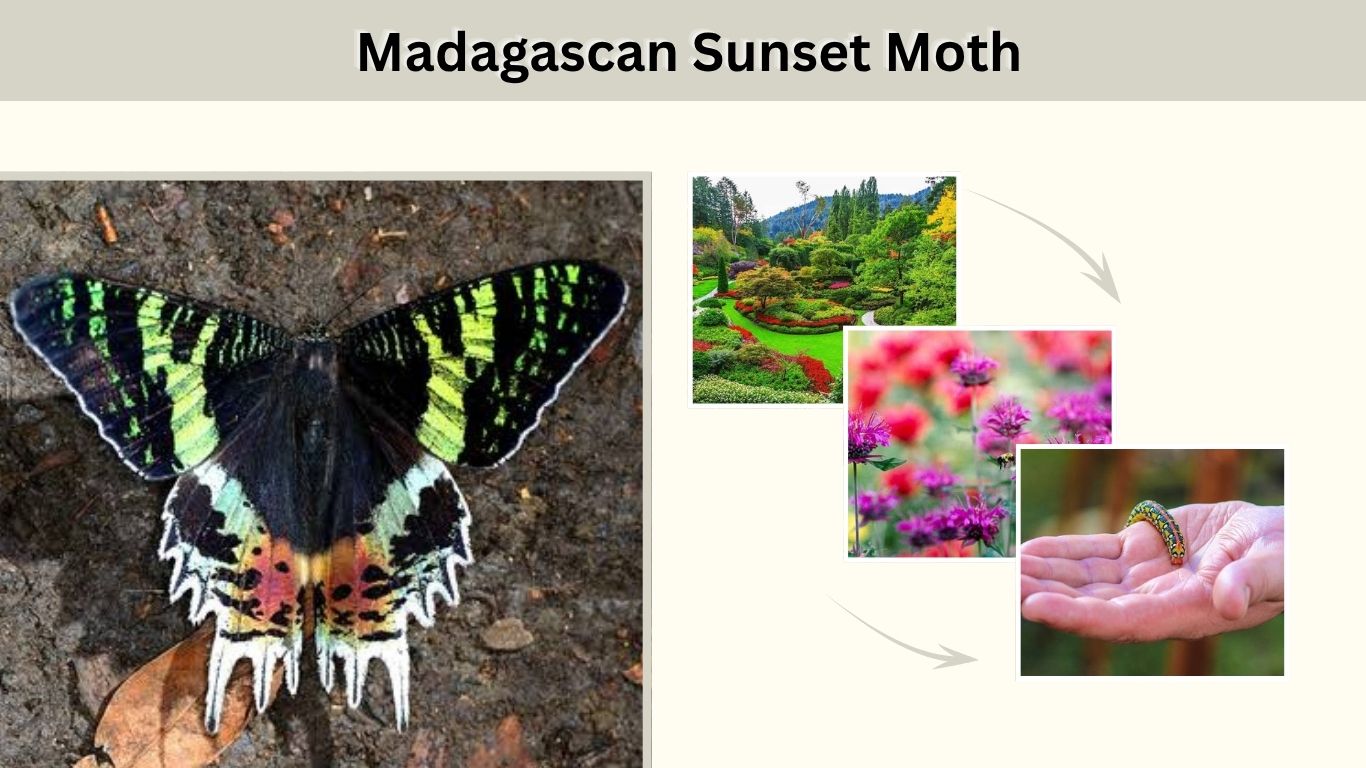
The Madagascan sunset moth looks like a butterfly painted in metallic green, orange, blue, and red. Despite its dazzling appearance and daytime activity, it is a true moth native to Madagascar. Also called the Madagascar sunset moth, this insect is famous for its shimmering wings, delicate tails, and close relationship with toxic host plants. Understanding its caterpillar, diet, habitat, and development reveals much more than its beauty alone. Here is a guide to the real species, with a brief look at its Animal Crossing counterpart.
Identification and Appearance
The Madagascan sunset moth’s scientific name is Chrysiridia rhipheus. It belongs to the family Uraniidae, which includes several moths with colorful wings and butterfly-like shapes. Its bright appearance challenges the familiar idea that moths are always brown and active only at night.
Size and Identifying Features
Adults typically have a wingspan of approximately 7–9 centimeters (2.8–3.5 inches).
Look for:
- Black wings crossed by iridescent green and blue markings.
- Orange, red, or golden areas on the hindwings.
- White fringes along the wing edges.
- Three tail-like extensions on each hindwing.
- Slender antennae without the obvious terminal clubs of many butterflies.
Why Do Its Wings Change Color?
The shimmering colors come largely from microscopic structures in the wing scales. Thin layers of cuticle and air interact with light, while curved scales influence how that light reflects.
This is called structural coloration. The perceived colors can shift with viewing angle and lighting. However, saying the moth has “no pigment” is inaccurate: its black areas are pigmented.
Madagascan Sunset Moth Habitat, Distribution, and Diet
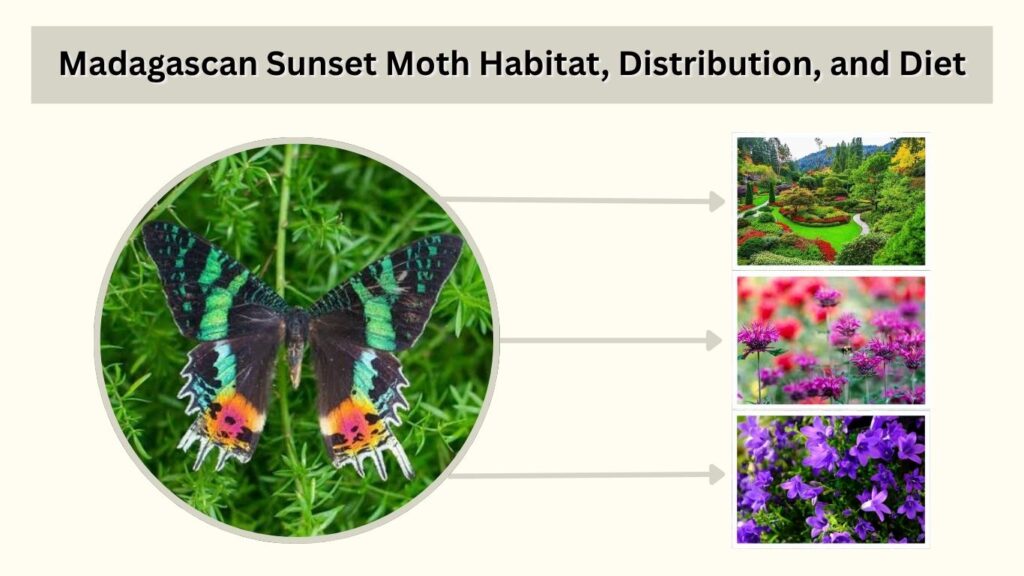
The Madagascan sunset moth is endemic to Madagascar, meaning its natural range is restricted to that island. Its ecology connects different forest habitats through the plants its caterpillars need. Adults and larvae have different diets, so flowers alone cannot provide everything required to complete the life cycle.
Where Does It Live?
The species occurs across suitable parts of Madagascar, including landscapes associated with eastern rainforests and western dry forests. Adults can move between areas containing their larval food plants.
These movements help explain why moth numbers can vary greatly from one location or season to another. A site with few adults at one time may support more when conditions change.
Caterpillar Host Plants
The larvae specialize on Omphalea, a plant genus in the spurge family. Documented Madagascan hosts include:
- Omphalea ankaranensis
- Omphalea occidentalis
- Omphalea palmata
- Omphalea oppositifolia
These plants occur in different regions and habitats. Their distribution helps shape the moth’s movements and breeding opportunities.
What Do Adult Sunset Moths Eat?
Adults drink nectar from flowers using a long, coiled mouthpart called a proboscis. They unroll it to reach nectar and coil it again afterward.
Unlike moth species that cannot feed as adults, sunset moths continue visiting flowers. Their nectar diet should not be confused with the caterpillar’s dependence on Omphalea.
Madagascan Sunset Moth Caterpillar and Life Cycle
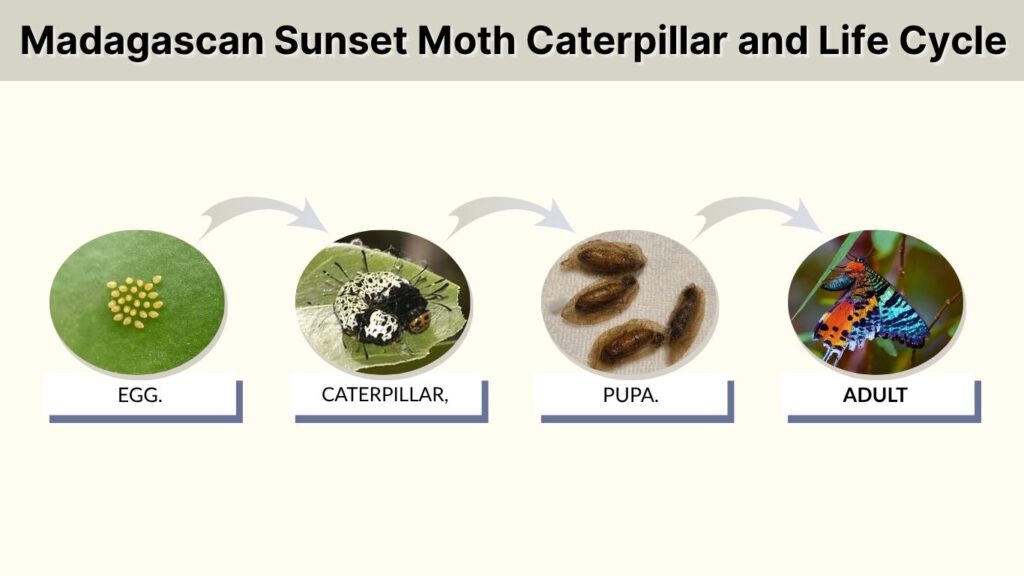
The Madagascan sunset moth undergoes complete metamorphosis: egg, caterpillar, pupa, and adult. Each stage has a different role. Larvae grow by feeding on plants, while adults disperse and reproduce. Development time depends on environmental conditions, so a single rigid schedule cannot describe every individual.
Caterpillar Identification
The caterpillar looks very different from the adult. Its recognizable features include:
- A pale yellowish or whitish body.
- Numerous contrasting black spots.
- Dark hairs with expanded tips.
- Reddish or orange legs and prolegs.
Eggs and Larval Development
Females lay eggs in groups on host leaves, usually on the underside. Newly hatched larvae begin eating leaf tissue.
As they grow, caterpillars consume more plant material and shed their outer skin through successive molts.
Cocoon, Pupa, and Emergence
The mature caterpillar spins a loose, mesh-like silk cocoon before pupating. Inside, its body reorganizes into the adult moth.
After emergence, the wings must expand and harden before normal flight. The cocoon is the silk covering; the pupa is the developmental stage inside it.
Madagascan Sunset Moth Toxicity and Conservation
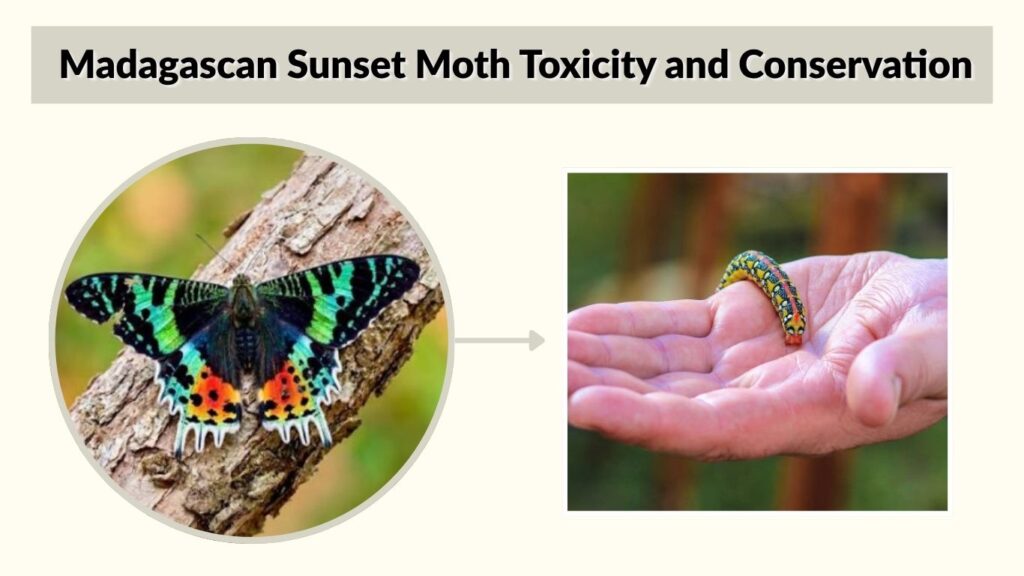
The sunset moth’s relationship with its host plants affects both its defenses and its future. The caterpillars consume plants containing defensive chemicals, and habitat changes can disrupt their food supply. Its spectacular colors therefore tell only part of the story: the less conspicuous host plants are equally important.
Is the Madagascan Sunset Moth Poisonous?
The caterpillars obtain defensive chemicals from Omphalea, retaining protection through later development. The adult’s bright colors help warn predators that it may be an unsuitable meal.
This is a chemical defense against being eaten, not venom delivered through a sting. Avoid eating insects or allowing pets to eat them, and observe wild moths without unnecessary handling.
Why Does Habitat Protection Matter?
Protecting this moth requires conserving its host plants as well as nectar sources. Forest clearance can remove breeding resources even if adults are still occasionally seen nearby.
Its restricted geographic range should not automatically be equated with an endangered classification. Similarly, being offered for sale does not prove that a specimen was sustainably sourced.
Madagascan Sunset Moth in Animal Crossing
The species also appears in Animal Crossing: New Horizons, where it flies near flowers during the daytime. Its availability follows the game’s seasonal rules. These times, prices, and conditions describe the virtual insect and should not be confused with the real moth’s biology.
ACNH Availability and Price
| Detail | New Horizons information |
| Northern Hemisphere | April–September |
| Southern Hemisphere | October–March |
| Active hours | 8 a.m.–4 p.m. |
| Location | Flying near flowers |
| Weather | Not during rain |
| Nook’s Cranny selling price | 2,500 Bells |
| Flick’s buying price | 3,750 Bells |
A player must have caught at least 20 bugs before it can spawn. Use a net to catch it while it is flying near flowers.
FAQs
Questions about this species often mix real insect biology with game information, specimen collecting, and symbolism. Keeping those subjects separate makes the answers clearer. In particular, lifespan estimates should distinguish the adult stage from the entire life cycle, and colorful photographs should not be treated as reliable guides to sex.
Is the Madagascan Sunset Moth a Butterfly?
No. It is a moth in the family Uraniidae. Bright colors and daytime flight occur in moths too, so neither characteristic makes an insect a butterfly.
How Long Do Madagascan Sunset Moths Live?
A dependable universal adult lifespan is difficult to establish from the available sources. Adult longevity is only one part of the life cycle; it excludes the time spent as an egg, caterpillar, and pupa. Avoid treating an unsourced fixed number as a biological rule.
How Can You Tell Males and Females Apart?
Do not rely on wing color alone. Lighting, viewing angle, wear, and individual variation affect appearance. Reliable identification of sex requires closer examination of anatomical features, ideally by someone experienced with the species.
Can You Keep a Madagascan Sunset Moth as a Pet?
Breeding it requires appropriate host plants for the caterpillars, not just flowers or sugar water for adults. Before purchasing, confirm whether the listing is for a living insect or a preserved specimen, and ask about its origin and applicable import requirements.
What Does a Madagascan Sunset Moth Tattoo Mean?
A person might choose it to represent transformation, beauty, or change. These are personal artistic interpretations, not a single universal meaning attached to the species.