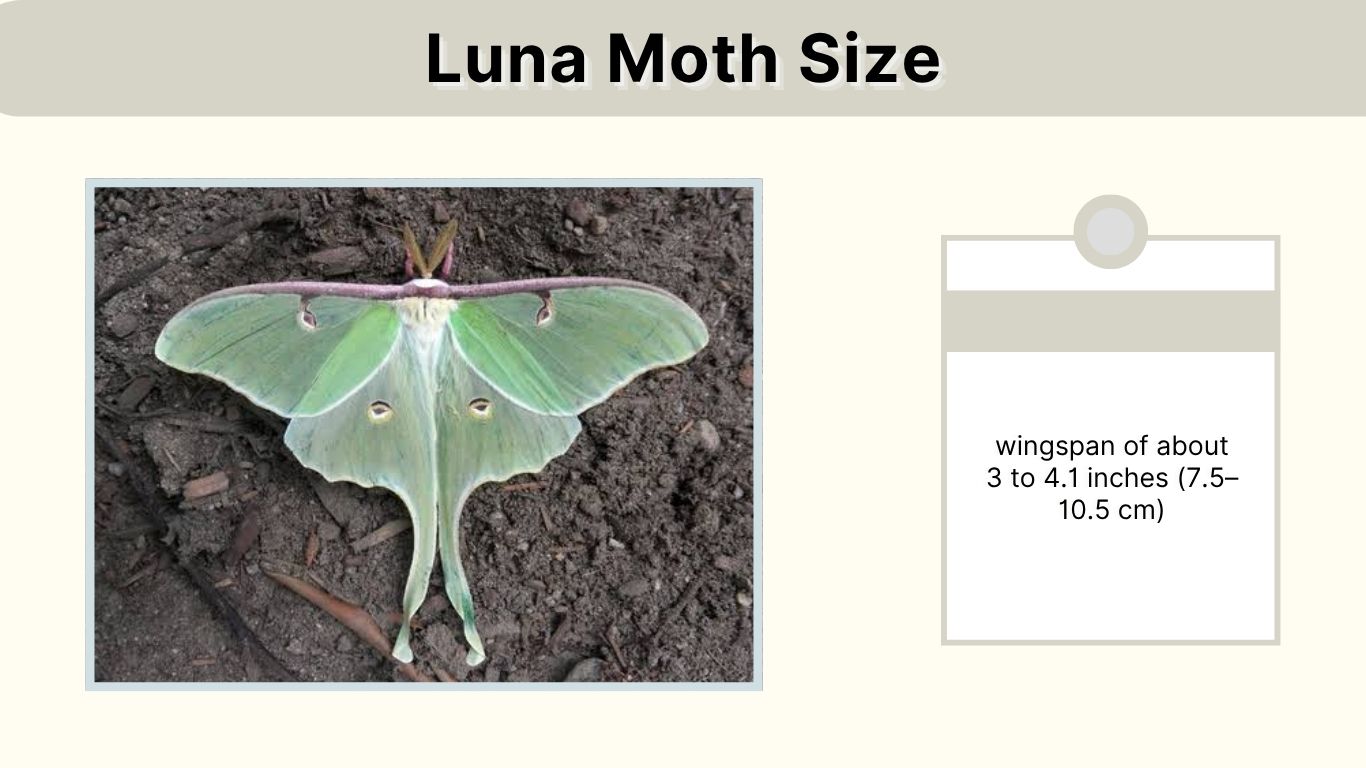
The Luna moth (Actias luna) is one of the largest and most recognizable moths in North America. Its pale green wings, long hindwing tails, and large eyespots can make it appear even bigger than its actual measurements. An adult Luna moth typically has a wingspan of about 3 to 4.1 inches (7.5–10.5 cm), although individual size can vary.
Luna moth size also changes dramatically throughout its life cycle. The tiny egg eventually develops into a caterpillar that may grow nearly 3 inches long before forming a cocoon and finally emerging as a large adult moth.
How Big Is a Luna Moth?
An adult Luna moth generally measures around 3–4.1 inches across its fully spread wings. Clemson University describes the species as having approximately a 3–4.5-inch wingspan, while Butterflies and Moths of North America gives a range of 2 15/16 to 4 1/8 inches.
Because of its broad wings and unusually long hindwing tails, a resting Luna moth can appear substantially larger than many common moths seen around homes and gardens.
| Luna Moth Feature | Typical Size |
| Adult wingspan | About 3–4.1 inches |
| Full-grown caterpillar | About 2.1–2.75 inches |
| Egg | Around 1.5 mm |
| Newly hatched caterpillar | Roughly 6–8 mm |
| Family size category | Large silk moth |
Luna Moth Wingspan
The wingspan is the most useful measurement when discussing adult Luna moth size. It is measured from the tip of one forewing to the tip of the other when the wings are fully extended.
A typical Luna moth reaches roughly 7.5–10.5 cm (2.9–4.1 inches) across.
This places the Luna moth among the larger moth species encountered in North America. Members of its family, Saturniidae, include many medium to very large moths, with family members collectively ranging up to about 15 cm in wingspan.
Luna Moth Actual Size
Pictures can sometimes make the Luna moth look enormous because its wings occupy a large surface area.
In real life, imagine something approximately as wide as the palm of an adult hand when the moth spreads its wings. A particularly large specimen can cover much of a person’s open palm.
The long tails extending from the hindwings also increase the moth’s overall visual dimensions, even though wingspan measurements primarily focus on the distance across the wings.
Luna Moth Size Comparison
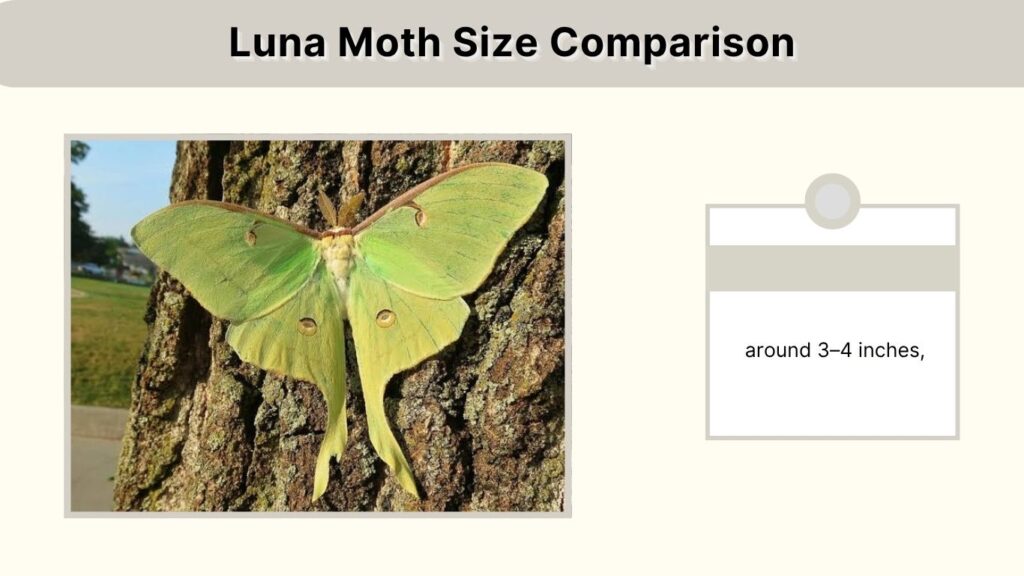
Compared with most small moths that gather around porch lights, Luna moths are strikingly large. Their combination of broad wings, long tails, and relatively thick bodies creates an impressive appearance.
For perspective, an adult Luna moth’s wingspan can approach the width of a small smartphone.
Is a Luna Moth Bigger Than Your Hand?
It depends on the person’s hand and how the moth is positioned.
With a wingspan around 3–4 inches, an average Luna moth may cover much of an adult palm but normally will not exceed the entire length of an adult hand from wrist to fingertips.
However, photographs often make them appear larger because their wings are displayed flat and their hindwing tails extend beyond the main wing surface.
Why Do Luna Moths Look So Large?
Several physical characteristics contribute to their impressive appearance.
Their forewings and hindwings are broad, while the hindwings end in exceptionally long tails. Each wing also has a noticeable eyespot. Combined with their pale green coloration and thick, fuzzy body, these features create a much larger visual profile.
Luna moths belong to the Saturniidae, or giant silk moth family, a group that contains some of North America’s largest moths.
Luna Moth Caterpillar Size
Before becoming a spectacular winged insect, the Luna moth spends an important part of its life as a large green caterpillar.
A fully grown Luna moth caterpillar usually reaches approximately 55–70 mm, or about 2 1/8 to 2 3/4 inches long, according to the University of Florida. Texas A&M Forest Service similarly describes a mature caterpillar as reaching roughly 3 inches and becoming about as thick as an adult person’s index finger.
What Does a Full-Grown Luna Moth Caterpillar Look Like?
A mature caterpillar is thick-bodied and bright green. It has small raised bumps and sparse hairs along the body, with subtle yellowish markings.
Identification features commonly include:
- Bright green body
- Approximately 2–3 inches long when mature
- Thick, rounded body
- Sparse hairs
- Small raised bumps along the body
- Yellowish lines or markings
- Reddish or pinkish spots may be visible
Despite their large appearance, Luna moth caterpillars are considered harmless to people.
How Fast Does the Caterpillar Grow?
A newly hatched Luna moth caterpillar is tiny compared with its mature size.
Early larvae may measure only several millimeters long. As they feed and pass through successive growth stages, known as instars, their bodies increase significantly in both length and thickness. University of Virginia information notes that Luna moth larvae can ultimately reach around 70 mm (2¾ inches).
This rapid transformation makes the difference between the egg, young caterpillar, and mature larva particularly dramatic.
Luna Moth Egg Size
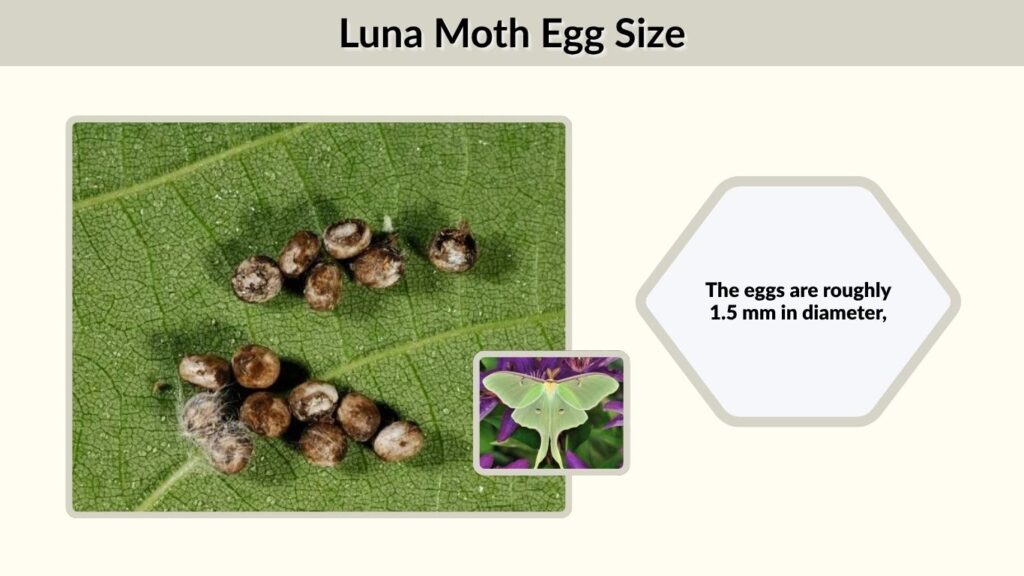
Luna moth eggs are surprisingly small considering the impressive size of the adult.
The eggs are roughly 1.5 mm in diameter, slightly oval and generally mottled or covered with brownish coloration.
Female Luna moths place their eggs on suitable host plants where the emerging caterpillars can quickly begin feeding.
Luna Moth Egg vs Adult Size
The difference between the egg and adult moth demonstrates how dramatically the insect changes during its life cycle.
An egg measuring only around 1.5 mm eventually produces an adult with wings spanning approximately 75–105 mm.
That means the adult’s wingspan can be dozens of times greater than the diameter of the original egg.
Luna Moth Cocoon and Pupa Size
Once fully grown, the caterpillar stops feeding and prepares to pupate. It produces silk and commonly incorporates leaves around itself to form a protective cocoon.
Rather than hanging prominently from branches like some silk moth cocoons, Luna moth cocoons may become wrapped among fallen or dried leaves. Penn State notes that Luna moth cocoons can remain disguised among leaf litter before adults emerge.
Is the Cocoon as Large as the Adult Moth?
No. The cocoon is much smaller than the wingspan of the adult moth.
The adult’s large wings develop while the insect is inside the pupal stage. When a Luna moth first emerges, its wings are initially small and crumpled. They subsequently expand to their full dimensions before the moth begins normal flight.
Therefore, finding a relatively modest-sized cocoon does not indicate that the emerging moth will be small.
Male vs Female Luna Moth Size
Male and female Luna moths are generally similar in overall wingspan, so size alone is not the most reliable way to determine sex.
The abdomen provides a better clue. Females usually have noticeably larger, heavier-looking abdomens because they carry eggs. Males tend to have slimmer abdomens and particularly large, feathery antennae.
These antennae help males detect pheromones released by females.
Does Luna Moth Size Vary?
Yes. Not every adult reaches exactly the same dimensions.
Genetics, sex, larval development, food availability, environmental conditions, and geographic population can contribute to differences among individuals.
For practical identification, an adult moth measuring approximately 3–4 inches across, with pale green wings, eyespots, and long tails, fits the typical Luna moth size and appearance.
Extremely unusual measurements should be treated cautiously because perspective in photographs can easily exaggerate an insect’s apparent size.
Luna Moth Size and Weight
There is no single useful standard weight for a wild adult Luna moth because body mass varies with sex, developmental condition, hydration, and reproductive status.
Females generally appear heavier through the abdomen because they carry eggs, while males tend to have slimmer bodies.
For identification, wingspan is much more commonly used than weight. If you are trying to determine whether a large green moth is a Luna moth, its 3–4-inch wingspan, long tails, eyespots, coloration, and antenna shape are more informative than trying to estimate its weight.
Luna Moth vs Lunar Hornet Moth Size
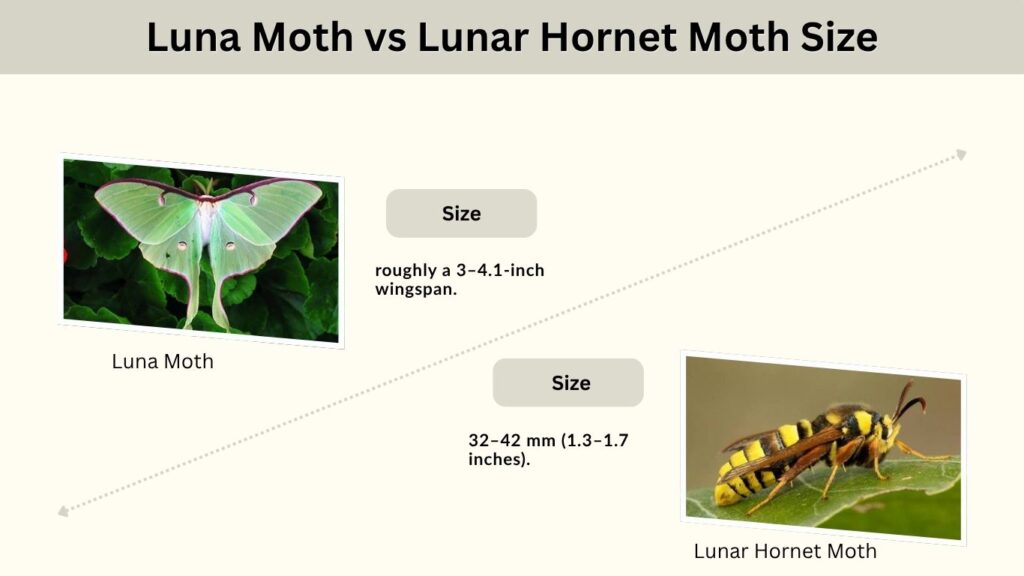
Despite their similar names, the Luna moth and lunar hornet moth are completely different moths.
The Luna moth (Actias luna) is a large North American silk moth with roughly a 3–4.1-inch wingspan. The lunar hornet moth (Sesia bembeciformis) is a European clearwing moth that mimics the appearance of a hornet and has a wingspan of only about 32–42 mm (1.3–1.7 inches).
Therefore, searches for “lunar moth size” may refer to the Luna moth, but lunar hornet moth size describes a separate species.
FAQs
How big can a Luna moth get?
Most adult Luna moths have a wingspan of roughly 3 to 4.1 inches (7.5–10.5 cm). Their long hindwing tails make them look even larger than their measured wingspan suggests.
What is the average Luna moth wingspan?
A useful general range is approximately 3–4 inches across. Individual moths vary, so not every adult reaches exactly the same size. Clemson University reports approximately a 3–4.5-inch wingspan for the species.
How big is a Luna moth caterpillar?
A full-grown Luna moth caterpillar generally reaches about 55–70 mm, or 2.1–2.75 inches long. Some descriptions round mature size to approximately 3 inches.
Are female Luna moths bigger than males?
Females and males can have similar wingspans, but females typically have noticeably larger abdomens because they carry eggs. Males usually have slimmer bodies and much broader, more strongly feathered antennae.
Is the Luna moth one of the largest moths?
Yes. The Luna moth belongs to Saturniidae, the giant silk moth family, which includes many of North America’s largest moths. With a wingspan commonly around 3–4 inches, the Luna moth is considerably larger than many moth species people encounter around homes and gardens.