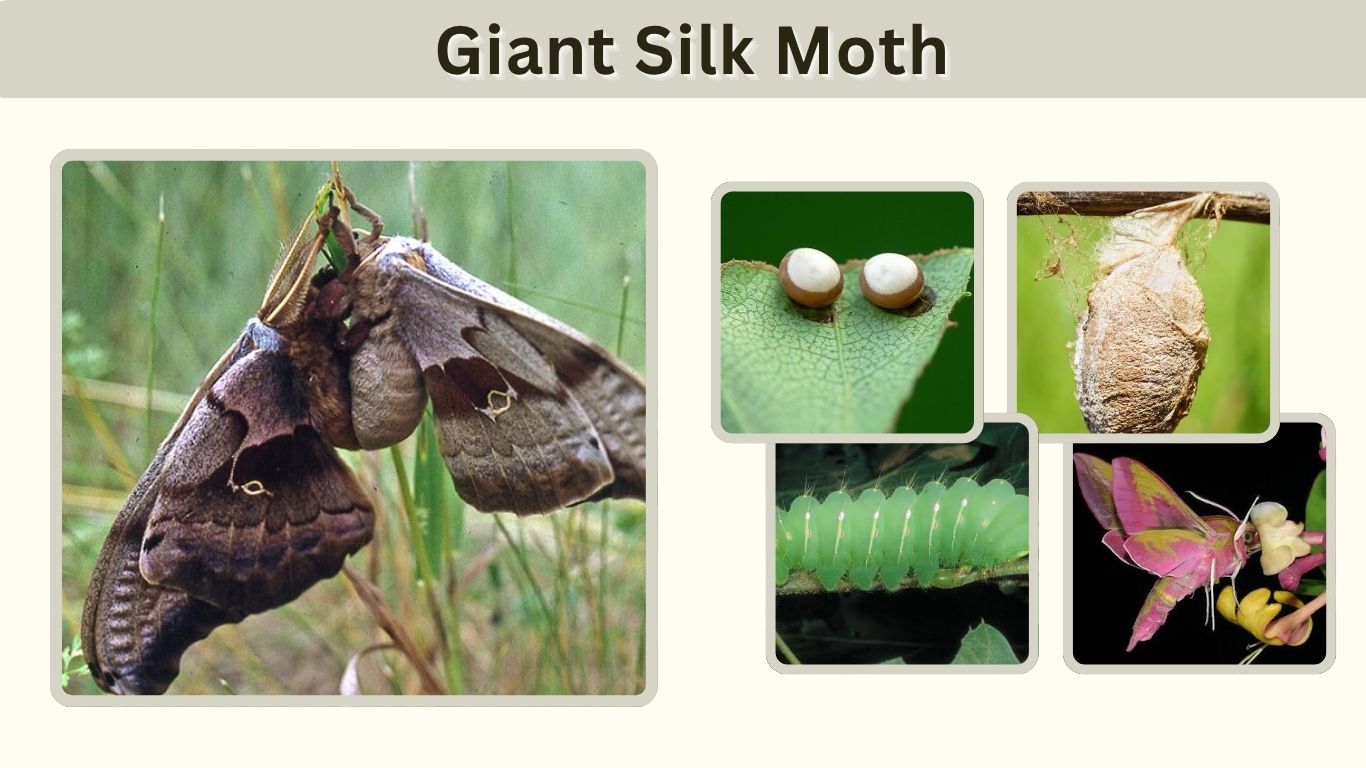
Giant silk moths are some of the largest and most striking moths in the world, recognized for their broad wings, bold patterns, and impressive caterpillars. Most belong to the family Saturniidae, which includes famous species such as the cecropia, Polyphemus, luna, and io moths. Their caterpillars spend weeks feeding and growing before spinning protective cocoons. Adult giant silk moths usually live only a short time because many species do not eat as adults. Their unusual life cycle, size, and appearance make them fascinating insects to observe.
What Is a Giant Silk Moth?
The term giant silk moth generally refers to large moths in the family Saturniidae. These moths occur in many regions of the world and include hundreds of species with different colors and wing patterns. Despite their impressive size, they are usually harmless. Their name comes partly from the strong silk cocoons produced by their caterpillars before pupation.
Giant Silk Moth Identification
Common characteristics of giant silk moths include:
- Broad, powerful-looking wings
- Large body compared with many other moths
- Prominent eyespots or colorful wing markings
- Feathery antennae, especially in males
- Thick, furry-looking thorax
- Wingspans that may exceed several inches
- Large caterpillars before the adult stage
- Silk cocoons produced before pupation
Colors vary dramatically between species. Some are brown or gray, while others display green, orange, red, pink, yellow, or white markings.
How Big Is a Giant Silk Moth?
Size depends on species. Some giant silk moths have wingspans of around 3 inches, while the largest members of the family can become considerably bigger.
North American species such as the cecropia moth are particularly impressive. Females are generally larger-bodied because they carry eggs, while males often have broader, more strongly feathered antennae that help them detect female pheromones.
Giant Silk Moth Species
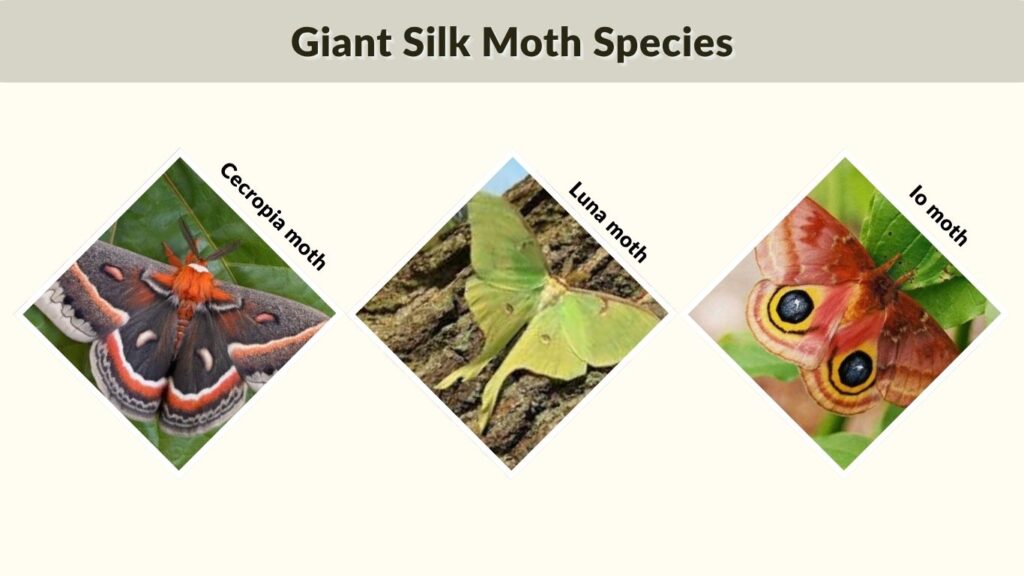
Giant silk moths are found across North America, Asia, Africa, Australia, and other regions. Individual species vary in size, coloration, caterpillar appearance, host plants, and geographic distribution. Some have dramatic eyespots that resemble the eyes of larger animals, while others rely on leaf-like camouflage to avoid predators.
Common Types of Giant Silk Moths
Well-known species include:
- Cecropia moth: One of the largest moths in North America.
- Polyphemus moth: Brown with large transparent-looking eyespots.
- Luna moth: Pale green with long hindwing tails.
- Io moth: Yellow or brown with prominent eyespots.
- Promethea moth: Displays noticeable differences between males and females.
- Imperial moth: Large yellow moth with purple or brown markings.
- Japanese giant silk moth: A large Asian saturniid with striking patterns.
- Rothschild’s silk moth: Known for colorful wings and dramatic markings.
Each species has particular habitat requirements and preferred caterpillar host plants.
Giant Silk Moths of North America
North America supports several spectacular giant silk moths. The cecropia, luna, Polyphemus, promethea, and io moths are among the best-known representatives.
They can occur in forests, wooded suburbs, gardens, and areas containing suitable host trees. Adults are usually most active at night and may occasionally appear near outdoor lights.
Their populations and exact ranges differ across the continent, so not every species occurs in every state or province.
Giant Silk Moth Caterpillar
Before becoming a large winged moth, every giant silk moth passes through a caterpillar stage. These caterpillars are often nearly as impressive as the adults. Many grow very large and develop colorful bumps, spines, or other distinctive structures as they mature. Their main purpose during this stage is to eat, grow, and store enough energy for metamorphosis and adult reproduction.
What Does a Giant Silk Moth Caterpillar Look Like?
Typical characteristics include:
- Large, thick body
- Green, yellow, brown, or brightly patterned coloration
- Multiple body segments
- Small knobs or tubercles on many species
- Strong chewing mouthparts
- Several molts during growth
- Size increasing dramatically before pupation
Cecropia caterpillars, for example, can become bright green with colorful raised tubercles. Polyphemus caterpillars are also large and green but have a different pattern and body structure.
What Do Giant Silk Moth Caterpillars Eat?
The caterpillars eat leaves from specific host plants. Their preferred plants vary between species.
Depending on the moth, caterpillars may feed on trees such as maple, oak, birch, willow, cherry, walnut, hickory, sassafras, or other deciduous plants.
Young caterpillars consume relatively small amounts, but older caterpillars can eat substantial quantities of foliage before reaching the cocoon stage. They usually remain on or close to their host plant during development.
Are Giant Silk Moth Caterpillars Poisonous?
Most giant silk moth caterpillars are not dangerously poisonous to humans, but people should avoid handling unidentified caterpillars carelessly. Some saturniid caterpillars have spines or defensive structures capable of producing irritation or painful reactions. The appearance and defensive ability of caterpillars vary greatly among species, making identification important before touching one.
Can Giant Silk Moth Caterpillars Hurt You?
Many commonly encountered giant silk moth caterpillars, including mature cecropia and Polyphemus caterpillars, are generally considered harmless to handle gently.
However, the io moth caterpillar is different. It has branching spines that can cause a painful stinging sensation when they contact skin.
For this reason, never assume that every large green silk moth caterpillar is safe. Observing it without touching is usually the safest approach, especially when species identification is uncertain.
Giant Silk Moth Life Cycle
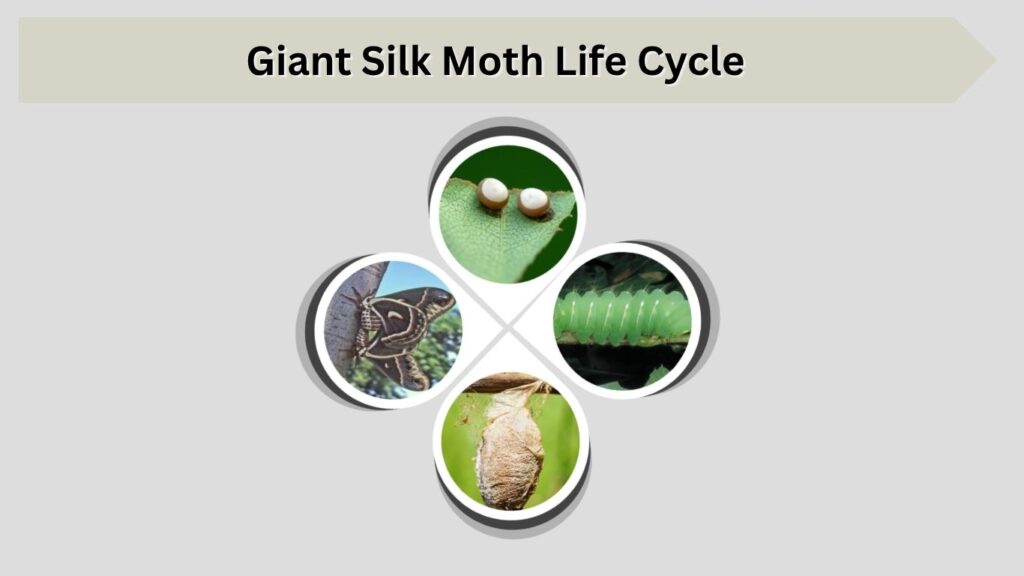
Giant silk moths undergo complete metamorphosis, passing through four distinct life stages: egg, caterpillar, pupa, and adult. Most of their active feeding occurs during the caterpillar stage. Once adulthood is reached, the moth’s priorities change almost entirely to mating and reproduction. This unusual pattern explains why adults often survive for only a short period.
Giant Silk Moth Life Cycle Stages
Their development includes:
- Egg: Females lay eggs on or near suitable host plants.
- Larva: Caterpillars hatch and begin eating leaves.
- Instars: Caterpillars molt repeatedly as they grow.
- Cocoon: Mature caterpillars spin silk around themselves.
- Pupa: Metamorphosis occurs inside the cocoon.
- Adult: The moth emerges, mates, and completes reproduction.
Depending on species and climate, the pupal stage may last through winter before adults emerge during warmer weather.
Giant Silk Moth Eggs
Females generally deposit eggs on plants that their offspring can use for food after hatching. Eggs may be placed individually or in small groups.
After hatching, tiny caterpillars immediately begin feeding. Because adult females often have only a short lifespan, egg laying usually occurs soon after mating.
The number of eggs can vary considerably, but a female may produce many offspring during her brief adult life.
Giant Silk Moth Cocoon
When a caterpillar reaches full size, it stops feeding and searches for a suitable place to pupate. It then produces silk and forms a protective cocoon. Depending on the species, the cocoon may be attached to a branch, wrapped within leaves, or hidden among vegetation and leaf litter.
What Does a Giant Silk Moth Cocoon Look Like?
Common cocoon features include:
- Tough layers of silk
- Brown, tan, gray, or cream coloration
- Oval or elongated shape
- Attachment to twigs or branches in some species
- Dead leaves incorporated into some cocoons
- A protected pupa inside
The silk casing helps protect the developing moth from weather and some predators.
The moth remains inside while dramatic changes transform the caterpillar’s body into the adult form. When development is complete and environmental conditions are appropriate, the adult moth emerges.
What Do Giant Silk Moths Eat?
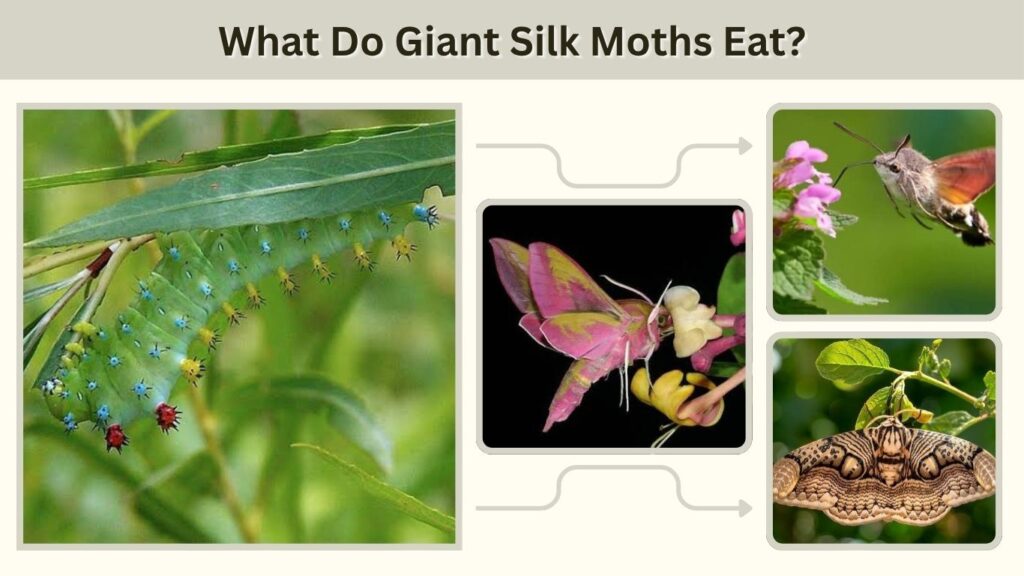
Adult feeding behavior is one of the most interesting aspects of giant silk moth biology. Many familiar Saturniidae species do not eat at all during adulthood. Their mouthparts are reduced or nonfunctional, so they depend entirely on stored energy accumulated while they were caterpillars.
Why Giant Silk Moths Do Not Eat as Adults
Adult giant silk moths devote their short lives primarily to reproduction. Because their caterpillar stage provides the necessary energy reserves, adults may survive without feeding.
Males spend considerable energy searching for females. Their large, feathery antennae can detect tiny amounts of female pheromones over considerable distances.
Females usually remain closer to suitable habitat, mate, and then lay their eggs. Once their stored energy is exhausted, the adults die naturally.
Giant Silk Moth Lifespan
The total life cycle can last many months, particularly when the insect spends winter as a pupa. However, the adult stage is surprisingly brief. Giant silk moths are designed for reproduction rather than long-term adult survival, so their impressive appearance may only be seen for a short period each year.
How Long Do Giant Silk Moths Live?
An adult giant silk moth commonly lives for roughly one to two weeks, although exact lifespan varies by species and environmental conditions.
Caterpillars live longer because they must feed through several developmental stages. Pupae may remain inside cocoons for months, particularly in regions with cold winters.
Therefore, most of the moth’s life is spent developing rather than flying as an adult.
Are Giant Silk Moths Dangerous?
Their large bodies and dramatic markings can make giant silk moths look intimidating, but adults are generally harmless to people. They are neither aggressive nor equipped to sting. Many also lack functional feeding mouthparts, making them incapable of biting humans in the way people sometimes imagine.
Can Giant Silk Moths Bite?
Adult giant silk moths do not pose a biting threat. Many species have greatly reduced mouthparts and cannot feed at all.
Their large size can occasionally surprise someone when a moth flies near a porch light or lands nearby, but the insect is usually focused on finding a mate.
The main caution involves certain caterpillar species with irritating or stinging spines rather than the adult moth itself.
FAQs
What Is a Giant Silk Moth?
A giant silk moth is a large moth belonging primarily to the family Saturniidae. Members include cecropia, Polyphemus, luna, io, and many other species. They are known for large wings, striking patterns, impressive caterpillars, and silk cocoons.
What Do Giant Silk Moths Eat?
Many adult giant silk moth species do not eat because their mouthparts are reduced or nonfunctional. They survive using energy stored during the caterpillar stage. Their caterpillars, however, eat large quantities of leaves from specific trees and other host plants.
Are Giant Silk Moth Caterpillars Poisonous?
Not all giant silk moth caterpillars are dangerous. Many, including cecropia and Polyphemus caterpillars, are generally harmless. However, some species such as io moth caterpillars have stinging spines that can cause painful skin irritation, so unidentified caterpillars should not be handled.
How Long Do Giant Silk Moths Live?
Adult giant silk moths usually live only about one or two weeks, depending on species and environmental conditions. Their entire life cycle is much longer because they spend considerable time as eggs, feeding caterpillars, and pupae developing inside protective cocoons.
Are Giant Silk Moths Rare?
The abundance of giant silk moths varies considerably by species and location. Some remain relatively common in suitable habitat, while others are encountered less frequently. Because adults are nocturnal and live only briefly, they may seem much rarer than they actually are.