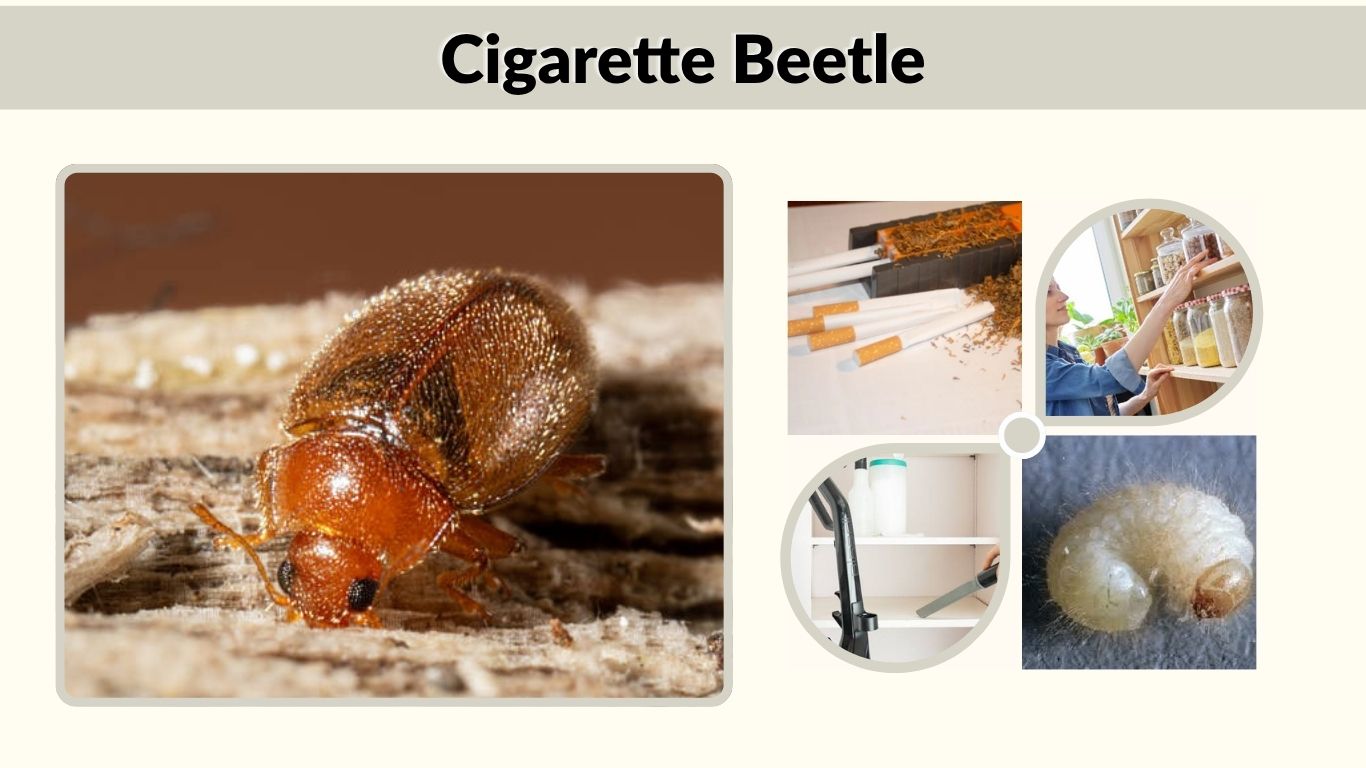
The cigarette beetle is a tiny reddish-brown pantry pest that attacks tobacco and many dried foods. Despite its name, it is not limited to cigarettes. It can infest spices, flour, cereal, rice, dried fruit, chocolate, pet food, birdseed, and similar stored products.
Adult beetles often appear near windows, lights, kitchen cabinets, or bedroom walls after flying away from the original infestation. They do not bite people, but their larvae can contaminate and damage valuable food products.
Cigarette Beetle Quick Facts
| Feature | Description |
| Scientific name | Lasioderma serricorne |
| Other name | Tobacco beetle |
| Adult size | Approximately 2–3 mm |
| Color | Yellowish-brown to reddish-brown |
| Body shape | Small, oval, and humpbacked |
| Can it fly? | Yes |
| Harmful stage | Larva |
| Main food | Tobacco and dried stored products |
| Bites humans | No |
| Typical life cycle | Approximately 40–90 days |
The cigarette beetle occurs worldwide and can produce several overlapping generations annually in warm environments. Its development speed depends mainly on temperature and the available food.
What Does a Cigarette Beetle Look Like?
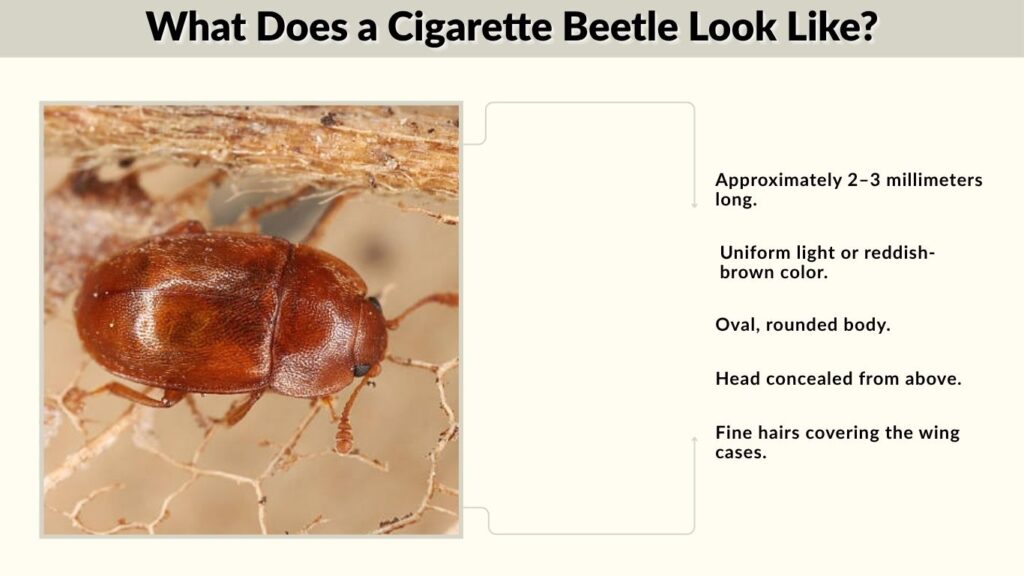
Adult cigarette beetles are extremely small, oval insects with a rounded, humpbacked appearance. Their heads bend downward and are mostly hidden beneath the thorax when viewed from above.
Cigarette Beetle Identification
Important characteristics include:
- Approximately 2–3 millimeters long
- Uniform light or reddish-brown color
- Oval, rounded body
- Head concealed from above
- Fine hairs covering the wing cases
- Smooth-looking wing covers
- Saw-like or serrated antennae
- Fully developed wings
Adults can fly and are attracted to light, so they are commonly discovered around windows even when the infestation began in a pantry or another room.
Cigarette Beetle Larvae
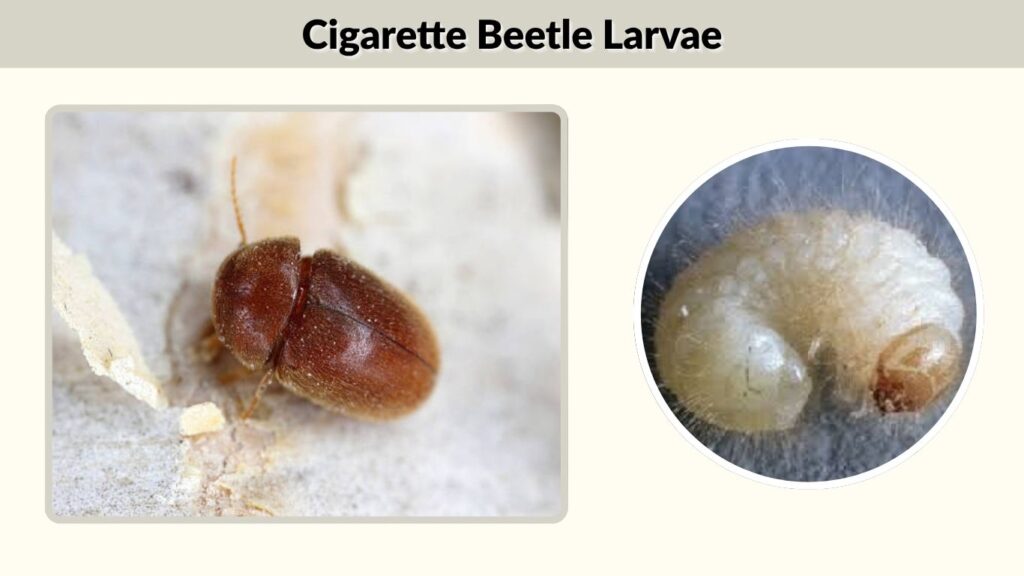
The larvae are cream or yellowish-white, curved grubs with brown heads. Fine hairs cover their bodies, giving them a slightly fuzzy appearance.
Larvae are the damaging stage. They move through stored products, feed continuously, and may create a protective cell or cocoon from food particles and debris before pupating. Adults generally do not feed after emerging.
Cigarette Beetle Eggs and Life Cycle
Female cigarette beetles lay approximately 10–100 eggs directly in or around suitable food. The eggs are extremely small and difficult to detect during an ordinary pantry inspection.
The complete life cycle includes four stages:
- Egg: Eggs are deposited near food and usually hatch within several days.
- Larva: The larva feeds and causes most of the product damage.
- Pupa: A mature larva constructs a protective cell before transforming.
- Adult: The adult emerges, mates, lays eggs, and may fly toward light.
Under favorable conditions, the complete life cycle commonly takes about 40–90 days. Warm temperatures allow populations to develop faster and may support five or six overlapping generations per year.
What Do Cigarette Beetles Eat?
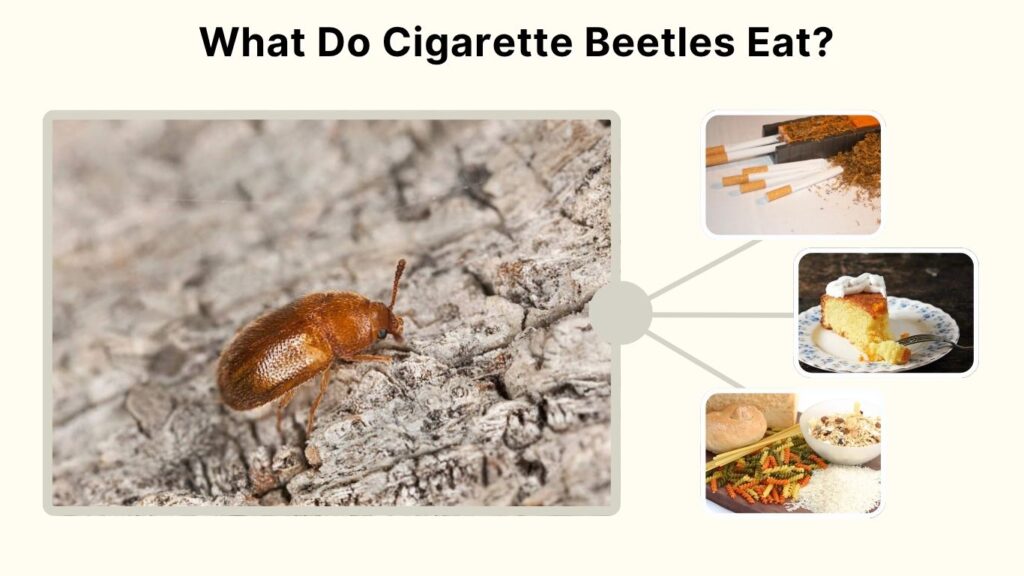
Cigarette beetles feed on many dried plant-based products. Their ability to survive on such a broad range of materials makes them difficult pantry pests.
Commonly infested products include:
- Cigarettes, cigars, and loose tobacco
- Flour, cake mix, and cornmeal
- Rice, pasta, cereal, and crackers
- Herbs and spices
- Cocoa and chocolate
- Coffee beans
- Nuts and seeds
- Raisins, dates, and other dried fruits
- Dry dog and cat food
- Birdseed
- Dried flowers and decorative plants
Spices such as paprika, chili powder, and cayenne pepper are especially important to inspect because infestations may remain unnoticed inside rarely used containers.
Where Do Cigarette Beetles Come From?
Cigarette beetles are usually brought into a home inside an already-infested food package. Eggs or young larvae may be present before the product is purchased.
Once adults emerge, they can fly into other rooms and appear on:
- Windowsills
- Kitchen walls
- Ceilings
- Bathroom surfaces
- Bedroom furniture
- Beds and bedding
- Lamps and light fixtures
Finding a cigarette beetle in a bedroom does not necessarily mean it is breeding in the bed. The adult may have flown from dry food, pet treats, tobacco, dried flowers, or another infested material elsewhere in the house.
Are Cigarette Beetles Harmful to Humans?
Cigarette beetles do not bite, sting, drink blood, or live on people. They are not considered human parasites.
Their main concern is food contamination. Larvae, shed skins, fecal material, web-like debris, and dead insects may accumulate inside infested products. Food showing signs of active infestation should be sealed and discarded rather than eaten.
Skin bumps appearing at the same time as cigarette beetles are likely caused by another source, such as mosquitoes, fleas, bed bugs, mites, or skin irritation.
Cigarette Beetle Damage
Larvae damage products by feeding and tunneling through them. Adult beetles may then leave small, round exit holes in packages as they emerge.
Common signs include:
- Tiny beetles inside packages
- Cream-colored larvae in food
- Small holes in paper or plastic packaging
- Powdery food residue
- Damaged spices, tobacco, or dried foods
- Empty pupal cases
- Beetles gathering near windows
They can infest unopened items by entering through package seams or developing inside products that were contaminated before purchase.
Cigarette Beetle vs Drugstore Beetle
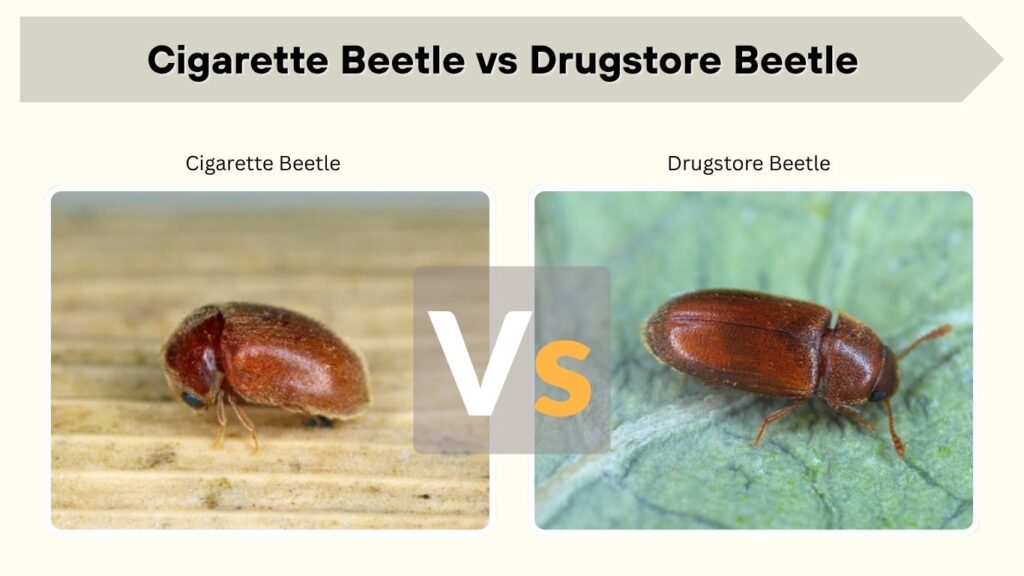
Cigarette beetles and drugstore beetles look almost identical without magnification. Both are tiny, brown, humpbacked pantry pests capable of flying.
| Feature | Cigarette beetle | Drugstore beetle |
| Scientific name | Lasioderma serricorne | Stegobium paniceum |
| Antennae | Serrated like a saw | End in a three-segmented club |
| Wing covers | Smooth and finely hairy | Have distinct grooved lines |
| Body color | Light reddish-brown | Reddish-brown |
| Main damage | Dried foods and tobacco | Dried foods, medicines, and other materials |
The clearest differences are visible under magnification. Cigarette beetles have saw-like antennae and smooth wing covers, while drugstore beetles have clubbed antennae and lined wing covers.
Cigarette Beetle vs Carpet Beetle
Carpet beetles usually have black, brown, white, or mottled coloring, depending on the species. Their larvae are elongated and noticeably hairy.
Cigarette beetles are uniformly brown and primarily infest stored food. Carpet beetle larvae more commonly damage wool, feathers, fur, animal hair, and natural-fiber fabrics.
Neither beetle bites people, although loose hairs from carpet beetle larvae can irritate sensitive skin.
Cigarette Beetle vs Bed Bug
A cigarette beetle is smaller, rounded, hard-shelled, and capable of flight. A bed bug is broader, flatter, wingless, and feeds on blood.
Bed bugs usually hide in mattress seams, headboards, bed frames, and nearby furniture. Cigarette beetles found on a bed have generally wandered or flown there from an infested stored product.
How to Get Rid of Cigarette Beetles
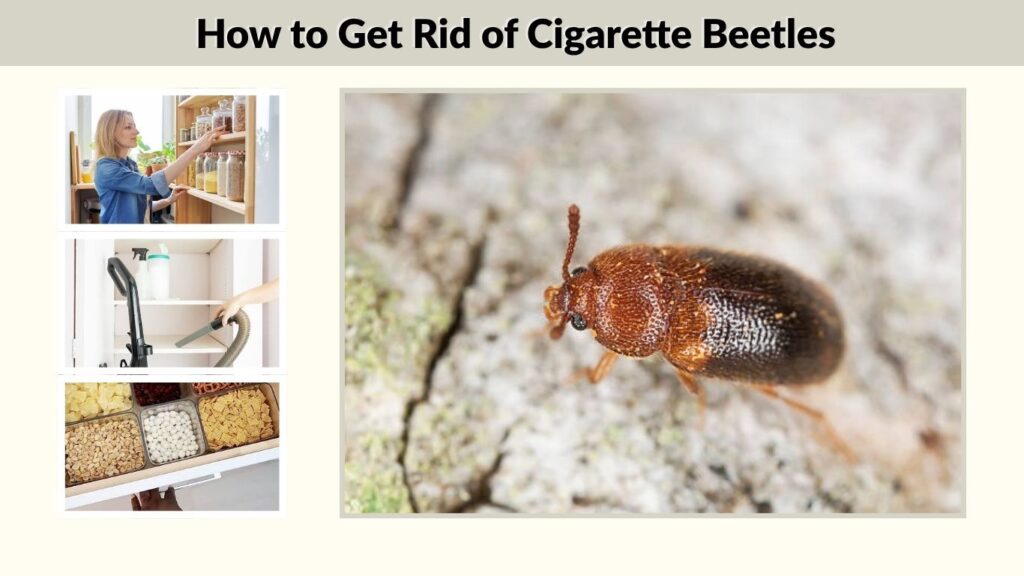
The most effective treatment is to locate and remove the breeding source. Killing only the adults seen on walls or windows will not eliminate larvae hidden inside food.
Inspect Stored Products
Empty the pantry and inspect every dried product, including unopened packages. Pay particular attention to spices, pet food, birdseed, chocolate, dried fruit, flour, and tobacco.
Look for larvae, adult beetles, damaged food, powdery residue, or tiny holes in packaging.
Discard Infested Items
Place contaminated products inside a strong plastic bag, seal it securely, and take it outside immediately. Do not leave infested food in an indoor trash container because adults may escape.
Clean the Pantry
Vacuum shelves, corners, cracks, shelf-support holes, and spilled food. Empty the vacuum outside, then wipe the cabinets and let them dry before replacing food.
Store Food Securely
Transfer dried products into airtight containers made from glass, metal, or rigid plastic. Thin bags and cardboard boxes can be penetrated or entered through small openings. Sealed containers also prevent an infestation in one product from spreading.
Do Cigarette Beetle Pheromone Traps Work?
Pheromone traps attract and capture adult male cigarette beetles. They are useful for confirming activity, locating concentrated areas, and monitoring whether control measures are working.
However, traps do not attract larvae or remove eggs and pupae inside food. They should support pantry inspection and source removal rather than serve as the only treatment.
Should You Use Cigarette Beetle Spray?
Spraying visible beetles provides only temporary control when infested food remains present. Avoid spraying pesticides directly onto food, dishes, preparation surfaces, or inside occupied food packages.
When a pesticide is necessary, use only a product labeled for the intended indoor location. Remove food and utensils before treatment and follow all label instructions concerning application, drying, ventilation, and cleanup.
FAQs
Can cigarette beetles fly?
Yes. Adults have functional wings and commonly fly toward windows or lights. This ability allows them to appear far from the infested food product.
Do cigarette beetles bite humans?
No. Cigarette beetles do not bite, sting, or feed on blood. Their larvae consume dried stored products rather than people or pets.
Why are cigarette beetles in my bedroom?
Adults may fly into bedrooms because they are attracted to light. Inspect nearby dried flowers, snacks, pet treats, tobacco, and other rooms containing stored food.
Are cigarette beetles difficult to eliminate?
They can persist when a small infested package is overlooked. Removing every breeding source, vacuuming thoroughly, and storing food in sealed containers usually provides effective control.
Should I call pest control?
Professional pest control may be needed when beetles continue appearing after all food and likely materials have been inspected. The source may be hidden inside a wall void, inaccessible storage area, or large commercial food space.