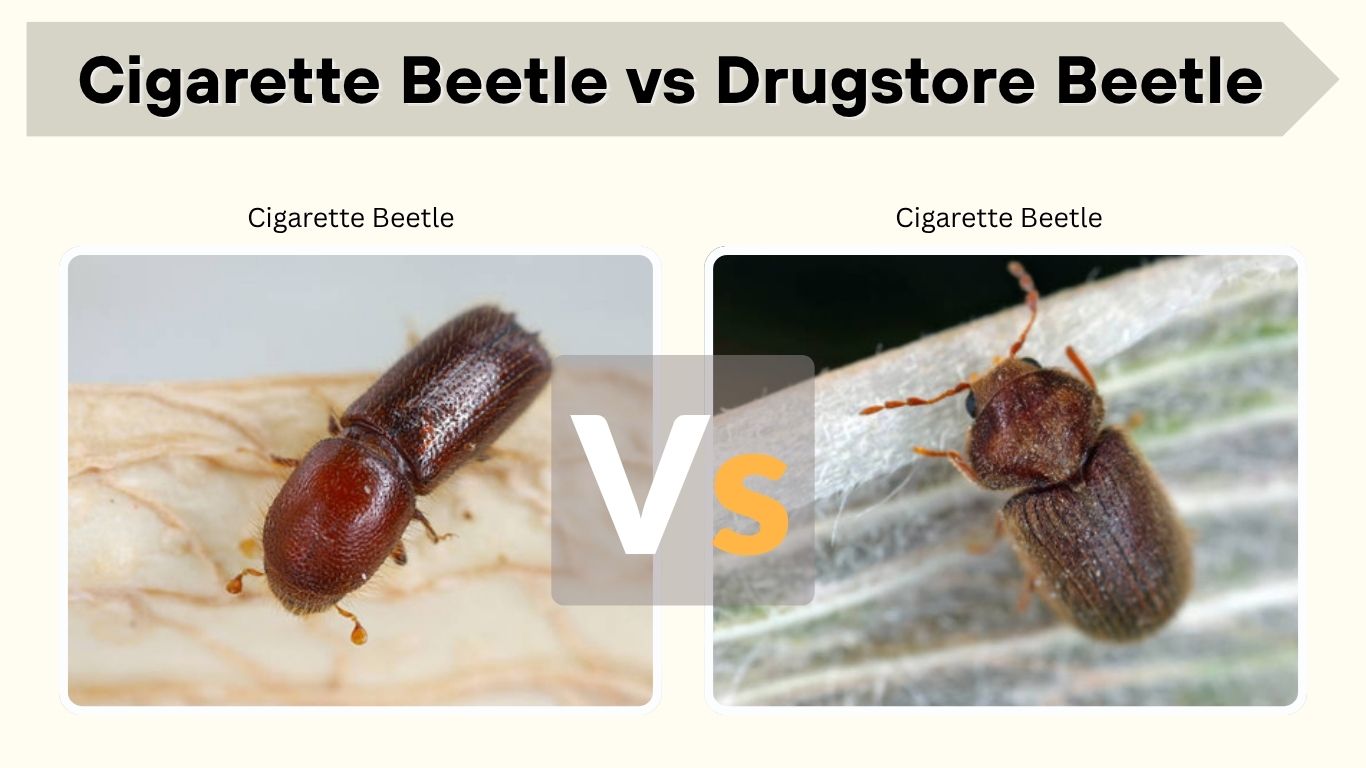
Cigarette beetles and drugstore beetles are tiny brown pantry pests that look almost identical at first glance. Both can infest spices, dried foods, pet food, seeds, and other stored products. However, you can separate them by examining their antennae, wing covers, body shape, and preferred food sources. Correct identification is useful because it helps you locate the infestation and choose suitable monitoring traps. This guide explains the important differences between cigarette beetles and drugstore beetles and how to remove either pest from your home.
Cigarette Beetle vs Drugstore Beetle: Quick Comparison
Cigarette beetles and drugstore beetles belong to the same family and have similar sizes, colors, and habits. The clearest differences are found on their antennae and wing covers.
| Feature | Cigarette beetle | Drugstore beetle |
| Scientific name | Lasioderma serricorne | Stegobium paniceum |
| Size | About 1/10 inch | About 1/10 to 1/7 inch |
| Color | Yellowish-brown to reddish-brown | Light brown to reddish-brown |
| Body shape | More rounded and humpbacked | More elongated and cylindrical |
| Antennae | Serrated or saw-like | Ends in a three-segmented club |
| Wing covers | Smooth without obvious grooves | Clearly grooved in lengthwise rows |
| Head | Bent downward | Bent downward |
| Flight | Strong flyer | Capable flyer |
| Common foods | Tobacco, spices, seeds, dried plants | Flour, biscuits, spices, medicines |
| Main damage | Contaminates tobacco and dried foods | Contaminates a wide variety of pantry goods |
What Is a Cigarette Beetle?
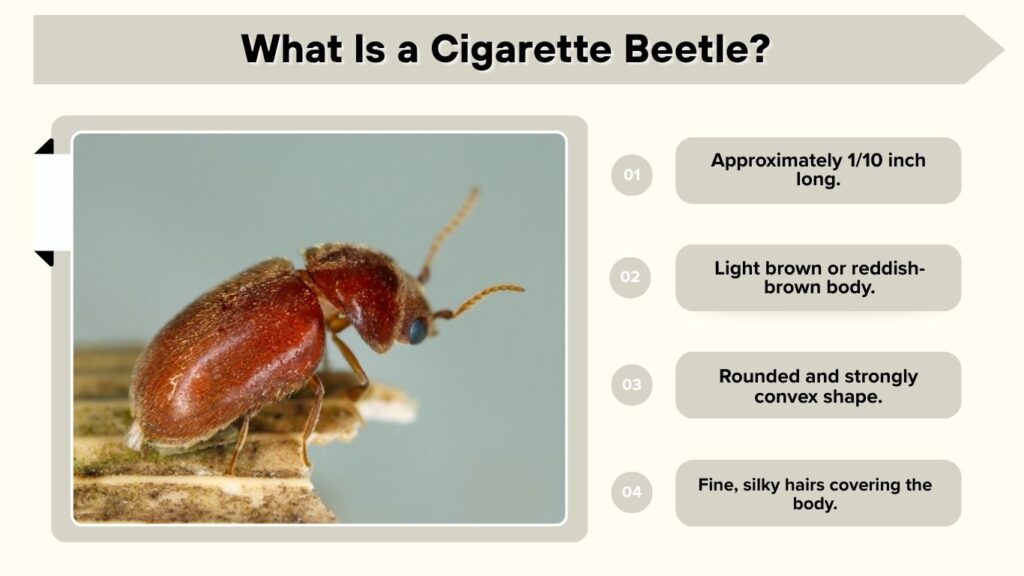
The cigarette beetle is a small stored-product pest known for feeding on tobacco products. However, it is not limited to cigarettes or tobacco. It can infest many dried foods and plant-based materials found inside homes, warehouses, shops, and food-processing facilities.
Adult cigarette beetles have oval, rounded bodies covered with fine hairs. Their heads bend downward beneath the thorax, creating a humpbacked appearance. Because of their tiny size, close inspection or magnification may be required for reliable identification.
Cigarette Beetle Identification
Look for the following characteristics:
- Approximately 1/10 inch long
- Light brown or reddish-brown body
- Rounded and strongly convex shape
- Fine, silky hairs covering the body
- Smooth wing covers without lined grooves
- Saw-like or serrated antennae
- Head hidden when viewed from above
- Adults commonly flying toward windows and lights
The serrated antennae are one of the strongest identification features. They look like a row of small teeth rather than ending in a distinct club.
What Do Cigarette Beetles Eat?
Despite their name, cigarette beetles feed on much more than tobacco. Common food sources include:
- Cigarettes and stored tobacco
- Paprika, chili powder and dried peppers
- Rice, flour and cereal
- Dried fruit and herbs
- Seeds and nuts
- Dry pet food
- Birdseed
- Dried flowers
- Leather and plant-based decorations
The larvae cause most of the damage. They remain hidden inside food or packaging while feeding and developing.
What Is a Drugstore Beetle?
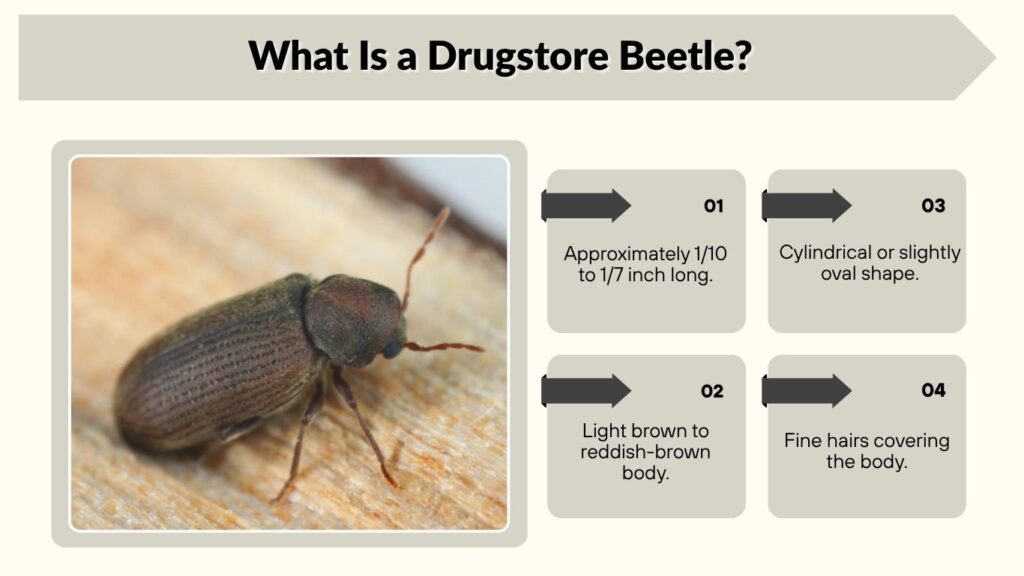
The drugstore beetle is another small stored-product pest. Its name comes from its historical habit of infesting medicinal herbs and materials stored in old drugstores. It is also known as the biscuit beetle or bread beetle.
Drugstore beetles have cylindrical brown bodies with fine hairs. Their heads are bent downward and partly concealed beneath the thorax. They commonly infest pantries, kitchens, food-storage rooms, pet-food containers, and commercial food facilities.
Drugstore Beetle Identification
Drugstore beetles can be recognized by these features:
- Approximately 1/10 to 1/7 inch long
- Light brown to reddish-brown body
- Cylindrical or slightly oval shape
- Fine hairs covering the body
- Distinct lengthwise grooves on the wing covers
- Antennae ending in a three-segmented club
- Head difficult to see from above
- Adults frequently found around lights and windows
The grooved wing covers and clubbed antennae are the best features for separating drugstore beetles from cigarette beetles.
What Do Drugstore Beetles Eat?
Drugstore beetles have an unusually broad diet. Their larvae may feed on:
- Biscuits and crackers
- Flour and baking mixes
- Pasta and cereal
- Spices and dried herbs
- Chocolate and candy
- Dried fruits
- Tea
- Dry pet food
- Birdseed
- Herbal medicines
- Books and paper
- Leather, wool and dried plants
They can sometimes chew through cardboard, paper, foil, and thin plastic packaging to reach food or escape from an infested product.
Main Differences Between Cigarette and Drugstore Beetles
These pests are closely related, but several physical features can help you tell them apart.
Antennae
The antennae provide one of the most reliable differences.
Cigarette beetles have serrated antennae. Each segment gives the antenna a saw-like appearance.
Drugstore beetles have antennae that end in a noticeable three-part club. The final three segments are larger than the remaining sections.
A magnifying glass may be necessary to examine this feature.
Wing Covers
The texture of the wing covers is another useful identification clue.
Cigarette beetles have smooth wing covers. Although the body has fine hairs, there are no obvious rows of deep lines.
Drugstore beetles have distinct grooves running lengthwise along the wing covers. These lines may be visible under magnification or in a clear close-up photograph.
Body Shape
Cigarette beetles generally appear rounder, more compact, and more strongly humpbacked.
Drugstore beetles tend to look slightly longer and more cylindrical. However, body shape can be difficult to compare without having both species together.
Food Preferences
Both beetles eat many of the same stored foods, especially spices, seeds, grains, dried herbs, and pet food.
Cigarette beetles are particularly associated with tobacco, paprika, chili powder, dried peppers, and plant materials.
Drugstore beetles are commonly associated with flour, biscuits, bread products, medicines, spices, chocolate, and dry animal food.
Food preference alone is not enough for positive identification because their diets overlap considerably.
Cigarette Beetle vs Drugstore Beetle Larvae
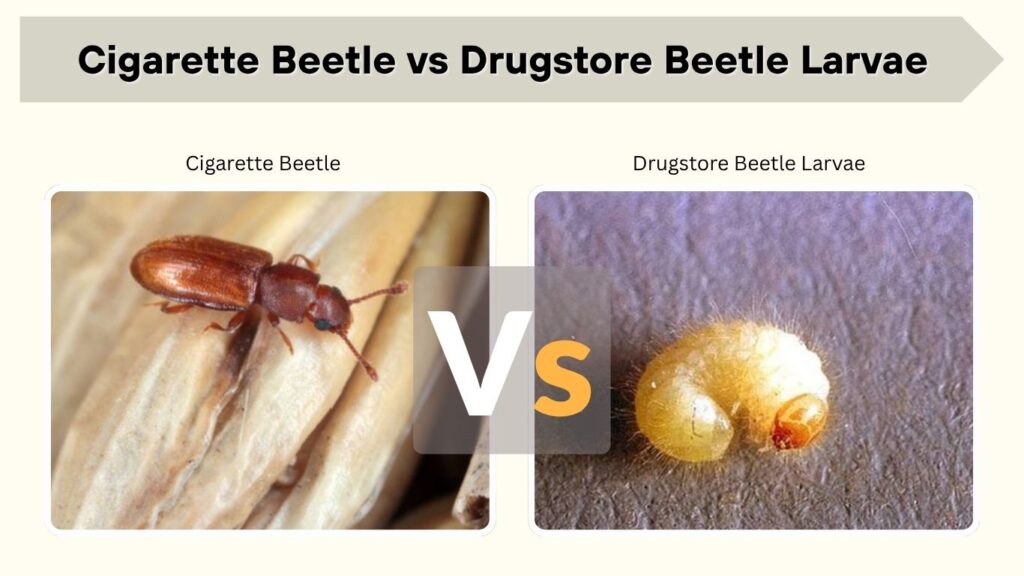
The larvae of both species are small, creamy white, curved grubs with brownish heads. They have fine hairs and usually remain concealed inside their food source.
| Feature | Cigarette beetle larva | Drugstore beetle larva |
| Color | Creamy white | Creamy white |
| Shape | Curved or C-shaped | Curved or C-shaped |
| Body covering | Fine hairs | Fine hairs |
| Location | Hidden in tobacco or food | Hidden in food or dry materials |
| Damage | Feeding and contamination | Feeding and contamination |
Because the larvae look extremely similar, identifying adults is generally easier. The infested product may provide an additional clue, but laboratory-level identification may be required in difficult cases.
Cigarette and Drugstore Beetle Eggs
Female beetles lay very small, pale eggs in cracks, food products, packaging folds, or areas containing suitable materials.
After hatching, the larvae enter the food and begin feeding. They may remain unnoticed for weeks because they develop beneath the product’s surface or inside packaging.
The eggs are difficult to see without magnification. Therefore, the absence of visible eggs does not mean a product is safe.
Drugstore and Cigarette Beetle Life Cycles
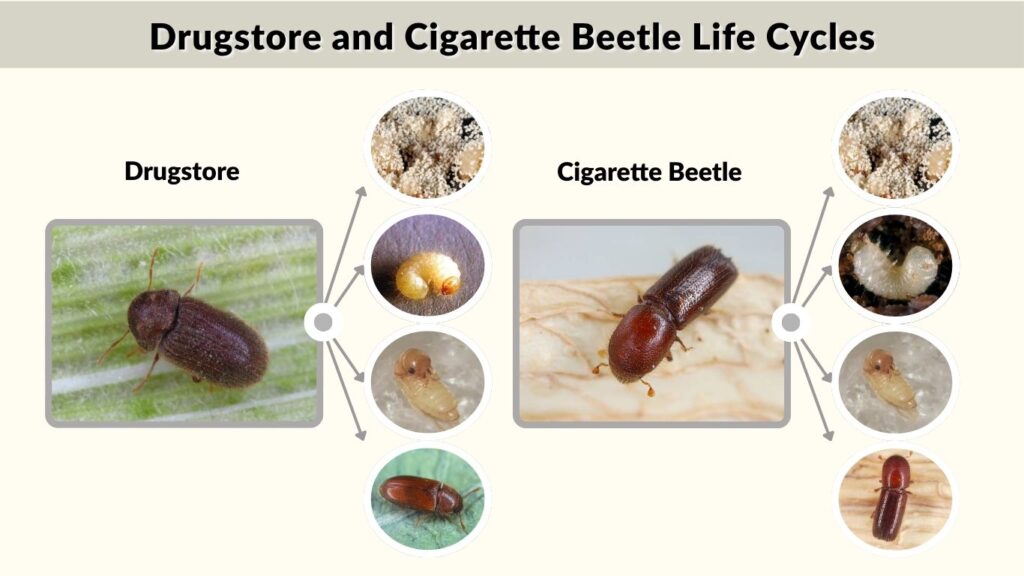
Both species undergo complete metamorphosis with four stages:
- Egg
- Larva
- Pupa
- Adult
The larval stage causes most food damage. When fully developed, the larva creates a protective cocoon or pupal cell using food particles and other materials.
The complete life cycle may take several weeks to a few months. Warm indoor temperatures and an abundant food supply allow populations to develop faster. Multiple generations may occur indoors throughout the year.
Are Cigarette and Drugstore Beetles Harmful?
Neither cigarette beetles nor drugstore beetles normally bite or sting humans. They do not live on people or feed on blood.
However, they can cause several problems:
- Contaminating food with larvae and waste
- Damaging stored products
- Creating holes in packaging
- Spreading between pantry items
- Increasing food waste
- Damaging tobacco, books or dried decorations
Eating a single beetle accidentally is unlikely to cause serious harm. Nevertheless, heavily infested food should be discarded because it may contain larvae, shed skins, waste, damaged particles, or mold.
Cigarette Beetle vs Drugstore Beetle vs Carpet Beetle
Carpet beetles may also appear as tiny indoor beetles, but they have different shapes, colors, and feeding habits.
| Feature | Cigarette beetle | Drugstore beetle | Carpet beetle |
| Typical color | Uniform brown | Uniform brown | Black, brown or patterned |
| Body shape | Rounded and humpbacked | Cylindrical | Rounded or oval |
| Main location | Pantry or tobacco products | Pantry and dry goods | Carpets, closets and windows |
| Larval food | Dried food and tobacco | Food and dry organic materials | Wool, fur, feathers and dead insects |
| Adult wing covers | Smooth | Grooved | Often patterned or scaly |
| Antennae | Serrated | Three-segmented club | Short and clubbed |
Varied carpet beetles often have mottled white, brown, yellow, or orange patterns. Black carpet beetles are darker and more elongated. Carpet beetle larvae also have visibly hairy bodies and tail-like bristles.
How to Get Rid of Cigarette and Drugstore Beetles
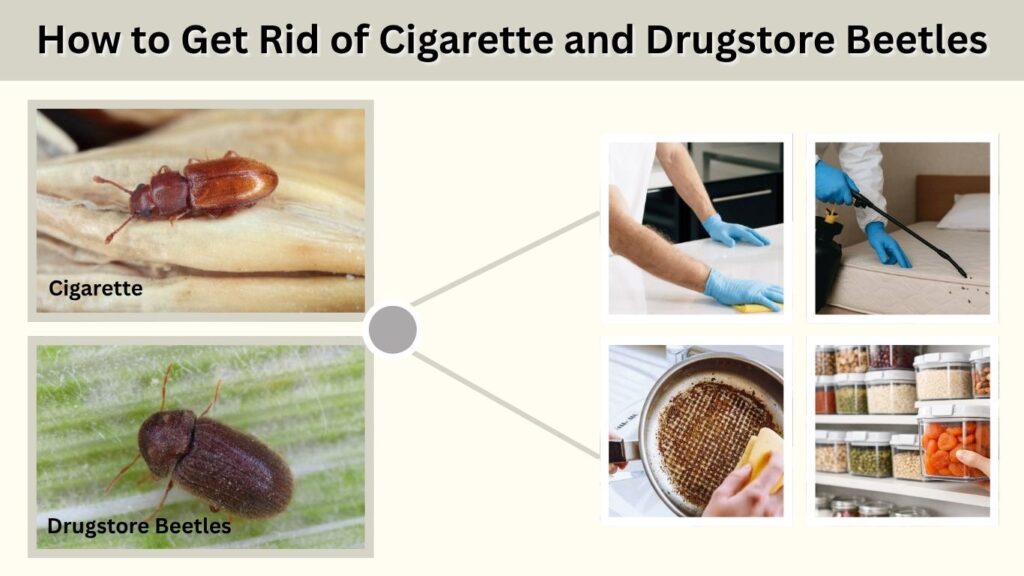
Control methods are almost identical for both species. The most important step is finding and removing the product in which the larvae are developing.
Inspect Stored Products
Check all dried products, including unopened packages. Pay special attention to:
- Spices
- Flour and cereal
- Crackers and biscuits
- Tobacco products
- Tea and dried herbs
- Pet food
- Birdseed
- Dried flowers
- Forgotten pantry products
Look for beetles, larvae, powdery residue, shed skins, web-like material, and small holes.
Discard Infested Materials
Seal infested products inside a strong plastic bag and remove them from the home. Do not leave the bag in an uncovered indoor bin because adult beetles may escape.
Vacuum and Clean
Empty the affected cabinet before vacuuming shelves, cracks, corners, hinges, peg holes, and drawer tracks.
Wash the storage area with warm, soapy water and allow it to dry. Vinegar can be used for cleaning, but it cannot eliminate larvae hidden inside food.
Store Food Properly
Place flour, spices, cereal, seeds, pet food, and other vulnerable products in airtight glass, metal, or thick plastic containers.
Thin bags and cardboard boxes do not provide sufficient protection.
Use the Correct Pheromone Trap
Pheromone traps can help identify and monitor an infestation. However, cigarette beetles and drugstore beetles may require species-specific lures.
A trap designed for one species may not effectively attract the other. Confirm the beetle’s identity before purchasing monitoring traps.
Limit Insecticide Use
Insecticides are rarely required in household pantries. Never spray food, dishes, utensils, pet bowls, or food-preparation surfaces.
A product labeled for pantry pests may sometimes be applied to empty cracks and crevices. Always follow the label instructions. A persistent infestation may require professional pest-control assistance.
FAQs
Which is bigger, a cigarette beetle or a drugstore beetle?
Both species are extremely small and similar in size. Drugstore beetles may be slightly longer, reaching about 1/7 inch, while cigarette beetles are usually close to 1/10 inch. Size alone is not reliable enough for identification.
Can cigarette and drugstore beetles fly?
Yes. Adults of both species can fly and are attracted to light. They may gather around windows, lamps, or ceilings far from the original infested product, making the source difficult to locate.
What is the easiest way to tell them apart?
Examine the antennae and wing covers. Cigarette beetles have saw-like antennae and smooth wing covers. Drugstore beetles have three-segmented clubbed antennae and clearly lined or grooved wing covers.
Do cigarette or drugstore beetles bite?
Neither species normally bites people or pets. They are stored-product pests, not blood-feeding insects. Unexplained bites are more likely to come from bed bugs, fleas, mosquitoes, mites, or another biting pest.
Can both beetles infest the same food?
Yes. Their diets overlap, and both may infest spices, dried herbs, grains, seeds, cereal, pet food, and other dry products. Physical characteristics are more dependable than the type of food when identifying them.