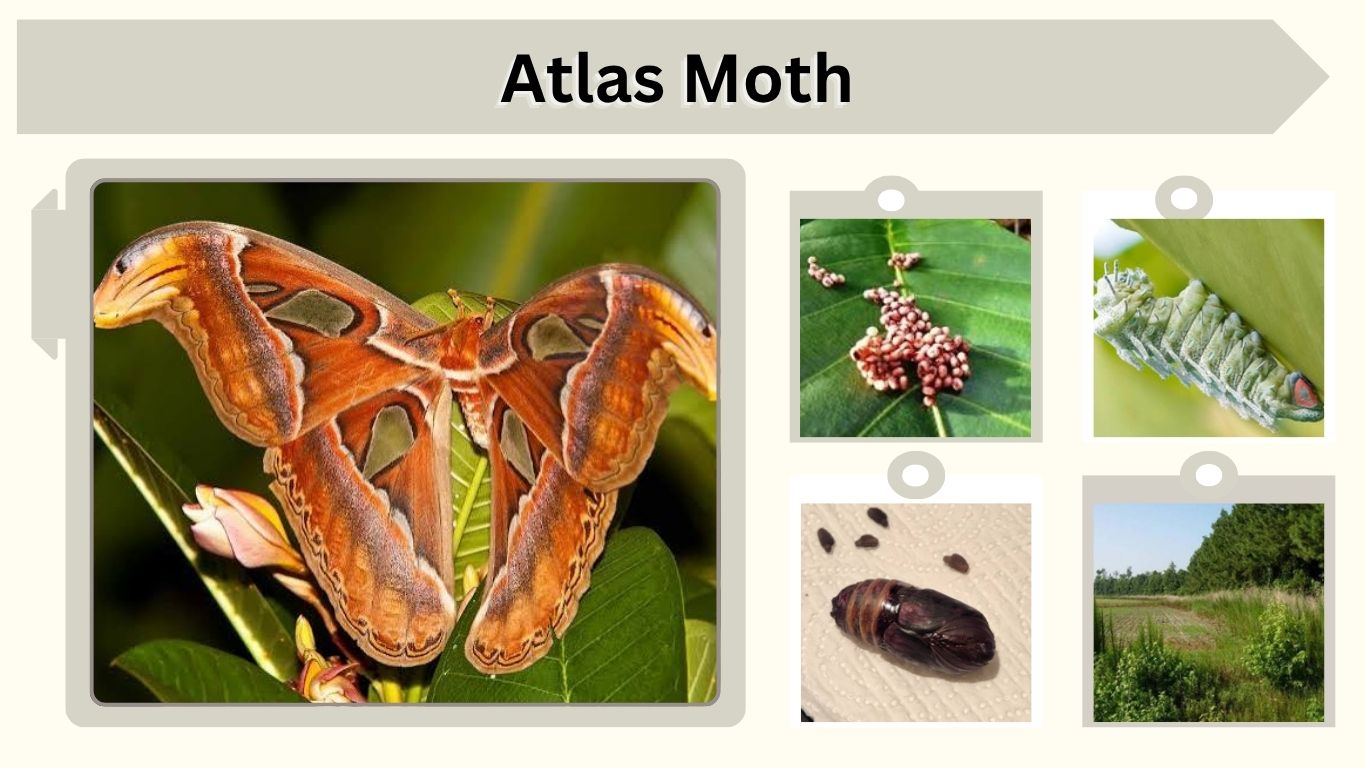
The Atlas moth (Attacus atlas) is one of the largest and most spectacular moths in the world. Famous for its enormous reddish-brown wings and snake-like wing tips, this tropical moth is native to parts of South and Southeast Asia. Its caterpillar is equally impressive, growing into a thick, pale green larva before producing a tough silk cocoon. Adult Atlas moths have an exceptionally short life because they cannot feed. Here is everything to know about their size, wingspan, caterpillar, habitat, diet, and life cycle.
Atlas Moth Identification and Appearance
The Atlas moth belongs to the giant silk moth family Saturniidae and is scientifically known as Attacus atlas. Its combination of enormous wings, rusty coloration, transparent wing patches, and unusually shaped forewing tips makes adults relatively easy to recognize. Those wing tips are especially famous because their patterns can resemble the head of a snake.
Atlas Moth Identification
- Scientific name: Attacus atlas
- Family: Saturniidae
- Color: Reddish-brown, orange, cream, black, and pinkish shades
- Wings: Extremely broad with patterned margins
- Wing patches: Large, triangular, translucent areas
- Wing tips: Curved and patterned somewhat like snake heads
- Body: Thick and comparatively small beside the huge wings
- Activity: Primarily nocturnal
- Adult feeding: Adults do not feed
The intricate wing pattern provides both beauty and possible defensive benefits. The tips of the forewings have markings that have long been compared with cobra or snake heads.
Why Do Atlas Moth Wings Look Like Snakes?
The elongated tips of the forewings contain markings that create a surprisingly snake-like appearance. The Natural History Museum notes that the moth’s Cantonese name translates to “snake’s head moth.”
When threatened, an Atlas moth may drop down and move its wings in a way that enhances this resemblance. The display may help discourage potential predators by making the harmless moth look like a more dangerous animal.
Atlas Moth Size and Wingspan
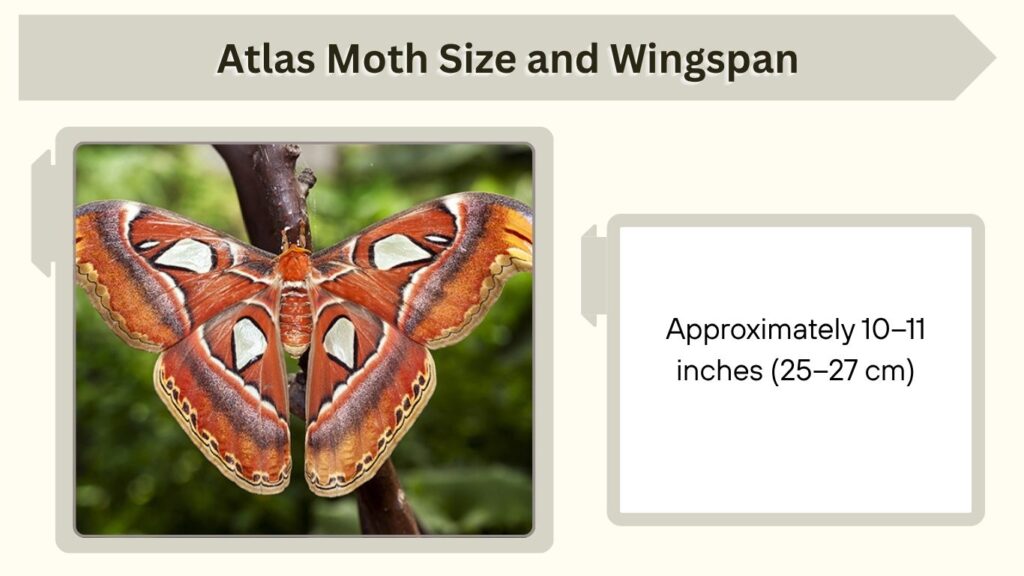
The Atlas moth is a true giant among moths. Although a few species can exceed it in wingspan, Attacus atlas is among the world’s largest moths when wing surface area is considered. Its enormous wings make it look even larger when fully spread, while females tend to be noticeably bigger and heavier-bodied than males.
How Big Is an Atlas Moth?
- Maximum wingspan: Approximately 10–11 inches (25–27 cm)
- Caterpillar length: Up to about 4.7 inches (12 cm)
- Body type: Thick-bodied giant silk moth
- Female size: Usually larger and heavier
- Male size: Generally smaller and more streamlined
The Natural History Museum reports wingspans of up to about 27 centimeters, while the California Academy of Sciences gives a maximum of roughly 10 inches. Either measurement places this moth among the giants of the insect world.
Male vs Female Atlas Moth
Female Atlas moths are generally larger than males and have heavier abdomens because they carry eggs. Males are usually smaller but possess broader, more feathery antennae.
Those large antennae help males detect chemical signals released by females. Because adults have very little time to reproduce, quickly locating a mate is particularly important.
Atlas Moth Caterpillar and Diet
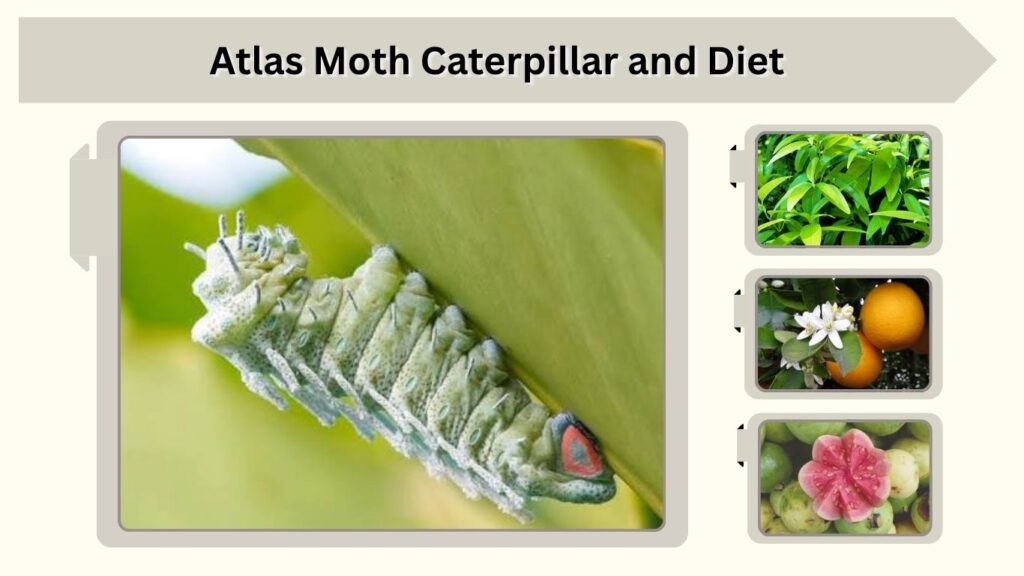
Before becoming an enormous adult, the Atlas moth spends its most important feeding period as a caterpillar. Atlas moth larvae can reach about 12 centimeters long and become remarkably thick. They consume large quantities of foliage because all the energy needed by the non-feeding adult must essentially be accumulated during the caterpillar stage.
Atlas Moth Caterpillar Identification
- Color: Pale green to bluish-green
- Body: Thick and fleshy
- Surface: Covered with whitish waxy material
- Structures: Small fleshy projections occur along the body
- Length: Can reach approximately 12 cm
- Behavior: Spends much of its time eating leaves
- Final stage: Produces silk and forms a cocoon
Young caterpillars begin small but grow dramatically through repeated molts. Fully developed larvae look almost oversized compared with ordinary garden caterpillars.
What Do Atlas Moth Caterpillars Eat?
Atlas moth caterpillars are leaf eaters. In the wild, documented host plants include cinnamon, citrus, guava, and Jamaican cherry. They may consume considerable foliage while developing.
The adult moth, however, does not continue this diet. Once it leaves the cocoon, it relies on energy reserves accumulated while it was a caterpillar.
Atlas Moth Life Cycle
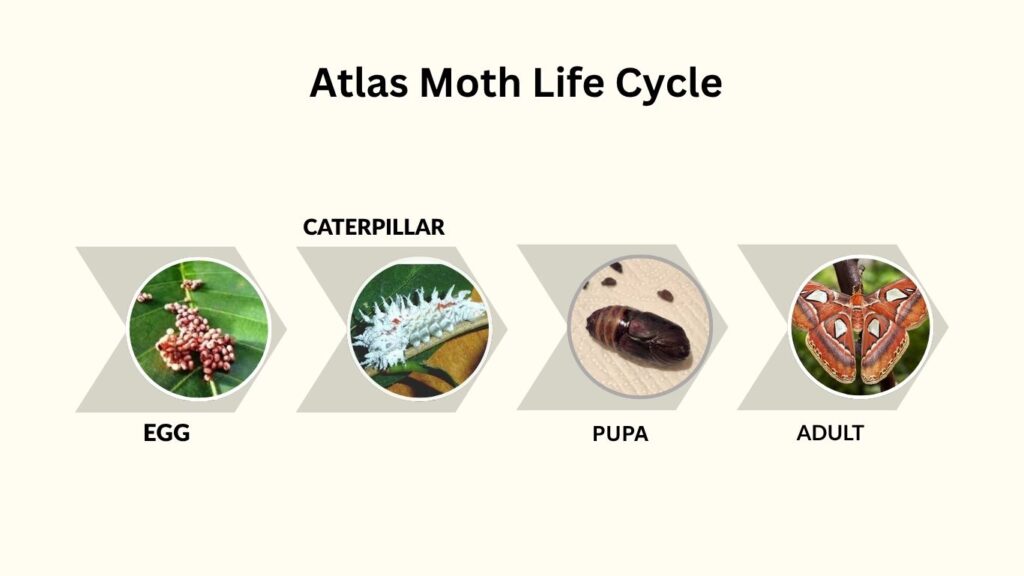
Like other moths and butterflies, the Atlas moth undergoes complete metamorphosis. Its life begins as an egg and progresses through caterpillar and pupal stages before becoming an adult. The dramatic transformation is particularly important in this species because almost all feeding and growth take place before adulthood.
Four Stages of the Atlas Moth Life Cycle
- Egg: A female lays fertilized eggs on suitable host vegetation.
- Caterpillar: The larvae hatch and begin consuming leaves.
- Pupa: A mature caterpillar encloses itself inside a silk cocoon.
- Adult moth: The adult emerges, expands its enormous wings, mates, and reproduces.
Eggs generally hatch after roughly one to two weeks, although development is influenced by environmental conditions.
Atlas Moth Cocoon and Pupa
When fully grown, the caterpillar produces strong brown silk and creates a protective cocoon. The silk produced by Atlas moth caterpillars has sometimes been called fagara silk.
Inside the cocoon, the larva becomes a pupa and undergoes the extensive transformation required to develop adult wings, antennae, legs, and reproductive structures. The durable abandoned cocoons have even been traditionally used for small purses in parts of Asia.
Atlas Moth Lifespan and Adult Behavior
The enormous adult Atlas moth has a surprisingly short life. Unlike many butterflies and moths that visit flowers to obtain nectar, adult Atlas moths emerge with a tiny, nonfunctional proboscis. Consequently, they cannot replenish their energy by eating and must survive entirely on the reserves accumulated during their caterpillar stage.
How Long Does an Atlas Moth Live?
Adult Atlas moths generally survive only around one to two weeks. Their limited stored energy means they must focus their brief adult lives on reproduction.
They often remain relatively inactive during the daytime, conserving energy. Activity increases at night when adults search for mates. Because flying with such enormous wings consumes energy, unnecessary movement is avoided.
Does an Adult Atlas Moth Eat?
No. Adult Atlas moths do not normally eat because their proboscis is extremely reduced and nonfunctional.
This means the caterpillar’s diet ultimately powers both metamorphosis and adult life. The adult emerges with a limited energy supply and cannot replace it once those reserves have been consumed.
Atlas Moth Habitat and Range
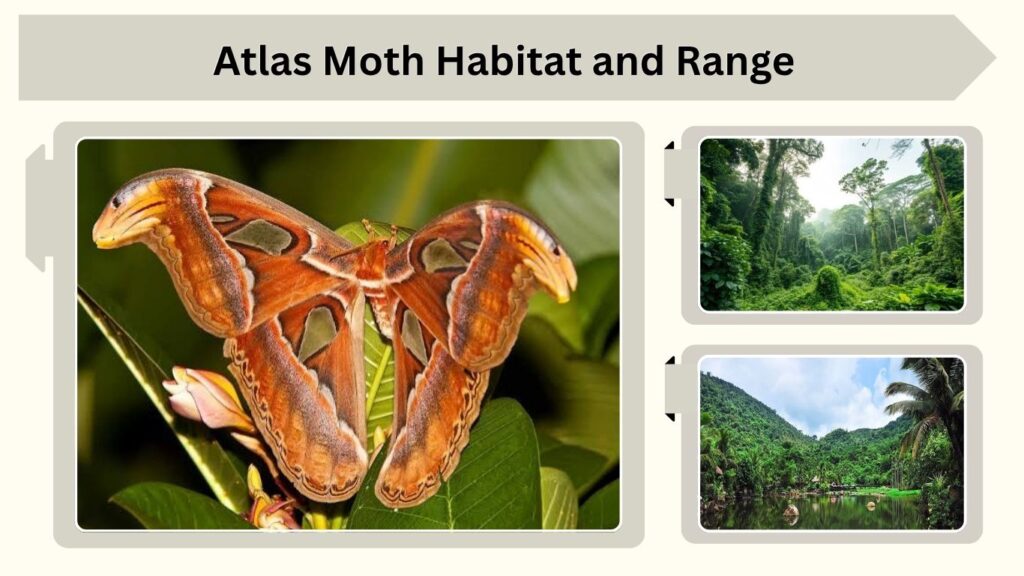
Atlas moths are native to tropical and subtropical regions of Asia. Warm temperatures and abundant host plants provide suitable conditions for their caterpillars. They are associated with forested and vegetated environments where larvae can find enough foliage to support their rapid growth and where adults can remain sheltered during daylight hours.
Where Do Atlas Moths Live?
The Atlas moth occurs naturally across parts of South, East, and Southeast Asia, including countries such as India, China, Malaysia, and Indonesia.
They are associated primarily with warm climates where their host trees and shrubs grow. Although captive Atlas moths are displayed in butterfly houses around the world, these exhibits should not be confused with the species’ natural range.
Are Atlas Moths Found in the United States?
Atlas moths are not native to the United States. A notable Atlas moth discovered in Washington State in 2022 was identified as what authorities believed to be the first confirmed U.S. record. Such isolated discoveries do not mean that an established native population exists.
Are Atlas Moths Poisonous or Dangerous?
Despite their huge size and intimidating snake-like wing patterns, Atlas moths are harmless to humans. The snake resemblance is a defensive visual display rather than evidence of venom or aggression. Adults are primarily interested in conserving energy, locating mates, and reproducing during their very short lives.
Is an Atlas Moth Poisonous?
Atlas moths are not considered poisonous or venomous to humans. Their dramatic coloration and huge wings should not be interpreted as signs that they are dangerous.
The caterpillar is also not known as one of the dangerous stinging caterpillars equipped with specialized venomous spines.
Do Atlas Moths Bite?
Atlas moths are not capable of delivering a meaningful defensive bite to humans. Adult mouthparts are greatly reduced, and the moth cannot even feed normally.
If one is encountered, it is best to observe it gently rather than handle it unnecessarily. Its large wings and scales can be damaged easily.
FAQs
Atlas moths attract plenty of attention because of their extraordinary size, unusual wings, and extremely short adult lifespan. Their biology is also different from many familiar nectar-feeding moths. The following answers cover some of the most common questions about their size, food, safety, caterpillar stage, and lifespan.
1. Is the Atlas moth the biggest moth in the world?
It is among the world’s largest moths and is especially impressive by wing surface area. However, some other moth species can achieve a greater maximum wingspan.
2. What is the Atlas moth wingspan?
A large Atlas moth can reach a wingspan of approximately 10–11 inches (25–27 cm).
3. What do Atlas moth caterpillars eat?
They eat plant leaves, including foliage from cinnamon, citrus, guava, and Jamaican cherry trees.
4. How long does an adult Atlas moth live?
Adult Atlas moths generally live for only about one to two weeks because they cannot feed and rely entirely on stored energy.
5. Are Atlas moths poisonous?
No. Atlas moths are not considered poisonous or dangerous to humans. Their snake-like wing tips are primarily a visual defensive adaptation rather than a weapon.