
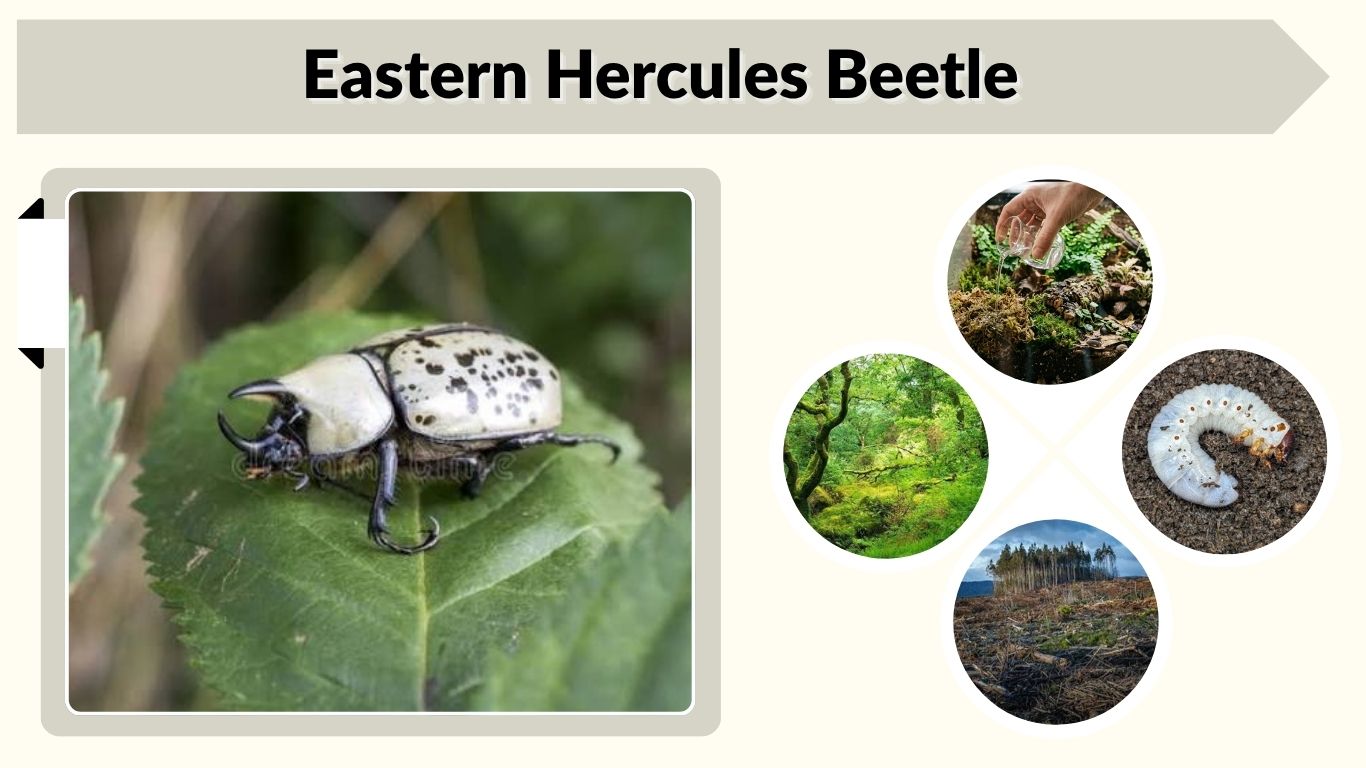
The Eastern Hercules beetle (Dynastes tityus) is one of the largest and heaviest beetles native to the eastern United States. Known for its impressive horns, strong body, and distinctive spotted appearance, this fascinating insect belongs to the rhinoceros beetle group. Male beetles have prominent horns, while females have rounded bodies without large horns. Despite their intimidating appearance, Eastern Hercules beetles are harmless to humans and play an important role in forest ecosystems. Learning about their size, identification, habitat, diet, life cycle, lifespan, and care helps explain why these remarkable beetles attract so much attention.
What Is an Eastern Hercules Beetle?
The Eastern Hercules beetle, scientifically known as Dynastes tityus, is a large species of scarab beetle belonging to the family Scarabaeidae. It is one of North America’s most recognizable rhinoceros beetles. These insects are especially notable for their unusual appearance, powerful legs, and impressive size.
Eastern Hercules Beetle Identification
Eastern Hercules beetles have distinctive characteristics that help separate them from other beetles found throughout North America.
- Scientific name: Dynastes tityus
- Common name: Eastern Hercules beetle
- Family: Scarabaeidae
- Color: Greenish-gray, yellowish-tan, or dark brown
- Markings: Irregular black spots on the wing covers
- Male appearance: Two prominent horns
- Female appearance: Rounded body without large horns
- Activity: Primarily nocturnal
- Native range: Eastern and southeastern United States
Their hardened wing covers can darken considerably when exposed to moisture, giving some individuals an almost black appearance.
Eastern Hercules Beetle Size and Appearance
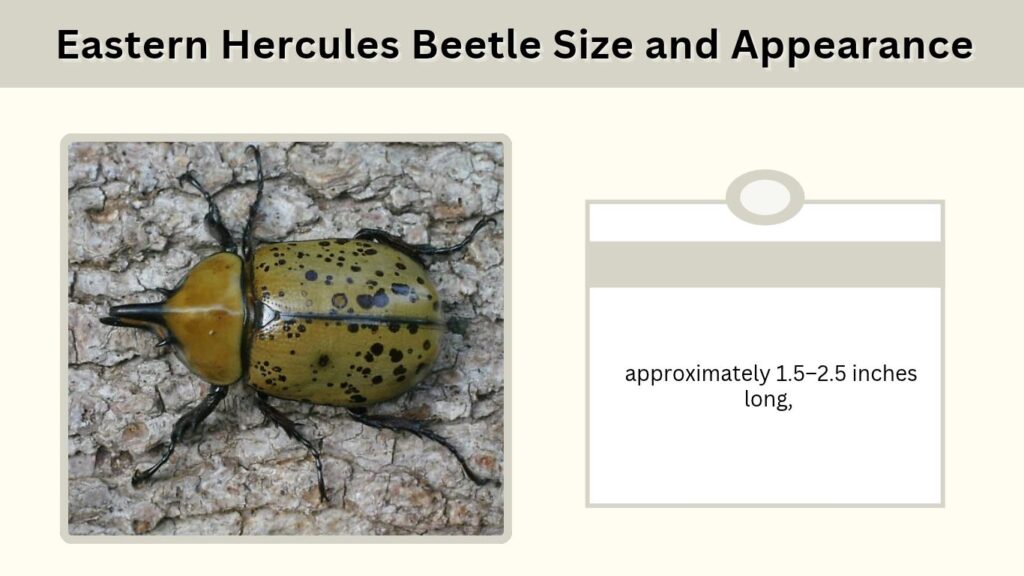
Eastern Hercules beetles are among the largest and heaviest insects in the eastern United States. Adults typically measure approximately 1.5–2.5 inches long, including the horns of males. Their bodies are broad, strongly built, and protected by a hardened outer skeleton.
Male Eastern Hercules Beetle
Male Eastern Hercules beetles are recognized by two prominent horns extending from the head and thorax. The upper horn curves forward, while the lower horn projects upward, forming a powerful gripping structure.
Males use these horns during competition for mates. Their horn length varies depending on their development and nutrition during the larval stage.
Female Eastern Hercules Beetle
Female Eastern Hercules beetles lack the large horns found on males. Instead, they have rounded heads, broad thoraxes, and smooth-looking body outlines.
Females are generally smaller than large males, although body sizes overlap. Their wing covers are commonly greenish or tan with irregular black spots, making them recognizable even without horns.
Eastern Hercules Beetle Male vs. Female
| Feature | Male | Female |
| Horns | Two prominent horns | No large horns |
| Size | Often larger | Usually smaller |
| Head | Horned | Rounded |
| Body | Long profile with horns | Broad, oval profile |
| Main reproductive role | Competes for mates | Lays eggs |
Where Do Eastern Hercules Beetles Live?
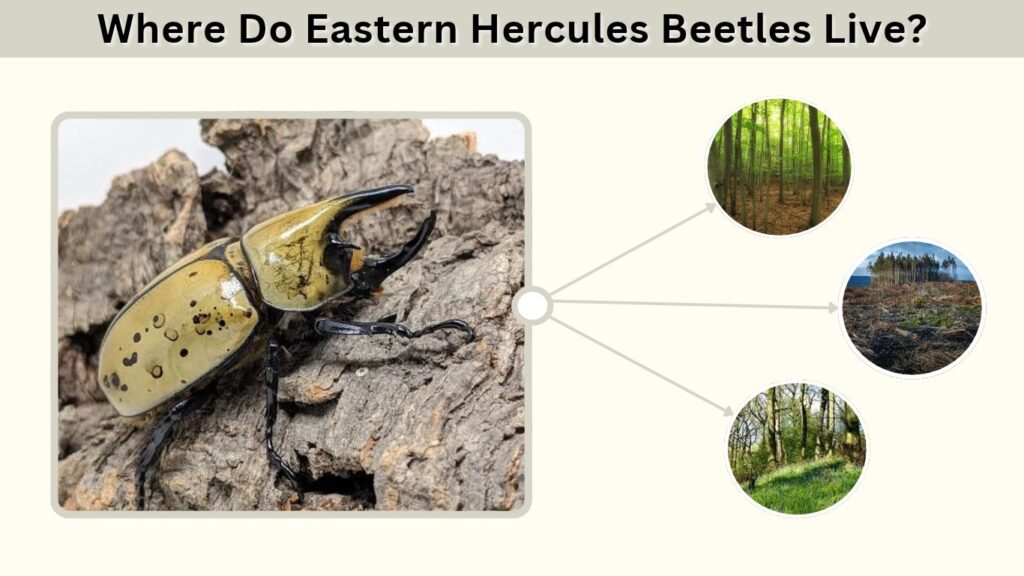
Eastern Hercules beetles inhabit much of the eastern and southeastern United States. Their distribution extends from portions of the Northeast through the Southeast and westward into parts of the central United States. They prefer wooded environments containing suitable trees and decaying hardwood, which supports larval development.
Eastern Hercules Beetle Range
Eastern Hercules beetles occur in numerous states, including:
- Florida: Found in suitable wooded habitats.
- North Carolina: Occur in forests and wooded communities.
- Virginia: Recorded in deciduous woodland habitats.
- Maryland: Found in areas containing mature trees and decaying wood.
- Missouri: Present in suitable forest environments.
- Arkansas: Relatively common in some wooded regions.
- Ohio: Occur in parts of the state.
- Tennessee: Found in suitable forest habitats.
Their broader range includes additional eastern states, although local abundance varies considerably.
Eastern Hercules Beetle Habitat
Eastern Hercules beetles prefer deciduous forests, woodlands, and environments containing mature trees.
Adults may appear around tree sap, fallen fruit, and outdoor lights. Larvae inhabit decomposing hardwood, particularly rotting logs, stumps, and cavities near tree bases.
What Do Eastern Hercules Beetles Eat?
Eastern Hercules beetles consume different foods throughout their lives. Adults mainly obtain nutrients from sugary plant materials, while larvae feed on decomposing wood and other organic matter.
These feeding habits make them valuable contributors to natural forest processes, particularly the breakdown and recycling of dead plant material.
Adult Eastern Hercules Beetle Diet
Adult Eastern Hercules beetles feed on tree sap and decaying fruit. They have been observed feeding around damaged areas of trees, especially ash trees.
In captivity, adults may eat soft fruits such as bananas and apples. Commercial beetle jelly can also provide a convenient source of sugary food.
Eastern Hercules Beetle Larvae Diet
Eastern Hercules beetle larvae consume decomposing hardwood and associated organic matter.
They commonly develop inside rotting hardwood logs and stumps, where they break down plant material over an extended period.
Unlike many root-feeding scarab grubs, Eastern Hercules beetle larvae are not generally considered serious agricultural pests.
Eastern Hercules Beetle Life Cycle
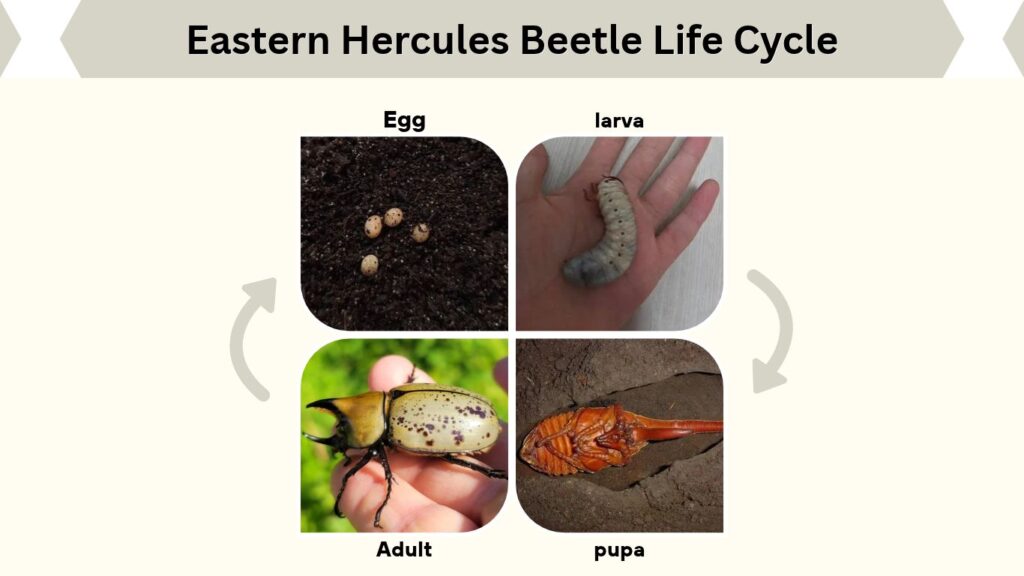
Eastern Hercules beetles undergo complete metamorphosis, developing through egg, larva, pupa, and adult stages. Their life cycle is relatively long compared with many smaller insects, often requiring approximately two to three years to complete. Most of that time is spent as larvae feeding inside decomposing wood.
1. Egg Stage
Female Eastern Hercules beetles deposit eggs in suitable decaying wood or soil cavities associated with dead trees.
The eggs are pale and rounded. Under favorable conditions, they generally hatch after approximately one month.
2. Eastern Hercules Beetle Larvae
Eastern Hercules beetle larvae are large, cream-colored grubs with brown heads and distinctly curved bodies.
They pass through three larval instars while feeding on decaying hardwood. This stage may last well over a year, depending on environmental conditions.
3. Pupal Stage
Mature larvae construct protective chambers from decaying wood particles and surrounding organic material.
Inside these chambers, they transform into adult beetles. Newly developed adults may remain underground before emerging during favorable seasonal conditions.
4. Adult Stage
Adult Eastern Hercules beetles commonly emerge during summer, especially around June and July in many areas.
Males search for females, while females eventually locate suitable egg-laying sites. Adults are frequently attracted to lights during nighttime activity.
Eastern Hercules Beetle Lifespan
Eastern Hercules beetles spend a significant portion of their lives hidden inside decomposing wood. Their long developmental period means the overall lifespan can be considerably longer than the period when adults are active aboveground.
How Long Do Eastern Hercules Beetles Live?
The entire Eastern Hercules beetle life cycle commonly takes approximately two to three years.
The larval stage accounts for much of this time. Adults may live for several months, and some remain inactive in protected chambers before seasonal emergence.
Captive lifespan varies depending on temperature, nutrition, moisture, and husbandry conditions.
Eastern Hercules Beetle Care as a Pet
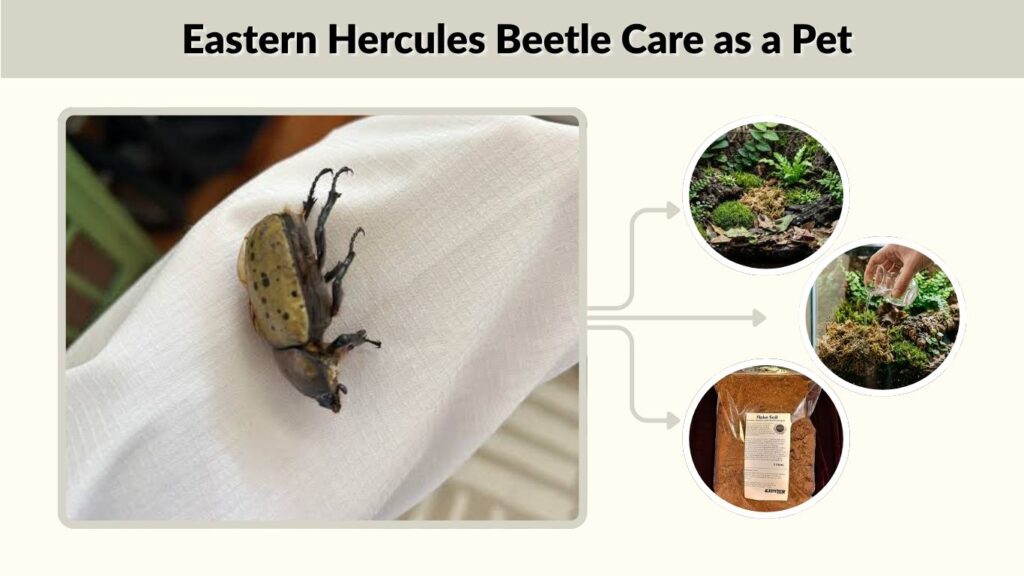
Eastern Hercules beetles are sometimes kept by insect enthusiasts because of their impressive appearance and relatively peaceful behavior. However, proper care requires suitable temperatures, adequate space, and appropriate food. Larvae have different nutritional requirements from adults and need specialized substrates for successful development.
Eastern Hercules Beetle Enclosure
A suitable enclosure should provide enough room for movement, climbing, and hiding.
Basic care recommendations include:
- Temperature: Approximately 68–77°F (20–25°C)
- Humidity: Moderate, with a slightly moist substrate
- Ventilation: Adequate airflow to prevent excessive mold
- Substrate: Moist organic material suitable for beetles
- Shelter: Bark, branches, and hiding places
- Lighting: Avoid direct sunlight and excessive heat
Adult males may compete with each other, so separate housing is generally preferable.
Feeding and Maintenance
Adult Eastern Hercules beetles can be offered ripe bananas, apples, or commercially prepared beetle jelly.
Remove uneaten food regularly to prevent mold growth. Maintain suitable moisture without allowing the substrate to become waterlogged.
Larvae require appropriately decomposed hardwood-based material, such as specialized fermented beetle substrate, rather than ordinary sand or garden soil.
Are Eastern Hercules Beetles Dangerous?
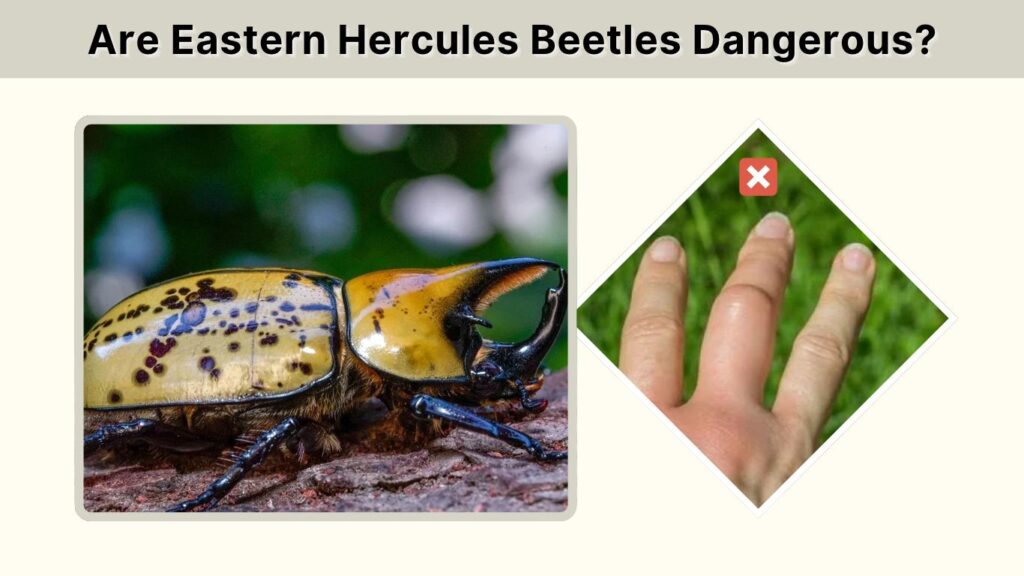
Eastern Hercules beetles may appear frightening because of their large size and prominent horns. However, they are not venomous, do not sting, and are generally harmless to people.
Their horns are used primarily during competition between males rather than for attacking humans.
Although they can grip skin with their strong claws, they are not known for delivering dangerous bites. Handle them gently and avoid squeezing their bodies.
Are Eastern Hercules Beetles Rare?
Eastern Hercules beetles are not uniformly rare throughout their native range. They can be relatively common in suitable wooded habitats, although encounters with adults are often infrequent.
Their secretive behavior contributes to their apparent rarity. Larvae remain hidden for long periods, while adults are primarily active at night.
Habitat changes and the loss of suitable decaying hardwood may affect local populations.
Eastern Hercules Beetle vs. Western Hercules Beetle
Eastern and Western Hercules beetles are closely related species belonging to the genus Dynastes. Both have powerful bodies, prominent male horns, and larvae that develop in decomposing wood.
However, their geographic distributions differ substantially.
| Feature | Eastern Hercules Beetle | Western Hercules Beetle |
| Scientific name | Dynastes tityus | Dynastes grantii |
| Distribution | Eastern United States | Southwestern United States |
| Common habitat | Deciduous forests | Mountain woodlands |
| Male horns | Present | Present |
| Female horns | Absent | Absent |
| Larval food | Decaying hardwood | Decaying hardwood |
The Eastern species is associated with eastern woodlands, while the Western species is especially well known from mountainous Arizona habitats.
FAQs
1. Can Eastern Hercules Beetles Fly?
Yes, Eastern Hercules beetles can fly despite their large, heavy bodies. They possess functional hindwings protected beneath hardened wing covers. Adults are mainly active at night and are sometimes attracted to porch lights, streetlights, and other artificial lighting.
2. Do Eastern Hercules Beetles Bite?
Eastern Hercules beetles are not known for dangerous bites. They possess chewing mouthparts but are generally harmless to humans. Their strong legs and claws may grip skin firmly, so gentle handling is recommended.
3. Why Do Eastern Hercules Beetles Turn Black?
Eastern Hercules beetles can become darker when exposed to increased moisture. Changes in how their wing covers interact with light can make their normally greenish or tan shells appear dark brown or nearly black.
4. Are Eastern Hercules Beetles Endangered?
Eastern Hercules beetles are not generally considered endangered throughout their native range. However, habitat destruction, removal of decaying trees, and changes in forest conditions may affect local populations by reducing suitable larval development sites.
5. How Can You Find Eastern Hercules Beetles?
Eastern Hercules beetles are most often encountered during warm summer months in wooded areas. Adults may visit outdoor lights at night or appear near trees producing sap. Looking around suitable forest habitats can improve the chances of observing one.
