
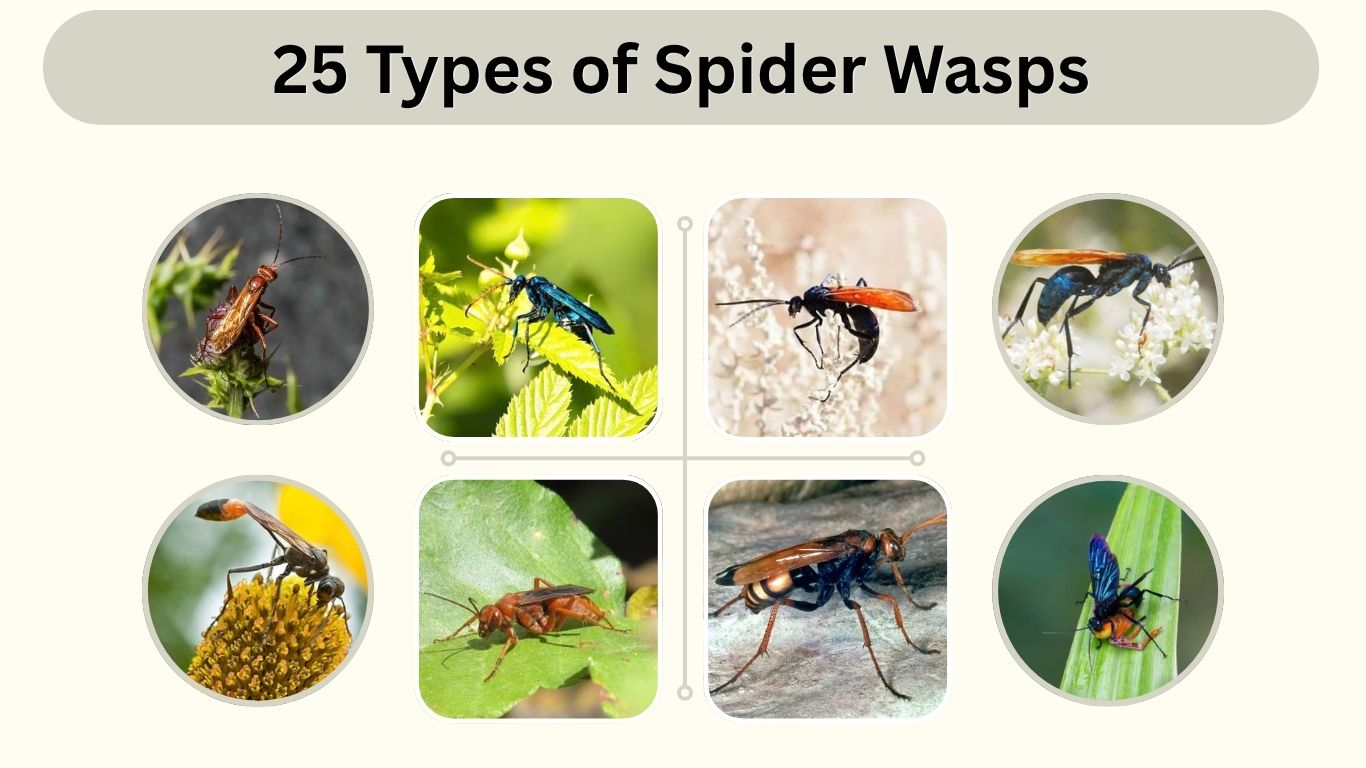
Spider wasps are fascinating solitary insects known for their remarkable hunting abilities, distinctive appearances, and unique reproductive behaviors. Belonging to the family Pompilidae, these wasps are found in various habitats worldwide, including forests, grasslands, deserts, and gardens. They come in different sizes and colors, ranging from metallic blue-black to bright orange and reddish-brown. Most species capture and paralyze spiders to feed their developing larvae. In this guide, we’ll explore 25 types of spider wasps, including their identification, habitat, distribution, behavior, diet, lifespan, and lifecycle.
1. American Blue-Black Spider Wasp (Anoplius americanus)
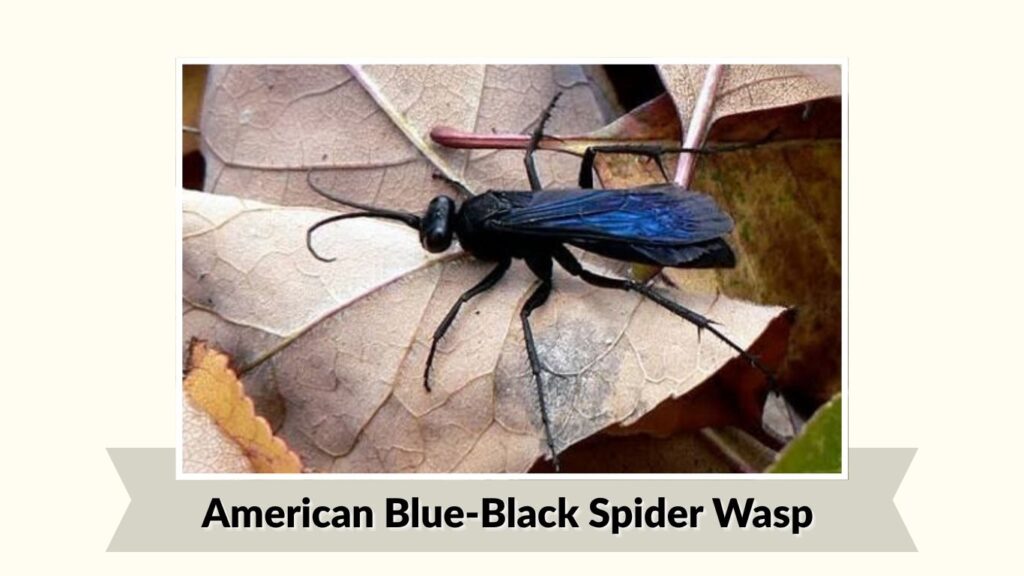
The American Blue-Black Spider Wasp is a solitary hunting wasp belonging to the family Pompilidae. Known for its dark, sometimes metallic-looking body and impressive spider-hunting abilities, this species plays an important role in controlling spider populations. It is widely distributed across North America and parts of Central America, where it inhabits natural landscapes, open areas, and flowering environments.
Identification
- Scientific Name: Anoplius americanus
- Family: Pompilidae
- Size: Approximately 12–20 mm long.
- Color: Predominantly black with a subtle bluish sheen and sometimes orange abdominal markings.
- Wings: Dark, smoky wings with noticeable veins.
- Legs: Long, slender, and equipped with spines for handling prey.
- Antennae: Elongated and typically dark-colored.
- Body Shape: Narrow waist, elongated abdomen, and streamlined appearance.
Habitat and Distribution
American Blue-Black Spider Wasps occur throughout much of North America, extending into Central America and the Caribbean. They inhabit woodland edges, grasslands, gardens, and other environments where spiders are abundant.
These wasps frequently explore the ground, searching through vegetation, leaf litter, and loose soil. Areas with suitable nesting substrates and flowering plants provide valuable resources for their survival.
Behavior and Diet
Female American Blue-Black Spider Wasps actively hunt spiders, particularly ground-dwelling species such as wolf spiders. After locating suitable prey, the female uses her venomous sting to paralyze the spider without immediately killing it.
She then transports the immobilized spider to a nesting location, where it becomes food for her developing offspring. Adult wasps primarily consume flower nectar, making them occasional flower visitors. Although females can sting, they are generally not aggressive toward humans unless threatened or handled.
Lifespan and Lifecycle
The lifecycle begins when a female lays an egg on a paralyzed spider stored inside a protected nest. After hatching, the larva feeds on the spider, obtaining the nutrients necessary for development.
The larva eventually pupates before emerging as an adult wasp. Development time varies with environmental conditions, particularly temperature and seasonal changes. The exact adult lifespan of this species is not well documented, but its reproductive strategy follows the typical solitary spider-wasp lifecycle.
2. Two-Spotted Spider Wasp (Episyron biguttatus)
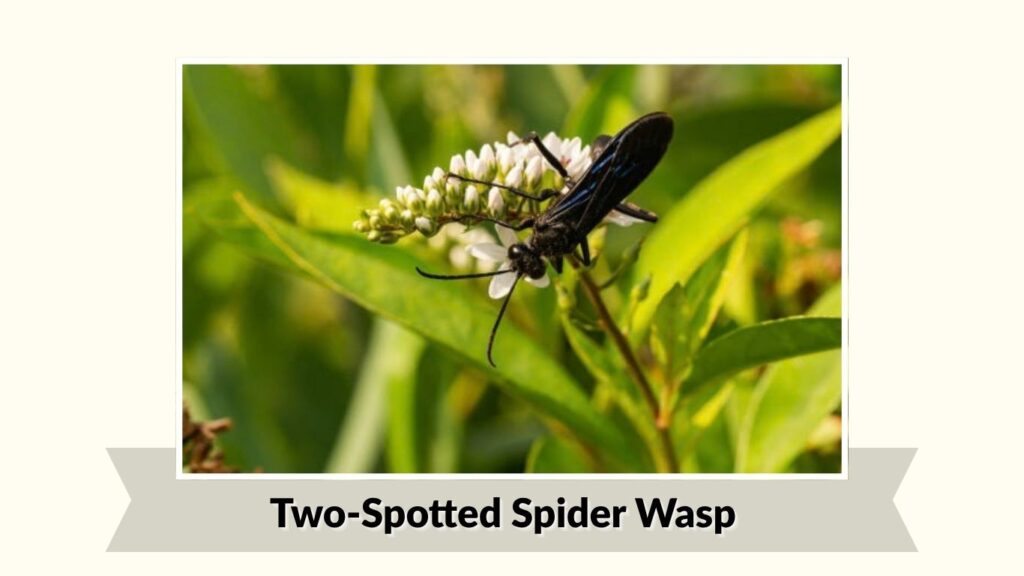
The Two-Spotted Spider Wasp is a solitary hunting wasp belonging to the family Pompilidae. This North American species is recognized for its dark body, pale abdominal markings, and remarkable ability to capture spiders. Unlike social wasps, it does not establish large colonies. Instead, individual females construct nests and provide paralyzed spiders as food for their developing offspring.
Identification
- Scientific Name: Episyron biguttatus
- Family: Pompilidae
- Size: Approximately 10–15 mm long.
- Color: Predominantly black with small whitish abdominal spots.
- Wings: Smoky or dark-colored with visible veins.
- Legs: Long, slender legs adapted for running and digging.
- Antennae: Dark, elongated, and slightly curved.
- Body Shape: Narrow waist with an elongated abdomen and compact thorax.
Habitat and Distribution
Two-Spotted Spider Wasps occur across several regions of North America, including the United States and parts of Canada. They inhabit open woodlands, grasslands, woodland edges, and areas where suitable spiders and nesting substrates are available.
Unlike some close relatives that favor sandy shorelines, Episyron biguttatus is also associated with more densely vegetated habitats and gravelly or loamy soils. These conditions provide opportunities for hunting and constructing protected nesting chambers.
Behavior and Diet
Female Two-Spotted Spider Wasps hunt spiders, particularly orb-weaving species. After locating prey, the female delivers a sting that immobilizes the spider, allowing her to transport it toward a nesting location.
The captured spider serves as a food supply for the developing larva. Adults obtain energy mainly from flower nectar and can occasionally be observed visiting flowering plants.
These wasps are generally solitary and spend much of their active time searching for prey or suitable nesting areas. They are not naturally aggressive toward humans but may sting when physically threatened.
Lifespan and Lifecycle
The lifecycle begins when a female provisions a nesting chamber with a paralyzed spider and deposits an egg.
After hatching, the larva feeds on the spider until it completes development. It then forms a cocoon and undergoes pupation before emerging as an adult.
The exact lifespan varies with seasonal conditions, and comprehensive species-specific lifespan information remains limited.
3. Five-Spotted Spider Wasp (Episyron quinquenotatus)
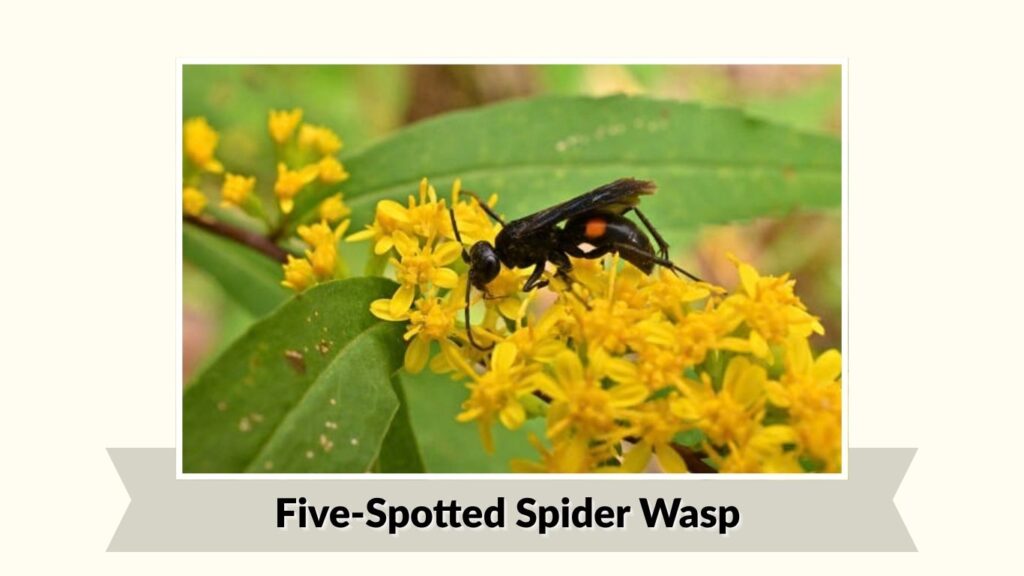
The Five-Spotted Spider Wasp is a small, distinctive North American spider-hunting wasp known for its dark coloration and contrasting white markings. It commonly inhabits sandy environments and plays a role in regulating orb-weaving spider populations. Like other solitary spider wasps, females carefully prepare underground nests and supply captured spiders as nourishment for their offspring.
Identification
- Scientific Name: Episyron quinquenotatus
- Family: Pompilidae
- Size: Approximately 10 mm long.
- Color: Mostly black with distinct white markings.
- Abdomen: Several white wedge-shaped markings along the sides.
- Wings: Smoky brown to nearly black, usually darker toward the tips.
- Legs: Long, dark legs, with specialized digging spines on female front feet.
- Antennae: Slender, dark, and slightly curved.
- Body Shape: Compact thorax, narrow waist, and elongated abdomen.
Habitat and Distribution
Five-Spotted Spider Wasps occur across much of North America, ranging from northern Canada into the southern United States. They are especially associated with open, sandy habitats near lakes, rivers, and other water bodies.
The species is frequently recorded around the Great Lakes, where suitable sandy nesting areas support local populations.
Its preferred habitats include beaches, exposed sandy ground, and sparsely vegetated areas. These environments make it easier for females to excavate burrows and locate spiders.
Behavior and Diet
Female Five-Spotted Spider Wasps specialize in capturing orb-weaving spiders. They search suitable habitats for prey and use their venomous sting to immobilize spiders before carrying them toward underground nests.
The female excavates a nesting chamber using specialized spines on her front legs. Once the spider is placed inside, she deposits an egg and closes the nest.
Adults primarily consume nectar from flowers rather than feeding directly on captured spiders. Their hunting activity is focused on providing food for their larvae.
Lifespan and Lifecycle
The lifecycle includes four developmental stages: egg, larva, pupa, and adult.
The egg hatches inside the nesting chamber, and the larva feeds on the immobilized spider. Once sufficiently developed, it creates a cocoon and enters the pupal stage.
Individuals that cannot finish development before cold weather may overwinter in a dormant immature stage. Adults become active again during favorable seasonal conditions.
4. Rusty Spider Wasp (Tachypompilus ferrugineus)
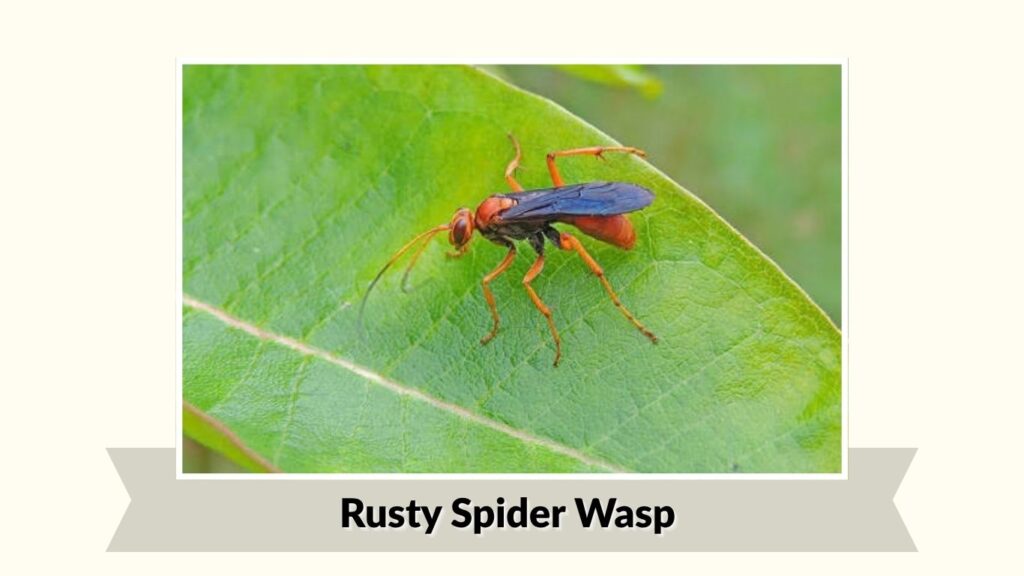
The Rusty Spider Wasp is a large, colorful solitary wasp recognized for its reddish-orange body and beautiful iridescent wings. This species belongs to the family Pompilidae and is particularly skilled at hunting large spiders. It often attracts attention when dragging prey several times its own weight across the ground toward a protected nesting site.
Identification
- Scientific Name: Tachypompilus ferrugineus
- Family: Pompilidae
- Size: Approximately 11–25 mm long.
- Color: Rusty red to reddish-orange body.
- Wings: Dark wings displaying iridescent blue or violet reflections.
- Legs: Long, slender, and reddish-colored.
- Antennae: Dark, elongated, and slightly curved.
- Body Shape: Narrow waist with an elongated abdomen and strong thorax.
Habitat and Distribution
Rusty Spider Wasps are native to the Americas and occupy various warm, open habitats where large spiders occur.
They may be encountered in grasslands, woodland edges, gardens, and areas containing exposed soil or suitable nesting cavities.
Females frequently explore the ground while searching for spider prey and protected places to construct their nests. Adults also visit flowers to obtain nectar.
Their relatively large size and colorful bodies make them easier to notice than many smaller spider-wasp species.
Behavior and Diet
Rusty Spider Wasps are powerful hunters that primarily target wolf spiders. Females may also capture other large wandering spiders.
After finding a suitable spider, the female stings it to cause paralysis. She then drags the immobilized prey toward her nesting chamber, sometimes transporting a spider considerably heavier than herself.
The spider provides essential nutrients for the developing larva, while adult wasps obtain carbohydrates from flower nectar.
Despite their intimidating appearance, Rusty Spider Wasps are generally nonaggressive toward humans.
Lifespan and Lifecycle
Female Rusty Spider Wasps prepare nesting chambers, provision them with immobilized spiders, and lay individual eggs on their prey.
After hatching, each larva consumes its spider host and gradually develops into the pupal stage.
The emerging adult eventually leaves the nest and begins searching for nectar, mates, and, in the case of females, suitable nesting locations.
Although the complete lifecycle is documented in general terms, the exact adult lifespan of this species remains poorly studied.
5. Black-Banded Spider Wasp (Anoplius viaticus)
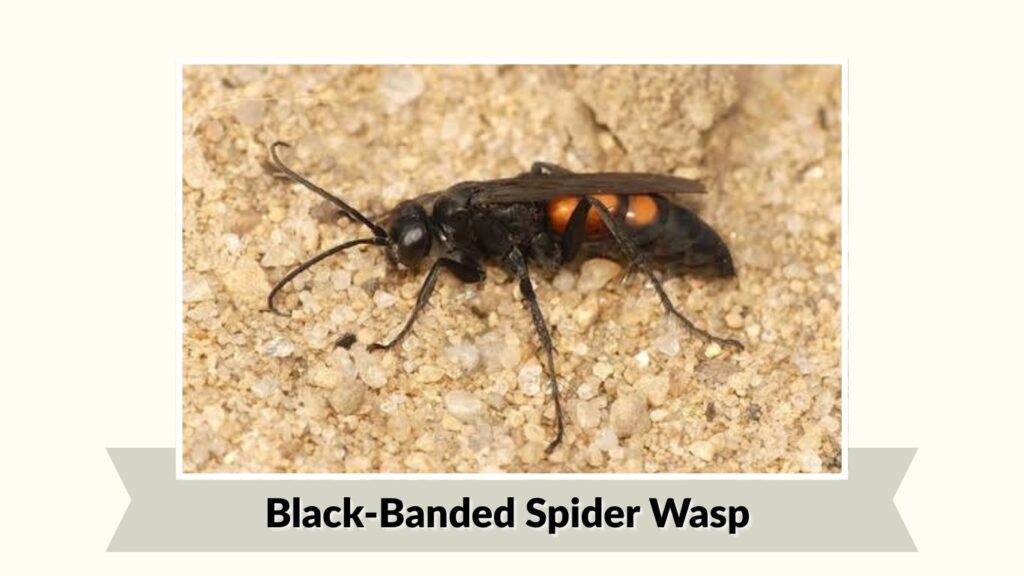
The Black-Banded Spider Wasp is a solitary hunting wasp recognized for its contrasting black and reddish abdominal markings. This species belongs to the family Pompilidae and is widely distributed across Europe and parts of Asia. It is particularly known for its ability to hunt ground-dwelling spiders and for its unusual overwintering behavior, which allows adult females to become active early in spring.
Identification
- Scientific Name: Anoplius viaticus
- Family: Pompilidae
- Size: Approximately 14 mm long.
- Color: Black head and thorax with reddish-orange abdominal segments.
- Abdomen: Red anterior segments featuring dark rear margins.
- Wings: Smoky brown with visible veins.
- Legs: Long, dark, and covered with fine spines.
- Antennae: Slender, dark, and slightly curved.
Habitat and Distribution
Black-Banded Spider Wasps are widespread throughout Europe and central Asia. They prefer open environments with sandy soils, including heathlands, coastal dunes, and woodland clearings.
These wasps are often observed running across exposed ground while searching for spiders. Areas with sparse vegetation provide suitable conditions for nest construction.
Females commonly establish nesting sites in loose soil where they can excavate individual chambers for their offspring.
Behavior and Diet
Female Black-Banded Spider Wasps mainly hunt wolf spiders, although they also capture other ground-dwelling spider species.
After paralyzing a spider, the female temporarily hides it in nearby vegetation while preparing her nesting chamber.
This species occasionally exhibits prey theft, with females attempting to steal spiders captured by other individuals.
Adult wasps feed on flower nectar and generally avoid human contact. Their hunting behavior helps regulate spider populations in natural habitats.
Lifespan and Lifecycle
Unlike many spider wasps, mated female Black-Banded Spider Wasps overwinter as adults inside protected burrows.
In spring, surviving females emerge and begin capturing spiders for reproduction. They construct nests, deposit eggs on paralyzed prey, and seal the chambers.
The larvae consume their spider hosts before pupating and eventually emerging as adults.
Newly developed females typically overwinter before beginning their own nesting activities the following spring.
6. Red-Legged Spider Wasp (Episyron rufipes)
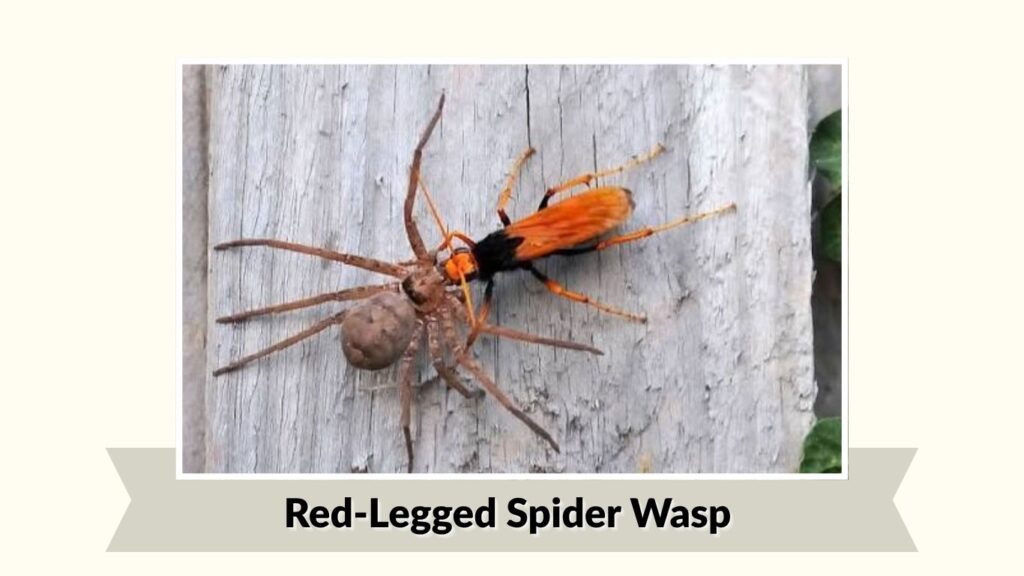
The Red-Legged Spider Wasp is a solitary species recognized for its distinctive reddish legs, dark body, and contrasting pale abdominal spots. This spider-hunting wasp inhabits sandy landscapes across Europe and parts of Asia. Females are highly specialized predators of orb-weaving spiders and use their digging abilities to construct underground nests for their developing offspring.
Identification
- Scientific Name: Episyron rufipes
- Family: Pompilidae
- Size: Approximately 8–12.5 mm long.
- Color: Primarily black with contrasting ivory abdominal markings.
- Legs: Reddish coloration on portions of the hind legs.
- Wings: Smoky or slightly brownish.
- Antennae: Long, dark, and flexible.
- Abdomen: Slender with small pale spots.
- Body Shape: Narrow waist and relatively robust thorax.
Habitat and Distribution
Red-Legged Spider Wasps are distributed across western Europe and extend into central Asia. They prefer warm, sandy habitats that provide suitable nesting conditions.
Typical environments include coastal dunes, heathlands, grasslands, gravel pits, and gardens with loose soil.
These wasps are particularly active during warmer months, commonly appearing from May through September in Britain.
Sandy ground is important because females excavate nesting chambers beneath the surface.
Behavior and Diet
Female Red-Legged Spider Wasps specialize in hunting orb-weaving spiders, especially species belonging to the genera Araneus and Meta.
Once a spider is captured and paralyzed, the female may temporarily suspend it among nearby vegetation while excavating a burrow.
She then transports the spider into the completed chamber and deposits an egg.
Adult wasps primarily consume flower nectar and frequently visit plants in the carrot family. They are solitary and do not form defensive colonies.
Lifespan and Lifecycle
The lifecycle begins with an egg laid on a paralyzed spider inside an underground nesting chamber.
Following hatching, the larva feeds on its stored prey and gradually increases in size. After completing larval development, it forms a cocoon and pupates.
Adult wasps emerge during suitable seasonal conditions and begin their reproductive activities. In Britain, the species generally produces one generation annually, although development and emergence depend on environmental conditions.
7. Golden Spider Wasp (Heterodontonyx australis)
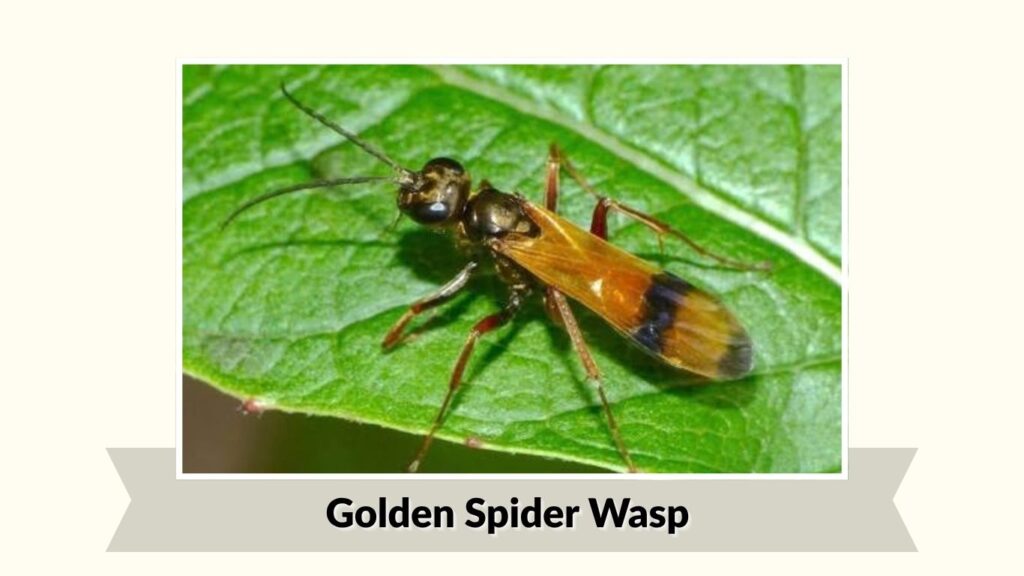
The Golden Spider Wasp is a colorful solitary hunting wasp native to Australia. It is recognized for its distinctive golden-orange body and its impressive ability to capture and paralyze spiders. This species was also introduced to New Zealand, where it has established populations. Its hunting techniques and carefully prepared underground nests make it an interesting member of the spider-wasp family.
Identification
- Scientific Name: Heterodontonyx australis
- Alternative Scientific Name: Cryptocheilus australis
- Family: Pompilidae
- Size: Females approximately 16–22 mm; males generally smaller.
- Color: Rich reddish-yellow to golden-orange.
- Wings: Transparent to lightly tinted with darker veins.
- Legs: Long and slender, suited for running and prey handling.
- Antennae: Elongated and flexible.
- Body Shape: Narrow waist with an elongated abdomen.
Habitat and Distribution
Golden Spider Wasps are native to southeastern Australia, including Tasmania. They were accidentally introduced into New Zealand during the twentieth century.
They inhabit open landscapes, woodland margins, gardens, and areas containing suitable nesting cavities.
Females often construct nests in compacted clay soils, beneath stones, or near tree stumps and other sheltered structures.
The availability of spider prey and suitable nesting conditions strongly influences their local distribution.
Behavior and Diet
Female Golden Spider Wasps mainly hunt spiders, including members of the nursery-web spider family.
They locate prey using vision and sensory information from their antennae. After approaching a spider, the female delivers venomous stings that cause paralysis.
She then drags the spider backward toward her prepared nesting chamber.
Adults visit flowers for nectar, while the developing larvae depend on captured spiders for nourishment.
Unlike social wasps, Golden Spider Wasps do not form colonies with workers.
Lifespan and Lifecycle
Female Golden Spider Wasps construct nesting chambers and provision them with immobilized spiders.
Each egg is laid on a spider, providing a food source for the developing larva. The larva consumes the host, grows, and eventually pupates.
This species may construct multiple cells within a nest, and some females reuse established nesting structures.
8. Orange Spider Wasp (Heterodontonyx bicolor)
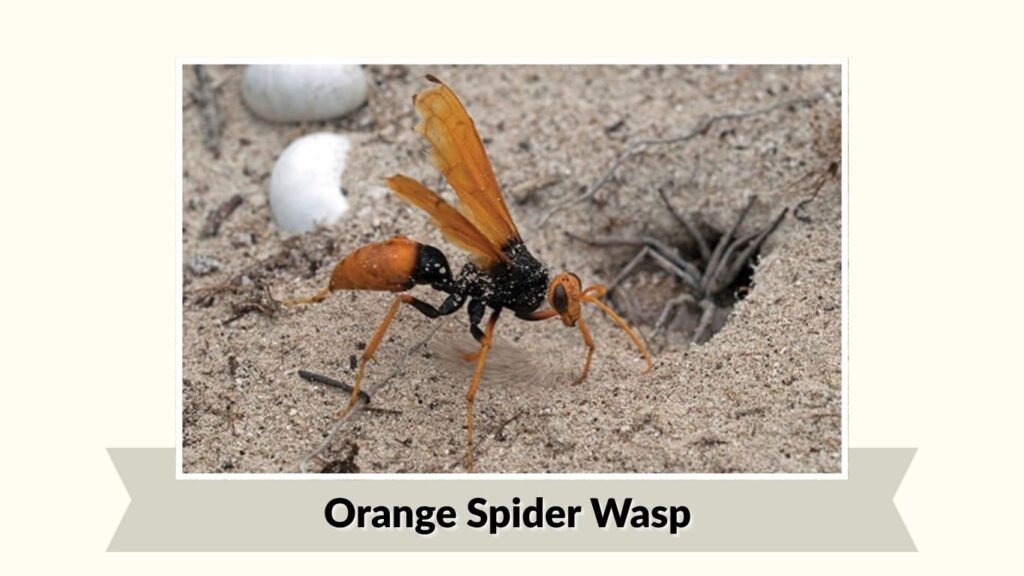
The Orange Spider Wasp is a large, strikingly colored solitary wasp found primarily in Australia. Its bright orange body, dark markings, and powerful hunting abilities distinguish it from many other spider-wasp species. Females are especially well known for capturing large huntsman spiders, which they immobilize and transport to underground nests as food for their offspring.
Identification
- Scientific Name: Heterodontonyx bicolor
- Alternative Scientific Name: Cryptocheilus bicolor
- Family: Pompilidae
- Size: Approximately 20–40 mm long.
- Color: Bright orange with contrasting black markings.
- Abdomen: Orange with a dark basal segment and a broad black band.
- Wings: Orange with darker bases and tips.
- Legs: Long, strong, and orange-black.
- Antennae: Elongated, with dark and orange coloration.
Habitat and Distribution
Orange Spider Wasps occur across much of Australia, including environments where large spiders are common.
They inhabit woodlands, grasslands, gardens, and open areas containing suitable prey and nesting substrates.
Females often search around vegetation, exposed soil, and sheltered areas where huntsman spiders hide.
The species has also been recorded outside mainland Australia, including New Zealand and parts of the nearby Australasian region.
Behavior and Diet
Female Orange Spider Wasps are formidable predators that primarily hunt huntsman spiders and occasionally wolf spiders.
After locating a spider, the female approaches cautiously and delivers a powerful sting to its underside, causing paralysis.
She then drags the immobilized spider toward a prepared nesting chamber.
The captured spider becomes the food supply for the developing larva, while adults obtain energy from flower nectar.
Although the sting can be extremely painful to humans, these wasps generally do not attack unless disturbed or handled.
Lifespan and Lifecycle
Orange Spider Wasps reproduce individually rather than establishing social colonies.
A female captures a spider, prepares a nesting chamber, and deposits an egg on the immobilized prey.
The emerging larva gradually consumes the spider before producing a protective cocoon and entering the pupal stage.
After development is complete, the adult emerges and begins searching for food and potential mates. The exact duration of each developmental stage depends on environmental conditions, and a definitive adult lifespan has not been established.
9. Giant Spider Wasp (Hemipepsis australasiae)
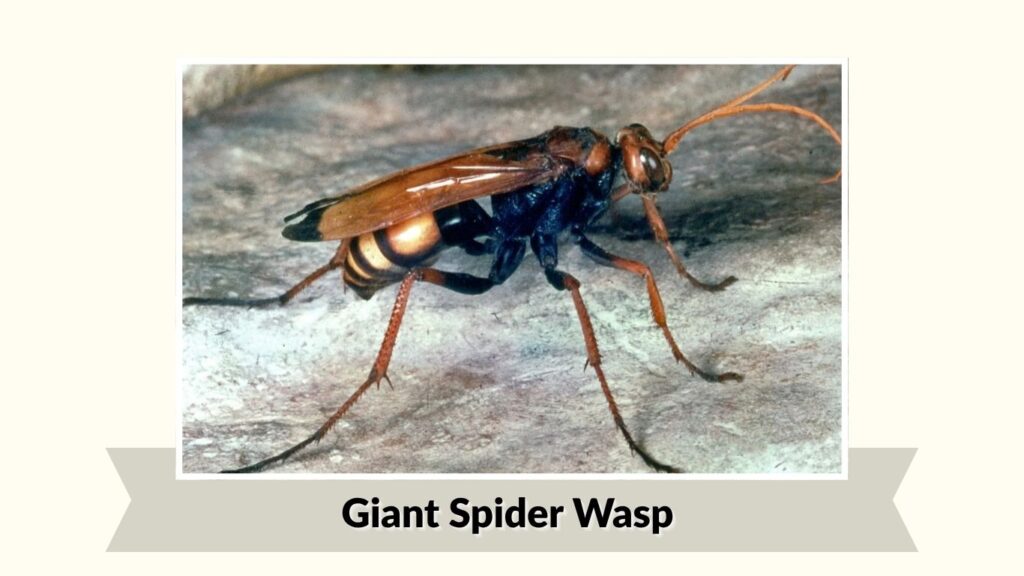
The Giant Spider Wasp is a large solitary hunting wasp belonging to the family Pompilidae. Hemipepsis australasiae is one species associated with this common name, although the term is also used for other large spider wasps. It occurs in Australia and parts of the surrounding region. Like other members of its family, it depends on spiders to provide food for its developing larvae.
Identification
- Scientific Name: Hemipepsis australasiae
- Family: Pompilidae
- Subfamily: Pepsinae
- Size: Large-bodied spider wasp; precise species-specific measurements are not consistently published.
- Color: Variable coloration, with golden or reddish tones reported in Australian forms.
- Wings: Well-developed wings with characteristic spider-wasp venation.
- Legs: Long and relatively powerful.
- Antennae: Elongated and flexible.
- Body Shape: Strong thorax, narrow waist, and elongated abdomen.
Habitat and Distribution
Hemipepsis australasiae has been documented in Australia, particularly in northern and warmer regions. Related forms have also been reported from Indonesia and other parts of Southeast Asia.
Australian collection records include Queensland, Central Australia, and South Australia.
Like other large spider-hunting wasps, it requires habitats containing suitable spiders, adult food sources, and protected nesting sites.
However, detailed studies identifying all preferred habitats and nesting conditions of this particular species remain limited.
Behavior and Diet
Giant Spider Wasps belong to a group of large solitary predators commonly associated with hunting substantial spider prey.
In typical Hemipepsis hunting behavior, females use their venomous sting to paralyze spiders and provide them as nourishment for developing offspring.
Adult spider wasps generally obtain energy from nectar and other sugary food sources.
Their large size may appear intimidating, but solitary spider wasps usually avoid unnecessary encounters with humans.
Detailed observations identifying the preferred prey species and hunting techniques of H. australasiae are limited, so behavior documented for related species should not automatically be treated as identical.
Lifespan and Lifecycle
Like other spider wasps, Hemipepsis australasiae undergoes complete metamorphosis through egg, larval, pupal, and adult stages.
The female provides spider prey for her offspring, allowing each larva to develop using the nutrients stored in its host. After larval feeding is completed, pupation produces an adult wasp capable of reproduction.
Its exact nesting period, number of generations per year, and average adult lifespan have not been adequately documented in accessible species-specific studies.
10. Bloody Spider-Hunting Wasp (Anoplius sanguineus)
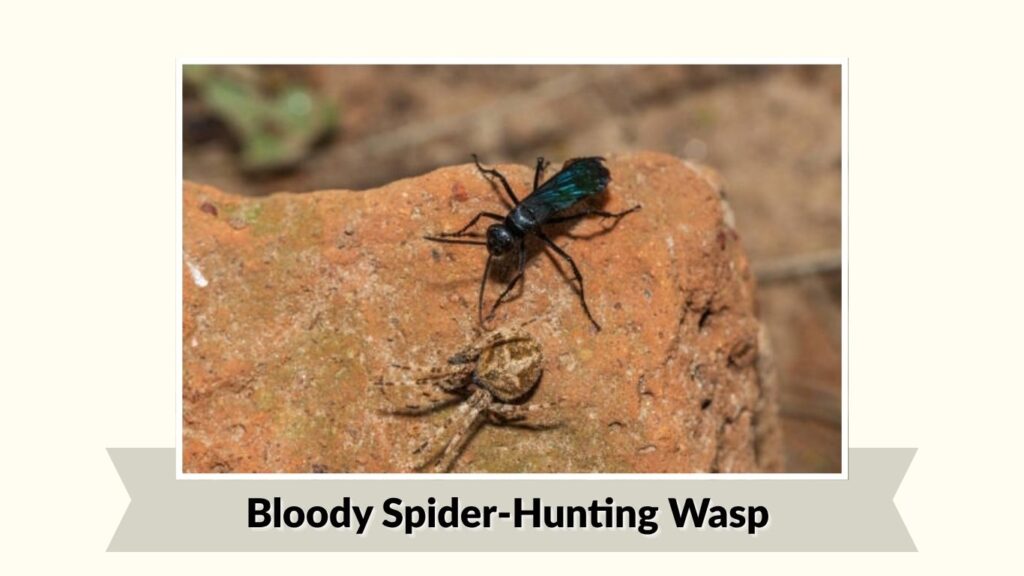
The Bloody Spider-Hunting Wasp is a solitary spider-hunting wasp belonging to the family Pompilidae. It is associated with the genus Anoplius, whose members are known for their fast movements and ability to capture spiders. Like other spider wasps, females use their venomous stings to immobilize prey and provide nourishment for their developing offspring.
Identification
- Scientific Name: Anoplius sanguineus
- Family: Pompilidae
- Genus: Anoplius
- Color: Dark body coloration, characteristic of many Anoplius species.
- Wings: Well-developed wings with visible venation.
- Legs: Long, slender legs adapted for running and handling prey.
- Antennae: Elongated and flexible.
- Body Shape: Narrow waist with a streamlined abdomen.
Habitat and Distribution
Detailed habitat information for Anoplius sanguineus is limited. Members of the genus Anoplius occupy various environments, including grasslands, woodland edges, sandy areas, and open ground.
These habitats provide access to spiders and suitable locations for nesting. Many related species prefer areas with loose soil, allowing females to excavate chambers beneath the surface.
The precise geographic distribution and habitat preferences of this particular species require confirmation from regional taxonomic records.
Behavior and Diet
Like other spider wasps, females are expected to hunt spiders as food for their larvae. They use venomous stings to immobilize prey before transporting it toward a nesting location.
Adult spider wasps generally consume flower nectar and other sugary substances rather than feeding on captured spiders.
They are solitary insects and do not establish large colonies. Their hunting activities primarily support reproduction.
Lifespan and Lifecycle
The typical spider-wasp lifecycle consists of four stages: egg, larva, pupa, and adult.
Females provide paralyzed spiders for their offspring, allowing the developing larvae to obtain nutrients from the immobilized prey.
After completing larval development, individuals enter the pupal stage before emerging as adults. The exact developmental duration and adult lifespan of Anoplius sanguineus are not well documented.
11. Eastern Tawny-Horned Spider Wasp (Entypus unifasciatus)
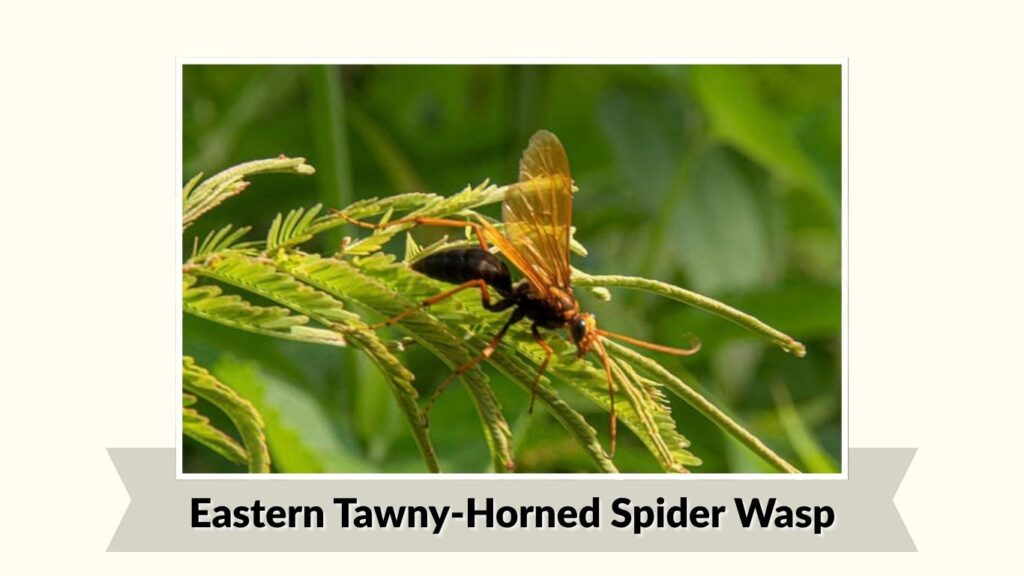
The Eastern Tawny-Horned Spider Wasp is a solitary hunting wasp native to North America. This distinctive species is recognized by its dark body, orange-tinted antennae, and contrasting abdominal markings. It is frequently associated with open habitats where large spiders are available. Females are powerful hunters that provision their nests with immobilized spiders to support larval development.
Identification
- Scientific Name: Entypus unifasciatus
- Family: Pompilidae
- Size: Approximately 15–25 mm long.
- Color: Predominantly black with contrasting abdominal markings.
- Antennae: Tawny orange to yellowish-orange.
- Wings: Dark, smoky, or slightly iridescent.
- Legs: Long and slender with dark coloration.
- Body Shape: Narrow waist, elongated abdomen, and robust thorax.
Habitat and Distribution
Eastern Tawny-Horned Spider Wasps occur in eastern North America, including portions of the eastern United States.
They inhabit woodland edges, open fields, meadows, and gardens where flowering plants and suitable spider prey are available.
Adults are commonly encountered during warmer months when temperatures support hunting and reproductive activity.
Females explore vegetation and ground-level shelters while searching for spiders. Areas containing suitable nesting substrates are particularly important for reproduction.
Behavior and Diet
Female Eastern Tawny-Horned Spider Wasps hunt spiders, especially relatively large ground-dwelling species.
After locating suitable prey, the female delivers a sting that causes paralysis. She then transports the spider to a nesting location where it becomes food for her offspring.
Adults primarily consume nectar from flowers, making them occasional visitors to flowering plants.
Despite their impressive size, these wasps are generally solitary and avoid unnecessary encounters with humans.
Lifespan and Lifecycle
The reproductive cycle begins when a female captures a spider and prepares a protected nesting chamber.
She deposits an egg on the immobilized spider, providing the newly hatched larva with a food source.
The larva consumes its prey before entering the pupal stage. After completing development, an adult wasp emerges. Seasonal temperatures and environmental conditions influence development, while the exact adult lifespan remains poorly documented.
12. Half-Belted Blue-Black Spider Wasp (Anoplius semicinctus)
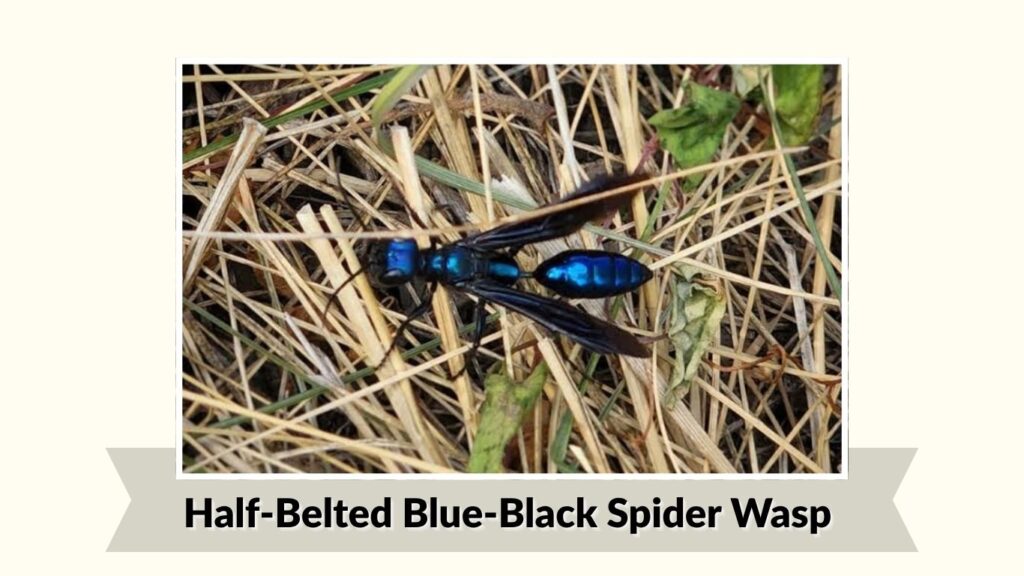
The Half-Belted Blue-Black Spider Wasp is a solitary wasp belonging to the family Pompilidae. It is known for its dark body and contrasting abdominal coloration. Like other members of the genus Anoplius, this species is associated with spider hunting and solitary reproduction. Females capture spiders and use them to supply nutrients to their developing larvae.
Identification
- Scientific Name: Anoplius semicinctus
- Family: Pompilidae
- Genus: Anoplius
- Color: Predominantly dark, with contrasting abdominal coloration.
- Wings: Smoky to dark-colored.
- Legs: Long and slender, suitable for running.
- Antennae: Dark and elongated.
- Body Shape: Narrow waist with a streamlined abdomen.
- Distinctive Feature: The common name refers to a partial belt-like abdominal marking.
Habitat and Distribution
The Half-Belted Blue-Black Spider Wasp is associated with North American spider-wasp fauna.
Like related Anoplius species, it may occupy open landscapes containing ground-dwelling spiders and suitable nesting locations.
Grasslands, woodland margins, sandy environments, and sparsely vegetated ground are typical habitats for many members of this genus.
However, precise habitat preferences and geographic boundaries for Anoplius semicinctus should be established using verified species records.
Behavior and Diet
Females of the genus Anoplius are specialized spider hunters. They actively search for prey, using their sensory abilities to detect spiders moving through vegetation or across the ground.
After locating a spider, the female delivers a venomous sting that immobilizes it.
The prey is then transported to a protected nesting location, where it provides nourishment for a developing larva.
Adults generally feed on nectar and other carbohydrate-rich substances. These wasps are solitary rather than social.
Lifespan and Lifecycle
The lifecycle follows the typical developmental pattern of spider wasps. A female provides spider prey for her offspring and deposits an egg associated with the immobilized host.
The developing larva consumes the spider before forming a cocoon and entering pupation. An adult eventually emerges and begins searching for food and reproductive opportunities.
The precise duration of development and adult lifespan of this species have not been well established.
13. Red-Tailed Spider Wasp (Tachypompilus analis)
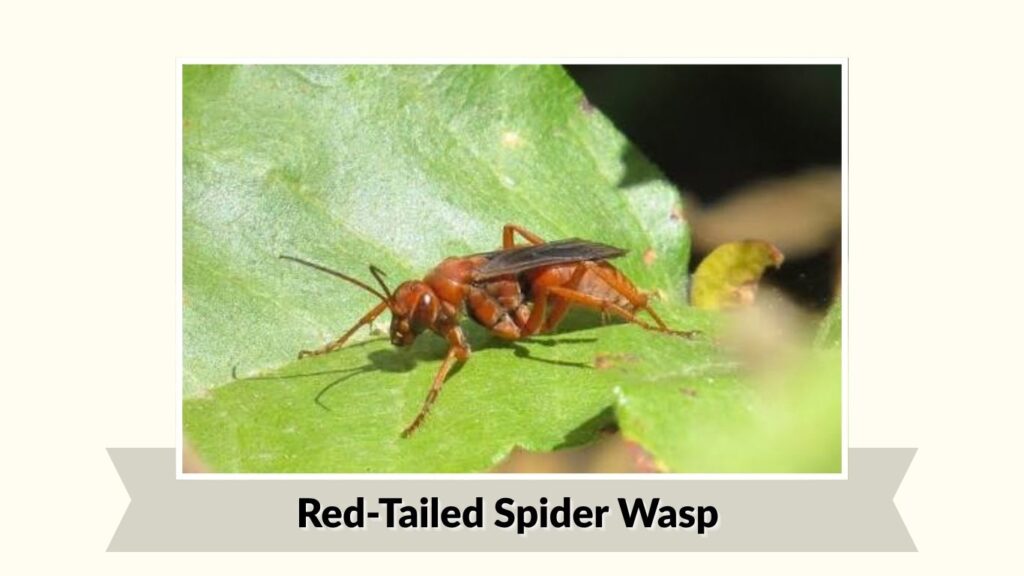
The Red-Tailed Spider Wasp is a solitary hunting wasp associated with the genus Tachypompilus. Members of this group are known for their speed, strong legs, and ability to capture large spiders. The name reflects the contrasting reddish coloration associated with the abdomen. Like other spider wasps, females depend on immobilized spiders to nourish their developing offspring.
Identification
- Scientific Name: Tachypompilus analis
- Family: Pompilidae
- Genus: Tachypompilus
- Color: Dark body with reddish abdominal coloration.
- Wings: Smoky or dark-colored with visible veins.
- Legs: Long, strong, and adapted for running.
- Antennae: Elongated and flexible.
- Body Shape: Narrow waist with a relatively powerful thorax.
- Distinctive Feature: Contrasting red coloration toward the abdomen.
Habitat and Distribution
Species belonging to the genus Tachypompilus inhabit various warm environments where spiders are abundant.
They may occur in open woodland, grasslands, gardens, and areas with suitable shelter for nesting.
Many members of this genus explore exposed ground, vegetation, and crevices while searching for large spiders.
However, the precise distribution and preferred habitat of Tachypompilus analis require species-specific confirmation.
Behavior and Diet
Female Tachypompilus wasps are known for hunting relatively large spiders, including wolf spiders and other wandering species.
They use their venomous sting to paralyze prey and then transport the immobilized spider toward a nesting location.
Unlike social wasps, they do not rely on workers to gather food or protect a communal nest.
Adults primarily consume nectar, while the developing larvae obtain protein from captured spiders.
Lifespan and Lifecycle
The lifecycle includes egg, larval, pupal, and adult stages. A female provides a protected nesting location with spider prey and deposits an egg for the developing offspring.
The larva consumes the spider before entering pupation. After completing development, the adult emerges and begins its independent life.
Environmental factors such as temperature and food availability influence the reproductive season. The exact adult lifespan of Tachypompilus analis is not well documented.
14. Orange-Collared Spider Wasp (Agenioideus cinctellus)
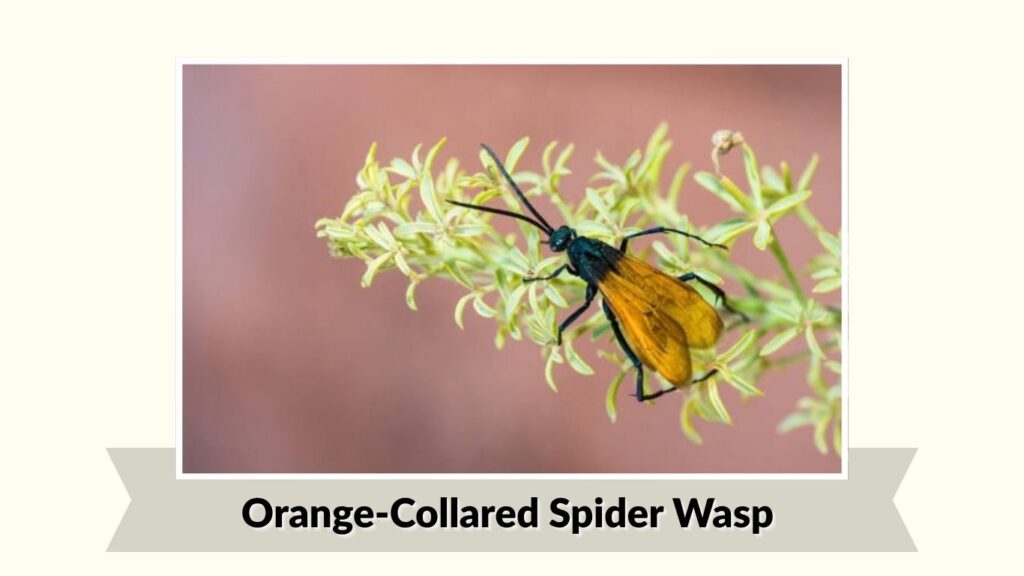
The Orange-Collared Spider Wasp is a small solitary wasp belonging to the family Pompilidae. Agenioideus cinctellus is a European spider-hunting species, although the common-name association and orange-collar description should be verified before publication. Members of this genus are known for their ability to locate spiders in sheltered habitats and use them as food for their developing larvae.
Identification
- Scientific Name: Agenioideus cinctellus
- Family: Pompilidae
- Genus: Agenioideus
- Size: Small to medium-sized spider wasp.
- Color: Predominantly dark body coloration.
- Wings: Transparent to lightly smoky.
- Legs: Slender and adapted for running.
- Antennae: Dark and elongated.
- Body Shape: Compact thorax with a narrow waist and elongated abdomen.
Habitat and Distribution
Agenioideus cinctellus occurs in parts of Europe, where it is associated with suitable spider-rich habitats.
Members of this genus frequently explore walls, rocky surfaces, woodland edges, and other sheltered environments.
Some species use existing cavities or protected spaces for nesting rather than constructing extensive underground burrows.
The exact habitat requirements of A. cinctellus may vary across its geographic range.
Behavior and Diet
Females of the genus Agenioideus hunt spiders and provide immobilized prey for their offspring.
They use their venomous stings to paralyze spiders before moving them into protected nesting locations.
Adult wasps primarily consume nectar and other sugary substances.
Their solitary lifestyle means each reproductive female is responsible for locating prey and provisioning her own nest.
These wasps generally avoid humans and do not display the defensive colony behavior associated with social wasps.
Lifespan and Lifecycle
The female deposits an egg in association with a paralyzed spider inside a protected nesting chamber.
After hatching, the larva feeds on the spider until it has accumulated sufficient nutrients for development. The larva eventually pupates and transforms into an adult wasp. Seasonal conditions influence the timing of emergence and reproduction.
Detailed species-specific information concerning the number of generations and average adult lifespan remains limited.
15. Spotted Cuckoo Spider Wasp (Ceropales maculata)
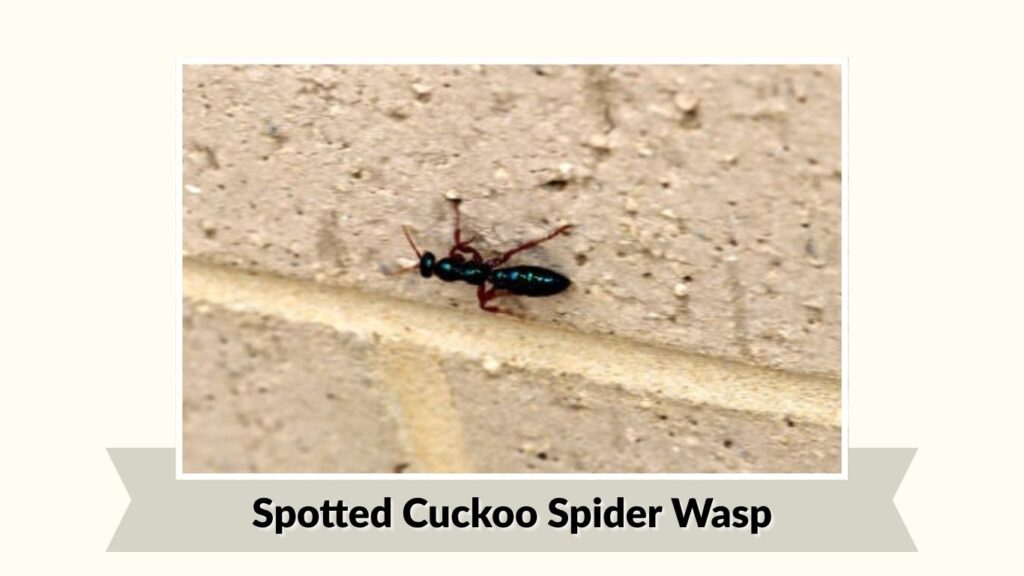
The Spotted Cuckoo Spider Wasp is a fascinating solitary wasp known for its unusual reproductive behavior. Unlike many spider wasps that capture their own prey, this species often exploits the hunting efforts of other spider wasps. Females lay their eggs on spiders captured by other species, allowing their offspring to develop using food collected by another wasp.
Identification
- Scientific Name: Ceropales maculata
- Family: Pompilidae
- Size: Approximately 5–12 mm long.
- Color: Black with contrasting pale or yellowish markings.
- Abdomen: Distinctive spotted or banded appearance.
- Wings: Transparent to lightly smoky.
- Legs: Long and slender.
- Antennae: Dark, elongated, and slightly curved.
- Body Shape: Narrow waist with a relatively compact abdomen.
Habitat and Distribution
Spotted Cuckoo Spider Wasps occur across much of Europe and parts of Asia.
They inhabit open woodlands, grasslands, heathlands, sandy areas, and gardens where other spider-wasp species are active.
Their presence is strongly influenced by the availability of suitable host wasps.
Females frequently patrol nesting areas and hunting territories, searching for opportunities to deposit eggs on spiders captured by other species.
Behavior and Diet
Unlike typical spider wasps, Ceropales maculata practices kleptoparasitism, a reproductive strategy involving the exploitation of another wasp’s prey.
A female approaches a spider that has already been captured and immobilized by another spider wasp.
She quickly deposits an egg on the spider, often taking advantage of moments when the original hunter is distracted.
The host wasp may then transport the spider into its own nest, unknowingly carrying the cuckoo wasp’s egg.
Adult Spotted Cuckoo Spider Wasps primarily consume nectar.
Lifespan and Lifecycle
The lifecycle begins when a female deposits an egg on prey captured by another spider wasp.
After hatching, the cuckoo wasp larva develops using the spider as its food source. It may outcompete or kill the original host wasp’s offspring. The larva eventually forms a cocoon and enters the pupal stage.
An adult emerges after development is completed. The exact adult lifespan varies with environmental conditions and is not firmly established.
16. Two-Speckled Cuckoo Spider Wasp (Ceropales bipunctata)
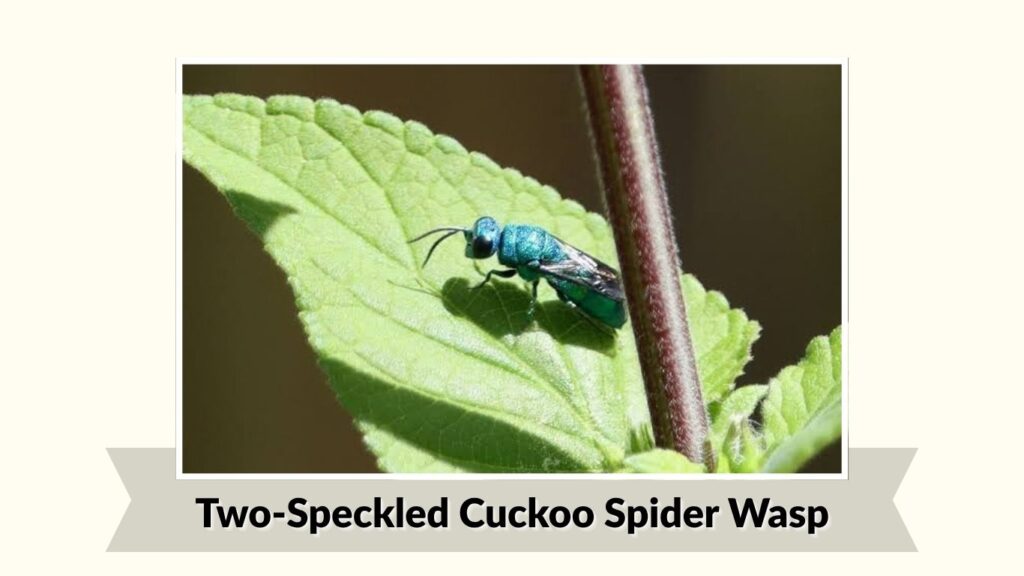
The Two-Speckled Cuckoo Spider Wasp is a solitary parasitic wasp belonging to the family Pompilidae. It is recognized for its small size and contrasting body markings. Like other cuckoo spider wasps, it uses an unusual reproductive strategy by exploiting spiders captured by other wasps rather than regularly hunting and provisioning its own prey.
Identification
- Scientific Name: Ceropales bipunctata
- Family: Pompilidae
- Genus: Ceropales
- Size: Small to medium-sized spider wasp.
- Color: Dark body with contrasting pale markings.
- Abdomen: Markings associated with the two-speckled appearance.
- Wings: Transparent to slightly smoky.
- Legs: Long, slender, and suited for quick movement.
- Antennae: Elongated and flexible.
Habitat and Distribution
The Two-Speckled Cuckoo Spider Wasp is associated with environments supporting other spider-wasp species.
Like related Ceropales species, it may be encountered in grasslands, woodland edges, sandy areas, and open landscapes where host wasps hunt.
Its reproductive success depends on locating suitable host species and gaining access to their captured spiders.
The precise geographic range and habitat preferences of Ceropales bipunctata require confirmation from taxonomic records.
Behavior and Diet
Female cuckoo spider wasps typically do not construct and provision their own nests.
Instead, they locate spiders that have been immobilized by other spider wasps and attempt to deposit eggs on the captured prey.
This reproductive strategy allows the cuckoo wasp to benefit from the hunting and nesting activities of another species.
Adults generally consume nectar and other carbohydrate-rich food sources.
Because they are solitary, these wasps do not establish colonies or cooperate in prey collection.
Lifespan and Lifecycle
The lifecycle begins when a female deposits an egg on a spider captured by another wasp.
The developing larva uses the spider as its primary food source, potentially preventing the original host wasp’s offspring from surviving.
After completing larval feeding, it enters the pupal stage and eventually emerges as an adult. The timing of reproduction depends partly on the seasonal activity of host spider wasps.
The precise adult lifespan and developmental duration of this species remain insufficiently documented.
17. Interrupted Spider Wasp (Anoplius interruptus)
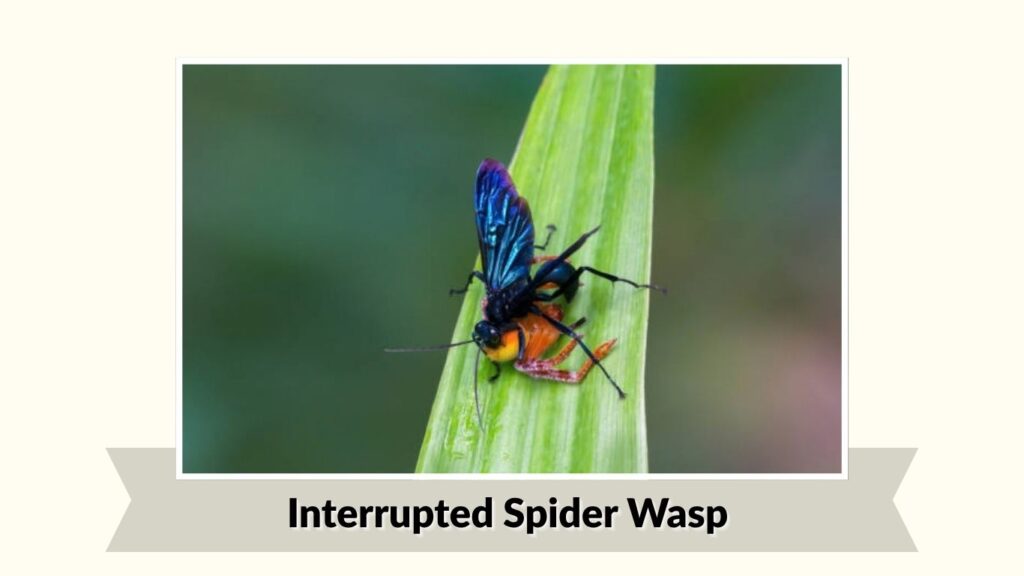
The Interrupted Spider Wasp is a solitary hunting wasp belonging to the genus Anoplius. Members of this genus are known for their active spider-hunting behavior, streamlined bodies, and long legs. The Interrupted Spider Wasp follows the general reproductive pattern of spider wasps, in which females provide immobilized spiders as food for their developing offspring.
Identification
- Scientific Name: Anoplius interruptus
- Family: Pompilidae
- Genus: Anoplius
- Color: Predominantly dark body coloration.
- Wings: Smoky or dark with visible venation.
- Legs: Long, slender, and adapted for rapid movement.
- Antennae: Dark, elongated, and flexible.
- Body Shape: Narrow waist with an elongated abdomen.
- Distinctive Feature: Species-level identification requires examination of structural characteristics rather than coloration alone.
Habitat and Distribution
The Interrupted Spider Wasp belongs to a genus containing species adapted to various terrestrial habitats.
Many Anoplius species occur in open fields, grasslands, woodland margins, sandy areas, and locations containing abundant spider prey.
Females frequently search the ground and vegetation for spiders while exploring suitable nesting sites.
Loose soil and protected ground-level cavities are important nesting resources for many members of the genus.
However, the exact geographic distribution and preferred habitat of Anoplius interruptus require verification through species-specific records.
Behavior and Diet
Female spider wasps use their venomous stings to immobilize spiders before transporting them toward nesting locations.
In the genus Anoplius, many species specialize in hunting ground-dwelling spiders, particularly wolf spiders.
The captured prey serves as a food source for developing larvae.
Adults generally obtain energy from flower nectar and other sugary substances.
These wasps are solitary and do not build communal colonies. They are usually nonaggressive toward humans unless physically threatened.
Lifespan and Lifecycle
The lifecycle consists of egg, larva, pupa, and adult stages.
A female provides a nesting chamber with immobilized spider prey and deposits an egg for her offspring.
The larva feeds on the spider before forming a cocoon and undergoing pupation.
After development is completed, an adult emerges and begins searching for food and reproductive opportunities.
Seasonal temperatures influence development, while the exact lifespan of Anoplius interruptus has not been well documented.
18. Toussaint’s Tarantula-Hawk Wasp (Hemipepsis toussainti)
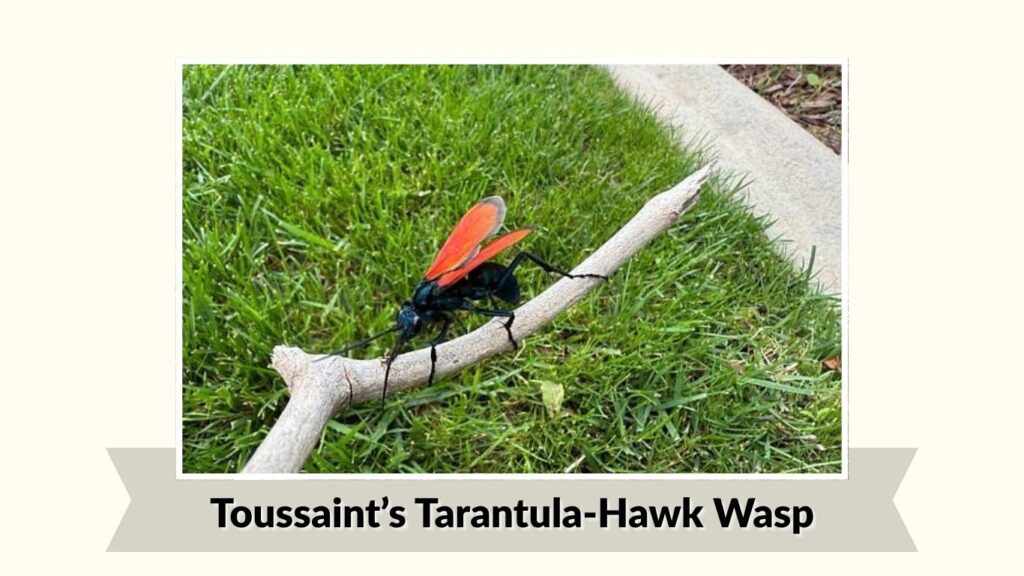
Toussaint’s Tarantula-Hawk Wasp is a solitary hunting wasp belonging to the family Pompilidae. This species is associated with dry environments in the southwestern United States, particularly Arizona. Like other members of the genus Hemipepsis, it possesses strong legs, a narrow waist, and specialized hunting behavior. Females provision their offspring with paralyzed spiders, while adults obtain energy from flowering plants.
Identification
- Scientific Name: Hemipepsis toussainti
- Family: Pompilidae
- Genus: Hemipepsis
- Size: Medium to large; precise species-specific body measurements are limited.
- Color: Dark body coloration, characteristic of many tarantula-hawk wasps.
- Wings: Well-developed, with distinctive venation used in identification.
- Legs: Long and powerful, adapted for hunting.
- Antennae: Elongated and flexible.
- Body Shape: Robust thorax, narrow waist, and elongated abdomen.
Habitat and Distribution
Toussaint’s Tarantula-Hawk Wasp has been recorded in Arizona, where warm temperatures and dry landscapes provide suitable conditions for its activities.
Members of Hemipepsis commonly occupy arid and semiarid environments, including desert scrub, open ground, and areas containing flowering shrubs.
They frequently explore ground-level habitats while searching for spiders. Males may occupy elevated vegetation to locate potential mates, while females search for prey.
The complete geographic distribution of this species is less thoroughly documented than that of several widespread tarantula hawks.
Behavior and Diet
Female tarantula-hawk wasps are specialized predators that capture spiders for their developing larvae.
A female uses her sting to immobilize suitable prey before moving it toward a protected nesting location.
Adult wasps consume nectar and can occasionally be observed visiting desert flowers.
They live independently rather than forming organized colonies. Despite their intimidating appearance, they typically avoid humans unless physically threatened.
Lifespan and Lifecycle
The reproductive lifecycle begins when a female captures and paralyzes a suitable spider.
She places the prey in a protected nesting location and deposits an egg. After hatching, the larva feeds on the spider before entering the pupal stage.
An adult eventually emerges and begins searching for nectar and reproductive opportunities.
The precise adult lifespan and developmental duration of H. toussainti remain poorly documented.
19. Elegant Tarantula-Hawk Wasp (Pepsis menechma)
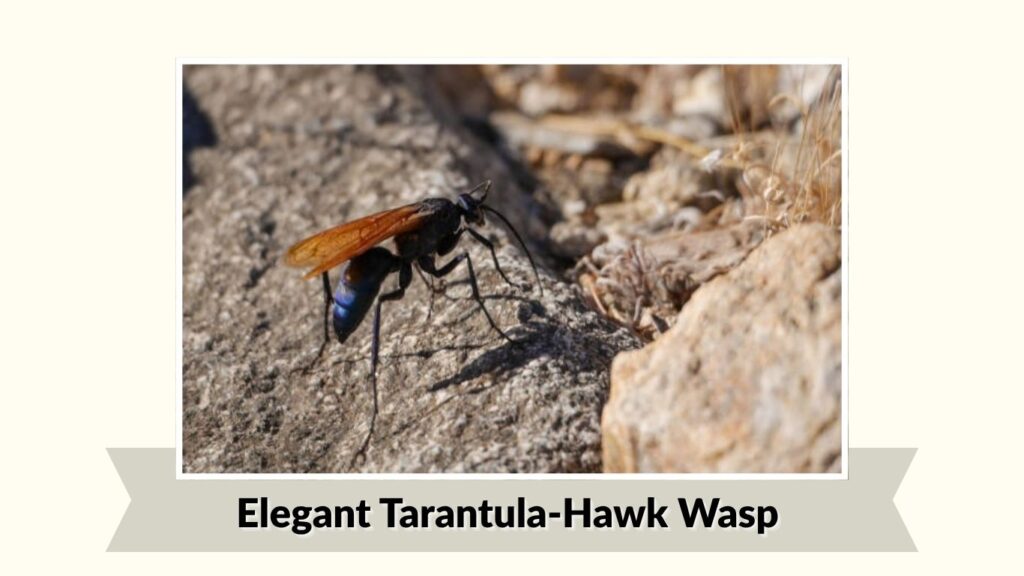
The Elegant Tarantula-Hawk Wasp is a distinctive spider wasp widely distributed throughout the Americas. This species belongs to the genus Pepsis, a group recognized for its impressive size, colorful bodies, and spider-hunting abilities. Its appearance varies considerably across different populations. Although called a tarantula hawk, its prey preferences may differ from those of other members of the genus.
Identification
- Scientific Name: Pepsis menechma
- Family: Pompilidae
- Genus: Pepsis
- Size: A relatively large spider wasp, with size varying among individuals.
- Color: Usually dark with a metallic blue, purple, or black appearance.
- Wings: Dark or contrasting in coloration, depending on geographic form.
- Legs: Long, slender, and powerful.
- Antennae: Elongated, sometimes with contrasting coloration.
- Body Shape: Narrow waist, strong thorax, and elongated abdomen.
Habitat and Distribution
Elegant Tarantula-Hawk Wasps occur across a broad geographic range extending from North America into Central and South America.
They inhabit open woodlands, grasslands, subtropical landscapes, and other environments containing suitable spider prey.
Different geographic populations may display noticeable variations in body and wing coloration, making identification from photographs challenging.
Adults frequently visit flowers for nectar, while females explore the ground and vegetation in search of potential prey and nesting sites.
Behavior and Diet
Female Elegant Tarantula-Hawk Wasps hunt spiders and use their venomous stings to immobilize prey.
Although this species belongs to the tarantula-hawk group, its common name does not establish that tarantulas are its exclusive prey.
Captured spiders provide nourishment for developing offspring. Adult wasps primarily obtain carbohydrates from flower nectar.
These wasps are solitary, and each female is responsible for locating prey and preparing suitable reproductive sites.
They generally avoid direct confrontation with humans.
Lifespan and Lifecycle
The lifecycle consists of four developmental stages: egg, larva, pupa, and adult.
After securing suitable spider prey, a female lays an egg associated with the immobilized host. The larva consumes the spider and eventually forms a cocoon before pupating.
Following metamorphosis, the adult emerges and begins searching for food and potential mates.
The precise duration of development varies with environmental conditions, and reliable species-specific adult lifespan estimates are limited.
20. Mexican Tarantula-Hawk Wasp (Pepsis mexicana)
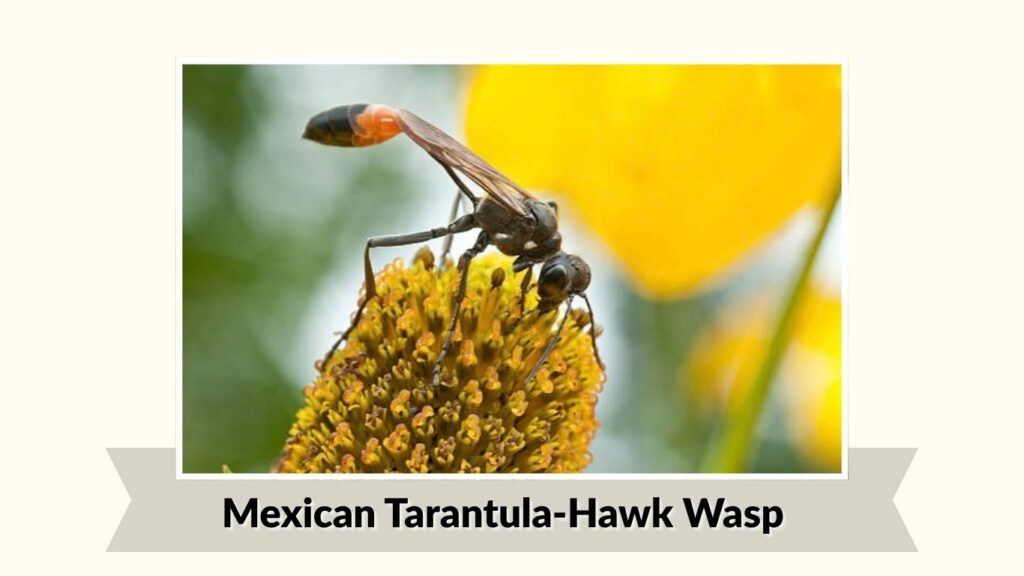
The Mexican Tarantula-Hawk Wasp is a solitary hunting wasp native to the southwestern United States, Mexico, and Central America. This species is recognized for its dark metallic body and distinctive wing coloration. Females hunt large spiders, including tarantulas, and provide them as food for their larvae. It commonly inhabits warm landscapes where suitable prey and flowering plants are available.
Identification
- Scientific Name: Pepsis mexicana
- Family: Pompilidae
- Genus: Pepsis
- Size: Females approximately 16–34 mm; males 13–21 mm.
- Color: Predominantly black with a metallic blue sheen.
- Wings: Usually dark with narrow, pale outer edges.
- Legs: Long, dark, and adapted for handling spiders.
- Antennae: Elongated and typically dark.
- Body Shape: Robust thorax, narrow waist, and elongated abdomen.
Habitat and Distribution
Mexican Tarantula-Hawk Wasps inhabit the southwestern United States, including portions of California, Arizona, and Texas.
Their range extends southward through Mexico and Central America into Costa Rica.
They occur in deserts, semiarid grasslands, open scrublands, and other warm environments supporting spider populations.
Females explore the ground and sheltered locations where tarantulas may establish burrows.
Adults visit flowering plants to obtain nectar, making areas with abundant flowers particularly valuable during the active season.
Behavior and Diet
Female Mexican Tarantula-Hawk Wasps are specialized spider predators.
After locating a suitable tarantula, the female uses her sting to inject venom that causes paralysis.
She then moves the immobilized spider to a protected nesting location where it serves as food for her offspring.
Adult wasps primarily consume nectar rather than spiders.
Although females possess powerful stings capable of causing significant pain, they generally avoid attacking humans unless physically disturbed.
Lifespan and Lifecycle
A female begins reproduction by locating and immobilizing suitable spider prey.
She prepares a nesting site, deposits an egg on the spider, and leaves the larva with a substantial food supply.
After hatching, the larva feeds on the immobilized spider before forming a cocoon.
The developing wasp eventually completes pupation and emerges as an adult.
The exact developmental period varies with temperature, available resources, and seasonal conditions. Species-specific adult longevity remains incompletely documented.
21. Milde’s Tarantula-Hawk Wasp (Pepsis mildei)
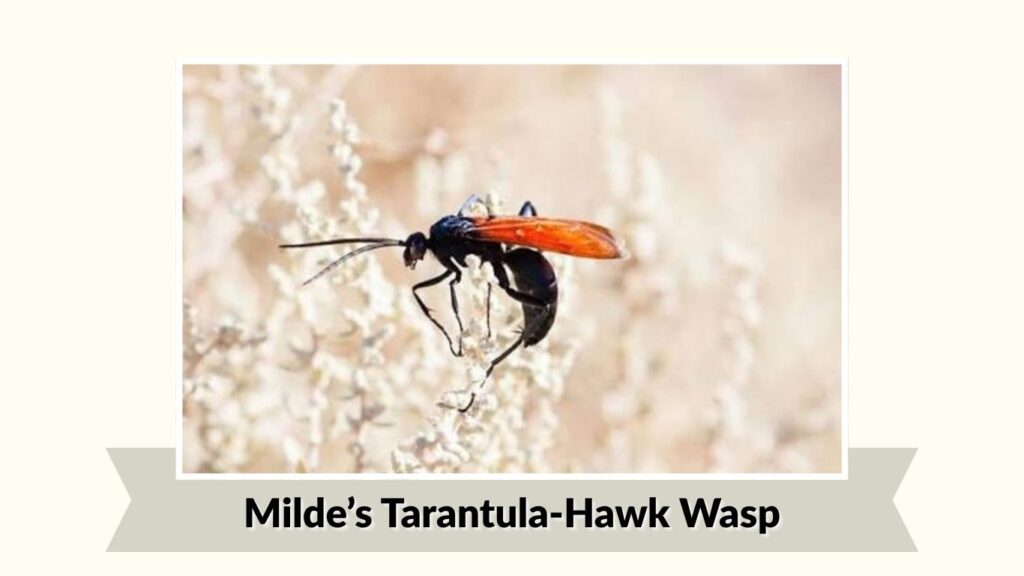
Milde’s Tarantula-Hawk Wasp is a large solitary spider wasp recognized for its metallic blue-black body, orange-brown wings, and contrasting antennae. This species occurs in the southwestern United States and Central America. Like other tarantula hawks, females are specialized predators that capture large spiders as nourishment for their offspring, while adults obtain energy primarily from nectar.
Identification
- Scientific Name: Pepsis mildei
- Family: Pompilidae
- Genus: Pepsis
- Size: Typically around 20–30 mm, although larger specimens occur.
- Color: Metallic blue-black body.
- Wings: Orange-brown with darker bases and tips.
- Legs: Long, dark, and powerful.
- Antennae: Orange or reddish, sometimes darker near the base.
- Body Shape: Narrow waist and elongated abdomen.
Habitat and Distribution
Milde’s Tarantula-Hawk Wasps inhabit warm regions of the southwestern United States, including California, Arizona, Colorado, and Texas.
Their distribution extends into Mexico and parts of Central America.
They occupy deserts, dry grasslands, open scrub, and landscapes containing suitable tarantula populations.
Adults frequently appear around flowering plants during warm weather, especially when nectar sources are abundant.
Females spend time searching the ground and exploring suitable habitats where large spiders may be found.
Behavior and Diet
Female Milde’s Tarantula-Hawk Wasps are powerful hunters that capture tarantulas as food for their offspring.
They locate suitable prey and use their venomous sting to cause paralysis.
The immobilized spider is transported into a protected nesting chamber, where a single developing larva can feed on it.
Adult wasps primarily consume flower nectar, although other sugary substances may also provide energy.
Despite their large size and painful defensive sting, these solitary wasps generally avoid humans.
Lifespan and Lifecycle
The lifecycle begins when a female captures a tarantula and prepares a suitable nesting chamber. She deposits an egg on the immobilized spider before securing the nest.
After hatching, the larva consumes its stored food supply and gradually develops. It eventually forms a cocoon and enters the pupal stage before emerging as an adult wasp.
Development depends on environmental conditions, while precise adult lifespan estimates for this species remain limited.
22. Thisbe’s Tarantula-Hawk Wasp (Pepsis thisbe)
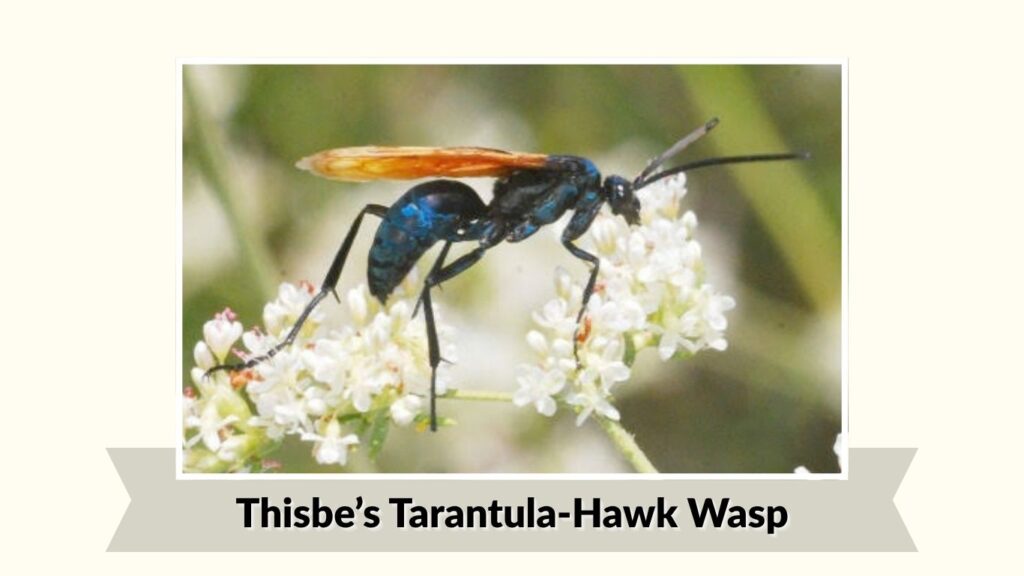
Thisbe’s Tarantula-Hawk Wasp is a large solitary hunting wasp native to the southwestern United States and northern Mexico. It is recognized for its metallic blue-black body, striking orange wings, and impressive ability to capture tarantulas. Females use their venomous stings to immobilize spiders, which become food for their larvae. Adults primarily visit flowers for nectar.
Identification
- Scientific Name: Pepsis thisbe
- Family: Pompilidae
- Genus: Pepsis
- Size: Females commonly 32–44 mm long.
- Color: Dark metallic blue or blue-black body.
- Wings: Bright orange-brown with darker markings and pale outer edges.
- Legs: Long, strong, and dark-colored.
- Antennae: Females often display distinctly curled antennae.
- Body Shape: Large thorax, narrow waist, and elongated abdomen.
Habitat and Distribution
Thisbe’s Tarantula-Hawk Wasps inhabit desert and semiarid environments throughout the American Southwest.
They occur in California, Arizona, New Mexico, Texas, and other western states, with populations extending into northern Mexico.
Typical habitats include desert scrub, grasslands, rocky landscapes, and open areas where tarantulas establish burrows.
Adults frequently visit flowering shrubs and other nectar-producing plants during warm weather.
Females spend considerable time exploring the ground while searching for tarantulas and suitable nesting locations.
Behavior and Diet
Female Thisbe’s Tarantula-Hawk Wasps are specialized hunters of tarantulas.
They locate spiders through visual and chemical cues before approaching and delivering a powerful sting.
The immobilized tarantula is transported to a protected nesting chamber, where it provides nourishment for a developing larva.
Adults primarily consume flower nectar and do not regularly feed on captured spiders.
These wasps are generally solitary and avoid confrontations with humans. However, females can deliver extremely painful defensive stings when threatened.
Lifespan and Lifecycle
The lifecycle begins when a female captures and paralyzes a tarantula.
She prepares a nesting chamber, deposits an egg on the spider, and secures the nest.
After hatching, the larva feeds on the immobilized spider and gradually develops.
The larva eventually produces a cocoon and enters the pupal stage.
Adult emergence occurs after metamorphosis is complete. Development depends on seasonal temperatures and environmental conditions, while adult longevity varies.
23. Orange-Horned Tarantula Hawk (Pepsis ruficornis)
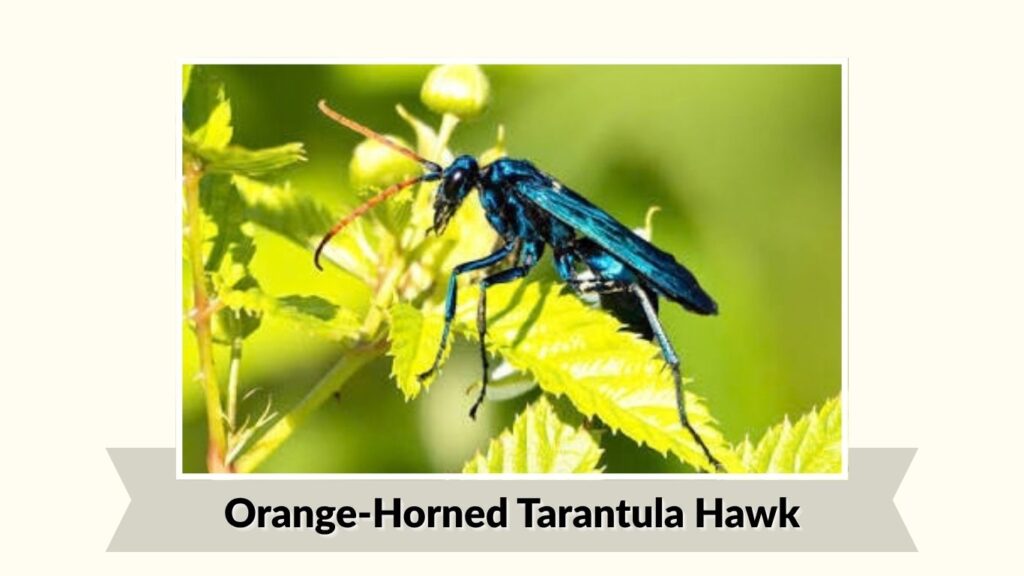
The Orange-Horned Tarantula Hawk is a large solitary spider wasp belonging to the genus Pepsis. It is recognized by its contrasting antennae and dark body coloration. This species occurs in tropical and subtropical regions of the Americas, including the Caribbean. Females hunt large spiders for their offspring, while adults primarily obtain energy from nectar-producing flowers.
Identification
- Scientific Name: Pepsis ruficornis
- Family: Pompilidae
- Genus: Pepsis
- Size: Large-bodied tarantula-hawk wasp.
- Color: Predominantly dark, often with a metallic appearance.
- Antennae: Distinctive orange or reddish coloration.
- Wings: Dark or contrasting coloration with noticeable veins.
- Legs: Long, strong, and adapted for handling spiders.
- Body Shape: Robust thorax, narrow waist, and elongated abdomen.
- Distinctive Feature: Orange-colored antennae are an important visual characteristic.
Habitat and Distribution
Orange-Horned Tarantula Hawks occur in tropical and subtropical parts of the Americas.
They have been recorded in the Caribbean, including islands such as Aruba, Bonaire, and Curaçao, as well as southern Florida.
Their habitats include warm open landscapes, scrub vegetation, woodland margins, and environments containing suitable spider populations.
Adults may visit flowering plants in search of nectar, while females investigate ground-level shelters and spider burrows.
The availability of large spiders influences where females can successfully reproduce.
Behavior and Diet
Female Orange-Horned Tarantula Hawks are solitary predators that capture spiders for their developing offspring.
Like other members of the genus Pepsis, they use venomous stings to immobilize prey before transporting it toward a nesting location.
Adult wasps primarily obtain carbohydrates from nectar and other naturally occurring sugary substances.
They do not build communal nests or establish colonies.
Although their sting can be painful, these wasps generally avoid humans and sting defensively when threatened.
Lifespan and Lifecycle
The lifecycle consists of four stages: egg, larva, pupa, and adult.
A female locates suitable spider prey and immobilizes it before preparing a protected nesting chamber.
She deposits an egg associated with the captured spider, allowing the newly hatched larva to feed on it.
After consuming its food supply, the larva enters the pupal stage and eventually develops into an adult. The exact developmental duration and average adult lifespan of this species remain insufficiently documented.
24. Red-Winged Tarantula Hawk (Pepsis rubra)
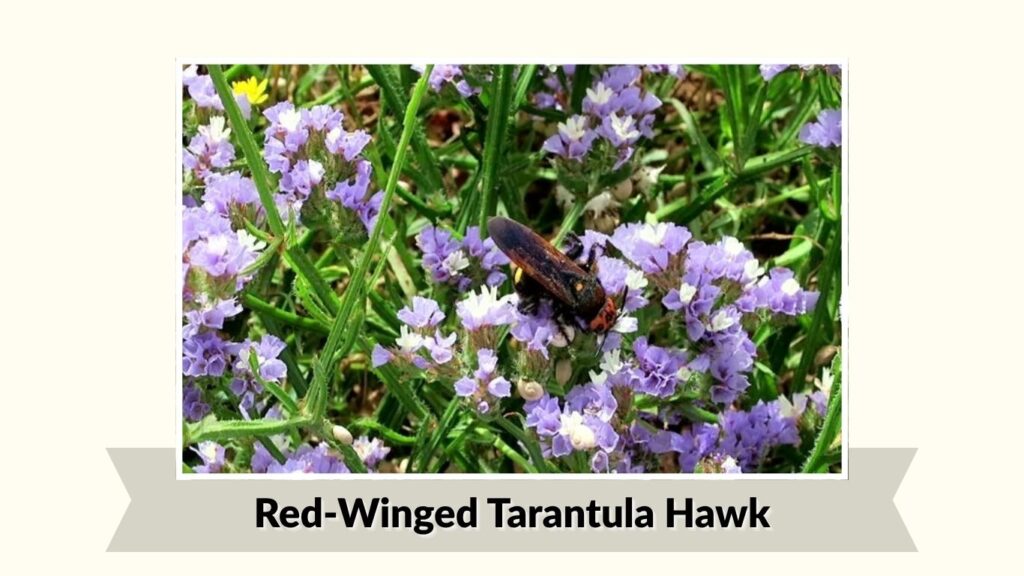
The Red-Winged Tarantula Hawk is a striking spider wasp belonging to the family Pompilidae. Its common name reflects the reddish coloration of its wings, which contrasts with its darker body. Native to tropical parts of the Americas, this species belongs to a group of large solitary wasps known for capturing spiders and provisioning their offspring with immobilized prey.
Identification
- Scientific Name: Pepsis rubra
- Family: Pompilidae
- Genus: Pepsis
- Size: Large-bodied spider wasp; exact dimensions vary.
- Color: Predominantly dark body coloration.
- Wings: Distinctive reddish or orange-red coloration.
- Legs: Long and strong, adapted for hunting spiders.
- Antennae: Elongated and flexible.
- Body Shape: Robust thorax, narrow waist, and extended abdomen.
- Distinctive Feature: Contrasting red wings are an important identifying feature.
Habitat and Distribution
Red-Winged Tarantula Hawks inhabit tropical regions of the Americas, including areas of the Caribbean.
They are associated with warm landscapes containing suitable spider prey and flowering plants.
Open woodland, scrub vegetation, and other habitats supporting large spiders may provide appropriate conditions for reproduction.
Adults often explore flowering vegetation in search of nectar, while females investigate ground-level habitats for prey.
The species’ precise habitat preferences and distribution vary geographically, and detailed local ecological studies remain limited.
Behavior and Diet
Female Red-Winged Tarantula Hawks belong to a group of specialized spider predators.
They use their venomous stings to immobilize prey, allowing the captured spider to become food for developing offspring.
Adult wasps primarily obtain energy from flower nectar rather than consuming the spiders they capture.
Their solitary lifestyle means individual females are responsible for finding prey and preparing nesting locations.
Although females can deliver painful stings, they generally avoid humans unless directly threatened or handled.
Lifespan and Lifecycle
The reproductive cycle begins when a female locates and captures a suitable spider.
After immobilizing her prey, she places it in a protected nesting location and deposits an egg.
The emerging larva feeds on the spider, obtaining the nutrients required for growth and development.
After completing larval feeding, it forms a cocoon and enters the pupal stage.
An adult eventually emerges and begins searching for nectar, mates, and reproductive opportunities.
The exact adult lifespan and developmental period of Pepsis rubra have not been firmly established.
25. Golden Hunter Wasp (Sphictostethus nitidus)
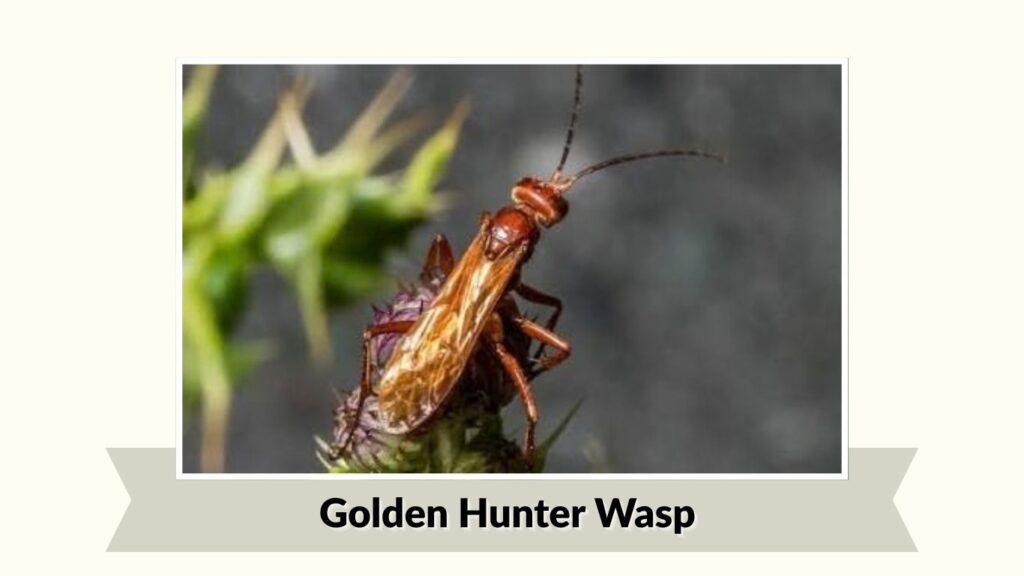
The Golden Hunter Wasp, also known as the Red Spider Wasp, is a colorful solitary hunting wasp endemic to New Zealand. It belongs to the family Pompilidae and is recognized for its reddish-brown body, yellowish wings, and energetic movements. Females capture various spiders, including ground-dwelling species, and store them in protected nesting chambers as food for their offspring.
Identification
- Scientific Name: Sphictostethus nitidus
- Family: Pompilidae
- Genus: Sphictostethus
- Size: Females approximately 8.5–22 mm; males 7.5–15 mm.
- Color: Reddish-brown with golden-yellow tones.
- Wings: Yellowish, sometimes with dark smoky markings in females.
- Legs: Long, reddish, and adapted for running.
- Antennae: Elongated and flexible.
- Body Shape: Slender body with a narrow waist and elongated abdomen.
Habitat and Distribution
Golden Hunter Wasps are native to New Zealand and occur on both the North and South Islands.
They inhabit various environments, including grasslands, woodland clearings, coastal dunes, dry riverbeds, and suburban gardens.
These adaptable wasps can also be found around logs, rocks, boulders, and other sheltered ground-level habitats.
Females frequently search beneath stones and among vegetation for spiders.
Their ability to occupy different environments has allowed them to establish populations across diverse New Zealand landscapes.
Behavior and Diet
Female Golden Hunter Wasps hunt several types of spiders, including large wandering spiders, tunnel-web spiders, and nursery-web spiders.
They actively search for prey, sometimes exploring beneath logs or entering sheltered areas where spiders hide.
After capturing a spider, the female uses her venomous sting to paralyze it. She then transports the immobilized prey into a nesting chamber.
Adult Golden Hunter Wasps primarily consume nectar and other sugary substances. They are solitary and generally avoid humans unless physically threatened.
Lifespan and Lifecycle
Female Golden Hunter Wasps prepare protected nesting chambers in soil cavities or beneath stones and other structures. A female places a paralyzed spider inside a chamber and deposits an egg on it.
The larva hatches and feeds on the immobilized prey until it completes development.After feeding, the larva pupates before emerging as an adult.
Males generally emerge slightly earlier than females, allowing them to locate potential mates.
The exact adult lifespan depends on environmental conditions and remains less thoroughly documented than the species’ hunting and nesting behavior.
FAQs
1. What Are the Most Common Types of Spider Wasps?
Common types of spider wasps include the American Blue-Black Spider Wasp, Two-Spotted Spider Wasp, Rusty Spider Wasp, Red-Legged Spider Wasp, and various tarantula hawks. These species differ in size, coloration, hunting techniques, and habitat preferences. Most belong to the family Pompilidae and are solitary hunters.
2. Are Spider Wasps Dangerous to Humans?
Spider wasps are generally not dangerous to humans because they are solitary and rarely behave aggressively. However, females can sting when threatened or handled. Some species, particularly tarantula hawks, deliver extremely painful stings. Serious allergic reactions are possible, so avoiding direct contact is recommended.
3. What Do Spider Wasps Eat?
Adult spider wasps primarily feed on flower nectar and other sugary substances. Female wasps hunt spiders, paralyze them with venom, and provide them as food for their developing larvae. Different spider-wasp species capture different types of spiders, including wolf spiders, orb-weavers, huntsman spiders, and tarantulas.
4. Where Do Spider Wasps Build Their Nests?
Spider wasps commonly build nests in sandy soil, loose ground, or sheltered cavities. Some species dig underground burrows, while others use existing holes, crevices, or protected spaces. Each female typically provisions her nest with one or more paralyzed spiders, depending on the species and nesting behavior.
5. How Long Do Spider Wasps Live?
The lifespan of spider wasps varies depending on their species, climate, and environmental conditions. Adults generally live for several weeks, although some species survive longer. Certain spider wasps overwinter as adults, while others remain in immature developmental stages until favorable conditions return. Their lifecycle includes egg, larva, pupa, and adult stages.
