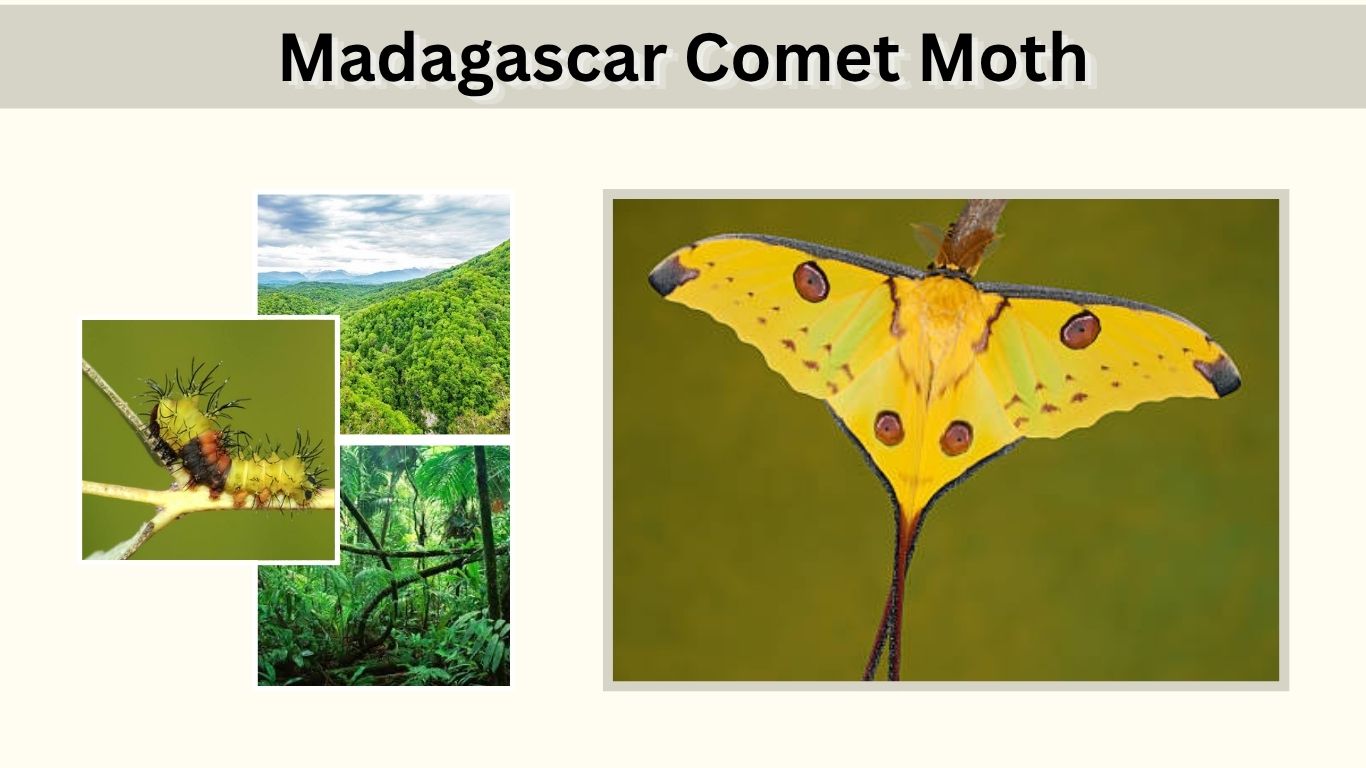
The Madagascar comet moth, also called the Madagascan comet moth or Madagascan moon moth, is one of the most spectacular silk moths in the world. Known scientifically as Argema mittrei, this enormous yellow moth is native to Madagascar and is famous for its reddish eyespots and extremely long hindwing tails. It spends most of its life developing as a caterpillar and pupa, while the adult survives only long enough to reproduce. Its striking appearance makes the comet moth one of Madagascar’s most recognizable native insects.
What Is the Madagascar Comet Moth?
The Madagascar comet moth is a giant silk moth belonging to the family Saturniidae. Its accepted scientific name is Argema mittrei. “Comet moth” and “Madagascan moon moth” are both recognized common names for the same species.
It is particularly famous for the males, which develop extraordinarily long tails extending from their hindwings. Together with the moth’s bright yellow coloration, these tails give it a comet-like appearance.
Madagascar Comet Moth Identification
- Scientific name: Argema mittrei
- Family: Saturniidae
- Bright yellow to yellow-green wings
- Four prominent reddish-brown eyespots
- Dark markings along the wing margins
- Extremely long hindwing tails
- Large, feathery antennae in males
- Females generally have broader bodies
- Males have longer, narrower tails than females
- Among the world’s largest silk moths
Male Madagascan moon moths can reach a wingspan of roughly 20 cm, with their tails extending about 15 cm.
Why Does the Comet Moth Have Such Long Tails?
The remarkable tails are more than decoration. Research on long-tailed silk moths suggests that these structures can help defend moths against bats.
As the moth flies, the moving tails can interfere with a hunting bat’s echolocation and redirect attacks toward the expendable tail rather than the moth’s body. A moth may therefore survive an encounter even if part of its tail is damaged.
Male vs. Female Comet Moths
Male comet moths typically have longer and slimmer tails. Their antennae are also noticeably larger and more feathery, helping them detect chemical signals released by females.
Females tend to be heavier-bodied because they carry eggs. They may remain relatively close to the place where they emerged while waiting for males to locate them.
Where Does the Comet Moth Live in Madagascar?
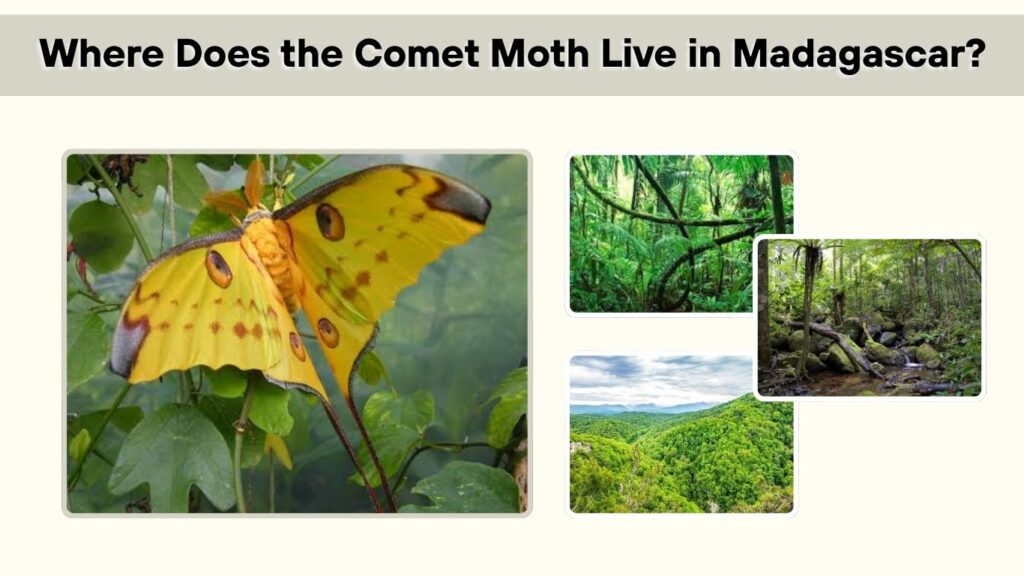
The Madagascar native comet moth is associated with the island’s tropical forest habitats. It occurs naturally nowhere else, making Madagascar’s remaining forests essential to its survival.
Comet Moth Habitat
Its natural environment includes:
- Tropical rainforest
- Humid forest
- Dense forest vegetation
- Areas containing suitable caterpillar host plants
- Protected and relatively undisturbed forest habitats
Because the species depends on Madagascar’s forest ecosystem, habitat destruction and deforestation are significant concerns.
Comet Moth in Ranomafana National Park, Madagascar
Ranomafana National Park is one location where the comet moth of Madagascar has been recorded. The park protects humid rainforest habitat and supports an exceptionally diverse range of native wildlife, including Argema mittrei.
The combination of dense vegetation, rainfall, and native plants makes forest areas such as Ranomafana suitable environments for large silk moths.
Finding an adult can still be difficult because comet moths are primarily active at night and adults have an exceptionally short lifespan.
Madagascar Comet Moth Life Cycle
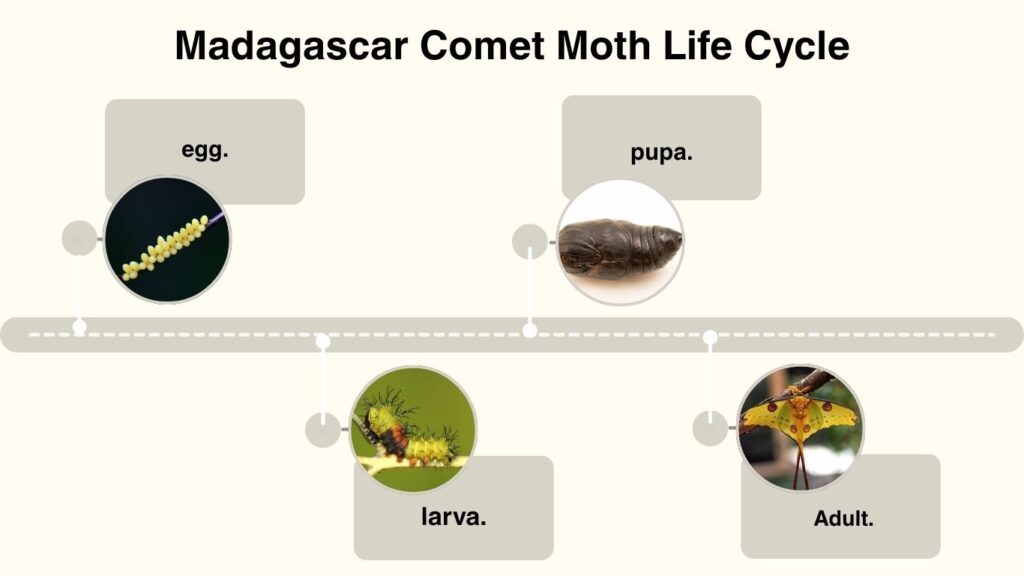
Like other moths, the Madagascar comet moth undergoes complete metamorphosis through egg, larva, pupa, and adult stages.
Egg Stage
A female may lay roughly 100–150 eggs. The eggs develop until small caterpillars hatch and begin searching for suitable leaves.
Caterpillar Stage
The caterpillar is the primary feeding stage.
Young larvae continually consume plant leaves and grow through several molts. Host plants reported for the species include plants in genera such as Eugenia and Weinmannia.
Unlike the short-lived adult, the caterpillar must consume enough food to provide energy for pupation and eventually adult reproduction.
Cocoon and Pupa
When fully grown, the caterpillar spins a silk cocoon.
One particularly interesting characteristic is the cocoon’s perforated structure. It contains numerous small openings. Researchers have suggested that these holes may allow rainwater to drain through, potentially reducing the risk of the developing pupa becoming waterlogged in Madagascar’s humid environment.
Inside the cocoon, the caterpillar transforms into a pupa before eventually emerging as an adult moth.
What Does the Madagascar Comet Moth Eat?
The answer depends entirely on its life stage.
Caterpillar Diet
Comet moth caterpillars feed heavily on leaves. Their goal is to store sufficient energy to complete metamorphosis and sustain the adult stage.
Do Adult Comet Moths Eat?
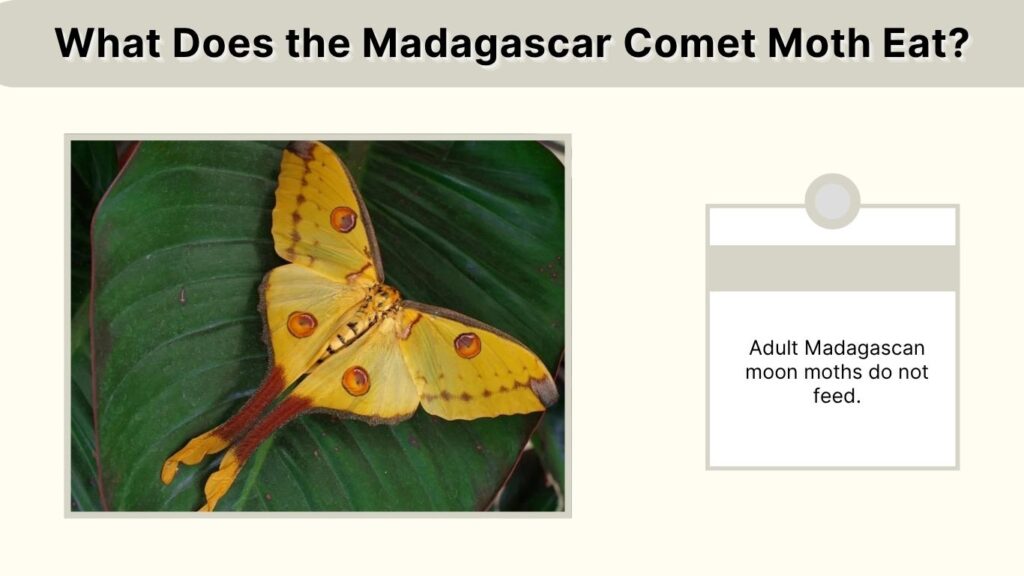
Adult Madagascan moon moths do not feed.
Although adults possess a mouth and digestive system, these structures are nonfunctional. The adult must survive on energy reserves accumulated during its caterpillar stage.
This unusual biology explains why adults live for such a short period.
How Long Does a Madagascar Comet Moth Live?
The adult life is extremely brief—typically only about six to eight days. During this period, the moth’s primary purpose is reproduction.
Males spend their limited adult lives searching for females. Their large feathery antennae are highly sensitive to female pheromones and help them locate potential mates.
After mating, females lay eggs and the next generation begins.
Is the Comet Moth the Same as the Madagascar Moon Moth?
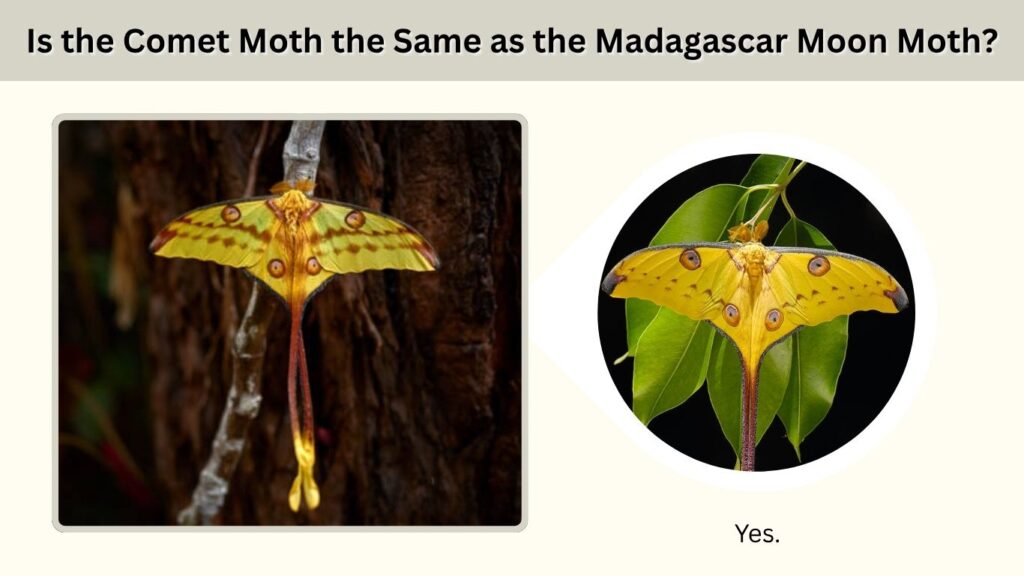
Yes. Comet moth, Madagascar comet moth, Madagascan comet moth, and Madagascan moon moth commonly refer to Argema mittrei.
The name “comet moth” refers to its spectacular trailing hindwings, while “moon moth” reflects its relationship and visual similarity to other large moon moths in the silk moth family.
It should not be confused with the African moon moth, Argema mimosae, which is a different species.
Is the Madagascar Comet Moth Rare?
The species has a restricted natural range because it is native to Madagascar. Forest loss is considered an important threat to its natural populations.
The Natural History Museum notes that deforestation is causing Madagascan moon moth numbers to decline in their native environment. Because Madagascar contains exceptionally high levels of endemism, continued forest protection is especially important for species that occur nowhere else.
Protecting intact and regenerating forests therefore benefits the comet moth along with thousands of other Malagasy animals and plants.
Interesting Madagascar Comet Moth Facts
It Is One of the Largest Silk Moths
With a male wingspan approaching 20 cm and extremely long tails, Argema mittrei ranks among the world’s largest and most visually impressive silk moths.
Adults Cannot Feed
An adult comet moth has only the energy stored during its caterpillar stage and generally survives for less than two weeks.
Males Use Huge Feathery Antennae
The male’s antennae provide a large surface area for detecting female pheromones, allowing males to locate potential mates efficiently.
Its Eyespots May Discourage Predators
The circular markings on its wings resemble eyes and may make the moth appear larger or more threatening to potential predators.
It Is Native to Madagascar
Wild Argema mittrei belongs to Madagascar’s unique forest fauna and is naturally associated with the island’s rainforest ecosystems.
FAQs
1. What is the scientific name of the Madagascar comet moth?
Its scientific name is Argema mittrei. It belongs to the giant silk moth family Saturniidae.
2. Is the comet moth native to Madagascar?
Yes. The species is native to Madagascar’s forests and is commonly known as both the Madagascan comet moth and Madagascan moon moth.
3. How big is a Madagascar comet moth?
Large males can have wingspans of around 20 cm, with extraordinarily long hindwing tails that can extend about 15 cm.
4. Does the Madagascar comet moth eat?
Caterpillars eat plant leaves, but adult moths do not feed because their adult mouthparts and digestive system are nonfunctional. Adults survive on stored energy.
5. Can you find comet moths in Ranomafana National Park?
Yes. Argema mittrei has been recorded from Ranomafana National Park, which protects humid rainforest habitat suitable for many native Madagascan insects.