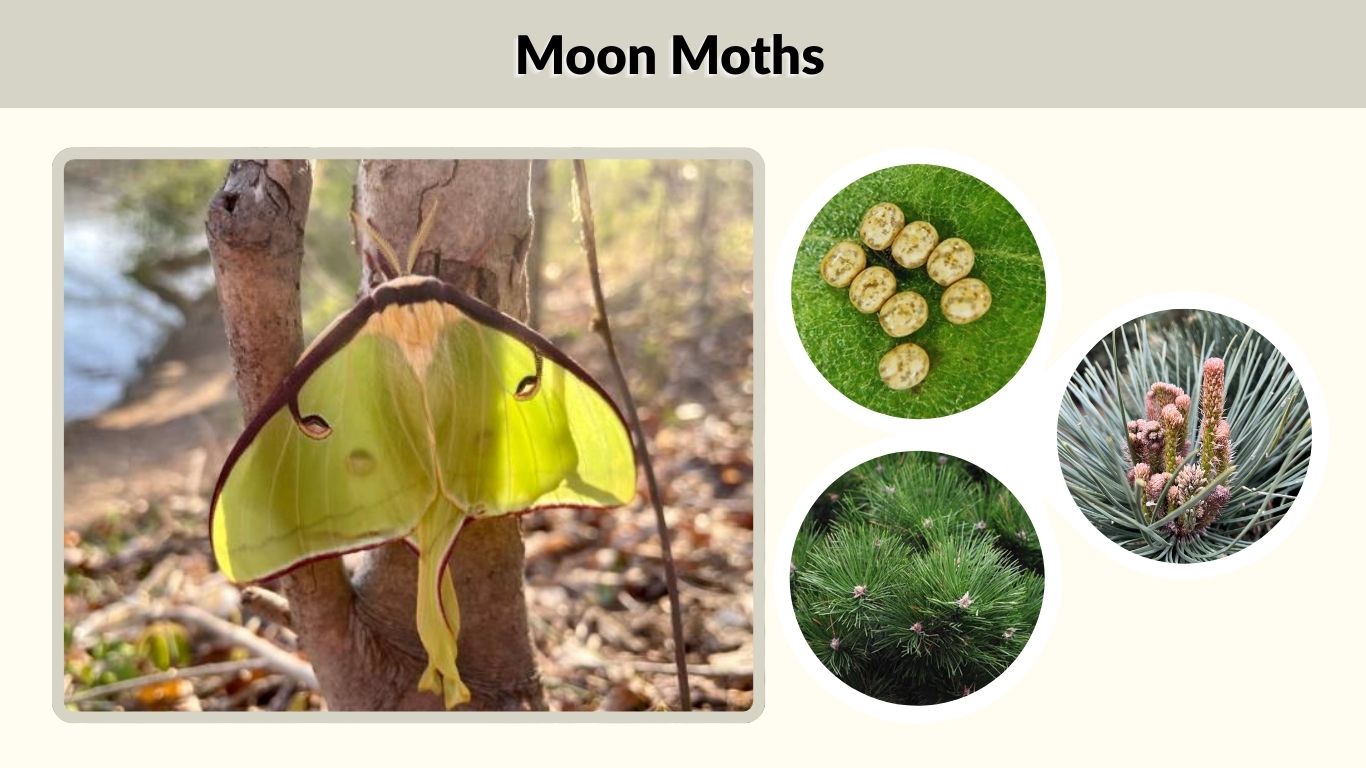
Moon moths are among the most striking giant silk moths, known for their pale green or yellow-green wings, dramatic hindwing tails, and large eyespots. The name is most often associated with moths in the genus Actias, including the famous luna moth, Indian moon moth, and Chinese moon moth, although some related giant silk moths are also called moon moths. These nocturnal insects are surrounded by another fascinating question: do moths really use the moon to navigate? Here’s what makes moon moths unique and what science says about moths, moonlight, and artificial lights.
What Are Moon Moths?
“Moon moth” is a common name rather than the name of a single species. It is particularly associated with members of the giant silk moth family Saturniidae. Many Actias species share pale colors, eyespots, and long tails, creating their characteristic moon-moth appearance.
Moon Moth Identification
Common characteristics include:
- Large, broad wings
- Green, yellow-green, or bluish-green coloration
- Long tails extending from the hindwings
- One eyespot on each wing
- Thick, often furry-looking bodies
- Large feathery antennae, especially in males
- Mainly nocturnal activity
- Large green caterpillars before adulthood
The long hindwing tails are particularly noticeable in many species and help distinguish them from ordinary household moths.
Types of Moon Moths
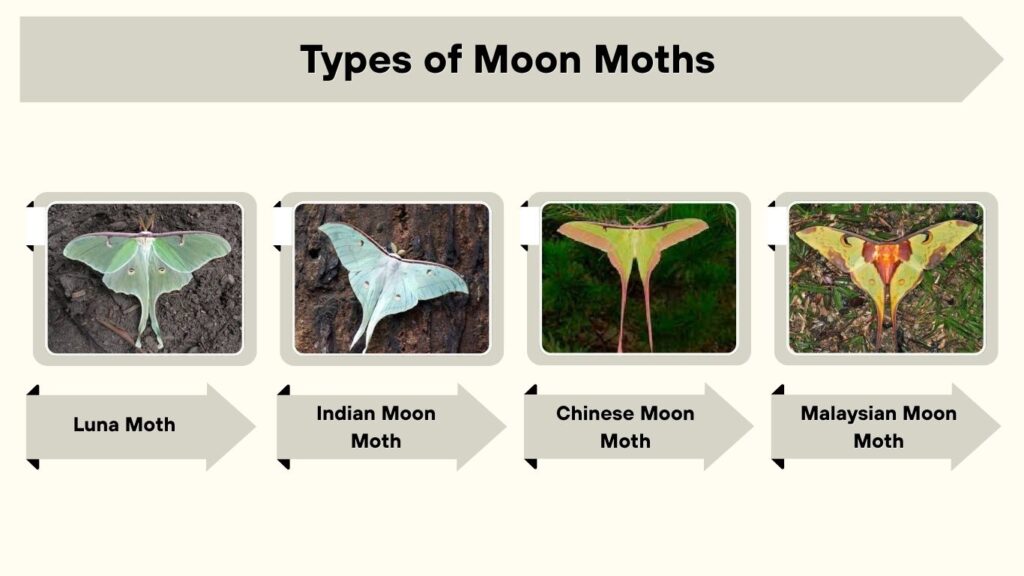
Several moth species are commonly described as moon moths. Although closely related, they occur in different parts of the world and vary in color, size, and tail length.
Luna Moth
The luna moth (Actias luna) is sometimes called the American moon moth. It occurs across much of eastern North America.
Adults have beautiful lime-green wings, transparent eyespots, and long tails on their hindwings. Luna moths are among the largest and most recognizable moths in North America.
Indian Moon Moth
The Indian moon moth (Actias selene), also called the Indian luna moth, occurs across parts of South and East Asia.
Its pale green wings have striking eyespots and extremely long hindwing tails. Its range includes India and extends through several areas of Asia.
Chinese Moon Moth
The Chinese moon moth (Actias ningpoana) is another large member of the genus.
It has green wings with distinctive eyespots and curved hindwing tails. It is closely related to the luna moth and other Asian Actias species.
Malaysian Moon Moth
The Malaysian moon moth, Actias maenas, is found in parts of Southeast Asia. It has the characteristic long tails and dramatic appearance associated with the moon-moth group.
Spanish Moon Moth
The Spanish moon moth is Actias isabellae, historically also known under the genus Graellsia. It is a European member of this remarkable group and has greenish wings patterned with dark lines and colorful eyespots.
African Moon Moth
The African moon moth (Argema mimosae) belongs to the same giant silk moth family but is not an Actias species.
Native to eastern and southern Africa, it has emerald-green wings, eyespots, and exceptionally long tails. Adults may reach around 10–12 cm across the wings.
Are Moon Moths and Luna Moths the Same?
Not exactly. A luna moth is one type of moon moth, but the term moon moth can describe several different species.
Moon Moth vs Luna Moth
The luna moth specifically refers to Actias luna, a North American species.
Other moon moths include the Indian moon moth, Chinese moon moth, Malaysian moon moth, and several related species.
Therefore:
Every luna moth can be called a moon moth, but not every moon moth is a luna moth.
The geographic location of the moth is often an important clue when identifying the species.
What Do Moon Moths Eat?
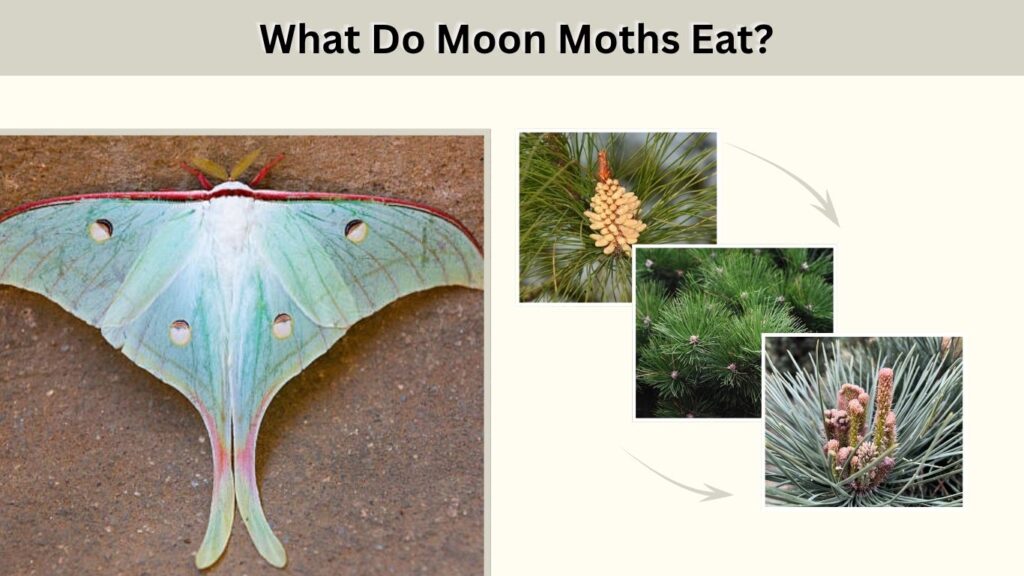
The answer depends on the moth’s life stage. Moon moths eat heavily as caterpillars but generally stop eating once they become adults.
What Do Moon Moth Caterpillars Eat?
Caterpillars feed on the leaves of suitable host trees and shrubs. The exact host plants vary by species.
Depending on the moon moth, larvae may use plants such as:
- Sweetgum
- Walnut
- Hickory
- Birch
- Persimmon
- Willow
- Sumac
- Marula
- Various regional trees and shrubs
The caterpillar needs to consume enough leaves to store energy for metamorphosis and its short adult life.
Do Adult Moon Moths Eat?
Most adult moon moths have reduced or nonfunctional mouthparts and do not eat after emerging from the cocoon.
Instead, they survive using energy stored during the caterpillar stage. For example, adult African moon moths lack functioning mouthparts and live on stored energy.
Their main purpose during adulthood is reproduction.
How Long Do Moon Moths Live?
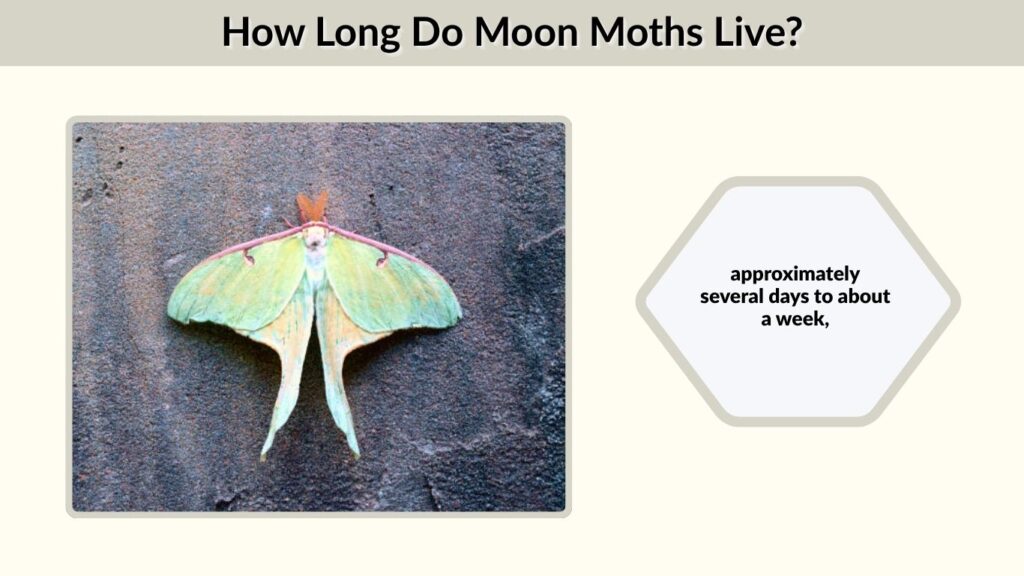
The spectacular adult stage is surprisingly short.
Adult Moon Moth Lifespan
Most adult giant silk moths of this type survive for approximately several days to about a week, although conditions and species can cause some variation.
Because adults do not regularly feed, their stored energy gradually runs out.
During this brief period, males search for females, mating occurs, and females lay eggs to begin another generation.
The complete life cycle is much longer because it also includes egg, caterpillar, pupa, and cocoon stages.
Moon Moth Life Cycle
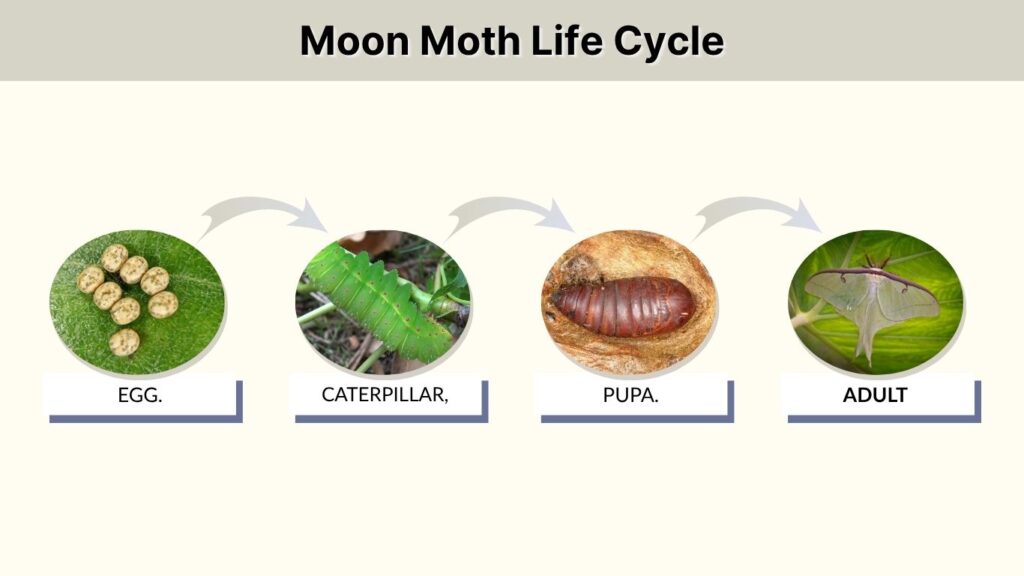
Like other moths, moon moths undergo complete metamorphosis.
Egg
After mating, a female places eggs on or near appropriate caterpillar host plants.
Caterpillar
The larvae hatch and begin eating leaves. They grow rapidly and molt several times before reaching full size.
Cocoon and Pupa
A mature caterpillar spins a silk cocoon and changes into a pupa. Depending on the species and climate, the moth may remain inside for weeks or much longer during unfavorable seasons.
Adult
The adult emerges, expands its wings, and begins searching for a mate. Because adults have such limited time, reproduction becomes their primary activity.
Are Moths Attracted to the Moon?
People often assume that moths circling porch lights are trying to fly toward a miniature “moon.” The real explanation appears more complicated.
Do Moths Use the Moon to Navigate?
A long-standing theory proposed that moths use distant celestial light, including the moon, to maintain a constant flight angle.
Because the moon is extremely far away, maintaining an angle relative to it could theoretically help an insect travel in a straight line.
However, newer research has changed our understanding of why insects circle nearby artificial lights.
A 2024 study using high-speed 3D tracking found that flying insects near artificial lights tended to turn their backs toward the light, a behavior called the dorsal light response. In nature, keeping the brighter sky above the body helps insects determine which direction is up. A nearby lamp can disrupt that system and produce circling, climbing, or diving behavior.
Why Do Moths Fly Around Lights?
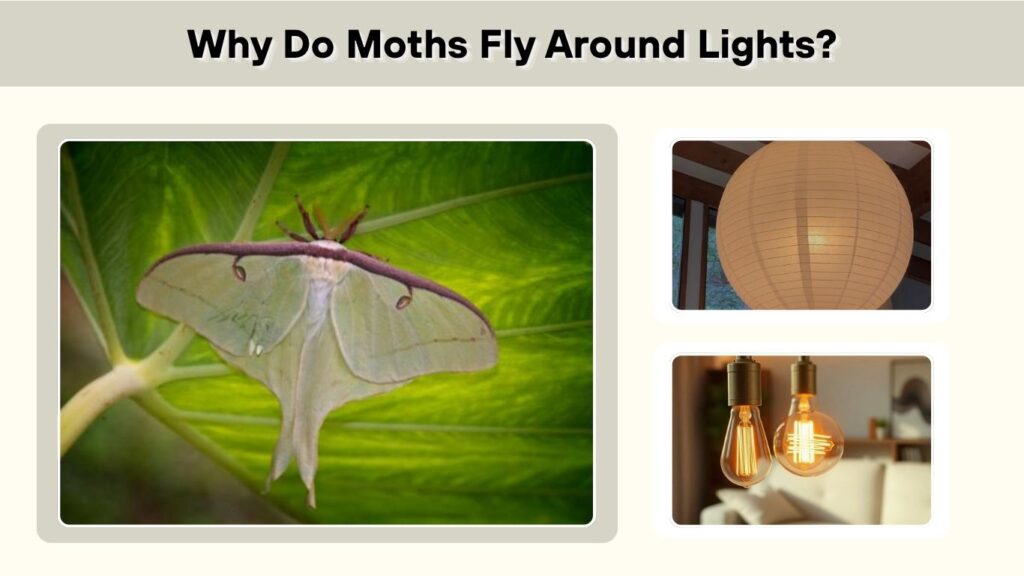
Moths do not necessarily look at a porch light and intentionally fly straight toward it.
Artificial Lights Confuse Flight Orientation
Under natural nighttime conditions, the sky is normally brighter than the ground. Flying insects can use this difference to help maintain proper orientation.
A bright artificial bulb creates an unusual situation because the brightest region may suddenly be beside or below the insect.
When the moth tries to keep its back oriented toward this bright source, its flight path can curve repeatedly around it.
This explains why moths may:
- Circle lamps
- Spiral around bulbs
- Fly upward and stall
- Dive toward the ground
- Appear trapped near a light
The 2024 research found this explanation better matched observed insect flight than the simple idea that insects were attempting to fly directly toward a lamp.
Do Moths Fly Toward the Moon?
No, moths are not trying to physically reach the moon.
The moon is hundreds of thousands of kilometers away, and natural celestial light does not produce the same close-range disturbance as a nearby bulb.
Moths and other nocturnal insects may use natural light information as part of orientation, but saying they simply “follow the moon” is an oversimplification.
Artificial lights are particularly disruptive because they create an intense point of light at extremely close range.
Moon Moth Meaning and Symbolism
Because moon moths are nocturnal and undergo dramatic metamorphosis, people sometimes associate them with transformation, renewal, mystery, intuition, and short-lived beauty.
These meanings are cultural or personal symbolism rather than biological characteristics.
The short adult lifespan of species such as luna and other giant silk moths also contributes to their association with appreciating temporary or fleeting experiences.
Interesting Moon Moth Facts
- Moon moths belong to the giant silk moth family Saturniidae.
- Many well-known species belong to the genus Actias.
- Luna moths are sometimes called American moon moths.
- Indian and Chinese moon moths occur in Asia.
- African moon moths belong to the genus Argema.
- Many species have exceptionally long hindwing tails.
- Caterpillars eat much more than adults.
- Adults of many species do not eat at all.
- Adult life often lasts only about a week.
- Artificial lights can disrupt their natural flight orientation.
FAQs
Are Moon Moths Rare?
It depends on the species and location. Some moon moths are locally common in suitable habitats but are rarely seen because adults are nocturnal and short-lived.
Are Moon Moths Dangerous?
No. Moon moths do not sting and are not considered dangerous to people. Their caterpillars are primarily leaf-eating insects.
What Is the Difference Between an Indian Moon Moth and a Luna Moth?
The Indian moon moth is Actias selene and occurs in Asia, while the luna moth is Actias luna and occurs in North America. Both have pale green wings, eyespots, and long hindwing tails.
Why Do Moths Follow the Moon?
Moths do not literally try to reach the moon. Natural sky light may contribute to orientation, while current evidence suggests nearby artificial lights interfere with an insect’s ability to determine which direction is up.
How Long Do Adult Moon Moths Live?
Many adult moon moths survive for only several days to roughly a week. They rely on energy accumulated as caterpillars and spend their short adult lives primarily finding mates and reproducing.