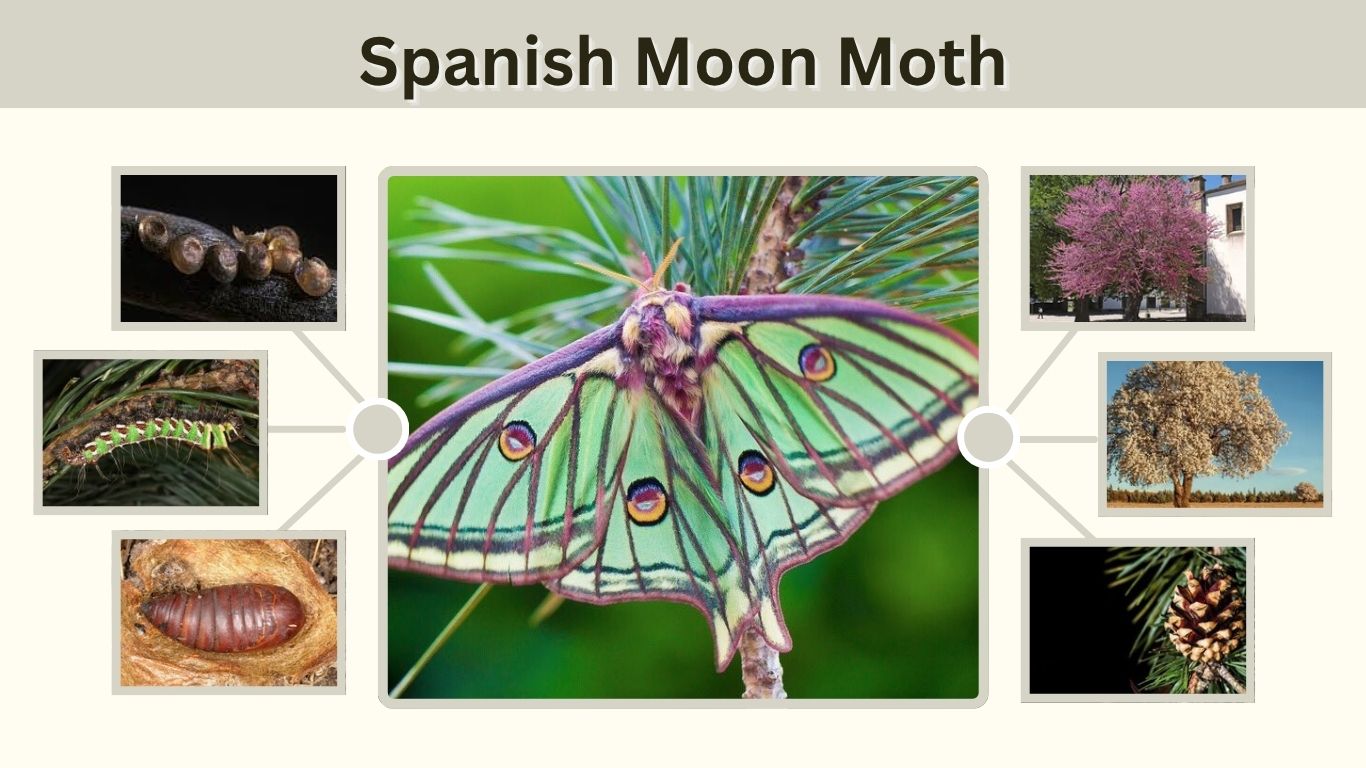
The Spanish Moon Moth (Graellsia isabellae) is one of Europe’s most spectacular moths, recognizable by its pale green wings, purple-brown markings, colorful eyespots, and elegant hindwing tails. This large silk moth occurs mainly in mountainous pine forests of Spain and parts of France. Unlike many familiar moths, adults do not feed and survive on energy stored during the caterpillar stage. Its unusual appearance, restricted distribution, and specialized relationship with pine trees make the Spanish Moon Moth an especially fascinating species.
What Is a Spanish Moon Moth?
The Spanish Moon Moth belongs to the silk moth family Saturniidae. Its scientific name is commonly given as Graellsia isabellae, although some classifications place it in the genus Actias. It was first scientifically described in the nineteenth century and remains strongly associated with mountainous pine forests of southwestern Europe.
Spanish Moon Moth Identification
Important characteristics include:
- Pale bluish-green or yellow-green wings
- Purple to reddish-brown wing veins and borders
- Four prominent eyespots
- Long hindwing tails, especially in males
- Thick, furry body
- Large feathery antennae on males
- Wingspan reaching roughly 8–10 cm
- Primarily nocturnal behavior
The translucent-looking green wings and strongly contrasting veins give the moth an almost stained-glass appearance.
Spanish Moon Moth Size
Adults are large compared with most European moths. Their wingspan can approach 10 cm, although individual size varies.
The long hindwing extensions of males make them appear even larger when resting or flying.
Despite their impressive appearance, Spanish Moon Moths are harmless to people and do not possess a functional feeding apparatus capable of biting humans.
Male vs Female Spanish Moon Moth
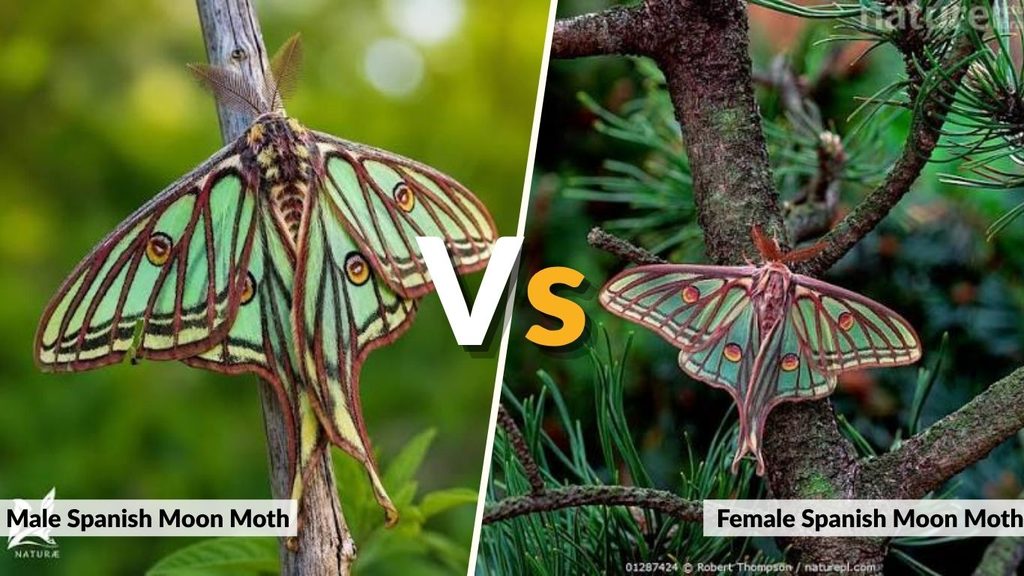
Male and female Spanish Moon Moths share the same beautiful green coloration, but several physical differences make mature adults relatively easy to distinguish.
Female Spanish Moon Moth
Females generally have:
- A larger, rounder abdomen
- Shorter hindwing tails
- Less strongly feathered antennae
- A heavier overall appearance
The enlarged abdomen contains developing eggs.
After emerging and becoming receptive, a female releases sex pheromones that males can detect from a distance. Research has identified the female-produced pheromone used to attract males.
Male Spanish Moon Moth
Males usually have longer hindwing tails and noticeably broader, feather-like antennae.
Those antennae contain sensory structures specialized for detecting female pheromones. Males can therefore locate females in dark forest environments without relying primarily on sight.
Their abdomen is generally narrower and more pointed than that of the female.
Spanish Moon Moth Habitat and Distribution
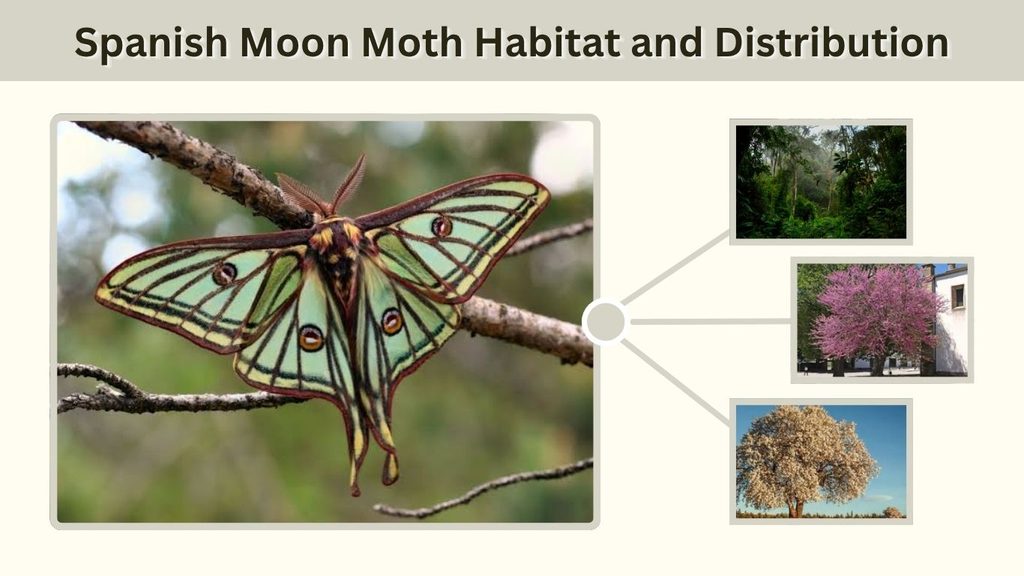
The Spanish Moon Moth has a much more restricted natural distribution than widespread species such as the Luna Moth. It is mainly associated with mountainous regions of the Iberian Peninsula and portions of the French Alps and Pyrenees.
Where Does the Spanish Moon Moth Live?
Its range includes populations in:
- Spain
- The Spanish Pyrenees
- Central and eastern Iberian mountain systems
- Southern French Alps
- French Pyrenees
- Other localized suitable pine forests
Research describes the species as concentrated mainly in mountainous areas of the eastern half of the Iberian Peninsula and the French Alps.
Preferred Habitat
Spanish Moon Moths primarily inhabit mountain pine forests.
Suitable habitat often occurs at elevations of approximately 900–1,800 meters, although populations can occur outside this general range. Sunny but not excessively dry pine forests provide particularly favorable conditions.
The distribution of appropriate pine species strongly influences where the moth can successfully reproduce.
Spanish Moon Moth Caterpillar
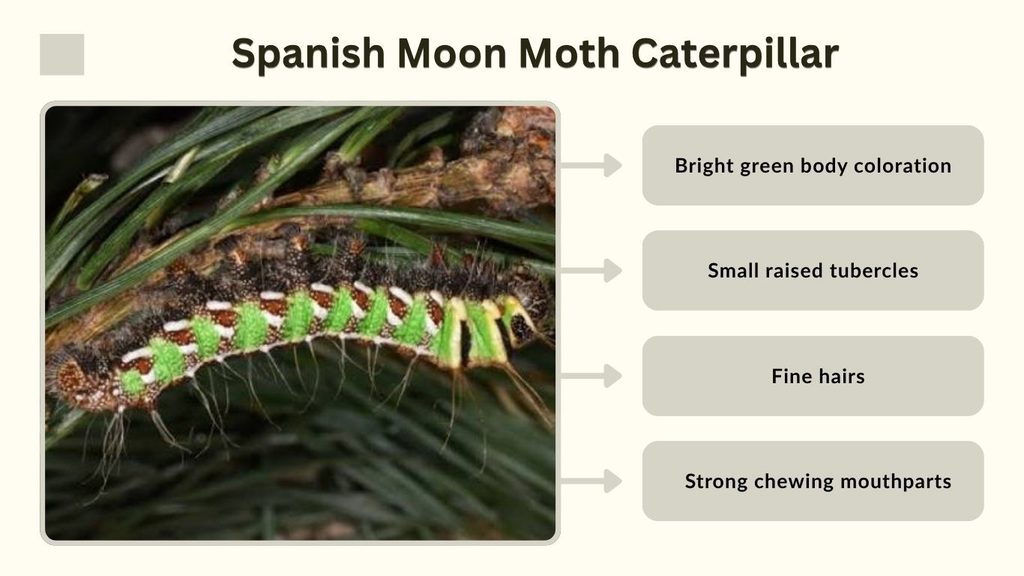
The caterpillar looks dramatically different from the adult. Young larvae are relatively dark after hatching, but later stages develop a brighter green appearance that provides camouflage among pine needles.
What Does the Caterpillar Look Like?
Mature caterpillars typically show:
- Bright green body coloration
- Thick, cylindrical shape
- Small raised tubercles
- Fine hairs
- Markings that blend with pine foliage
- Strong chewing mouthparts
Unlike the adult moth, the caterpillar spends much of its life actively feeding.
It must accumulate enough energy to complete pupation and support the adult stage because the mature moth does not eat.
Spanish Moon Moth Host Plants
Important caterpillar host plants include:
- Scots pine (Pinus sylvestris)
- Black pine (Pinus nigra)
- Other suitable Pinus species in some populations
Scots pine and black pine are considered the two principal host plants across much of the species’ range.
The caterpillars eat pine needles rather than leaves from ordinary garden plants.
Spanish Moon Moth Life Cycle
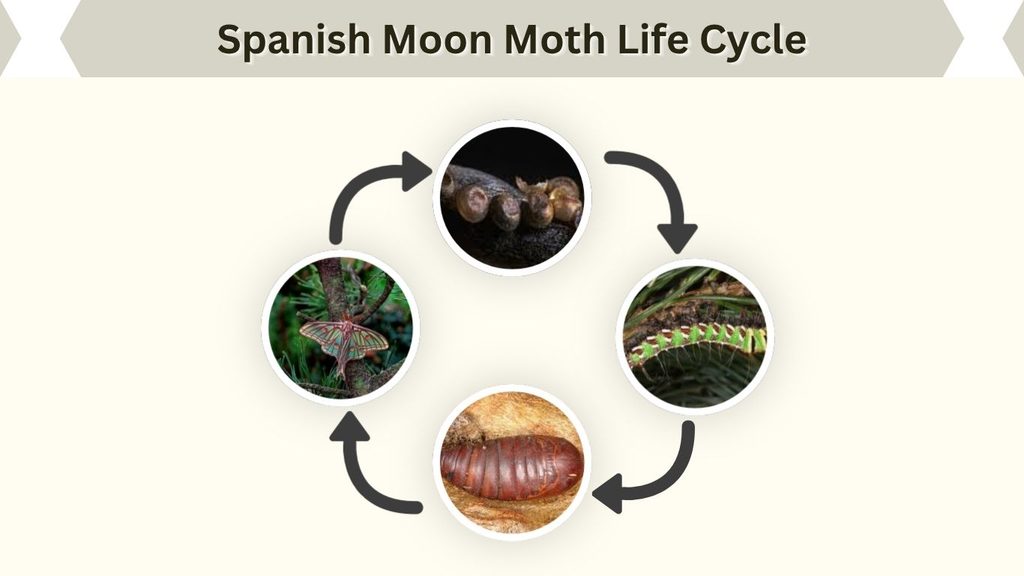
The Spanish Moon Moth undergoes complete metamorphosis through egg, caterpillar, pupa, and adult stages. It typically produces only one generation per year, although development can be prolonged under some environmental conditions.
From Egg to Adult
The main stages are:
- Egg: Females place eggs on pine branches, twigs, or needles.
- Caterpillar: Larvae hatch and begin feeding on pine needles.
- Growing larva: Caterpillars pass through several developmental stages.
- Pupa: Mature caterpillars descend and pupate near ground level.
- Overwintering: The species normally spends winter as a pupa.
- Adult: Moths emerge mainly during spring and early summer.
The adult flight period is generally concentrated from roughly April through June, although timing varies by elevation, region, and weather.
Spanish Moon Moth Cocoon
When ready to pupate, the mature caterpillar leaves its feeding area and produces a relatively loose cocoon near the ground among vegetation and forest litter.
The pupal stage carries the insect through winter before adult emergence.
This overwintering strategy allows adults to appear when spring temperatures and reproductive conditions become suitable.
How Long Does a Spanish Moon Moth Live?
The adult portion of the Spanish Moon Moth’s life is surprisingly short.
Adult saturniid moths have reduced mouthparts, and the Spanish Moon Moth does not feed as an adult. It relies entirely on energy accumulated while it was a caterpillar. Sources describe the adult stage as lasting only days to around a couple of weeks under favorable conditions.
Why Adults Do Not Eat
The primary purpose of adulthood is reproduction.
After emerging, males search for females. Females mate and then deposit their eggs on suitable pine hosts.
Once their stored energy reserves are exhausted, the adults die naturally.
Their extremely short adult lifespan makes the long caterpillar and pupal stages particularly important to the species.
Spanish Moon Moth vs Luna Moth
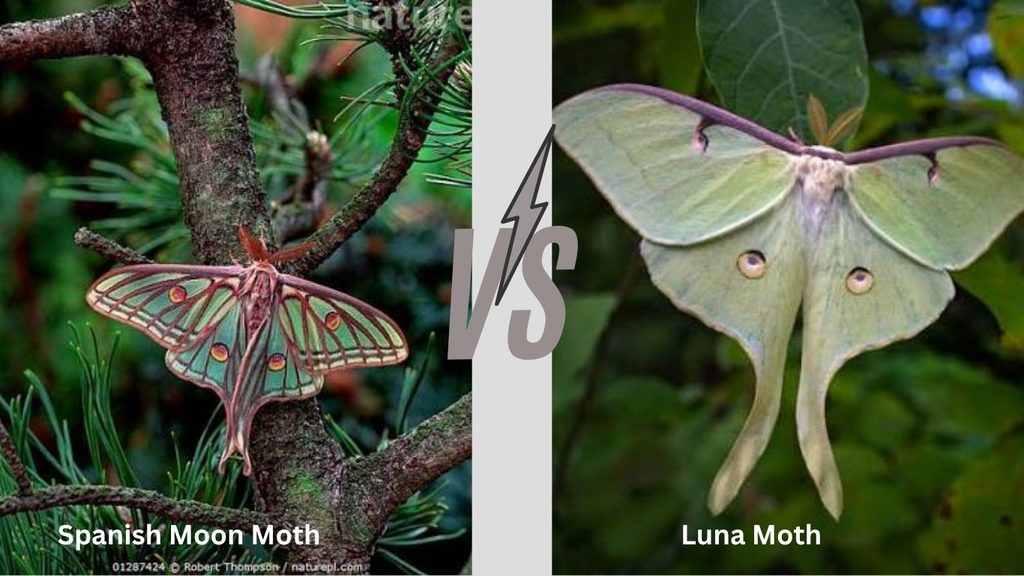
The Spanish Moon Moth is sometimes confused with the Luna Moth (Actias luna) because both are large green silk moths with long hindwing tails.
However, they are different species from different geographic regions.
Key Differences
Spanish Moon Moth:
- Native primarily to Spain and parts of France
- Strong purple-brown veins across the wings
- Multiple prominent eyespots
- Larvae mainly associated with pine trees
- Scientific name Graellsia isabellae
Luna Moth:
- Native to North America
- Usually has smoother pale green wings
- Has distinctive eyespots but different wing markings
- Caterpillars feed on deciduous trees such as walnut and sweetgum
- Scientific name Actias luna
Both belong to the family Saturniidae and both have non-feeding adults.
Is the Spanish Moon Moth Rare?
The Spanish Moon Moth has a restricted and fragmented distribution rather than occurring throughout Europe. It is legally protected in parts of its range and is included in European conservation frameworks. Research has identified habitat specialization and geographic isolation among its populations.
The IUCN’s 2026 update lists the Spanish Moon Moth as Vulnerable, reflecting conservation concern for this localized species.
Main Conservation Concerns
Potential pressures include:
- Loss or alteration of pine forest habitat
- Forest fires
- Changes in forest management
- Climate-related habitat shifts
- Fragmentation of populations
- Illegal collecting
Protecting suitable mountain pine forests is therefore important for maintaining healthy populations.
Spanish Moon Moth Meaning and Symbolism
There is no scientifically established spiritual meaning for the Spanish Moon Moth. However, its transformation from caterpillar to winged adult has inspired symbolic interpretations.
People sometimes associate moon moths with transformation, renewal, change, beauty, intuition, and the temporary nature of life.
These meanings come from cultural or personal interpretation rather than biology.
FAQs
1. What is the scientific name of the Spanish Moon Moth?
Its scientific name is Graellsia isabellae. Some taxonomic treatments also place the species in the genus Actias.
2. What do Spanish Moon Moth caterpillars eat?
The caterpillars primarily feed on pine needles, particularly those of Scots pine and black pine.
3. Do adult Spanish Moon Moths eat?
No. Adults do not feed. They survive using energy reserves accumulated during their caterpillar stage.
4. Where are Spanish Moon Moths found?
They occur mainly in mountainous pine forests of Spain and localized regions of France, including parts of the Alps and Pyrenees.
5. Is a Spanish Moon Moth the same as a Luna Moth?
No. The Spanish Moon Moth is a European species, while the Luna Moth is native to North America. Although both are large green silk moths, their markings, host plants, and geographic ranges differ.