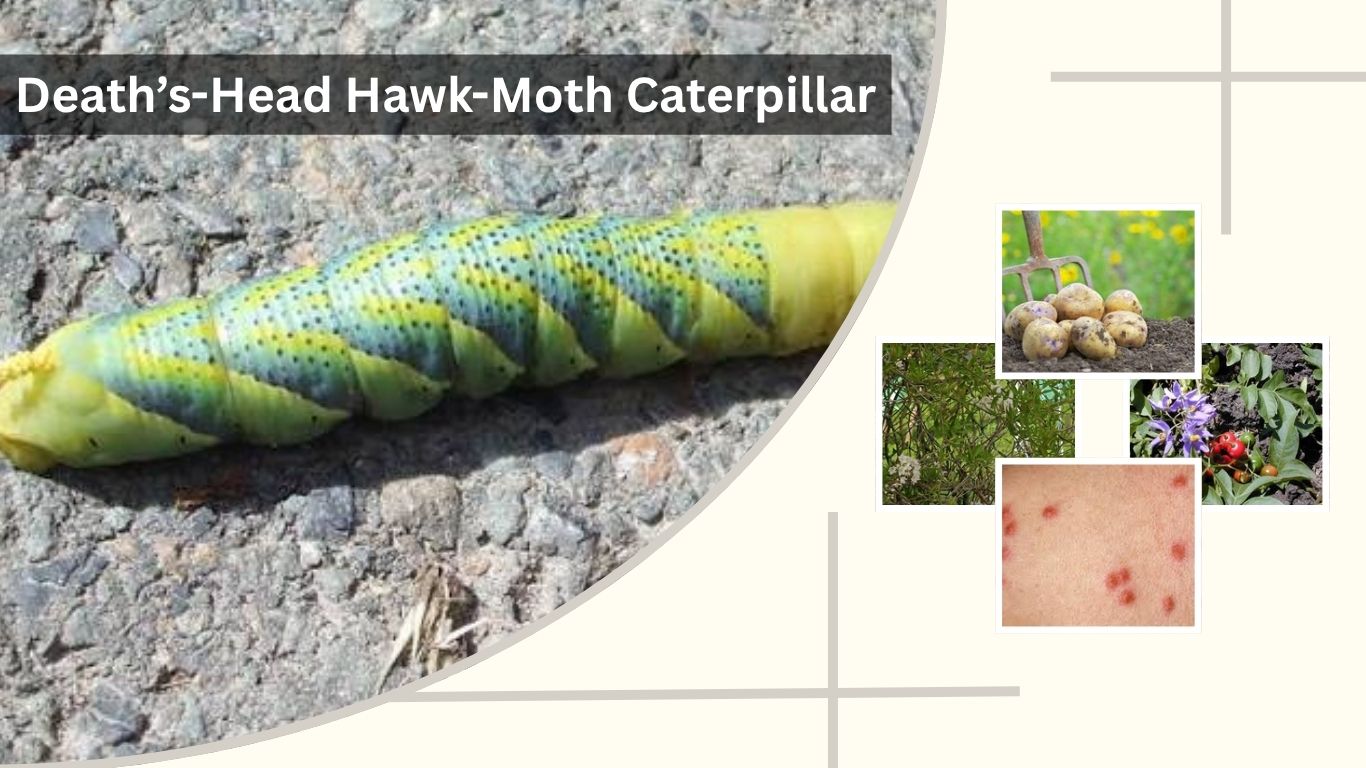
The death’s-head hawk-moth caterpillar is an impressive larva known for its large size, bright colors, diagonal body markings, and distinctive curved tail horn. Most references to this caterpillar concern Acherontia atropos, the African death’s-head hawk-moth. Despite its intimidating appearance, the caterpillar is not considered dangerous to people. It spends most of its larval life feeding heavily on suitable plants before eventually leaving the vegetation and burrowing underground to pupate. This guide covers its appearance, size, food, behavior, bite risk, and life cycle.
What Is a Death’s-Head Hawk-Moth Caterpillar?
The death’s-head hawk-moth caterpillar is the larval stage of a large moth in the hawk-moth family Sphingidae. The name “death’s-head hawk-moth” can apply to three Acherontia species, although Acherontia atropos is the species most commonly meant, particularly in European references.
During the caterpillar stage, the animal’s main purpose is to eat, grow, and store enough energy to complete metamorphosis.
Death’s-Head Hawk-Moth Caterpillar Identification
A mature caterpillar can usually be recognized by several characteristics:
- Very large, thick body
- Yellow, green, or brown coloration
- Blue or purplish diagonal markings along the sides
- Small dark spots on the body
- Large head and powerful mouthparts
- Distinctive curved horn at the rear
- Smooth, robust appearance
- Strong gripping legs
The rear horn is typical of many hawk-moth caterpillars and may look sharp, but it is not a stinger.
Different Caterpillar Colors
One unusual feature of Acherontia atropos is the amount of color variation among mature larvae.
The most familiar form is bright yellow with blue or bluish-purple diagonal stripes. Green and brown forms also occur. These differences can make two caterpillars of the same species look surprisingly different.
Therefore, color alone should not be used for identification. Body structure, markings, host plant, and the characteristic tail horn are also useful.
Death’s-Head Hawk-Moth Caterpillar Size
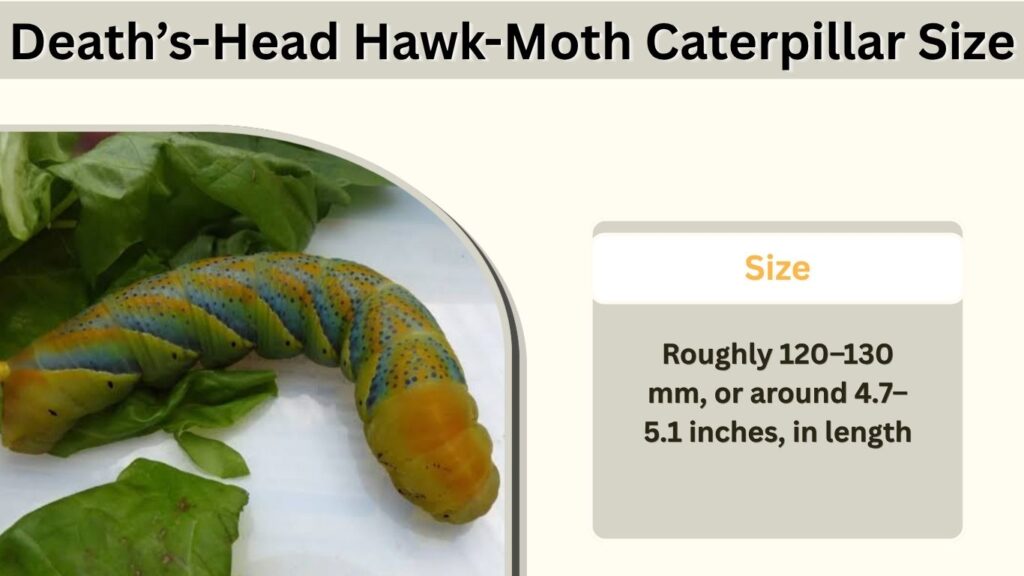
These caterpillars become exceptionally large before pupation. Mature larvae may reach roughly 120–130 mm, or around 4.7–5.1 inches, in length.
Their considerable size is necessary because they must accumulate enough resources to transform into a large adult hawk moth.
How Big Does the Caterpillar Get?
A fully grown caterpillar generally has:
- Length: Up to approximately 12–13 cm
- Body: Thick and heavy
- Tail: Prominent curved horn
- Final stage: Much larger than younger larvae
Young caterpillars are naturally much smaller and change considerably as they molt through successive developmental stages.
Why Does It Become So Large?
Caterpillars are essentially the growth stage of a moth’s life.
They repeatedly consume foliage, grow, and shed their skin. By the final larval stage, the death’s-head hawk-moth caterpillar has developed the body reserves needed for pupation and adult development.
Once mature, feeding eventually stops and the caterpillar begins searching for an appropriate place to pupate.
What Do Death’s-Head Hawk-Moth Caterpillars Eat?
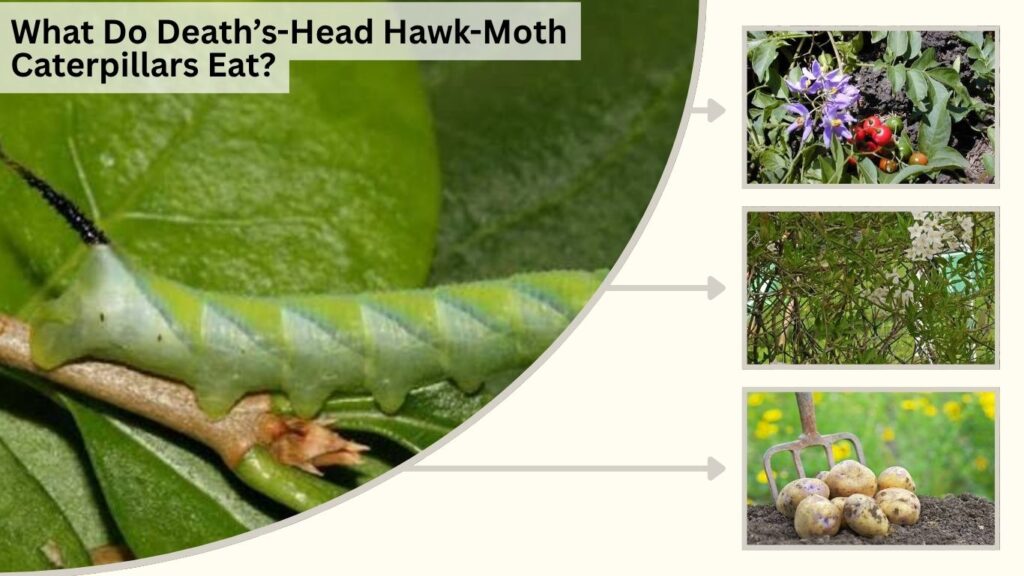
Potatoes are one of the best-known food plants of Acherontia atropos. In areas where migrating adults reproduce, large caterpillars are occasionally discovered feeding in potato fields.
However, the species is not necessarily restricted to a single host plant.
Death’s-Head Hawk-Moth Caterpillar Food
Known or reported host plants include:
- Potato
- Other nightshade-family plants
- Physalis
- Jasmine
- Some olive-family plants
- Other suitable broad-leaved host plants
Host preference can vary geographically, so a caterpillar found on a plant should not automatically be moved to a completely different species of plant.
Do They Eat Potatoes?
The caterpillars are strongly associated with potato plants, but they primarily consume the leaves and other foliage, not the underground potato tubers.
A large final-stage caterpillar can consume considerable foliage because rapid feeding is necessary before pupation.
How Do They Feed?
The caterpillar uses strong chewing mouthparts called mandibles to cut pieces from leaves.
It normally remains close to an acceptable food source and feeds repeatedly. As nearby leaves are depleted, the caterpillar moves to fresh foliage. This behavior allows it to gain substantial body mass during its larval development.
Does a Death’s-Head Hawk-Moth Caterpillar Bite?
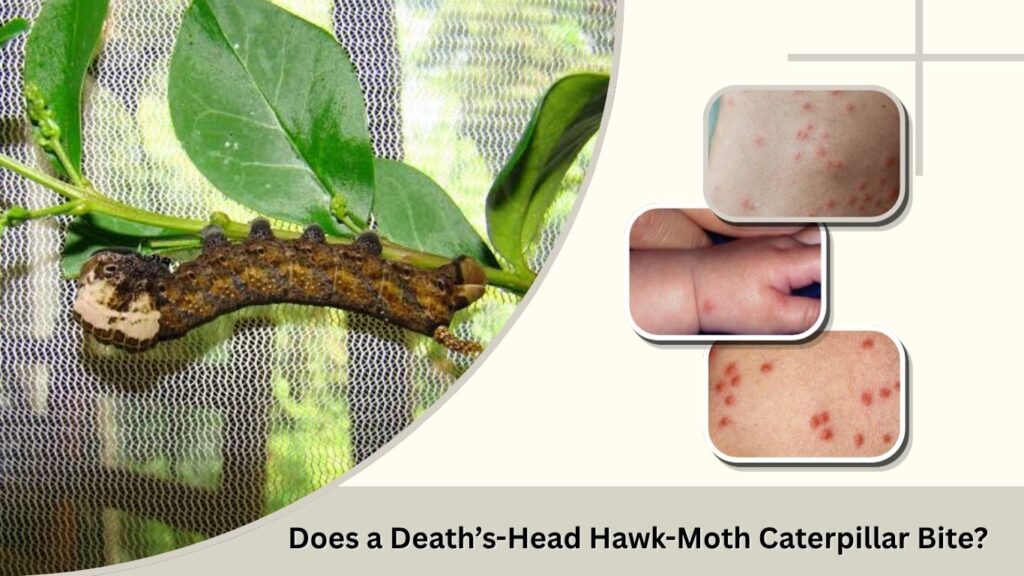
A death’s-head hawk-moth caterpillar has strong mandibles designed for chewing leaves. If seriously disturbed, a caterpillar may use its mandibles defensively, but it is not regarded as a dangerous biting insect. Reports describe defensive bites as essentially harmless to human skin.
Is the Caterpillar Poisonous?
The caterpillar is not generally considered poisonous or dangerously venomous to humans.
Important characteristics include:
- It has no venomous stinger.
- Its tail horn does not inject venom.
- It lacks the obvious urticating hairs found on some medically important caterpillars.
- It does not hunt or attack people.
- Defensive behavior generally occurs only when the animal is disturbed.
Its bright coloration and large horn can make it appear much more threatening than it actually is.
Can You Touch One?
Brief contact is unlikely to be dangerous, but unnecessary handling is best avoided.
Caterpillars have soft bodies that can be injured by squeezing or dropping. Oils, chemicals, insect repellents, or other substances on human hands may also be harmful to the animal.
If one needs to be moved, allowing it to crawl naturally onto a leaf or suitable container is preferable to gripping its body.
What Is the Horn on the Caterpillar?
The curved structure at the back is often called a caudal horn or tail horn.
Hawk-moth larvae are sometimes called hornworms because this structure occurs in many members of the family.
Does the Tail Horn Sting?
No. The horn is not a stinger.
Although it may appear sharp or threatening, it does not function like the stinger of a bee or wasp. In Acherontia atropos, the mature caterpillar’s horn is distinctive because it is curved and textured rather than simply straight and smooth.
This feature can actually be useful when identifying the caterpillar.
Death’s-Head Hawk-Moth Caterpillar Life Cycle
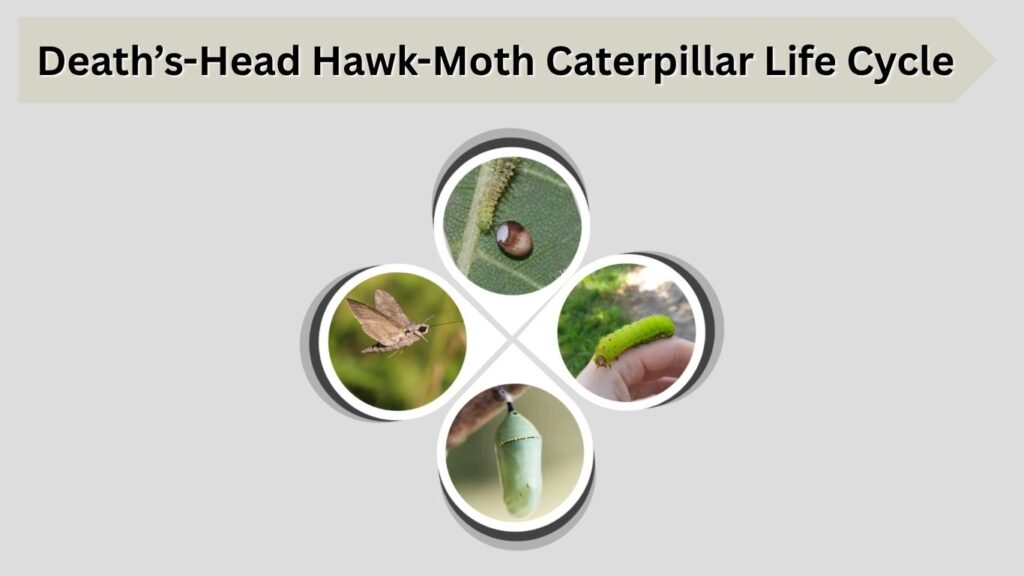
The caterpillar represents only one part of the death’s-head hawk-moth life cycle. Like other moths, the species undergoes complete metamorphosis.
Its main developmental stages are egg, larva, pupa, and adult moth.
From Egg to Caterpillar
The life cycle follows this general sequence:
- A female deposits eggs on suitable host plants.
- Small caterpillars hatch and begin feeding.
- The larvae grow through several stages called instars.
- Each growing caterpillar molts repeatedly.
- The final-stage larva becomes very large and eventually stops feeding.
- It leaves its host plant and searches for suitable soil.
- Pupation occurs underground.
- An adult death’s-head hawk moth later emerges.
Butterfly Conservation specifically notes that A. atropos caterpillars pupate underground.
What Happens Before Pupation?
A mature caterpillar may suddenly stop eating and begin wandering.
This is normal behavior. Rather than indicating illness, wandering can mean the larva has finished feeding and is searching for soil where it can construct an underground pupation chamber.
Unlike species that form obvious silk cocoons hanging from branches, the death’s-head hawk-moth normally disappears beneath the ground before transforming.
Where Are Death’s-Head Hawk-Moth Caterpillars Found?
Acherontia atropos is principally associated with Africa and warmer regions around the Mediterranean, although adults are powerful migrants capable of traveling north into other parts of Europe.
Places You May Find Caterpillars
They can occur around:
- Potato fields
- Gardens
- Agricultural areas
- Allotments
- Nightshade-family plants
- Warm open countryside
- Areas visited by egg-laying adult moths
In Britain, the species is a migrant rather than a permanently established resident. Caterpillars may therefore be particularly notable during years when larger numbers of adult moths arrive.
FAQs
1. What does a death’s-head hawk-moth caterpillar look like?
A mature caterpillar is very large and thick-bodied, with a prominent curved horn at the rear. It may be yellow, green, or brown and commonly displays contrasting diagonal markings along its sides. Mature individuals can reach around 12–13 cm long.
2. What does a death’s-head hawk-moth caterpillar eat?
Potato foliage is one of its best-known foods. The caterpillar can also use other suitable host plants, including various plants related to nightshades and several additional plant groups depending on location.
3. Can a death’s-head hawk-moth caterpillar bite?
It has strong chewing mandibles and may use them defensively when seriously disturbed. However, it is not considered a dangerous biting caterpillar, and reported defensive bites are generally harmless to human skin.
4. Is the horn on a death’s-head caterpillar poisonous?
No. The curved horn at the rear of the caterpillar is not a venomous stinger. It is a characteristic body structure found in many hawk-moth larvae and poses little threat to people.
5. Where does the caterpillar go when fully grown?
Once mature, the caterpillar stops feeding, leaves its host plant, and searches for suitable ground. It then burrows into the soil and forms an underground chamber where it changes into a pupa before eventually emerging as an adult moth.