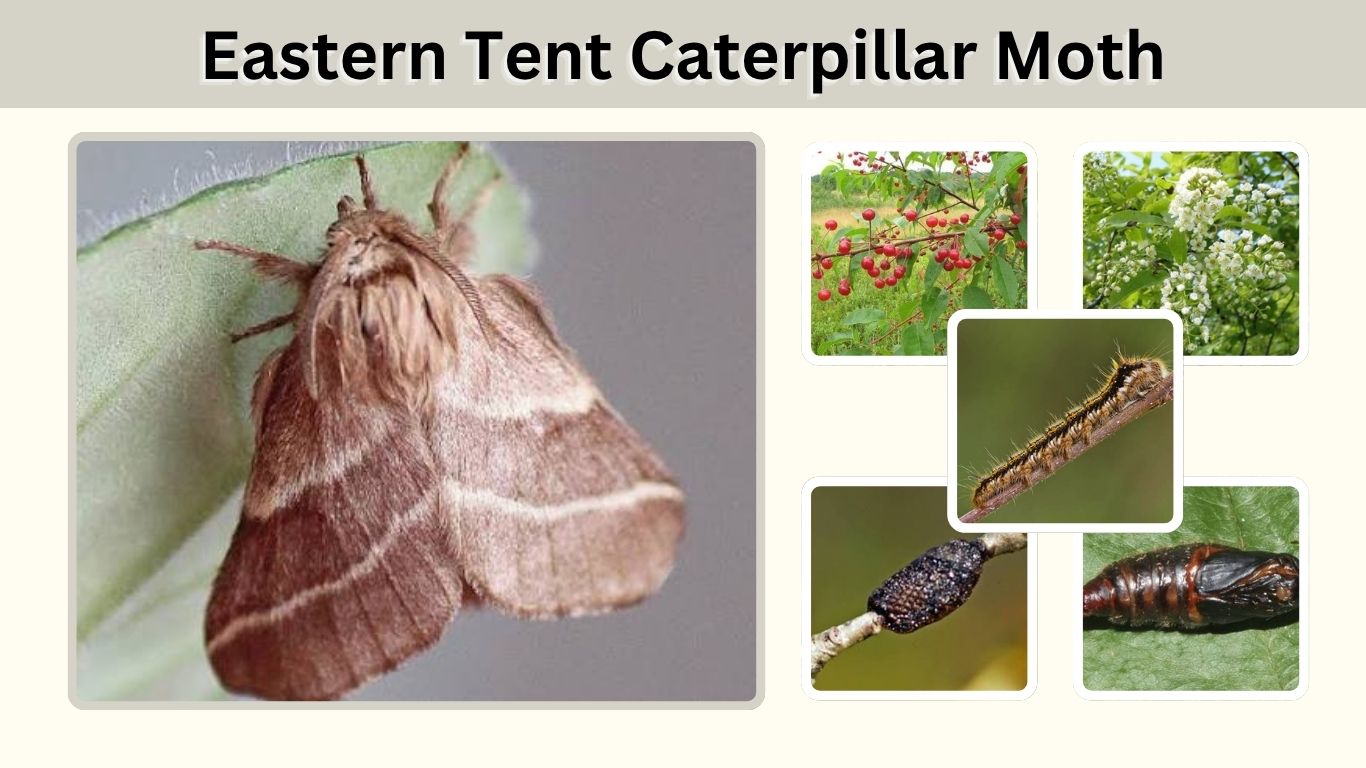
The eastern tent caterpillar moth is a native North American insect best known for the large silk tents its caterpillars build in spring. These social caterpillars commonly gather on cherry, apple, crabapple, and related trees. Although their webs may look alarming, healthy mature trees usually recover from occasional feeding. Understanding the insect’s appearance, adult size, diet, cocoon, life cycle, and differences from spongy moths can help homeowners identify it correctly and manage unwanted colonies.
What Is an Eastern Tent Caterpillar Moth?
The eastern tent caterpillar moth, scientifically known as Malacosoma americanum, belongs to the Lasiocampidae family. It occurs throughout much of the eastern and central United States, extending westward toward the Rocky Mountains. It is native to North America rather than an introduced invasive species.
The insect spends most of its life as an egg or caterpillar. Its most recognizable stage appears in early spring, when groups of larvae construct white silk tents in the forks of host trees.
| Quick fact | Description |
| Scientific name | Malacosoma americanum |
| Family | Lasiocampidae |
| Adult color | Tan, reddish brown or warm fawn brown |
| Adult wingspan | Approximately 0.9–1.7 inches |
| Caterpillar length | Up to about 2 inches |
| Main host plants | Cherry, apple, crabapple, plum and hawthorn |
| Generations | One per year |
Eastern Tent Caterpillar Identification
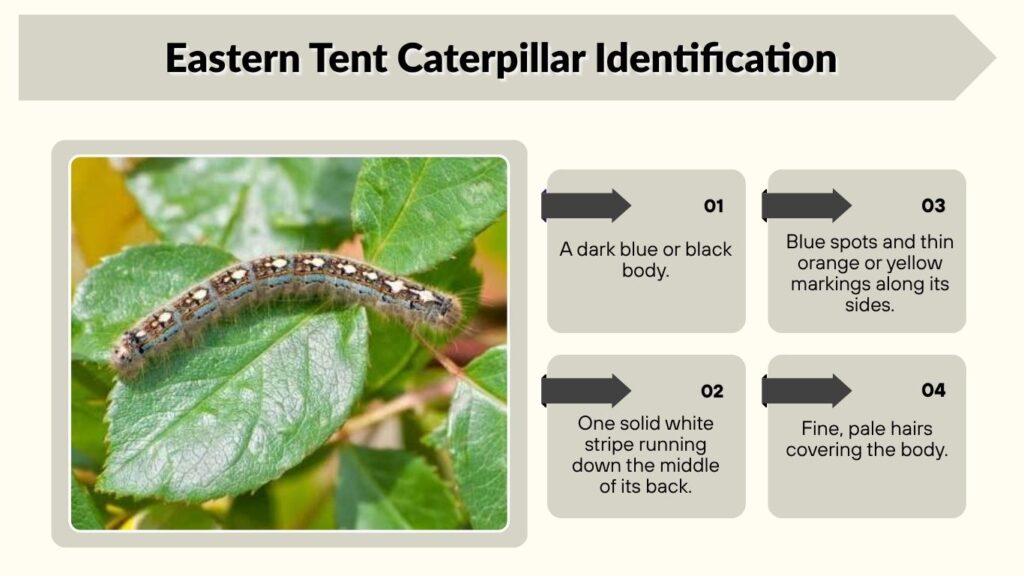
The caterpillar is usually easier to recognize than the adult moth. Identification should be based on its solid white back stripe, colorful side markings, communal behavior, and the location of its tent.
What Does the Caterpillar Look Like?
A mature eastern tent caterpillar has several distinctive features:
- A dark blue or black body
- One solid white stripe running down the middle of its back
- Blue spots and thin orange or yellow markings along its sides
- Fine, pale hairs covering the body
- A mature length of approximately two inches
The unbroken white dorsal stripe is particularly useful because several similar hairy caterpillars have spots or broken lines instead.
What Does the Tent Look Like?
Eastern tent caterpillars build dense, expanding silk tents where two branches meet. The larvae leave the shelter to feed on nearby leaves and return between feeding periods, during bad weather, and when temperatures change.
The tent itself does not eat or directly injure the branch. Most plant damage comes from caterpillars removing leaves. Tents become larger and dirtier as the colony grows, accumulating droppings, shed skins, and silk layers.
What Does the Adult Moth Look Like?
Adult eastern tent caterpillar moths are relatively plain compared with their colorful larvae. Their subdued coloring allows them to blend against bark, wood, and other natural surfaces.
Adult Appearance and Size
The adult moth is typically warm tan, reddish brown or fawn brown. Two pale, creamy-white lines cross each forewing, sometimes surrounding a lighter central band. Its body is thick and fuzzy, and the wings form a triangular shape when held over the body.
Its wingspan generally ranges from approximately 2.2 to 4.4 centimeters, or about 0.9 to 1.7 inches. Females are usually larger and heavier-bodied than males, while males often have more noticeably feathered antennae.
Adult moths are primarily active at night. They may be attracted to porch lights and other outdoor lighting during their late-spring or early-summer flight period.
Eastern Tent Caterpillar Moth Life Cycle
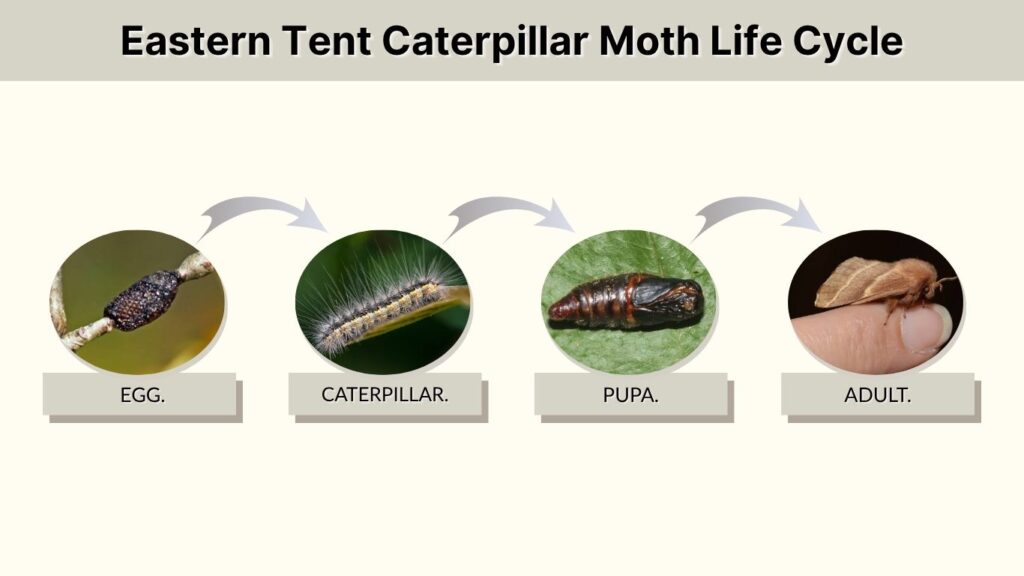
The species undergoes complete metamorphosis, passing through egg, caterpillar, pupa, and adult stages. It produces only one generation each year.
1. Egg Stage
After mating, females deposit a dark, shiny egg mass around a small twig. The mass may contain approximately 150–400 eggs and resembles a varnished ring wrapped around the branch.
The developing larvae remain inside their eggs through summer, fall, and winter. They hatch in early spring near the time their host tree begins producing tender new leaves.
2. Caterpillar Stage
Newly hatched larvae gather near a branch fork and begin constructing their communal tent. The caterpillars feed for approximately four to six weeks, enlarging the shelter as they grow.
They frequently leave the tent before dawn, in the evening, or at night to eat. Silk and chemical trails help colony members travel between the shelter and productive feeding areas.
3. Cocoon and Pupal Stage
Once fully grown, caterpillars separate from the colony and search for protected pupation sites. Cocoons may appear beneath logs, under loose bark, among leaves, near fences, or in cracks and sheltered areas around buildings.
The cocoon is oval, loosely woven and usually white to yellowish. A powdery yellow substance may be visible within its silk. The pupal period generally lasts several weeks before the adult emerges.
4. Adult Moth Stage
Adults typically emerge from late May through June, although timing varies with location and weather. Their main purpose is reproduction. They mate, females lay egg masses, and the next generation remains within the eggs until the following spring.
What Do Eastern Tent Caterpillar Moths Eat?
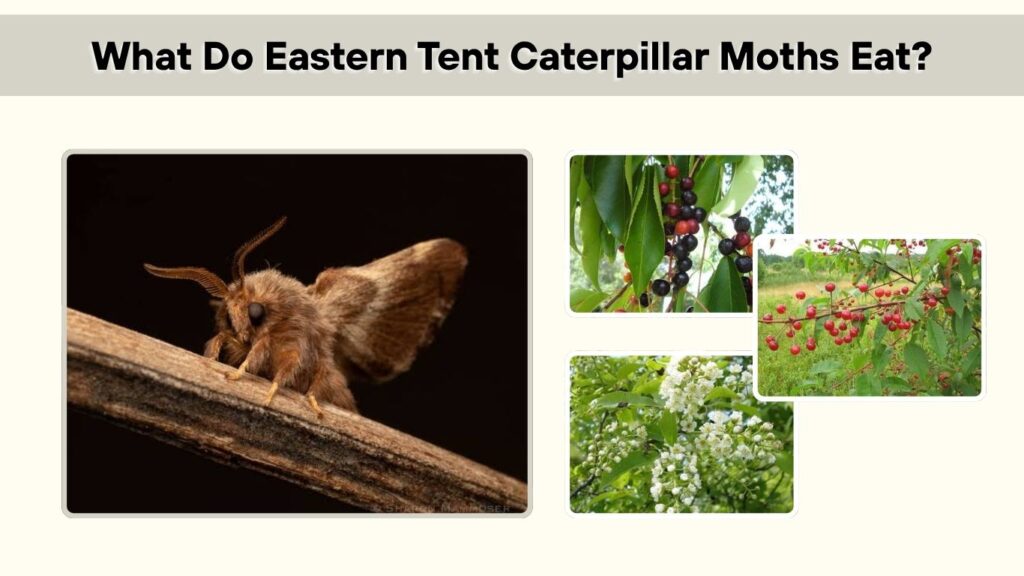
Diet changes dramatically between the larval and adult stages. Nearly all noticeable feeding and plant damage occurs while the insect is a caterpillar.
Caterpillar Food
Eastern tent caterpillars prefer trees and shrubs in the rose family. Common host plants include:
- Black cherry
- Chokecherry
- Pin cherry
- Apple and crabapple
- Plum and peach
- Hawthorn
When preferred food becomes scarce, the caterpillars may feed on other broadleaf trees and shrubs. They consume leaves rather than wood, bark, clothing, stored grain, or household materials.
Adult Moth Food
Adult eastern tent caterpillar moths generally do not feed. They survive on energy stored during the larval stage and have a short adult life devoted primarily to mating and egg laying.
Are Eastern Tent Caterpillar Moths Poisonous?
Eastern tent caterpillar moths do not sting, and the adults are not dangerous to people. The caterpillars do not have the toxic airborne hairs associated with browntail moth caterpillars.
However, it is still sensible to avoid handling hairy caterpillars with bare hands. Their hairs may cause minor mechanical irritation in sensitive individuals. They can also create a nuisance when large numbers crawl across patios, driveways, buildings, or outdoor furniture.
Eastern tent caterpillars require special attention around horses. Research has associated accidental ingestion of caterpillars by pregnant mares with mare reproductive loss syndrome. Caterpillars and tents should therefore be controlled around horse pastures and feeding areas.
Eastern Tent Caterpillar vs Spongy Moth
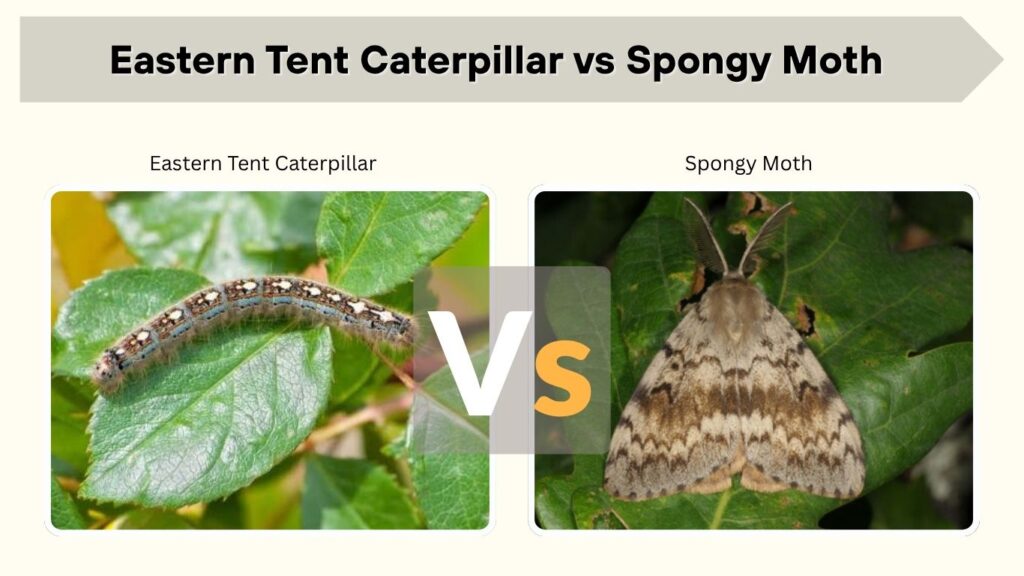
The spongy moth was formerly known as the gypsy moth. It is an invasive species that does not build the same large communal tents created by eastern tent caterpillars.
| Feature | Eastern tent caterpillar | Spongy moth caterpillar |
| Back markings | One solid white stripe | Five pairs of blue dots followed by six pairs of red dots |
| Silk tent | Builds a tent in branch forks | Does not build a communal branch-fork tent |
| Preferred hosts | Mainly cherry, apple and related trees | Feeds on hundreds of woody plant species |
| Origin in North America | Native | Introduced and invasive |
| Egg mass | Shiny ring around a twig | Fuzzy tan mass on bark or other surfaces |
The paired blue and rusty-red spots make mature spongy moth caterpillars easy to separate from the single-striped eastern tent caterpillar.
Eastern Tent Caterpillar vs Browntail Caterpillar
Browntail caterpillars have dark brown bodies, broken white side stripes, and two red-orange spots near the rear. Their microscopic hairs can cause an itchy rash and respiratory problems.
Eastern tent caterpillars have one solid white stripe down the center of the back and build large spring tents in branch forks. Browntail caterpillars create smaller overwintering webs near branch tips. They present a much greater human-health concern because their toxic hairs may remain irritating in the environment for years.
Do Eastern Tent Caterpillars Damage Trees?
A large colony can remove many leaves and may completely defoliate a small tree. The bare branches and dirty webbing can look severe, but established deciduous trees can often produce replacement leaves and recover.
Repeated defoliation, drought, disease, or other stresses increase the possibility of lasting damage. Young fruit trees and recently planted ornamental trees deserve greater protection than healthy mature trees.
FAQs
What type of moth does an eastern tent caterpillar become?
It becomes the eastern tent caterpillar moth, Malacosoma americanum. The adult is a fuzzy tan or reddish-brown moth with two pale diagonal lines across each forewing. Its appearance is much less colorful than the striped blue, black, orange, and white caterpillar.
How long does an eastern tent caterpillar moth live?
The complete life cycle lasts approximately ten months, most of which is spent developing inside the egg or feeding as a caterpillar. The adult moth stage is extremely brief and may last only about five days, during which mating and egg laying occur.
When do eastern tent caterpillars become moths?
Caterpillars normally pupate during late spring or early summer. Adult moths commonly emerge from late May through June, depending on climate and local weather. Cooler northern locations may experience activity later than warmer areas farther south.
Do eastern tent caterpillar moths bite?
No. Adult eastern tent caterpillar moths do not bite or sting people. They are short-lived, nocturnal insects focused on reproduction. The caterpillars also do not sting, although avoiding unnecessary handling is advisable because their body hairs may irritate sensitive skin.
What animals eat eastern tent caterpillars?
Birds are among their most important predators, particularly when caterpillars are young. Predatory insects, parasitoid flies, and disease-causing organisms also reduce colonies. These natural enemies frequently cause populations to decline after several years of high caterpillar activity.