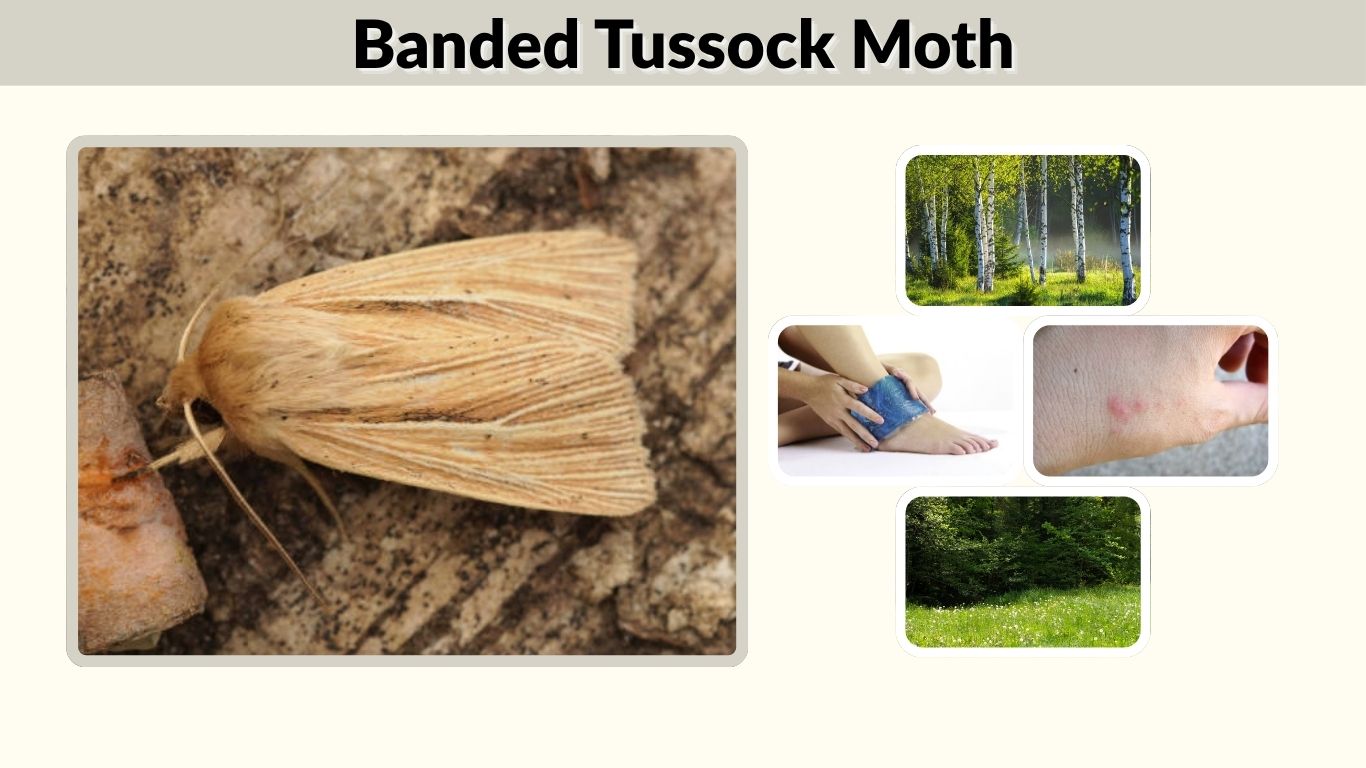
The banded tussock moth is a pale, attractive moth commonly found near deciduous forests, gardens, and suburban landscapes. Its fuzzy caterpillar is much more noticeable than the adult and is often discovered crawling across tree trunks, decks, sidewalks, and outdoor furniture.
Although its long hairs can make it look dangerous, the banded tussock moth caterpillar does not possess a venomous stinger. However, its hairs may irritate sensitive skin and produce an itchy rash. Learning how to identify this species can help you observe it safely and distinguish it from more irritating tussock moth caterpillars.
What Is a Banded Tussock Moth?
The banded tussock moth, scientifically known as Halysidota tessellaris, is a North American tiger moth in the family Erebidae. It is also called the pale tiger moth or tessellated halisidota.
The word “tessellaris” refers to the checkered or mosaic-like pattern found on the adult moth’s wings. The term “tussock” describes the thick tufts of hair covering the caterpillar.
Banded tussock moths are usually associated with wooded habitats because their caterpillars feed on the foliage of many deciduous trees. Adults are nocturnal and may be found resting near outdoor lights during the warmer months.
Banded Tussock Moth Identification
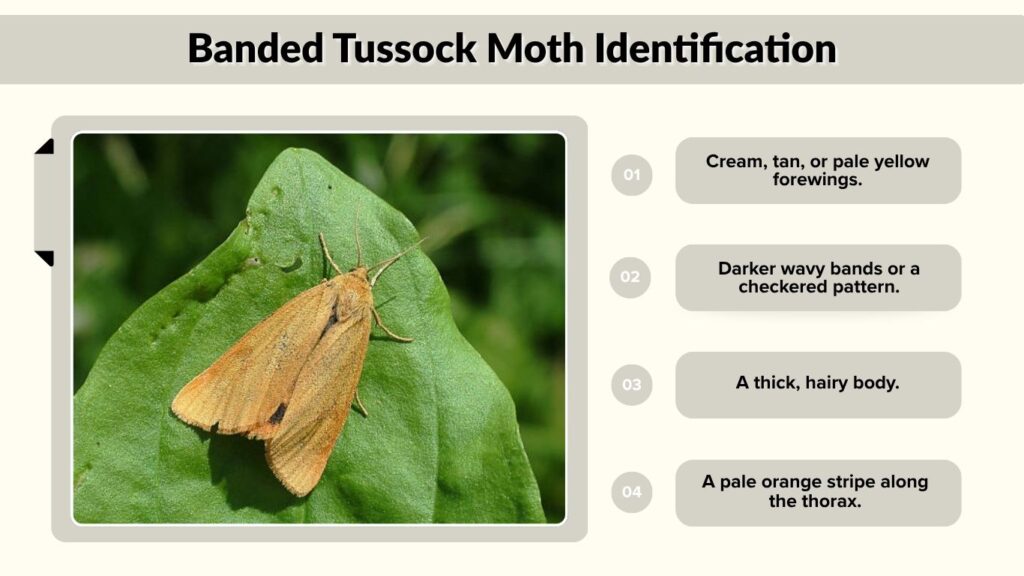
The adult moth and caterpillar look very different. The adult has patterned wings and a stout, furry body, while the larva is covered in long tufts of pale hair.
Adult moth appearance
An adult banded tussock moth typically has:
- Cream, tan, or pale yellow forewings
- Darker wavy bands or a checkered pattern
- A thick, hairy body
- A pale orange stripe along the thorax
- Small blue-green or turquoise lines beside the orange stripe
- Wings held roof-like over the body while resting
The pale wings may appear almost white under bright artificial lighting. The checkered pattern can be subtle, particularly on worn individuals.
The adult’s exact identification can be challenging because the banded tussock moth closely resembles the sycamore tussock moth and other members of the genus Halysidota. In some cases, adult moths cannot be reliably separated from photographs alone.
Caterpillar appearance
The banded tussock moth caterpillar is usually tan, yellowish, gray, or light brown. Its body is covered with long hairs that give it a soft, woolly appearance.
Important identification features include:
- Long yellow, tan, white, or gray body hairs
- Several darker tufts running along the back
- Extra-long black and white hair pencils near the front and rear
- A black or dark brown head
- A body length that may approach 1½ inches when mature
Color can vary considerably. Some caterpillars appear pale cream or white, while others are distinctly yellow, brown, or gray. Older caterpillars are generally larger, hairier, and easier to recognize.
Banded Tussock Moth Size
Adult banded tussock moths are medium-sized. Their wingspan is generally around 1½ to 2 inches, although exact size varies by sex and individual development.
Mature caterpillars are commonly around 1 to 1½ inches long. Their long hairs make them look larger than their actual bodies. Younger larvae are much smaller and may lack the dramatic hair tufts seen on mature caterpillars.
Size should not be used as the only identification feature because several similar tiger moth and tussock moth caterpillars reach approximately the same length.
Are Banded Tussock Moth Caterpillars Poisonous?
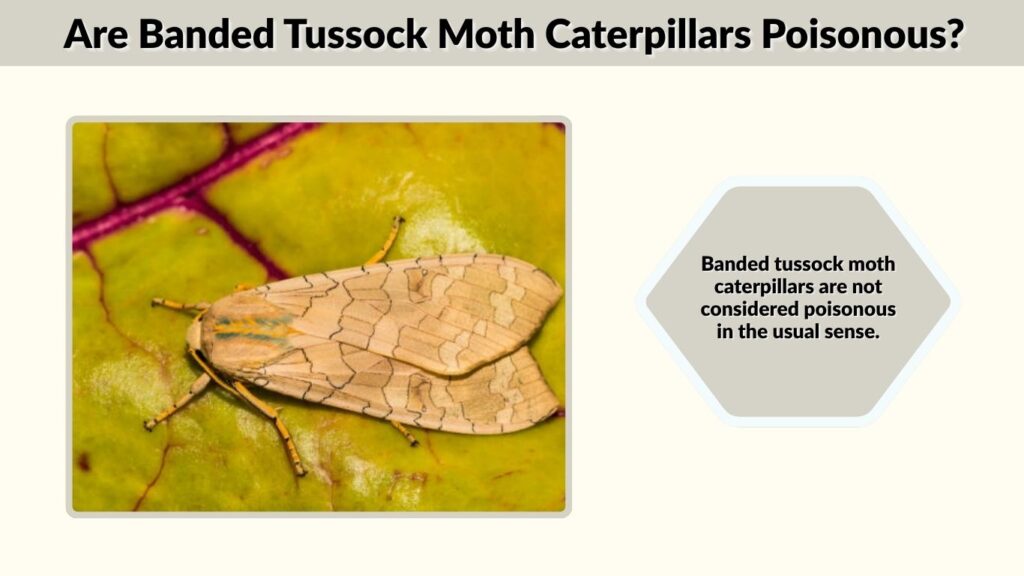
Banded tussock moth caterpillars are not considered poisonous in the usual sense. They do not inject venom, and merely being near one is not dangerous.
However, their hairs may cause mechanical irritation when they become embedded in the skin. Some people are more sensitive than others and may develop redness, burning, itching, or a localized rash after handling the caterpillar.
Many tussock moth caterpillars have defensive hairs that can irritate sensitive skin. The University of Maine specifically includes the banded tussock caterpillar among tussock caterpillars whose hairs may cause an itchy rash.
The terms “poisonous” and “venomous” are sometimes used loosely online. A more accurate description is that the caterpillar is potentially irritating, rather than dangerously poisonous.
Do Banded Tussock Moth Caterpillars Sting?
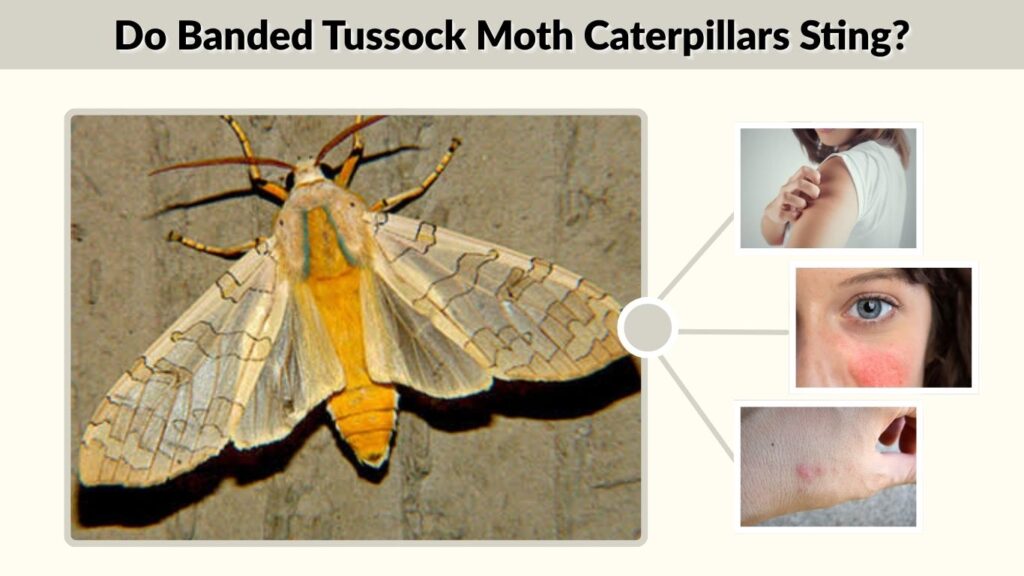
Banded tussock moth caterpillars do not sting in the way that bees, wasps, or truly venomous caterpillars do. They have no stinger and do not deliberately inject venom.
The prickling or burning sensation sometimes described as a “sting” comes from contact with the caterpillar’s hairs. These hairs may break off, lodge in the skin, and trigger irritation.
A person may experience:
- Itching
- Redness
- Small raised bumps
- Mild swelling
- Burning or prickling
- A rash limited to the contact area
Reactions are usually mild and temporary, but individual sensitivity varies. Children and people with sensitive skin may have a more noticeable response.
Can You Touch a Banded Tussock Moth Caterpillar?
It is best not to touch one with bare hands. Even when a caterpillar is not highly venomous, its hairs may cause discomfort or become trapped in the skin.
Children should be taught to observe fuzzy caterpillars without picking them up. Pets should also be discouraged from pawing at or chewing them.
To move a caterpillar, allow it to crawl onto a leaf, piece of cardboard, or small stick. Place it near a suitable tree or shrub rather than crushing it.
The adult moth can generally be observed safely, but handling any moth may damage the delicate scales covering its wings.
Banded Tussock Moth Caterpillar Rash Treatment
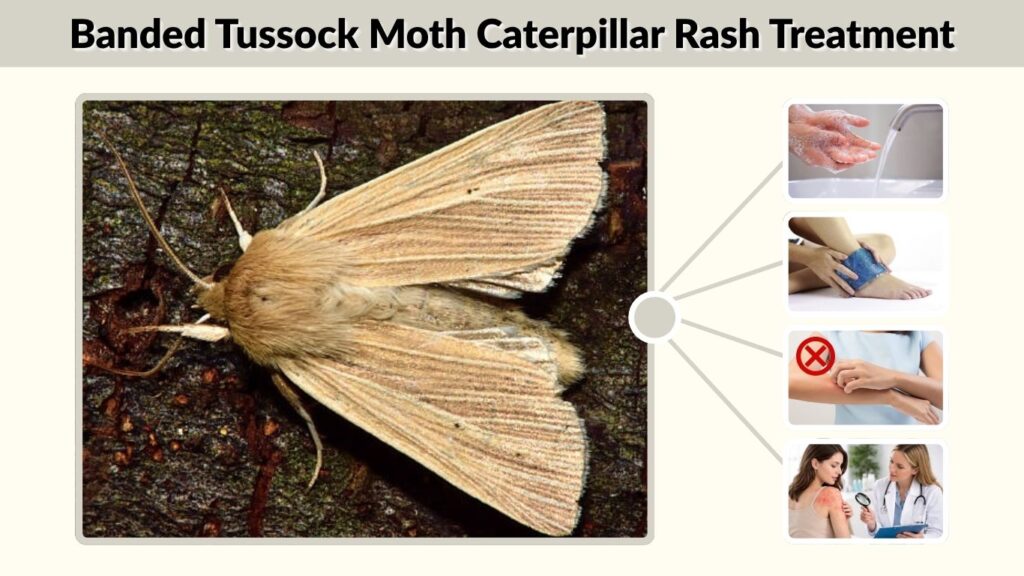
Skin irritation after touching a caterpillar is usually manageable with simple first aid.
Remove loose hairs
Avoid rubbing the affected area because this may push the hairs deeper into the skin. Press adhesive tape gently against the skin and lift it away. Repeat with fresh tape to remove remaining hairs.
Wash the area
Clean the skin with soap and cool water. Pat it dry with a clean towel.
Reduce itching and swelling
Apply a cold compress for 10 to 15 minutes. Over-the-counter hydrocortisone cream or an oral antihistamine may help with itching when used according to its directions.
Seek medical care if the rash spreads, becomes extremely painful, affects the eyes or mouth, or does not improve. Breathing difficulty, facial swelling, faintness, or widespread hives require urgent medical attention.
What Do Banded Tussock Moth Caterpillars Eat?
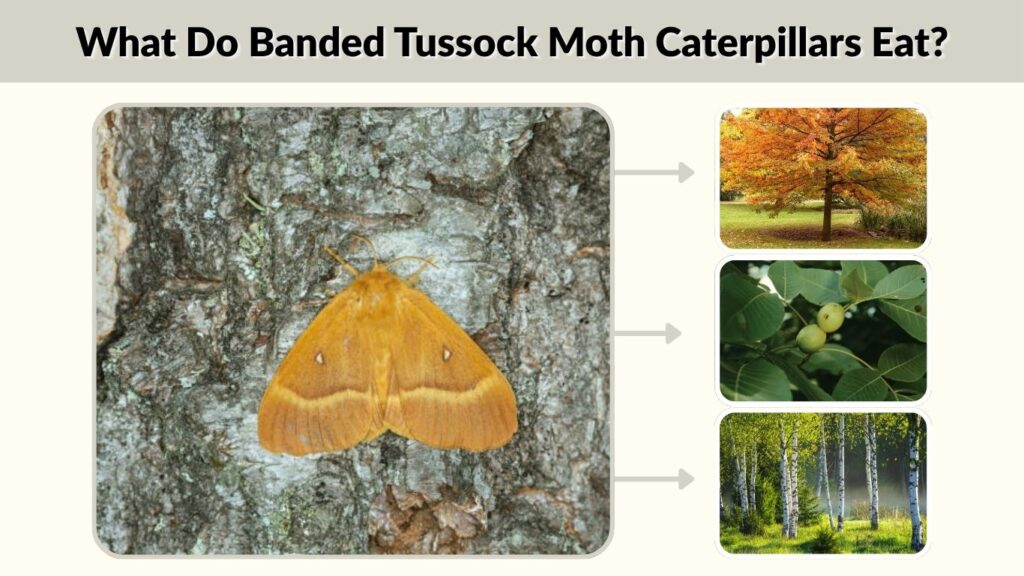
Banded tussock moth caterpillars are generalist herbivores. Instead of depending on one plant, they eat the leaves of many deciduous trees and shrubs.
Common host plants include:
- Oak
- Hickory
- Birch
- Ash
- Elm
- Walnut
- Willow
- Poplar
- Alder
- Hazel
- Hackberry
- Tulip tree
- Grape
They usually consume leaf tissue while leaving some of the larger veins intact. Young larvae may feed in groups, while older caterpillars are more likely to feed independently.
Adult moths do not damage trees. The caterpillar is the feeding stage, while the adult’s main purpose is reproduction.
Are Banded Tussock Moths Good or Bad?
Banded tussock moths are generally considered a normal and beneficial part of woodland ecosystems rather than serious pests.
Their caterpillars consume leaves, but they rarely occur in numbers high enough to cause lasting damage to healthy mature trees. Trees can normally tolerate limited feeding, especially late in the growing season.
The caterpillars and adult moths also serve as food for birds, predatory insects, spiders, and other wildlife. Unless severe defoliation is occurring, control is usually unnecessary.
Gardeners may remove individual caterpillars from young or vulnerable plants by relocating them with a stick or leaf. Gloves should be worn to prevent skin contact.
Banded Tussock Moth Life Cycle
The life cycle includes four stages: egg, larva, pupa, and adult.
Egg stage
Female moths lay clusters of eggs on or near suitable host plants. The eggs hatch into small caterpillars that begin feeding on leaves.
Caterpillar stage
The larvae eat and grow through several developmental stages called instars. Their hair becomes longer and more pronounced as they mature.
In parts of the northern United States, caterpillars may be especially noticeable from midsummer into early fall. UMass reports that eggs hatch and larvae begin feeding around mid-July, with caterpillar activity continuing into September. Timing varies according to climate and location.
Cocoon and pupal stage
A mature caterpillar creates a loose cocoon from silk and incorporates some of its body hairs into the outer surface. Pupation takes place inside this protective structure.
Because the cocoon may contain irritating hairs, it should not be handled with bare hands. The species may overwinter as a pupa in colder regions.
Adult stage
The adult moth emerges, expands its wings, and searches for a mate. Adults are active mainly at night and may be attracted to porch lights and illuminated windows.
Depending on climate, one or more generations may occur during a year.
Habitat and Range
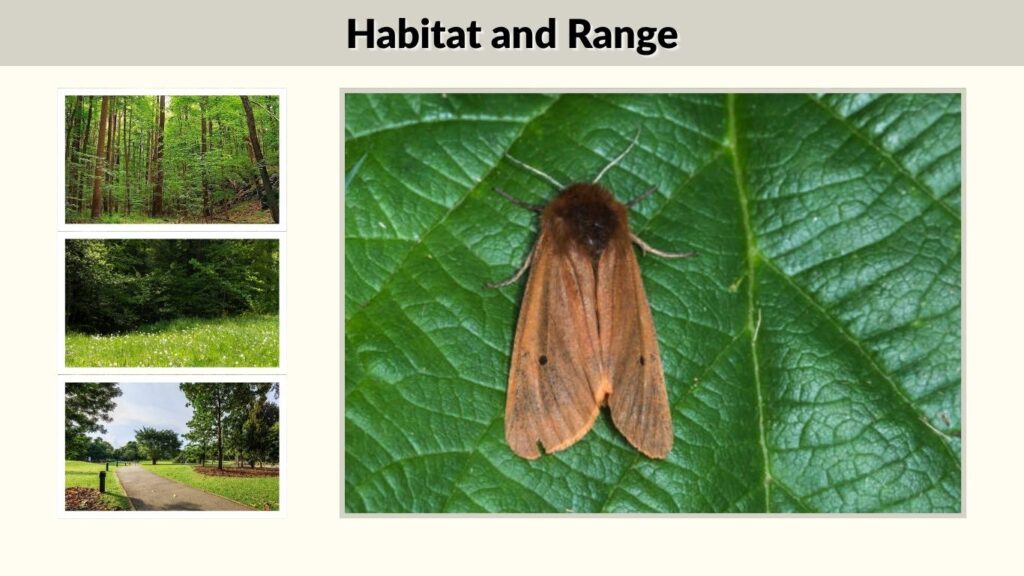
Banded tussock moths occur across a broad portion of eastern and central North America. They are common or abundant through much of their range, although their abundance may be lower in the southernmost parts of Florida and Texas.
Typical habitats include:
- Deciduous forests
- Woodland edges
- Parks
- Gardens
- Suburban neighborhoods
- River corridors
- Areas containing mature host trees
The caterpillars may wander away from trees before pupating, which explains why they are often found on buildings, fences, driveways, and outdoor furniture.
Banded Tussock Moth vs Similar Caterpillars
Several fuzzy caterpillars may be confused with this species.
| Caterpillar | Main identifying features | Skin concern |
|---|---|---|
| Banded tussock moth | Tan or yellow hairs with long black and white hair pencils | Hairs may cause mild irritation |
| Hickory tussock moth | Mostly white with bold black markings | May cause an itchy rash |
| Sycamore tussock moth | Pale hairs, often associated with sycamore trees | Hairs may irritate skin |
| White-marked tussock moth | Four prominent cream-colored back tufts and a red head | Contact may cause irritation |
| Banded woolly bear | Black and reddish-brown bands with short dense bristles | Usually less irritating |
Host plant, body markings, hair arrangement, and geographic location are useful identification clues. Adult banded and sycamore tussock moths may be especially difficult to separate visually.
FAQs
Is a banded tussock moth dangerous?
The adult moth is harmless, and its caterpillar is not considered dangerously venomous. However, caterpillar hairs may irritate sensitive skin, so direct handling should be avoided.
Does a banded tussock moth caterpillar bite?
It does not normally bite people. Discomfort associated with touching one generally comes from its detachable hairs rather than its jaws.
What does a banded tussock moth caterpillar turn into?
It forms a silk-and-hair cocoon, pupates, and later emerges as a pale tan or cream-colored moth with darker checkered bands across its wings.
What do banded tussock moth caterpillars eat?
They feed on numerous deciduous plants, including oak, birch, ash, elm, hickory, walnut, willow, poplar, alder, grape, and hackberry.
Should I remove banded tussock moth caterpillars?
Removal is usually unnecessary because they rarely cause serious tree damage. A caterpillar on a vulnerable plant can be relocated using a leaf, stick, or gloved hand.