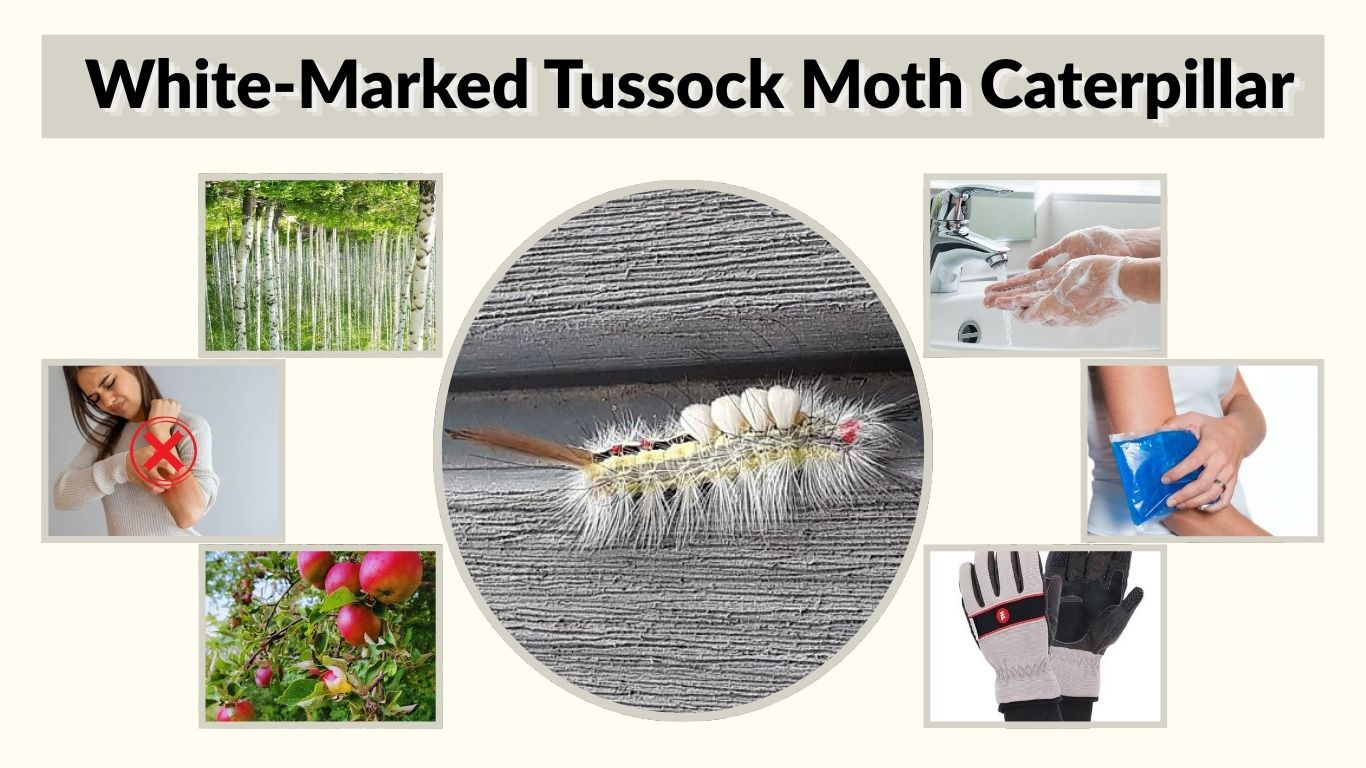
The white-marked tussock moth caterpillar (Orgyia leucostigma) is a distinctive, hairy caterpillar found mainly across eastern North America. Its colorful red head, four pale back tufts, and long black hair pencils make it easy to recognize. Although it is neither poisonous nor venomous, its irritating hairs can cause an itchy rash after skin contact. The caterpillar also feeds on numerous trees and shrubs, occasionally becoming abundant enough to damage ornamental plants.
What Is a White-Marked Tussock Moth Caterpillar?
The white-marked tussock moth caterpillar is the larval stage of a native North American moth in the family Erebidae. It is most noticeable during spring and summer, although the timing varies according to climate and location.
Populations are normally controlled by predators, parasitoids, diseases, and environmental conditions. However, numbers can occasionally increase rapidly in a particular neighborhood, park, schoolyard, or wooded area. Young caterpillars may also travel by hanging from silk threads and being carried by the wind.
Quick Facts
| Feature | Description |
| Scientific name | Orgyia leucostigma |
| Adult size | Caterpillar grows about 1–1½ inches long |
| Main range | Eastern North America and parts of Canada |
| Common season | Spring through late summer |
| Main food | Leaves of trees and shrubs |
| Human risk | Irritating hairs may cause dermatitis |
| Generations | Usually one to three, depending on location |
White-Marked Tussock Moth Caterpillar Identification
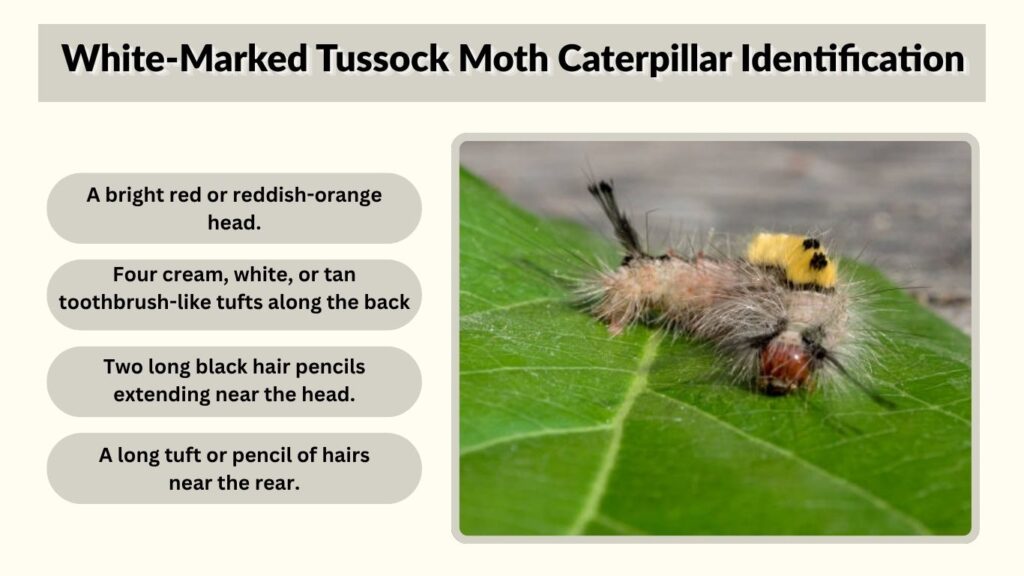
This species has a dramatic appearance that sometimes encourages children and curious adults to touch it. Its “fuzzy” body should be treated as a warning rather than an invitation to handle it.
Look for the following identification features:
- A bright red or reddish-orange head
- Four cream, white, or tan toothbrush-like tufts along the back
- Two long black hair pencils extending near the head
- A long tuft or pencil of hairs near the rear
- A yellowish or cream-colored body with dark dorsal markings
- Two noticeable red bumps toward the rear of the body
- Numerous fine white or pale hairs covering the sides
- A mature length of approximately 1¼ to 1½ inches
The four upright back tufts are among the best features for separating this species from other fuzzy caterpillars. Color may vary slightly between individuals and developmental stages.
Is the White-Marked Tussock Moth Caterpillar Poisonous?
The white-marked tussock moth caterpillar is not considered poisonous or venomous. It does not inject venom through a true stinger, nor does it bite people in the usual sense.
However, some of its fine hairs contain or carry irritating material. When the hairs become embedded in sensitive skin, they may produce contact dermatitis. Therefore, people commonly describe an encounter as a “sting,” even though the reaction is caused by physical contact with the hairs.
Cocoons can also cause irritation because caterpillars incorporate their body hairs into the cocoon. Even an old or empty cocoon should not be handled with bare hands.
Symptoms of Contact
A reaction may begin within minutes or develop shortly after exposure. Possible symptoms include:
- Redness or small red bumps
- Burning, prickling, or stinging sensations
- Localized swelling
- Itching or tenderness
- Raised welts or a patchy rash
- Eye irritation if hairs are transferred to the eyes
Reactions differ between individuals. Some people develop only brief irritation, while sensitive individuals may experience itching for several days. Children may be particularly vulnerable because they are more likely to pick up colorful caterpillars.
White-Marked Tussock Moth Caterpillar Sting Treatment
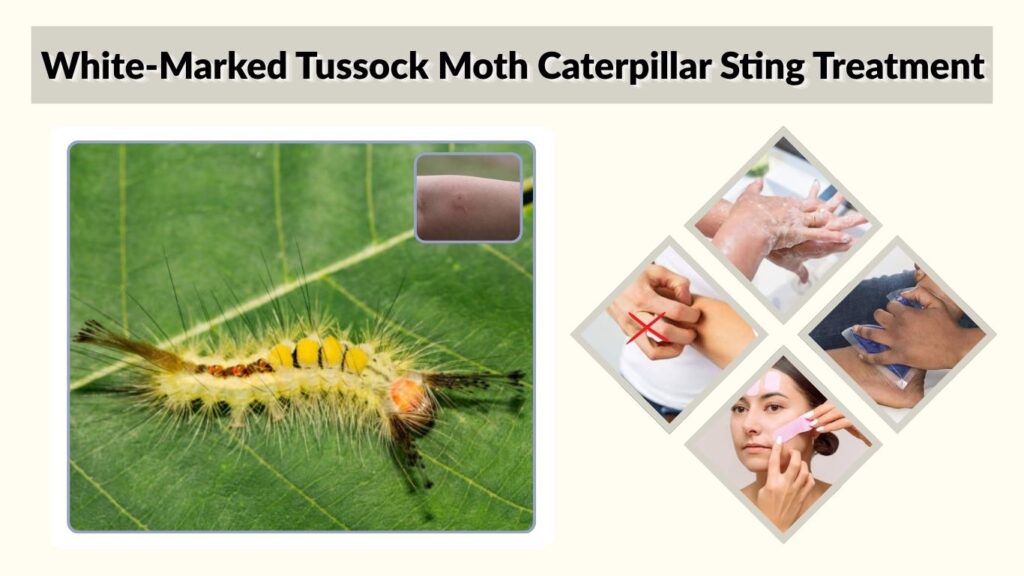
Avoid rubbing or scratching the area because this can push the hairs farther into the skin. The first goal is to remove loose hairs before washing the affected area.
- Remove the caterpillar safely. Use a leaf, stick, tweezers, or another object instead of touching it with bare fingers.
- Apply adhesive tape. Place sticky tape gently over the affected skin and pull it away. Repeat with fresh tape to lift out remaining hairs.
- Wash the area. Clean the skin carefully with soap and water. Avoid vigorous scrubbing.
- Use a cold compress. Apply wrapped ice or a cool compress for approximately 10 minutes to reduce discomfort and swelling.
- Treat the itching. An over-the-counter hydrocortisone product or antihistamine may help, but follow the label and ask a healthcare professional when treating a child or someone with another medical condition.
Seek urgent medical help if the person develops trouble breathing, facial or throat swelling, dizziness, widespread hives, severe eye pain, or rapidly worsening symptoms. Hairs embedded in an eye may require professional removal.
Are These Caterpillars Dangerous to Dogs?
The caterpillar is not known for poisoning dogs through venom. Nevertheless, its hairs may irritate a dog’s nose, lips, tongue, eyes, or exposed skin. Dogs may encounter caterpillars while sniffing grass, decks, tree trunks, or fallen leaves.
Do not allow a dog to lick, chew, or play with a hairy caterpillar. Contact a veterinarian promptly if the dog develops heavy drooling, pawing at its mouth, facial swelling, repeated vomiting, eye irritation, coughing, breathing difficulty, or refusal to eat. Do not apply human creams or essential oils without veterinary guidance.
What Do White-Marked Tussock Moth Caterpillars Eat?
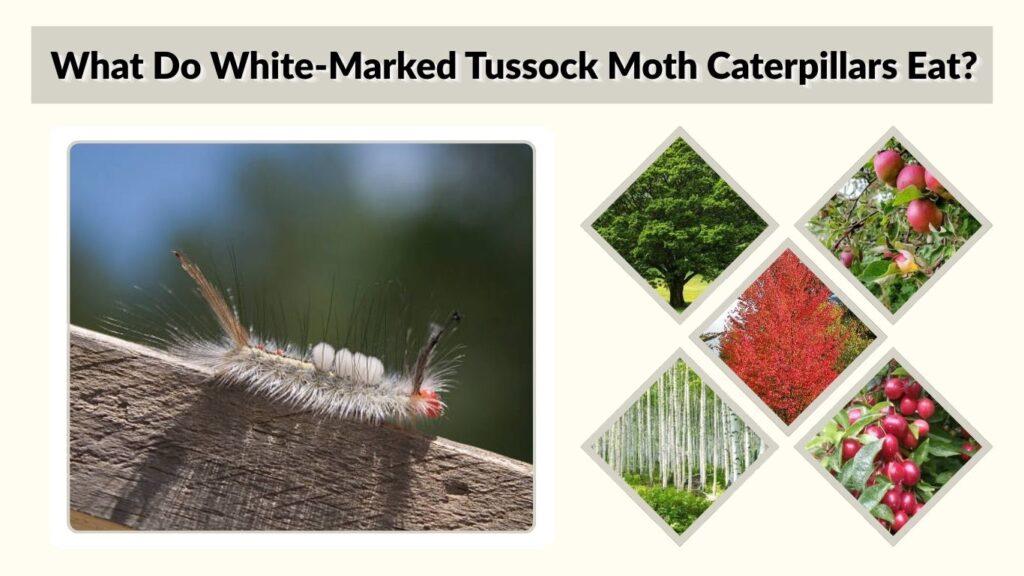
White-marked tussock moth caterpillars feed on a remarkably broad range of deciduous trees, conifers, shrubs, and ornamental plants. Frequently reported hosts include:
- Oak
- Maple
- Birch
- Apple and crabapple
- Cherry and plum
- Elm
- Willow
- Poplar
- Basswood or linden
- Hackberry
- Hickory and walnut
- Rose
- Sycamore
- Fir and larch
Young caterpillars scrape tissue from the leaf surface, producing transparent or skeletonized patches. Older larvae may consume most of a leaf while leaving the petiole and major veins. More than 100 plant genera have been reported as potential hosts.
White-Marked Tussock Moth Life Cycle
This moth overwinters as an egg. The wingless adult female deposits a mass of eggs on or near her old cocoon and covers them with a protective frothy material.
Egg and Caterpillar Stages
Eggs generally hatch as trees begin producing leaves in spring. The caterpillars feed and pass through several growth stages for approximately a month. Newly hatched larvae may disperse on silk strands, while older caterpillars usually feed independently.
Cocoon and Adult Moth
A mature caterpillar spins a grayish cocoon containing silk and body hairs. The cocoon may be attached to tree bark, branches, fences, outdoor furniture, buildings, or other protected surfaces.
Adults often emerge approximately two weeks later. The male is a winged gray-brown moth, while the pale female has extremely reduced wings and cannot fly. Depending on location and temperature, the species may produce one to three generations each year.
How to Get Rid of White-Marked Tussock Moth Caterpillars
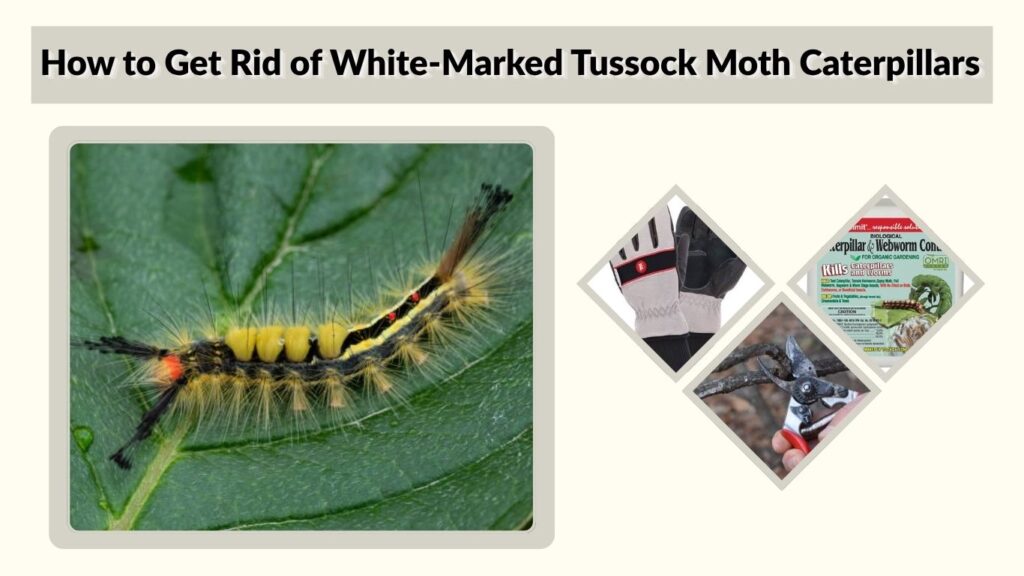
Control is usually unnecessary when only a few caterpillars are present. Mature trees generally tolerate minor leaf loss, and natural predators frequently reduce populations.
For larger infestations:
- Wear gloves, long sleeves, closed shoes, and eye protection.
- Use tongs to place individual caterpillars in a container of soapy water.
- Remove accessible egg masses and old cocoons without touching them directly.
- Wash contaminated clothing separately after outdoor work.
- Prune heavily infested small branches when practical.
- Spray young, actively feeding caterpillars only when plant damage justifies treatment.
- Choose a product labeled for caterpillar control on the affected plant.
- Consider Bacillus thuringiensis var. kurstaki, or Bt, for young larvae.
- Hire an arborist or licensed applicator when tall trees require treatment.
Spraying mature caterpillars crawling across decks, fences, or walls is often ineffective because they may have already stopped feeding and begun searching for cocoon sites. Always follow the pesticide label and avoid unnecessary treatment near pollinators, ponds, pets, and children.
FAQs
Can a white-marked tussock moth caterpillar bite?
It has chewing mouthparts designed for eating leaves, but it does not normally bite or attack people. The burning or stinging feeling associated with this caterpillar usually comes from irritating hairs becoming embedded in the skin.
How long does the caterpillar rash last?
A mild reaction may improve within several hours or by the following day. Itching can continue for several days in sensitive individuals. Seek medical advice when the rash is severe, widespread, infected, or not improving.
Is the white-marked tussock moth caterpillar found in Florida?
Yes. The species occurs in Florida and elsewhere across eastern North America. Warmer regions may support multiple generations during a growing season, so caterpillars can be encountered at different times from spring through fall.
Why are these caterpillars all over my deck?
Mature caterpillars often leave their food plants and crawl across decks, fences, walls, vehicles, and outdoor furniture while searching for protected places to form cocoons. Nearby trees may also release young caterpillars that travel on silk strands.
Is the white-marked tussock moth native to the UK?
It is primarily a North American species and is not considered a typical native UK caterpillar. Similar-looking UK caterpillars may belong to other tussock moth species, so identification should be based on several physical features rather than hairiness alone.