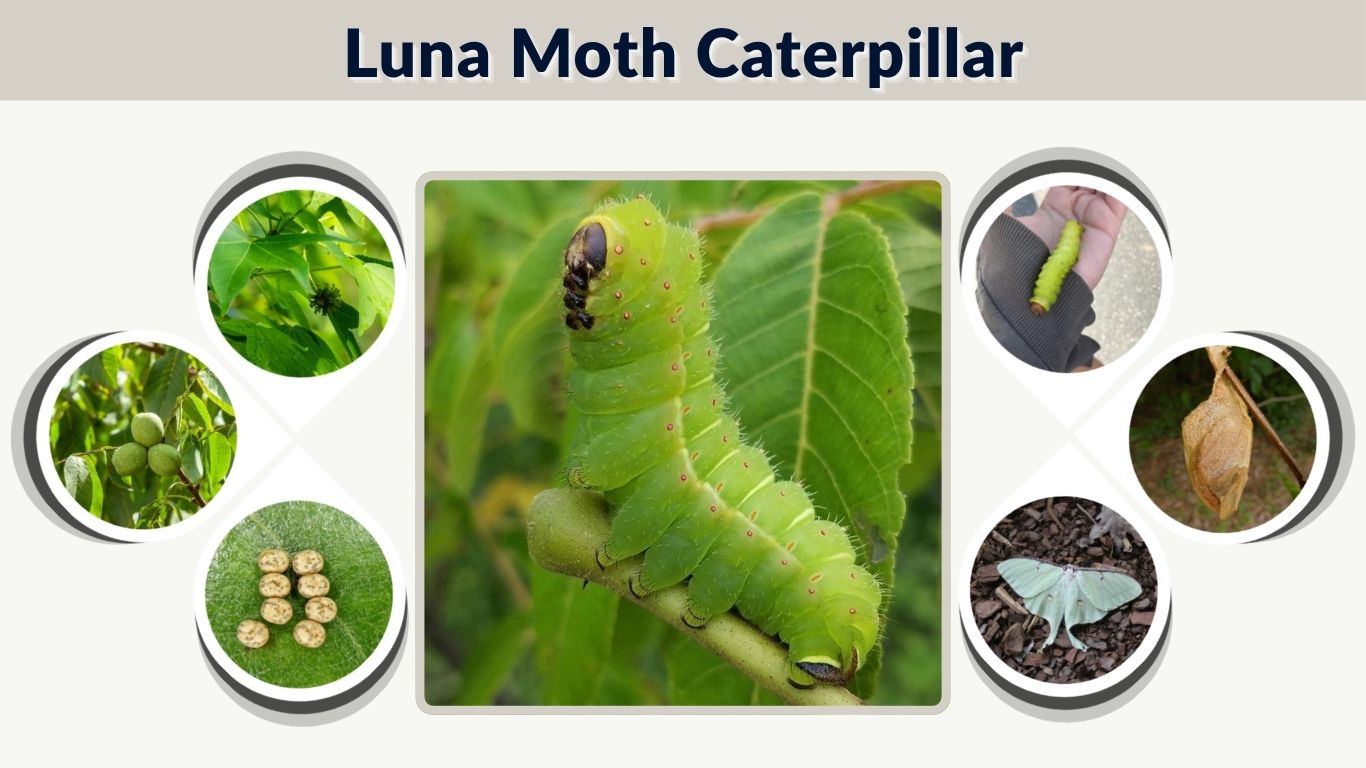
A luna moth caterpillar is the larval stage of the beautiful green luna moth, one of North America’s most recognizable giant silk moths. Many people search for “lunar moth caterpillar,” but the correct name is luna moth caterpillar. This large green caterpillar is harmless to people, fascinating to observe, and closely tied to the trees it eats before spinning its cocoon.
What Is a Luna Moth Caterpillar?
A luna moth caterpillar is the young feeding stage of the luna moth, scientifically known as Actias luna. Before becoming the pale green adult moth with long tails and eyespots, it spends several weeks as a soft-bodied green caterpillar eating leaves.
Unlike fuzzy stinging caterpillars, the luna moth caterpillar is smooth, plump, and usually bright green. It belongs to the giant silk moth family, a group known for large caterpillars and impressive adult moths.
Luna Moth or Lunar Moth Caterpillar?
“Lunar moth caterpillar” is a common search variation, but “luna moth caterpillar” is the standard name. The word “luna” means moon, which fits the adult moth’s pale green, moonlike appearance. Both search terms usually refer to the same insect.
Where Luna Moth Caterpillars Live
Luna moths are found in much of eastern North America. They are associated with deciduous forests, wooded yards, parks, and areas with suitable host trees. You may find the caterpillars on leaves, branches, or later wandering when they are ready to pupate.
What Does a Luna Moth Caterpillar Look Like?
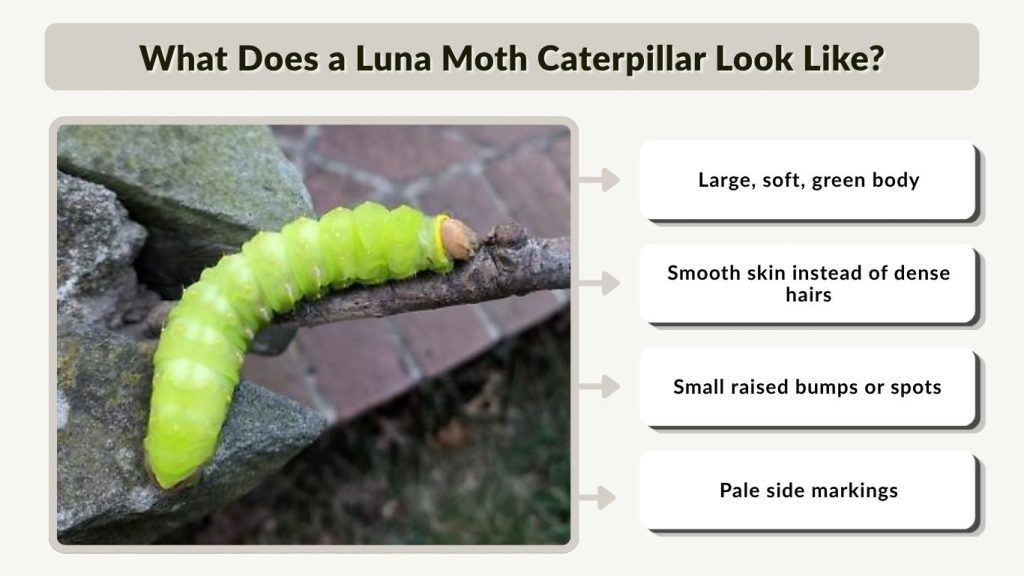
A luna moth caterpillar is usually large, green, smooth, and chunky. It does not have the long hairs or fuzzy tufts seen on tussock moth or dagger moth caterpillars. As it grows, it becomes thick and rounded, with small raised spots and pale lines along the body.
Young caterpillars are smaller and may look paler or slightly yellow-green. Mature caterpillars are often bright green and can look like a “giant green caterpillar.” Near the end of the caterpillar stage, some individuals may turn reddish, pinkish, orange, or brownish before making a cocoon.
Key Identification Features
Look for these traits when identifying a luna moth caterpillar:
- Large, soft, green body
- Smooth skin instead of dense hairs
- Small raised bumps or spots
- Pale side markings
- No sharp tail horn like a hornworm
- Found on tree leaves rather than tomato plants
- May turn pink, red, orange, or brown before pupating
Color alone is not enough for identification. The host plant, body shape, and lack of a rear horn are also important clues.
Luna Moth Caterpillar Size
A mature luna moth caterpillar can grow quite large compared with many garden caterpillars. By its final stage, it is often around two to three inches long. It looks thick, heavy, and rounded because it stores energy for the cocoon and adult moth stage.
The adult luna moth does not feed, so the caterpillar stage is the main eating stage. This is why the caterpillar spends so much time consuming leaves before pupation.
Luna Moth Caterpillar Growth Stages
Luna moth caterpillars grow through several molts. Each growth phase is called an instar. After hatching from an egg, the small caterpillar eats, grows, sheds its skin, and repeats the process until it reaches full size.
| Stage | What Happens | What to Notice |
|---|---|---|
| Egg | Female lays eggs on host leaves | Tiny eggs on leaf surfaces |
| Early caterpillar | Larva begins feeding | Small green body |
| Later instars | Caterpillar grows quickly | Larger, plumper green body |
| Prepupal stage | Stops feeding and may change color | Pink, red, orange, or brown tones |
| Cocoon | Spins silk among leaves | Protected pupa inside cocoon |
| Adult moth | Emerges to mate | Pale green wings and long tails |
What Does a Luna Moth Caterpillar Eat?
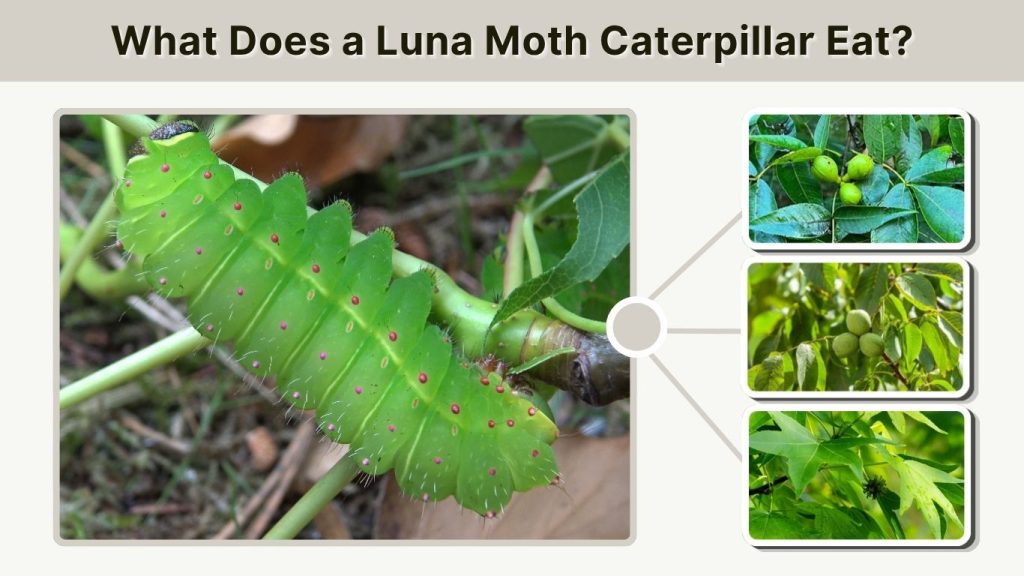
Luna moth caterpillars eat leaves from specific host trees. They do not eat random household food, fruit slices, or packaged caterpillar food. If you are trying to care for one, the safest food is fresh leaves from the same type of tree where it was found.
Common luna moth caterpillar host plants include:
- Hickory
- Walnut
- Sweet gum
- Persimmon
- Sumac
- Birch
- Willow
- Maple
- Oak in some regions
Host plant use can vary by region. A caterpillar found on hickory should continue receiving hickory leaves, while one found on sweet gum should be fed sweet gum if possible.
What Do You Feed a Luna Moth Caterpillar?
Feed it fresh, pesticide-free leaves from its host plant. Replace wilted leaves daily. Do not mix leaves from unknown plants unless you are sure they are safe host plants. Caterpillars often refuse unfamiliar leaves, especially after they are already used to one host.
If you do not know the host plant, take a photo of the tree and leaves. Tree identification is often the key to caring for the caterpillar correctly.
Is a Luna Moth Caterpillar Poisonous?
A luna moth caterpillar is not considered poisonous or venomous to humans. It does not have stinging hairs like some fuzzy caterpillars, and it does not have a dangerous bite. It is generally safe to observe.
However, that does not mean you should handle it often. Caterpillars are delicate. Oils, lotions, insect repellent, or rough handling can harm them. If you need to move one, use a leaf or soft brush instead of squeezing it with your fingers.
Can You Touch a Luna Moth Caterpillar?
You can usually touch one gently, but it is better not to unless necessary. If it is in danger on a sidewalk, driveway, or patio, move it with a leaf or small container. Keep it close to the tree or wooded area where it was found.
Wash your hands after contact, especially if you have sensitive skin. While luna moth caterpillars are not known as stinging caterpillars, any insect contact can occasionally irritate sensitive skin.
Luna Moth Caterpillar Life Cycle
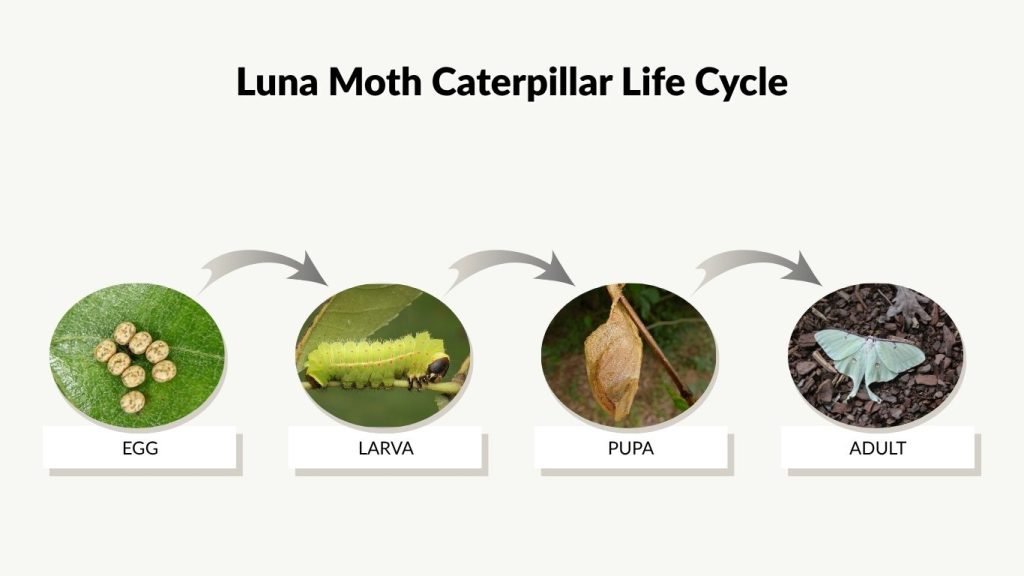
The luna moth goes through complete metamorphosis: egg, caterpillar, pupa, and adult moth. The caterpillar stage is the feeding stage. The cocoon stage is the transformation stage. The adult stage is mainly for reproduction.
Egg Stage
A female luna moth lays eggs on suitable host plant leaves. The eggs hatch into tiny caterpillars that begin eating soon after emerging. Young larvae may feed quietly on the same tree where they hatched.
Caterpillar Stage
The caterpillar eats leaves and molts several times. This stage usually lasts several weeks, depending on temperature, region, food quality, and season. During this time, the caterpillar grows from a tiny larva into a large green caterpillar.
Cocoon and Chrysalis Stage
Technically, moths form a pupa inside a cocoon, while butterflies form a chrysalis. Many people search for “luna moth caterpillar chrysalis,” but “cocoon” is the better word for luna moths.
When ready, the caterpillar may leave the branch and spin a silk cocoon among leaves. In many cases, the cocoon is hidden in leaf litter. This is one reason leaving some fallen leaves in a yard can help moths and other insects survive.
Adult Luna Moth Stage
The adult luna moth emerges with pale green wings, long tails, and eyespots. Adults live briefly and do not feed. Their main purpose is to find a mate and reproduce. This short adult life is normal for giant silk moths.
Luna Moth Caterpillar Care
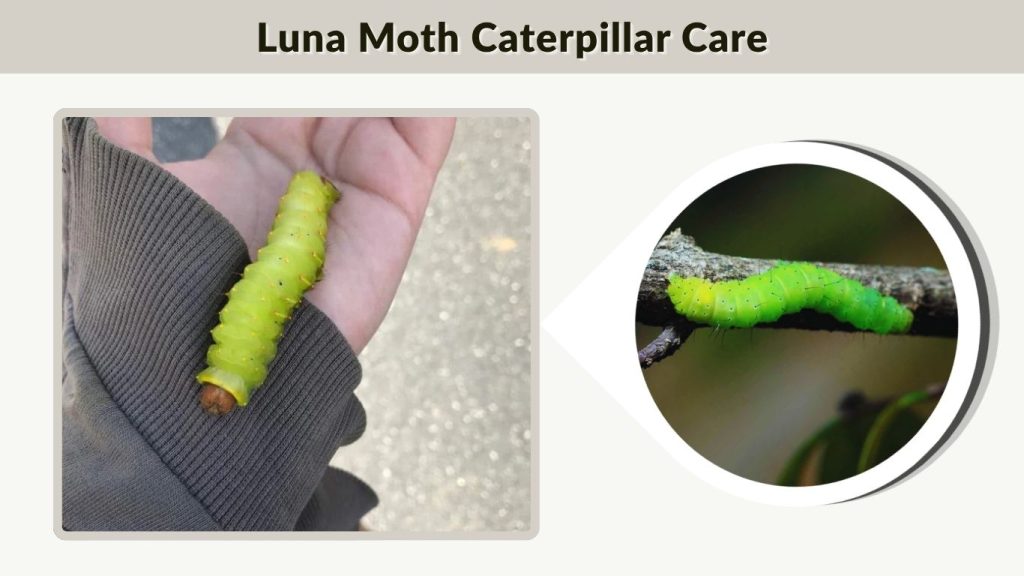
Raising a luna moth caterpillar can be rewarding, but it requires fresh leaves, cleanliness, and gentle handling. The goal should be observation, not keeping it as a long-term pet.
Basic Care Tips
If you find a luna moth caterpillar and want to raise it, follow these steps:
- Keep it in a ventilated container.
- Add fresh host plant leaves daily.
- Remove old leaves and droppings often.
- Avoid leaves treated with pesticides.
- Do not place the container in direct hot sun.
- Add dry leaves when it is ready to cocoon.
- Release the adult moth outdoors after emergence.
A caterpillar that stops eating and changes color may be ready to pupate. At that point, it needs a safe place to spin its cocoon, not more handling.
Should You Buy a Luna Moth Caterpillar?
Many people search for luna moth caterpillars for sale or luna moth caterpillar kits. Before buying, check local laws and ethical concerns. Transporting insects across regions can spread disease or introduce nonlocal genetics. It is usually better to observe native caterpillars where they naturally occur.
If you purchase from a breeder, make sure they are reputable and that the species is legal to keep in your area.
Luna Moth Caterpillar Look-Alikes
Several large green caterpillars are confused with luna moth caterpillars. Some are harmless, while others are plant pests.
Polyphemus Moth Caterpillar vs. Luna Moth Caterpillar
Polyphemus moth caterpillars are also large and green. They belong to the same giant silk moth family and can look similar. Polyphemus caterpillars may appear chunkier and have different side markings. The adult moth is brown with large eyespots, not pale green with long tails.
Cecropia Moth Caterpillar vs. Luna Moth Caterpillar
Cecropia caterpillars are usually easier to separate because they have large colorful knobs or tubercles. Mature cecropia caterpillars can be bluish-green with yellow, orange, and blue bumps. Luna caterpillars are smoother and less brightly ornamented.
Hornworm vs. Luna Moth Caterpillar
Tomato hornworms and tobacco hornworms have a pointed horn at the rear. Luna moth caterpillars do not have that horn. Hornworms also feed on tomato, pepper, eggplant, tobacco, and related plants, while luna moth caterpillars feed on tree leaves.
What to Do If You Find a Luna Moth Caterpillar
If you find a luna moth caterpillar, the best response is usually to leave it alone. It is part of the local ecosystem and will become a beautiful adult moth if it survives.
You may move it only if it is in danger. For example, if it is crossing a road, sidewalk, or driveway, gently move it to a nearby safe area with trees. Try to place it near the same kind of plant it was found on.
When the Caterpillar Turns Brown, Red, or Pink
A luna moth caterpillar turning brown, orange, red, or pink is often in the prepupal stage. This can happen when it is finished feeding and preparing to make a cocoon. It may wander away from the host plant to find a sheltered place.
Do not assume it is sick just because it changes color. If it is active and looking for a place to hide, it may simply be ready to pupate.
Luna Moth Caterpillar Facts
Luna moth caterpillars are popular because they are large, bright, and connected to one of the most beautiful moths in North America. They are also important leaf-eating insects that support birds, predators, and forest food webs.
Useful facts include:
- The caterpillar is the main feeding stage.
- The adult luna moth does not eat.
- Caterpillars feed on specific host trees.
- Mature caterpillars spin silk cocoons.
- The adult moth is pale green with long tails.
- The caterpillar is not a butterfly larva; it becomes a moth.
- “Lunar moth caterpillar” usually means luna moth caterpillar.
FAQs
Is a luna moth caterpillar poisonous?
No, a luna moth caterpillar is not considered poisonous or venomous to humans. It does not have stinging hairs like some fuzzy caterpillars. Still, it is best to avoid unnecessary handling because caterpillars are fragile and sensitive to oils, lotions, and rough contact.
What does a luna moth caterpillar eat?
A luna moth caterpillar eats leaves from host trees such as hickory, walnut, sweet gum, persimmon, sumac, birch, willow, maple, and sometimes oak. The best food is the same tree species where the caterpillar was found, because it may refuse unfamiliar leaves.
What does a luna moth caterpillar look like?
A luna moth caterpillar is usually large, smooth, plump, and green. It may have pale side markings and small raised spots. It does not have thick fuzz or a rear horn. Before pupating, it may turn pinkish, reddish, orange, or brownish.
How long is a luna moth a caterpillar?
The caterpillar stage usually lasts several weeks, depending on weather, food, and location. During this time, it eats leaves, molts through several instars, and grows quickly. Once mature, it stops feeding, changes color, and prepares to spin a cocoon.
Can you raise a luna moth caterpillar?
Yes, but only with proper care. Keep it in a ventilated container, feed fresh pesticide-free host leaves, clean droppings daily, and provide dry leaves for cocooning. Once the adult moth emerges, release it outdoors so it can mate and continue its life cycle.