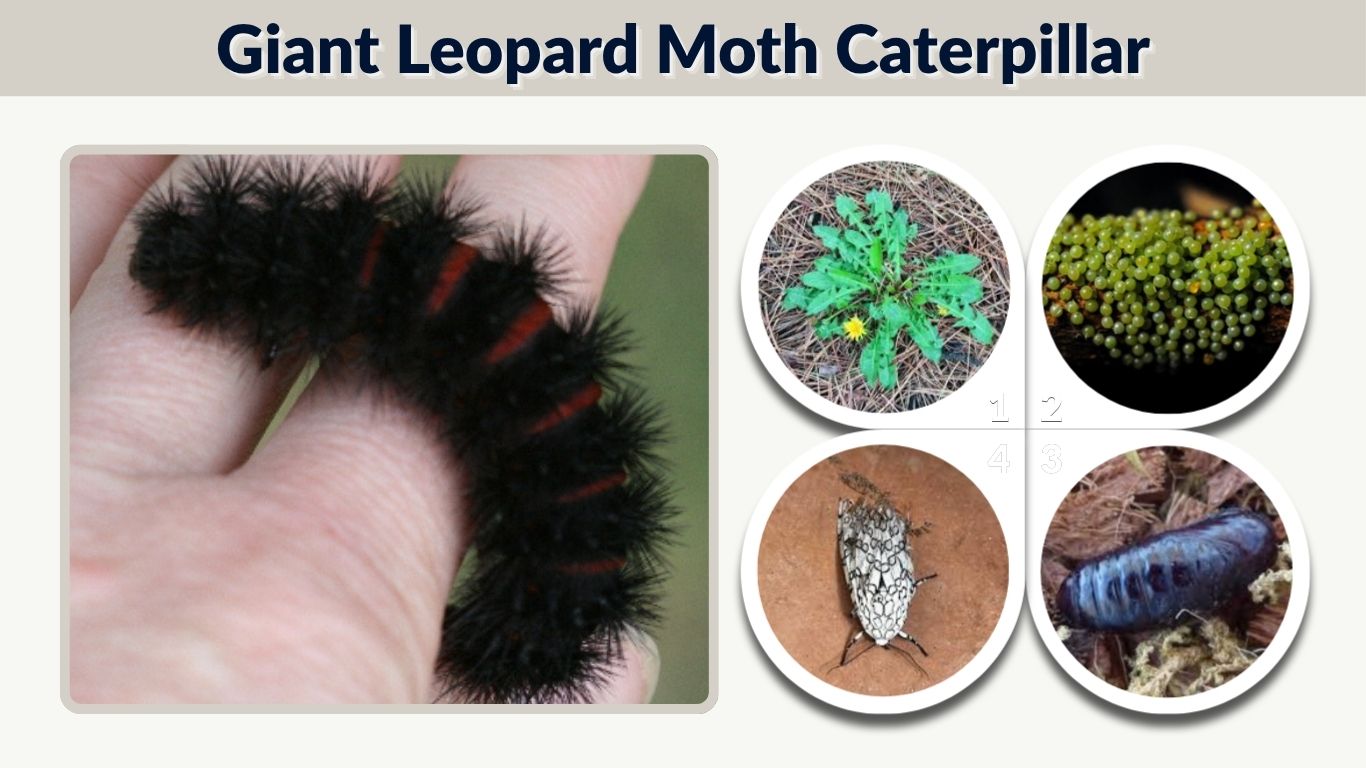
The giant leopard moth caterpillar is a large black fuzzy caterpillar that often surprises people in gardens, lawns, wooded edges, and sidewalks. Its bristly body and hidden red bands can make it look dangerous, but this caterpillar is usually more interesting than harmful. This guide explains how to identify it, whether it is poisonous, what it eats, how its life cycle works, and how it compares with woolly bear caterpillars.
What Is a Giant Leopard Moth Caterpillar?
The giant leopard moth caterpillar is the larval stage of the giant leopard moth, scientifically known as Hypercompe scribonia. It is also called the great leopard moth or eyed tiger moth. Although the adult moth is white with bold black spots, the caterpillar looks very different. It is mostly black, fuzzy, and covered with stiff bristles.
This caterpillar belongs to the tiger moth group, which includes several hairy caterpillars. Because of its appearance, many people mistake it for a woolly bear caterpillar. However, the giant leopard moth caterpillar is usually larger, darker, and has red or orange bands between its body segments.
Quick Identification Features
You can recognize a giant leopard moth caterpillar by looking for these traits:
- Dense black bristles covering the body
- Red or orange bands visible between body segments
- A habit of curling into a tight ball when disturbed
- A size that may reach about 2 to 3 inches when mature
- Orange or red spiracles along the sides of the body
When the caterpillar is stretched out, it may look like a long black fuzzy “woolly worm.” When it curls up, the red bands become much easier to see.
Is the Giant Leopard Moth Caterpillar Poisonous?
One of the most common questions is whether the giant leopard moth caterpillar is poisonous. In most cases, it is not considered poisonous or venomous to people. It does not have the painful venomous spines found on some dangerous caterpillars, and it is not known for stinging.
That said, it is still best to avoid handling caterpillars with bare hands. The bristles may irritate sensitive skin, especially for people who react easily to insect hairs, dust, or plant material. Children and pets should be discouraged from touching or tasting fuzzy caterpillars.
Can It Sting or Bite?
The giant leopard moth caterpillar does not sting. Its bristles may look sharp, but they are mainly a defensive covering. When threatened, the caterpillar usually curls into a ball instead of attacking.
It is also not a biting threat to humans. Caterpillars have mouthparts for chewing leaves, not for biting people in defense. If one is picked up roughly, it may move around or curl tightly, but it is not trying to harm you.
Is It Dangerous to Dogs or Cats?
A dog or cat that sniffs a giant leopard moth caterpillar is unlikely to be in serious danger, but eating one is not recommended. The bristles could irritate the mouth or stomach, and some insects may taste bad as a natural defense.
If a pet eats a caterpillar and then drools, vomits, paws at the mouth, or seems uncomfortable, contact a veterinarian. Most encounters are minor, but it is safer to prevent pets from chewing on wild caterpillars.
Giant Leopard Moth Caterpillar Identification Table
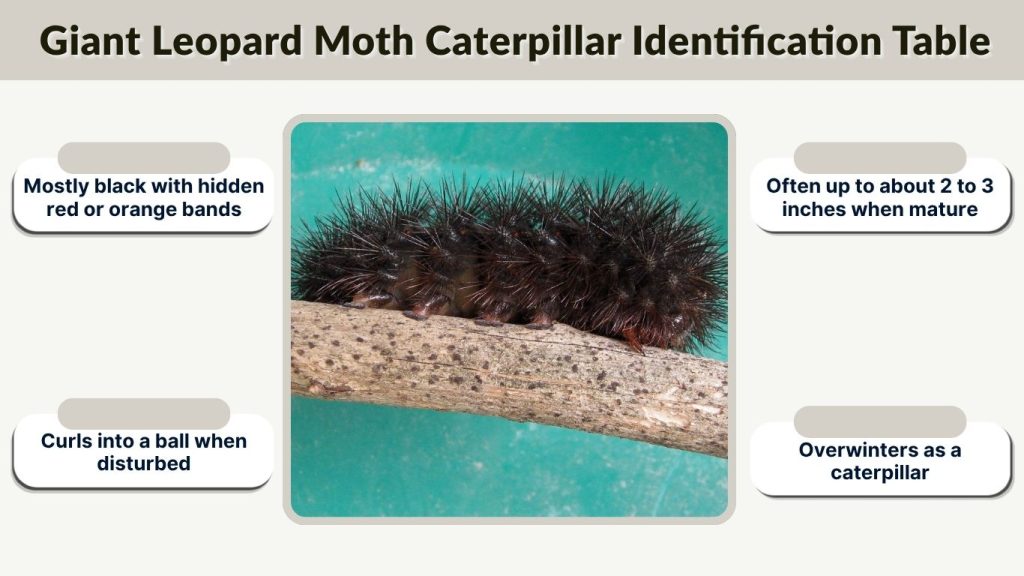
The table below summarizes the most useful identification and safety points.
| Feature | Giant Leopard Moth Caterpillar |
| Scientific name | Hypercompe scribonia |
| Adult form | Giant leopard moth, a white moth with black spots |
| Caterpillar color | Mostly black with hidden red or orange bands |
| Texture | Fuzzy, bristly, and woolly-looking |
| Size | Often up to about 2 to 3 inches when mature |
| Defense | Curls into a ball when disturbed |
| Sting risk | Does not sting |
| Common foods | Broad-leaved plants, weeds, shrubs, and some garden plants |
| Active season | Often seen from spring through fall, depending on region |
| Winter stage | Overwinters as a caterpillar |
What Does a Giant Leopard Moth Caterpillar Eat?
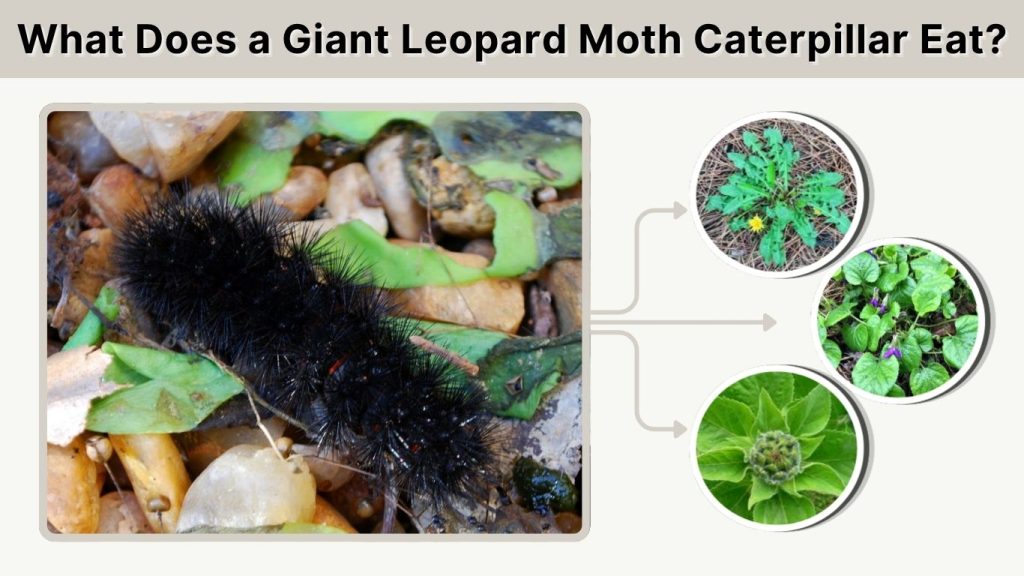
Giant leopard moth caterpillars feed on a wide range of broad-leaved plants. They are not limited to one host plant, which is one reason they can show up in many different habitats.
They may feed on wild plants, garden plants, shrubs, and deciduous trees. Commonly listed food plants include dandelion, violet, sunflower, willow, maple, cherry, cabbage, and plantain. They may also use other broad-leaved plants available in the area.
Common Food and Host Plants
A giant leopard moth caterpillar may eat:
- Dandelion leaves
- Violet leaves
- Plantain
- Sunflower leaves
- Willow leaves
- Maple leaves
- Cherry leaves
- Cabbage and similar garden greens
- Other broad-leaved weeds and wildflowers
Because they have a broad diet, finding one on a plant does not always mean that plant is its only food source. It may simply be resting or moving to another feeding spot.
Are They Bad for Gardens?
Usually, one or two giant leopard moth caterpillars are not a major garden problem. They may chew leaves, but they rarely appear in huge numbers compared with serious pest caterpillars. In many cases, they are part of the normal backyard ecosystem.
If you find one on a valuable plant, the simplest solution is to gently move it with a leaf or small container to a safe area with broad-leaved weeds or native plants. Avoid spraying pesticides for a single caterpillar, especially because many moths and butterflies are beneficial parts of the food web.
Giant Leopard Moth Caterpillar Life Cycle
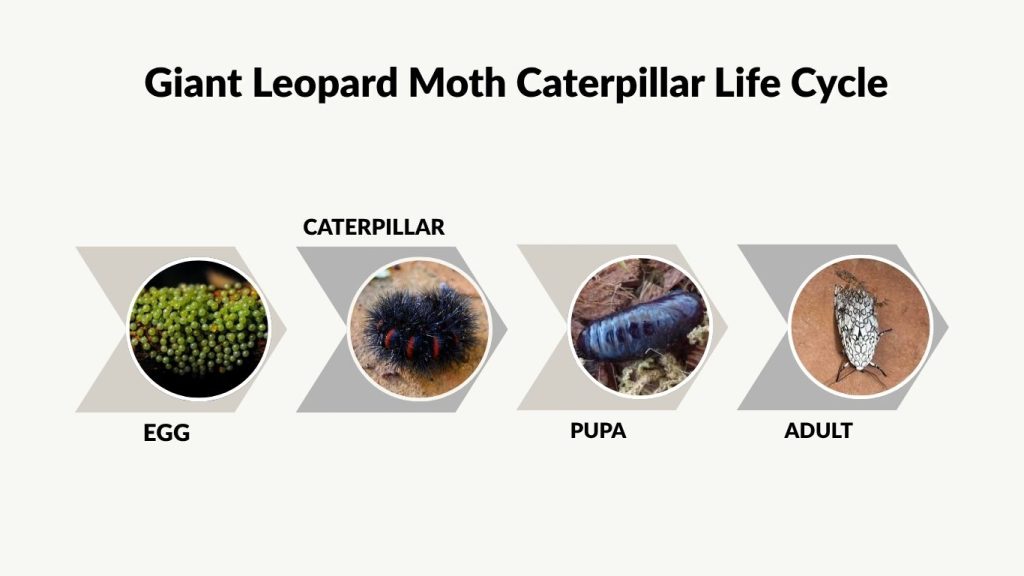
The giant leopard moth goes through complete metamorphosis: egg, larva, pupa, and adult. The caterpillar stage is the most commonly noticed stage because the larva is large, dark, and often seen crossing paths or resting on low plants.
After feeding and growing, the caterpillar eventually pupates. Later, the adult moth emerges. The adult looks strikingly different from the larva, with white wings marked by black spots or rings. Its abdomen may show blue and orange markings, although these are often hidden when the moth is resting.
Egg Stage
The female moth lays eggs on or near suitable host plants. When the eggs hatch, tiny caterpillars begin feeding. Young larvae may look different from mature caterpillars, but they become darker and more recognizable as they grow.
Caterpillar Stage
The caterpillar stage is when most feeding and growth happen. The larva molts several times as it increases in size. Mature giant leopard moth caterpillars are usually black and bristly, with red or orange bands between the segments.
This is also the stage in which the species may overwinter. In colder areas, the caterpillar may spend winter hidden under leaf litter, bark, or other sheltered places.
Pupa and Cocoon Stage
When ready to transform, the caterpillar forms a protected pupal stage. People often search for a “giant leopard moth caterpillar cocoon,” but the structure may not look like a neat silk cocoon from a textbook. It may involve silk, body hairs, and sheltered material around the pupa.
During this stage, the caterpillar’s body reorganizes into the adult moth. The time spent pupating can vary depending on temperature, season, and local conditions.
Adult Moth Stage
The adult giant leopard moth is a beautiful white moth with black spots. Some spots may look like hollow rings. Adults are mostly active at night and may be attracted to lights.
The adult stage is mainly for reproduction. After mating and egg-laying, the life cycle begins again.
Where Do Giant Leopard Moth Caterpillars Live?
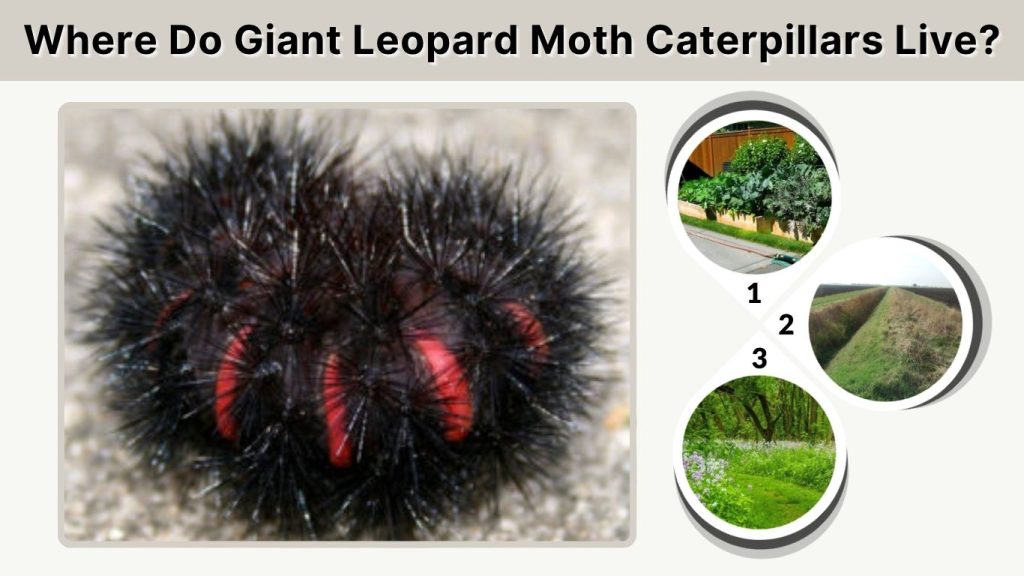
Giant leopard moth caterpillars are found in much of eastern North America and parts of nearby regions. They are often associated with areas that provide host plants and shelter, including gardens, fields, woodland edges, bottomland forests, and weedy areas.
They may be seen in states such as Florida, Texas, Ohio, and many areas across the eastern United States. Searchers sometimes ask about California or the UK, but the giant leopard moth is primarily a North American species. If you find a similar black fuzzy caterpillar outside its usual range, it may be another moth species.
Common Places to Spot Them
Look for them in:
- Lawns and garden beds
- Weedy edges and field margins
- Deciduous woodland edges
- Under fallen leaves
- Near broad-leaved host plants
- Sidewalks and driveways, especially when they are wandering
They are often noticed when they are moving across open ground, possibly searching for food, shelter, or a pupation site.
Giant Leopard Moth Caterpillar vs Woolly Bear
The giant leopard moth caterpillar is often confused with woolly bear caterpillars. This is understandable because both can look fuzzy and dark. However, they are not the same caterpillar.
The common banded woolly bear usually has black ends and a reddish-brown band around the middle. It becomes the Isabella tiger moth. The giant leopard moth caterpillar is usually black overall, with red or orange bands hidden between body segments rather than a wide brown middle band.
Main Differences
Here are the easiest ways to tell them apart:
- Giant leopard moth caterpillars are usually mostly black.
- Their red or orange bands are between segments and show clearly when curled.
- Banded woolly bears often have a broad rusty-brown middle band.
- Giant leopard moth caterpillars can grow larger and look more bristly.
- The adult giant leopard moth is white with black spots, while the Isabella tiger moth is yellowish-orange to tan.
If the caterpillar curls into a ball and shows red rings between black bristles, it is likely a giant leopard moth caterpillar.
How to Care for a Giant Leopard Moth Caterpillar
Some people find a giant leopard moth caterpillar and want to raise it. Short-term observation can be educational, but wild caterpillars are usually best left outdoors when possible. If you do keep one briefly, the goal should be safe observation and release, not long-term captivity.
Place it in a ventilated container with fresh leaves from the plant where you found it. Add a dry paper towel at the bottom and keep the container out of direct sun. Replace leaves daily and remove droppings to prevent mold.
Basic Care Tips
For short-term care:
- Use a clean container with air holes
- Provide fresh leaves from the original host plant
- Do not add a water dish, because caterpillars can drown
- Keep the container shaded and at outdoor-like temperatures
- Clean out frass daily
- Release the caterpillar near safe vegetation if you cannot care for it properly
If the caterpillar stops eating and becomes inactive, it may be preparing to molt, overwinter, or pupate. Do not assume it is dead right away.
What to Do If You Find One
If you find a giant leopard moth caterpillar, the best response is usually simple: observe it, avoid unnecessary handling, and let it continue its life cycle. It is not usually a pest that requires control.
If it is in danger on a road, driveway, or walkway, you can move it gently using a leaf, stick, or small container. Place it near low vegetation, leaf litter, or a safe garden edge.
When Not to Touch It
Avoid bare-handed contact when:
- You have sensitive skin or allergies
- A child wants to handle it roughly
- You are unsure of the species
- The caterpillar is injured or stressed
- You found several different fuzzy caterpillars and cannot identify them
A “look but don’t touch” approach is safest for both people and caterpillars.
FAQs
Is the giant leopard moth caterpillar poisonous?
The giant leopard moth caterpillar is not generally considered poisonous or venomous to humans. It does not sting like some hazardous caterpillars. However, its bristles may irritate sensitive skin, so it is best to avoid handling it with bare hands.
Can you touch a giant leopard moth caterpillar?
You can often move one safely with a leaf, stick, or container, but bare-handed handling is not recommended. The caterpillar does not sting, but the stiff hairs may bother sensitive skin. It is better to observe it without touching.
What does a giant leopard moth caterpillar eat?
It eats many broad-leaved plants, including dandelion, violet, sunflower, willow, maple, cherry, cabbage, plantain, and other garden or wild plants. Because it has a wide diet, it can appear in lawns, gardens, fields, and woodland edges.
What does a giant leopard moth caterpillar turn into?
It turns into the adult giant leopard moth, a striking white moth with black spots or rings on the wings. The adult looks very different from the black fuzzy caterpillar and is mostly active at night.
Is a giant leopard moth caterpillar the same as a woolly bear?
It is a type of woolly-looking tiger moth caterpillar, but it is not the common banded woolly bear. Giant leopard moth caterpillars are mostly black with red or orange bands between segments, while banded woolly bears usually have a rusty-brown middle band.